Blog

Epidemiology of Ductal Carcinoma In Situ

  • One in eight women (i.e., 12% to 13%) in the United States (US):
    • Will be diagnosed with breast cancer in there lifetime:
      • 20% to 25% of these newly diagnosed cases are DCIS
  • In 2022:
    • An estimated 287,850 new cases of invasive breast cancer are expected to be diagnosed in women in the U.S.:
      • Along with 51,400 new cases of non-invasive (in situ) breast cancer
    • About 43,250 women in the U.S. are expected to die in 2022 from breast cancer:
      • Death rates have been steady in women under 50 since 2007:
        • But have continued to drop in women over 50
      • The overall death rate from breast cancer:
        • Decreased by 1% per year from 2013 to 2018
      • These decreases are thought to be the result of:
        • Treatment advances and earlier detection through screening
      • For women in the U.S., breast cancer death rates are higher than those for any other cancer:
        • Besides lung cancer
  • As of January 2022:
    • There are more than 3.8 million women with a history of breast cancer in the U.S:
      • This includes women currently being treated and women who have finished treatment
  • Breast cancer is the most commonly diagnosed cancer among American women:
    • In 2022, it’s estimated that about 30% of newly diagnosed cancers in women:
      • Will be breast cancers
  • Breast cancer became the most common cancer globally as of 2021:
    • Accounting for 12% of all new annual cancer cases worldwide:
      • According to the World Health Organization
  • In women under 45:
    • Breast cancer is more common in Black women than white women
  • Overall, Black women:
    • Are more likely to die of breast cancer
  • For Asian, Hispanic, and Native-American women:
    • The risk of developing and dying from breast cancer is lower
  • Ashkenazi Jewish women have a higher risk of breast cancer:
    • Because of a higher rate of BRCA mutations
  • Widespread use of screening mammography:
    • Has resulted in a 10-fold increase in the reported incidence of DCIS since the mid-1980s:
      • But since 2003:
        • The incidence of DCIS has declined in women age 50 years and older:
          • Possibly due to decreased use of hormone replacement therapy
        • While the incidence in women under 50 continues to increase
    • Approximately 1 in every 1,300 mammography examinations performed in US:
      • Will lead to a diagnosis of DCIS:
        • Representing 17% to 34% of all mammographically detected breast cancers
    • Before the introduction of screening mammography:
      • Most cases of DCIS were not detected until a palpable mass formed:
        • But today, 80% to 85% of DCIS cases are screen detected
  • The incidence of DCIS in autopsy studies is higher than in the general population:
    • Suggesting that not all DCIS lesions become clinically significant and supporting concerns that most of the increase in DCIS incidence is due to the detection of nonaggressive subtypes that are unlikely to progress to invasive cancer
  • The median age reported for patients with DCIS ranges from:
    • 47 to 63 years:
      • Similar to that reported for patients with invasive carcinoma:
        • However, the age of peak incidence for DCIS:
          • 96.7 per 100,000 women – occurs between the ages of 65 and 69 years:
            • Which is younger than that for invasive breast cancer, for which peak incidence 453.1 per 100,000 women – occurs between the ages of 75 and 79 years
  • The frequency of first-degree relatives having breast cancer (i.e., 10% to 35%) as well as rates of deleterious mutations in the breast cancer–associated (BRCA) genes:
    • Are the same for patients with DCIS as for women with invasive breast malignancies
  • Other risk factors for DCIS including:
    • Older age
    • Proliferative breast disease
    • Increased breast density
    • Nulliparity
    • Older age at primiparity
    • History of breast biopsy
    • Early menarche
    • Late menopause
    • Long-term use of postmenopausal hormone replacement therapy
    • Elevated body mass index in postmenopausal women:
      • Are the same as those for invasive breast cancer, but in many instances:
        • The association between a given characteristic and invasive cancer is stronger than the association between that characteristic and DCIS

#Arrangoiz #CancerSurgeon #BreastSurgeon #SurgicalOncologist #BreastCancer #LCIS #DCIS #DuctalCarcinomaInsitu #LobularNeoplasia #LobularCarcinomaInsitu #Surgeon #Teacher #Miami #Mexico #MSMC #MountSinaiMedicalCenter

Gynecomastia with a Testicular Mass

The finding of non-painful bilateral breast swelling is classic for gynecomastia.

A thorough history and physical examination are required to determine the underlying etiology.

While lymphoma may present with a testicular mass, it is unlikely to cause gynecomastia. Exogenous testosterone and Klinefelter’s syndrome are possible explanations for gynecomastia, but do not present with a testicular mass.

A Sertoli cell tumor, however, produces androgen, which explains both the testicular mass and the gynecomastia.

While breast cancer is in the differential, it is less likely as the swelling is bilateral; testicular metastases are rare.

Hotko YS. Male breast cancer: clinical presentation, diagnosis, treatment. Exp Oncol. 2013;35:303-310.

Swerdloff RS, Ng C. Gynecomastia: Etiology, Diagnosis and Treatment. [Updated June 20, 2011]. In: De Groot LJ, Beck-Peccoz P, Chrousos G, et al, eds. Endotext. South Dartmouth, MA: MDText.com, Inc.; 2000-2015.

Acellular Dermal Matrix (ADM) in Breast Reconstruction

In a meta-analysis of 16 studies, ADM was found to be associated with a higher likelihood of seroma (pooled OR, 3.9; 95% CI, 2.4-6.2), infection (pooled OR, 2.7; 95% CI, 1.1-6.4), and reconstructive failure (pooled OR, 3.0; 95% CI, 1.3-6.8).

The rates of hematoma (pooled OR, 2.0; 95% CI, 0.8-5.2), cellulitis (pooled OR, 2.0; 95% CI, 0.9-4.3), and skin flap necrosis (pooled OR, 1.9; 95% CI, 0.6-5.4) were not significantly different from reconstruction without ADM.

Furthermore, in a randomized controlled trial, use of ADM had no effect on postoperative pain and narcotic use, nor on the rate at which tissue expanders could be expanded.

Ho G, Ngueyen TG, Shahabi A, Hwang BH, Chan LS, Wong AK. A systematic review and meta-analysis of complications associated with acellular dermal matrix-associated reconstruction. Ann Plast Surg. 2012;68:346-356.

McCarthy CM, Lee CN, Halvorson EG, et al.The use of acellular dermal matrices in two-stage expander/implant reconstruction:  a multicenter, blinded, randomized controlled trial. Plast Reconstr Surg 2012;130(5 Suppl 2):57S-66S.

Multicentric Ductal Carcinoma In Situ (DCIS)

  • Multicentric DCIS is defined as:
    • DCIS presenting as separate, discontinuous foci of disease involving more than one quadrant
  • The reported incidence of multicentricity may depend on the extent of the pathologic review and therefore varies:
    • From 18% to 60%
  • Because mammary lobules are not constrained by artificially imposed quadrant segregations:
    • Cursory pathologic examination:
      • May incorrectly interpret contiguous intraductal spread as multicentricity
  • Approximately 96% of all local recurrences:
    • After treatment of DCIS occur in the same quadrant as the index lesion:
      • Implicating residual untreated disease:
        • Rather than multicentricity as the cause of recurrence

#Arrangoiz #CancerSurgeon #BreastSurgeon #SurgicalOncologist #BreastCancer #LCIS #DCIS #DuctalCarcinomaInsitu #LobularNeoplasia #LobularCarcinomaInsitu #Surgeon #Teacher #Miami #Mexico #MSMC #MountSinaiMedicalCenter
Multifocal Ductal Carcinoma In Situ (DCIS)

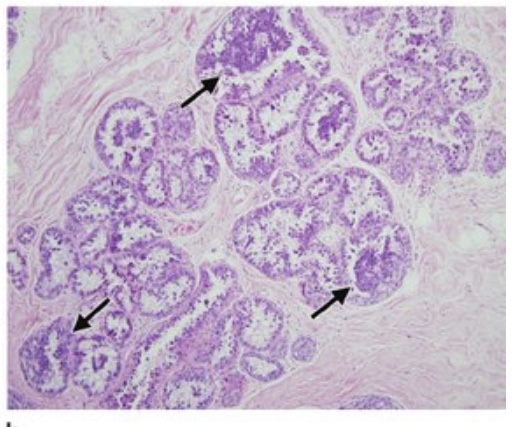
  • Multifocal DCIS is generally defined as:
    • DCIS present as two or more foci separated by at least 5 mm within the same breast quadrant
  • Most investigators believe that multifocal disease:
    • In fact represents intraductal spread from a single focus of DCIS
  • By careful serial subsectioning, Holland et al. (1990):
    • Demonstrated that multifocal lesions that appeared to be separate using traditional pathologic techniques:
      • Actually originated from the same focus in 81 of 82 mastectomy specimens

#Arrangoiz #CancerSurgeon #BreastSurgeon #SurgicalOncologist #BreastCancer #LCIS #DCIS #DuctalCarcinomaInsitu #LobularNeoplasia #LobularCarcinomaInsitu #Surgeon #Teacher #Miami #Mexico #MSMC #MountSinaiMedicalCenter
Diagnosis of DCIS Part II

  • Magnetic Resonance Imaging:
    • Mammography:
      • Remains the standard for radiographic evaluation of DCIS
    • The cost and accessibility of magnetic resonance imaging (MRI):
      • Make it less feasible as an effective screening method
    • However, there is evidence that patients at high risk for breast cancer or those with very dense breasts:
      • May benefit from screening with MRI
    • Contrast-enhanced MRI:
      • Is more sensitive than mammography:
        • In the detection of both DCIS and invasive cancer
    • However, fibrocystic changes and other benign findings:
      • Can mimic DCIS on MRI:
        • Leading to unnecessary biopsies
    • MRI is increasingly being utilized after initial diagnosis in the preoperative evaluation:
      • To identify multicentric and contralateral lesions:
        • Because presence of either of these may change the surgical treatment strategy
      • Hollingsworth et al. (2008):
        • Reported that MRI detected multicentric disease:
          • Defined as a separate focus of cancer more than 5 cm away from the index lesion or discontinuous growth to another breast quadrant:
        • In 4.3% of 149 patients who presented with DCIS
      • Lehman et al. (2007):
        • Reported the utility of MRI in detecting contralateral breast cancer in a group of 969 patients with unilateral breast cancer:
          • 196 of whom had DCIS
        • Of the patients with DCIS:
          • MRI prompted additional biopsies in 18 patients
        • Contralateral breast cancer was detected in five patients:
          • 28% of those biopsied and 2.6% of those with DCIS
        • The sensitivity of detecting contralateral breast cancer was:
          • 71%
        • The specificity of detecting contralateral breast cancer was:
          • 90%
        • While MRI is associated with increased likelihood of change in the surgical plan for a patient with unilateral breast cancer:
          • It is unclear whether these altered (and usually more extensive) surgical plans are actually treating clinically significant disease that might have otherwise decreased the patient’s disease-free or overall survival
  • In a review of over 2,300 patients with breast-conserving therapy (BCT, i.e., lumpectomy and radiation) for DCIS at Memorial Sloan Kettering between 1997 and 2010:
    • There was no association between receipt of preoperative MRI and risk of locoregional recurrence or contralateral breast cancer:
      • Regardless of whether the patient received radiation (Pilewskie et al., 2014)
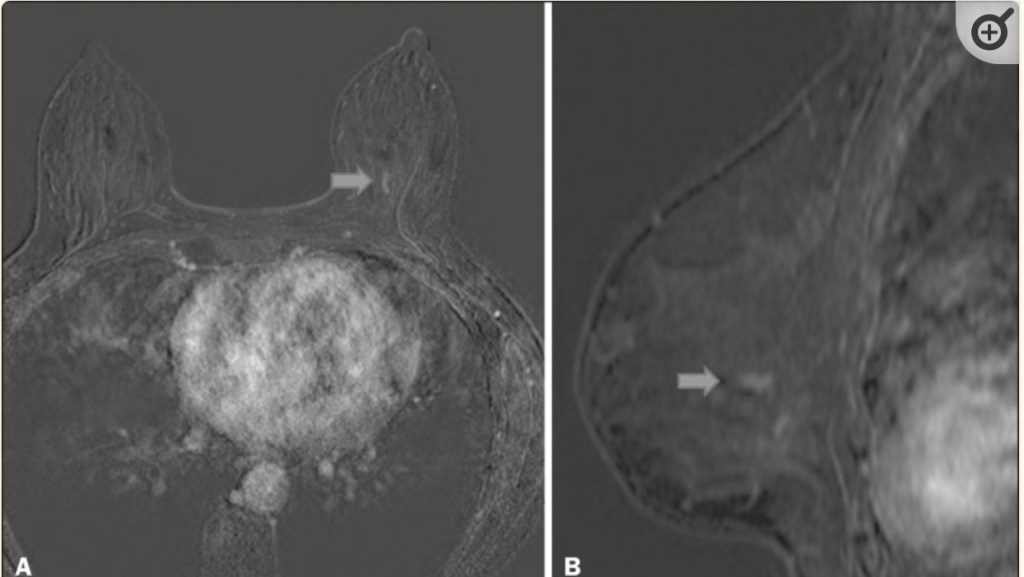
  • The typical appearance of DCIS on MRI:
    • Is non-mass enhancement
  • Although mammography can be more sensitive than MRI for DCIS associated with calcifications:
    • Uncalcified DCIS may be better visualized by MRI
  • Kuhl and colleagues prospectively assessed 7,319 women who had undergone both preoperative mammography and MRI:
    • Of 167 women with pure DCIS on final pathology:
      • 92% (n = 153) were diagnosed by MRI and 56% (n = 93) were diagnosed by mammography:
        • Of those diagnosed with high-grade DCIS:
          • 48% were missed by mammography but diagnosed by MRI only
  • A meta-analysis looking at the association of preoperative MRI and surgical management of patients with DCIS:
    • Showed no significant difference in the proportion of women with positive margins or in the need for re-excision after BCS
    • Overall mastectomy rates did not differ significantly, whether or not preoperative MRI was performed (odds ratio [OR] 1.23; p = .34)
  • Pilewskie and colleagues reported a large series of women undergoing BCS for DCIS:
    • Found no difference in locoregional recurrence rates or contralateral breast cancer rates:
      • In women who had perioperative MRI and those who did not
  • Although MRI can be useful in assessment of extent of disease and is an adjunct to traditional imaging in patients who have discordant results or mammographically occult disease:
    • Routine use of MRI is not advocated for the perioperative management of DCIS
Contrast-enhanced, high-resolution MRI. Axial sequence, with digital subtraction (A) and sagittal MRI sequence (B), showing a linear area of enhancement (arrows) in the posterior third of the central region/junction of the medial quadrants of the left breast. The pathology study of the surgical specimen revealed DCIS, nuclear grade 2.

#Arrangoiz #CancerSurgeon #BreastSurgeon #SurgicalOncologist #BreastCancer #LCIS #DCIS #DuctalCarcinomaInsitu #LobularNeoplasia #LobularCarcinomaInsitu #Surgeon #Teacher #Miami #Mexico #MSMC #MountSinaiMedicalCenter
Accelerated Partial Breast Irradiation (APBI)

The use of catheter-based, accelerated partial-breast irradiation (APBI) offers many potential advantages over routine whole-breast radiation therapy, including decreased treatment time and decreased radiation dose delivered to uninvolved portions of the breast and adjacent organs. This has resulted in significant interest in APBI, with more than 32,000 women in the United States having had treatment with a breast brachytherapy catheter.

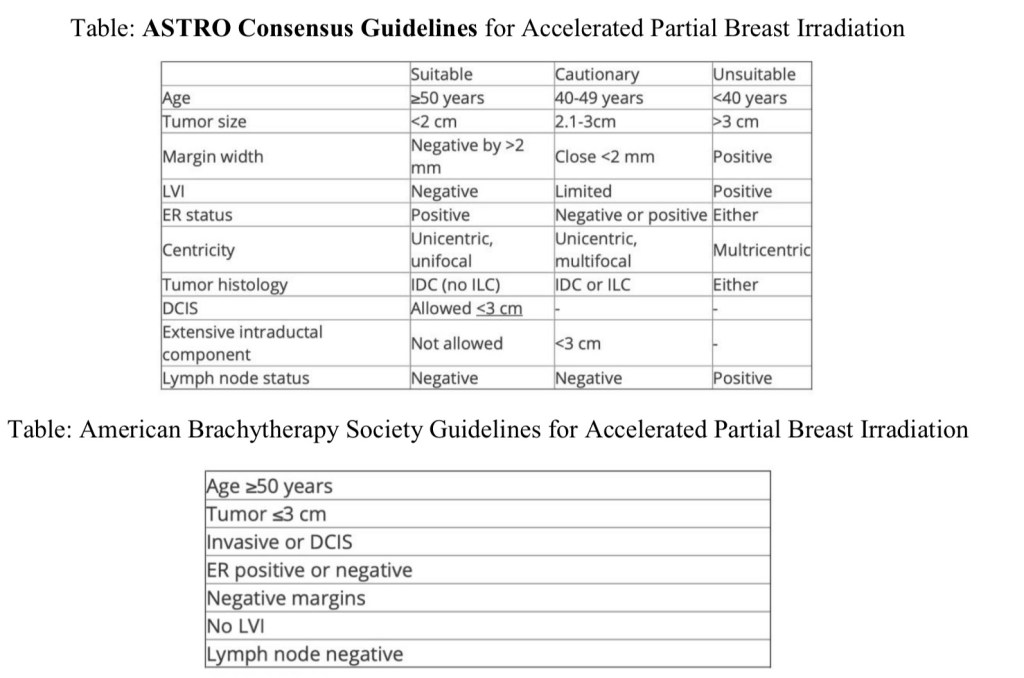
However, randomized clinical trials comparing APBI with conventional whole-breast radiation therapy have yet to be completed. In light of this, the American Society for Radiation Oncology (ASTRO) has issued a consensus statement regarding the appropriate use of APBI, categorizing potential patients for APBI into three groups: suitable, cautionary, and unsuitable. A similar, but somewhat more liberal guideline was put forth by The American Brachytherapy Society.

Accelerated partial breast irradiation includes multiple techniques such as: interstitial brachytherapy, applicator brachytherapy, external beam radiation therapy.

The Groupe Européen de Curie thérapie of European Society for Radiotherapy and Oncology (GEC-ESTRO) trial randomized 1184 patients with low-risk invasive carcinoma or ductal carcinoma in situ (DCIS) treated with breast-conserving surgery to either whole-breast irradiation (WBI) or APBI using multi catheter brachytherapy. The cumulative incidence of local recurrence at 5 years was 1.44% with APBI and 0.92% with WBI.

The Florence trial randomized 520 patients to either WBI or APBI with intensity-modulated radiation therapy, with a mean follow-up of 5 years. The rate of local recurrence was 1.5% in both arms.

The American Society of Breast Surgeons’ Mammo Site Registry found 5-year rates of local recurrence were less than 4%.

An older randomized trial from Hungary using interstitial APBI and electrons found that the 5-year local recurrence rate of 4.7%.


It is important to recognize that these outcomes are likely due to the highly selected, low-risk patient populations included in many of the APBI trials as evidenced by the tables / guidelines: patients tend to be postmenopausal, tumors less than 3 cm, without DCIS, node negative, ER-positive.


Arthur D W, Vicini F A, Kuske RR, Wazer DE, American Brachytherapy Society. Accelerated partial breast irradiation: an updated report from the American Brachytherapy Society. Brachytherapy. 2003;2:124-130.

Hughes KS, Schnaper LA, Berry D, et al. Cancer and Leukemia Group B; Radiation Therapy Oncology Group; Eastern Cooperative Oncology Group. Lumpectomy plus tamoxifen with or without irradiation in women 70 years of age or older with early breast cancer. N Engl J Med. 2004;351:971-977.

National Comprehensive Cancer Network. NCCN Clinical Practice Guidelines in Oncology. Breast Cancer. Available at http://www.nccn.org.

Smith BD, Arthur DW, Buchholz TA, et al. Accelerated partial breast irradiation consensus statement from the American Society for Radiation Oncology (ASTRO). J Am Coll Surg. 2009;209:269-277.

Giuliano AE, Ballman KV, McCall L, et al. Effect of Axillary Dissection vs No Axillary Dissection on 10-Year Overall Survival Among Women With Invasive Breast Cancer and Sentinel Node Metastasis: The ACOSOG Z0011 (Alliance) Randomized Clinical Trial. JAMA. 2017; 318(10): 918-926. doi: 10.1001/jama.2017.11470.

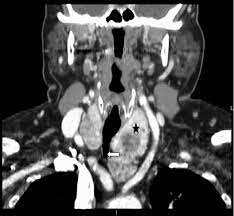
Goiter

  • The term goiter refers to:
    • An abnormal growth of the thyroid gland
  • Depending on the etiology goiters can be:
    • Diffuse
    • Nodular
  • May be associated with:
    • Normal thyroid hormone production
    • Decreased thyroid hormone production
    • Increased thyroid hormone production
  • The clinical manifestations vary with:
    • Thyroid function and with the size and location of the goiter
  • Anatomical Relationships:
    • In healthy adults without iodine deficiency:
      • A normal thyroid gland is approximately:
        • 4.0 cm to 4.8 cm x 1.0 cm to 1.8 cm x 0.8 cm to 1.6 cm in size
      • Mean sonographic volume of:
        • 7 mL to 10 mL:
          • Thyroid volume measured by ultrasonography:
            • Is slightly greater in men than women
            • Increases with age and body weight
            • Decreases with increasing iodine intake
  • Weight of the thyroid gland:
    • 10 grams to 20 grams:
      • As high as 30 grams is considered normal
  • The normal thyroid gland:
    • Is immediately caudal to the larynx and encircles the anterolateral portion of the trachea
  • The thyroid gland is bordered by:
    • The trachea and esophagus posteriorly
    • The carotid sheath laterally
  • Enlarging thyroid lobes:
    • Usually grow outward:
      • Because of their location in the anterior neck in front of the trachea:
        • Covered only by the thin strap muscles, subcutaneous tissue, and skin
    • As a result of this outward growth:
      • Even very large goiters:
        • May not compress the trachea or impinge on the great vessels lateral to the lobes:
          • However, in patients with substantial enlargement of one lobe or asymmetric enlargement of both lobes:
            • The trachea, esophagus, or blood vessels:
              • May be displaced or, less often, compressed
          • Bilateral lobar enlargement:
            • Especially if the goiter extends posterior to the trachea:
              • May cause either:
                • Compression or concentric narrowing of the trachea
                • Compression of the esophagus
                • Compression of the jugular veins
  • The thoracic inlet:
    • Is an ovoid area that measures approximately 5 cm x 10 cm:
      • Boundaries:
        • The sternum anteriorly
        • The first thoracic vertebral body posteriorly
        • The first ribs laterally
    • The inlet is traversed by the:
      • Trachea
      • Esophagus
      • Blood vessels
      • Nerves
    • The inferior pole of each thyroid lobe:
      • Normally lies above the thoracic inlet:
        • However, with some goiters, there is growth of one or both lobes through the inlet into the thoracic cavity:
          • Which can result in obstruction of any of the structures in the inlet:
            • Such goiters are called substernal:
              • Although retrosternal is probably a more precise term
  • Most substernal goiters are in the:
    • Anterolateral mediastinum:
      • But approximately 10%:
        • Are located primarily in the posterior mediastinum
  • The prevalence of substernal goiter as a percentage of thyroidectomies:
    • Ranges from 2% to 19%

#Arrangoiz #ThyroidSurgeon #HeadandNeckSurgeon #CancerSurgeon #MSMC #MountSinaiMedicalCenter #Miami #Mexico #Goiter #SubsternalGoiter

Lobular Carcinoma and MRI Use

The data for preoperative MRI in the setting of either lobular or ductal carcinoma is controversial.

Routine preoperative MRI is not mandatory for either entity and is not anticipated to change the rate of repeat excision for positive margins or recurrence. It should be used on a case-by-case basis, taking into account other factors, such as breast density and additional risk factors.

Invasive lobular carcinoma is described pathologically as small cells that infiltrate the mammary stroma and adipose tissue in a single file pattern due to a lack of E-cadherin. The cells induce minimal reaction in the surrounding tissue, making them insidious both radiographically and pathologically. Classic-type invasive lobular carcinoma is usually positive for estrogen receptor and negative for HER2, but this is not universally true, as HER2 subtypes do exist. Lobular cancers respond less well to neoadjuvant chemotherapy than their ductal counterparts.

Orvieto E, Maiorano E, Bottiglieri L, et al. Clinicopathologic characteristics of invasive lobular carcinoma of the breast: results of an analysis of 530 cases from a single institution. Cancer. 2008;113:1511-1520.

Purushotham A, Pinder S, Cariati M, Harries M, Goldhirsch A. Neoadjuvant chemotherapy: not the best option in estrogen receptor-positive, HER2-negative, invasive classical lobular carcinoma of the breast? J Clin Oncol. 2010;28:3552-3554.

Turnbull L, Brown S, Harvey I, et al. Comparative effectiveness of MRI in breast cancer (COMICE) trial: a randomized controlled trial. Lancet. 2010;375:563-571.

Inflammatory Breast Cancer (IBC)

Inflammatory breast cancer (IBC) is a clinical diagnosis made on the basis of a breast that rapidly enlarges; that is red, firm, and has skin edema (peau d’orange); and that involves 30% of the breast or more with a palpable border.

On evaluation of a specimen obtained by skin punch biopsy, the hallmark of this disease is dermal lymphatic invasion by tumor cells, but this pathologic finding is not necessary to make the diagnosis.

Nearly all women with IBC have lymph node involvement at the time of diagnosis, and sentinel lymph node biopsy has been shown to have a high false-negative rate in these patients. Hence, sentinel node biopsy is not indicated.

Approximately 30% of women with IBC will have distant metastatic disease; thus, all women with IBC should have a thorough staging work-up at the time of diagnosis.

As IBC has an American Joint Committee on Cancer (AJCC) stage of IIIb or higher (owing to its designation of T4d, N0-3, M0-1), neoadjuvant chemotherapy is the recommended first course of treatment.

Skin-sparing mastectomy is contraindicated.

Because the degree of pathologic response to neoadjuvant chemotherapy predicts prognosis, and the intensity of preoperative therapy predicts response, all chemotherapy up front instead of a so-called sandwich approach of chemotherapy/surgery/chemotherapy is preferred.

Surgery is indicated if disease responds well, as this gives the best chance for disease-free survival.

Post-mastectomy radiation therapy is required to reduce the risk of chest wall recurrence in these patients.

Cristofanilli M, Gonzalez-Angulo AM, Buzdar AU, Kau SW, Frye DK, Hortobagyi GN. Paclitaxel improves the prognosis in estrogen receptor negative inflammatory breast cancer: the M.D. Anderson Cancer Center experience. Clin Breast Cancer. 2004;4:415-419.

Dawood S, Cristofanilli M. What progress have we made in managing Inflammatory breast cancer? Oncology (Williston Park). 2007;21:673-687.

National Comprehensive Cancer Network. NCCN Clinical Practice Guidelines in Oncology. Breast Cancer. Available at http://www.nccn.org.

Panades M, Olivotto IA, Speers CH, et al. Evolving treatment strategies for inflammatory breast cancer: a population-based survival analysis. J Clin Oncol. 2005;23:1941-1950.