CALGB 9343 Trial

  • The Cancer and Leukemia Group B (CALGB) 9343 trial:
    • Enrolled 647 patients:
      • From 1994 until 1999
    • Long-term follow-up data:
      • Were published in 2013:
        • With a median follow-up of:
          • 12.6 years
      • Women age 70 years or older:
        • With clinical stage I:
          • cT1, cN0, cM0
          • ER-positive breast cancer
          • Treated by lumpectomy
      • Were randomly assigned to receive:
        • Tamoxifen plus radiation therapy (TamRT) or Tamoxifen alone (Tam)
        • At 10 years:
          • 98% of women:
            • Receiving TamRT were free from local and regional recurrences
          • Compared to 91% of those receiving Tam
        • The 10-year estimates of overall survival (OS) were:
          • 67% (95% confidence interval [CI], 62–72%) in the TamRT group versus
          • 66% (95% CI, 61%–71%) in the Tam group:
            • But the difference was not statistically significant
      • In addition to concluding that:
        • While RT (in addition to Tam):
          • Reduces locoregional recurrence:
            • The authors noted that “the impact of breast cancer in this select group of older women is much smaller than that of comorbid conditions”:
              • Only 3% of women in study have died as a result of breast cancer whereas 49% have died as a result of other causes
  • References:
    • Hughes KS, Schnaper LA, Bellon JR, et al. Lumpectomy plus tamoxifen with or without irradiation in women age 70 years or older with early breast cancer: long-term follow-up of CALGB 9343. J Clin Oncol. 2013;31:2382-2389

#Arrangoiz #BreastSurgeon #CancerSurgeon #SurgicalOncologist #CASO #CenterforAdvancedSurgicalOncology #BreastCancer
21-Gene Recurrence Score (Oncotype Dx)

  • The 21-gene recurrence score assay:
    • Is a gene-expression assay:
      • That provides prognostic and predictive information:
        • In hormone receptor positive breast cancer
      • The 21-gene recurrence score:
        • Estimates the likelihood of distant recurrence in women with:
          • ER+ breast cancer with up to 3 lymph nodes positive
        • It also predicts who is more likely to benefit from adjuvant chemotherapy:
          • Patients with more than 3 lymph nodes:
            • Usually receive adjuvant chemotherapy and 21-gene signature assay is not routinely ordered
  • The recurrence score based on the 21-gene assay ranges from:
    • 0 to 100:
      • Is predictive of chemotherapy benefit:
        • When it is higher than 25
  • Both tamoxifen and aromatase inhibitors:
    • Have been shown to:
      • Reduce recurrence rates and improve survival in postmenopausal women
    • Although chemotherapy has been shown to be beneficial in many patient subsets:
      • The 21-gene recurrence score was developed:
        • To help ascertain which patients with:
          • ER-positive, node-negative breast cancer:
            • Would be most likely to benefit from chemotherapy in addition to adjuvant tamoxifen
    • In patients with an intermediate recurrence score:
      • The benefit of chemotherapy is unclear
  • The Trial Assigning IndividuaLized Options for Treatment (Rx) [TAILORx] trial:
    • Is a randomized prospective trial:
      • That randomized women with ER-positive breast cancer:
        • With a score of 11 to 25 to:
          • Chemotherapy plus endocrine therapy to endocrine therapy alone
      • This trial is closed to accrual, and the results of this trial for this cohort are pending:
        • However:
          • Outcomes data from a subset of 1626 patients with a recurrence score of less than 10:
            • Were recently published
        • These patients were assigned to:
          • Receive endocrine therapy alone without chemotherapy
        • This study reported a 5-year local recurrence rate of:
          • 0.5% in women with a recurrence score of:
            • Less than 10
        • Furthermore:
          • At 5 years:
            • The invasive disease free survival was:
              • 93.8%
            • The rate of freedom from recurrence of breast cancer at a distant site was:
              • 99.3%
            • At distant or local site was:
              • 98.7%
            • Overall survival rate of:
              • 98%
        • The authors concluded that a favorable gene expression profile:
          • Is associated with a very low rate of recurrence:
            • At 5 years with endocrine therapy alone
  • References:
    • Early Breast Cancer Trialists’ Collaborative Group (EBCTCG), Dowsett M, Forbes JF, et al. Aromatase inhibitors versus tamoxifen in early breast cancer: patient-level meta-analysis of the randomised trials. Lancet. 2015;386(10001):1341-1352.
    • Sparano JA, Gray RJ, Makower DF, et al. Prospective validation of a 21-gene expression assay in breast cancer. N Engl J Med. 2015;373(21):2005-2014.
    • Sparano JA et al, N Engl J Med 2018 Sparano JA, Gray RJ, Makower DF, Pritchard KI, Albain KS, Hayes DF, et al. Adjuvant chemotherapy guided by a 21-gene expression assay in breast cancer. N Engl J Med 2018;379(2):111-121.
    • Paik S, Tang G, Shak S, Kim C, Baker J, Kim W, et al. Gene expression and benefit of chemotherapy in women with node-negative, estrogen receptor-positive breast cancer. J Clin Oncol; 2006;24(23):3726-3734.
    • Dowsett M, Cuzick J, Wale C, Forbes J, Mallon EA, Salter J, et al. Prediction of risk of distant recurrence using the 21-gene recurrence score in node-negative and node-positive postmenopausal patients with breast cancer treated with anastrozole or tamoxifen: a TransATAC study. J Clin Oncol. 2010;29(11):1829-1834.
    • Roberts MC, Miller DP, Shak S, Petkov VI. Breast cancer-specific survival in patients with lymph node-positive hormone receptor-positive invasive breast cancer and Oncotype DX Recurrence Score results in the SEER database. Breast Cancer Res Treat. 2017;163(2):303-310.

#Arrangoiz #CancerSurgeon #BreastSurgeon #BreastCancer #CASO #CenterforAdvancedSurgicalOncology

Thyroid Cancer Epidemiology

  • The American Cancer Society’s most recent estimates for thyroid cancer incidence in the United States for 2021 are:
    • 44,280 new cases of thyroid cancer:
      • 12,150 in men
      • 32,130 in women
    • Approximately 2,200 deaths from thyroid cancer:
      • 1,050
      • 1,150 women
  • The rate of new cases of thyroid cancer was:
    • 15.7 per 100,000 men and women per year
  • The death rate was:
    • 0.5 per 100,000 men and women per year
      • These rates are age-adjusted and based on 2013 to 2017 cases and 2014 to 2018 death
  • Roughly 1.3% of men and women will be diagnosed with thyroid cancer at some point during their lifetime, based on 2015–2017 data
  • In 2017, there were an estimated:
    • 859,838 people living with thyroid cancer in the United States 
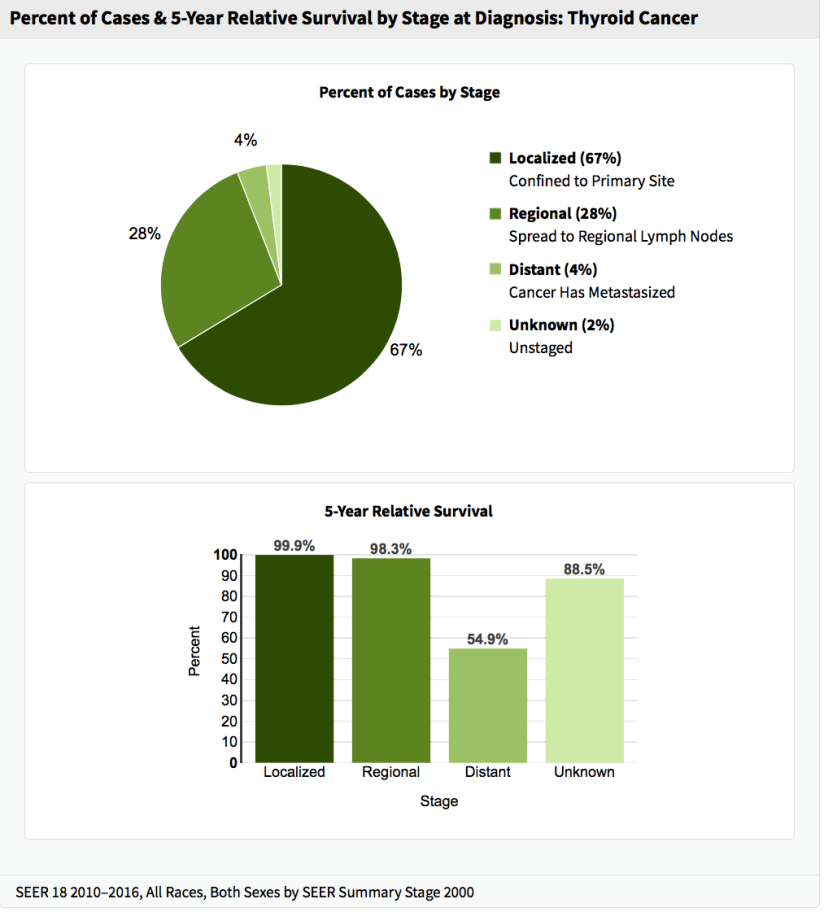
  • Approximately 67% of thyroid cancers are localized (confined to the primary site)
  • 28% have spread to regional lymph nodes
  • 4% had metastasized to distant sites
  • The 5-year relative survival for:
    • Localized thyroid cancer is 99.9%
    • For patients with regional metastasis is 98.3%
    • With distant metastasis is 54.9% 

#Arrangoiz #ThyroidSurgeon #CancerSurgeon #ThyroidExpert @CASO #CenterforAdvancedSurgicalOncology

Evolution of HER-2 Targeted Therapies

  • The development of the monoclonal antibody trastuzumab (Herceptin):
    • Has revolutionized the treatment of patients with HER-2-positive breast cancer
  • The exact mechanism of action of trastuzumab remains unclear:
    • It is postulated that its action includes:
      • Antibody-dependent cellular toxicity
      • Inhibition of cell cycle progression
      • Antiangiogenic effects
  • The use of trastuzumab was first approved by the Food and Drug Administration (FDA) in 1998 for the treatment of HER-2-positive metastatic disease:
    • Since that time, drug testing progressed to the adjuvant and neoadjuvant settings
    • Today, trastuzumab is regarded as the standard of care for patients with HER-2-positive breast cancer.
  • Other agents include:
    • The small-molecule tyrosine kinase inhibitor lapatinib
    • Pertuzumab
    • Trastuzumab-emtansine
    • Neratinib
    • Ertumaxomab

#Arrangoiz #CancerSurgeon #BreastSurgeon #SurgicalOncologist #BreastCancer #HERPositiveBreasrtCancer #CASO #CenterforAdvancedSurgicalOncology

Molecular Basis of HER-2-Positive Breast Cancer

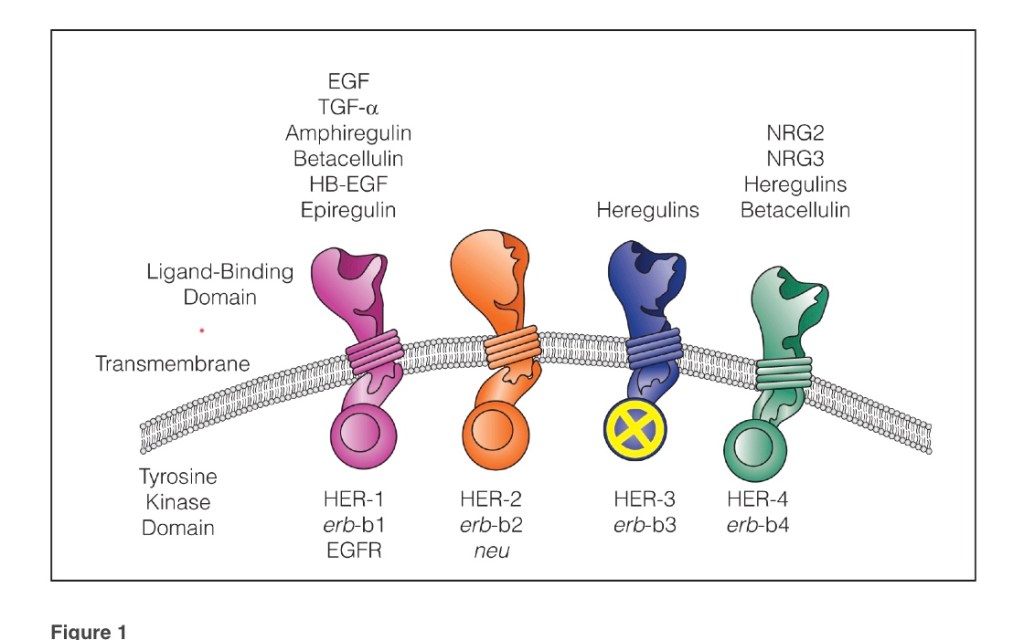
– The human epidermal receptor (HER) or erbB proteins are members of the subclass I of the
receptor tyrosine kinase superfamily

– This group contains four members:

Epidermal growth factor receptor (EGFR)/erbB1/HER-1

ErbB2/HER-2/neu

ErbB3/HER-3

ErbB4/HER-4

– These proteins are made up of an extracellular ligand-binding domain, a membrane-spanning region, and a cytoplasmic domain with tyrosine kinase activity

#Arrangoiz @BreastSurgeon #CancerSurgeon #SurgicalOncologist #BreastCancer #HER2PositiveBreastCancer #CASO #CenterforAdvancedSurgicalOncology

Identification of HER-2

  • The evaluation of HER-2 is recommended in all cases of breast cancer at the time of initial diagnosis and / or at the time of recurrence to guide therapy
  • A number of methods are used for HER-2 testing including:
    • Immunohistochemistry (IHC)
    • Florescence in situ hybridization (FISH)
    • Enzyme-linked immunosorbent assay (ELISA) analysis of serum and tumor
    • Western blot
    • Southern blot
    • Chromogenic in situ hybridization (CISH)
    • Silver in situ hybridization (SISH)
    • Polymerase chain reaction (PCR)
  • IHC and FISH:
    • Are currently the main testing modalities for HER-2-positive breast cancer
  • HER-2 expression in breast cancer:
    • Is primarily assessed semiquantitatively by IHC
  • The 2013 American Society of Clinical Oncology (ASCO) and the College of American Pathologists (CAP) guidelines:
    • Outline an IHC scoring method based on four classes:
      • 0, 1+, 2+, and 3+
    • A score of 0 is negative:
      • Indicating no observed staining in invasive tumor cells
    • A score of 1+ is negative:
      • Indicates:
        • Weak, incomplete membrane staining in any proportion of invasive tumor cells or
        • Weak, complete membrane staining in less than 10% of invasive tumor cells
    • A score of 2+ is equivocal:
      • Indicating:
        • Circumferential membrane staining that is incomplete and / or
        • Weak / moderate and in more than 10% of invasive tumor cells or
        • Complete and circumferential membrane staining that is intense and in 10% or less of invasive tumor cells
      • All 2+ equivocal cases undergo subsequent testing by FISH
    • A score of 3+ is positive:
      • Indicates circumferential membrane staining that is complete and intense in a homogeneous and contiguous population, present in more than 10% of invasive tumor cells, and readily appreciated using a low-power objective
  • FISH:
    • Is a sensitive and accurate method of scoring invasive breast tumor tissue for HER-2 expression
    • Initial gene amplification studies by FISH assessment:
      • Used chromosome 17 centromere (CEP17) or another gene on the same chromosome as an internal control:
        • With a ratio of 2.0 or greater:
          • Considered evidence of HER-2 amplification
    • These criteria were used as the cutoff for enrollment in trials evaluating HER-2 targeted therapies
  • In 2007, the ASCO / CAP guidelines were changed to define HER-2 amplified:
    • As a ratio of 2.2 or greater
  • More recent guidelines:
    • Have changed the ratio cutoff back to a ratio of 2.0 or greater with the inclusion of criteria to account for HER-2 copy number per tumor cell
    • Based on the recent guidelines, HER-2 is amplified in cases where the:
      • HER-2 / CEP17 ratio is 2.0 or greater with an average HER-2 copy number of more than 4.0 signals/cell or
      • HER-2 / CEP17 ratio is less than 2.0 with an average HER-2 copy number of 6.0 or more signals / cell using a dual probe or a HER-2 copy number of 6.0 or more copies/cell using a single probe
    • FISH testing is negative for HER-2 amplification with a:
      • HER-2 / CEP17 ratio of less than 2.0 with an average HER-2 copy number of less than 4.0 signals/cell or an average HER-2 copy number of less than 4.0 signals / cell using a single probe

#Arrangoiz @CancerSurgeon #BreastSurgeon #SurgicalOncologist #CASO #BreastCancer #HER2PositiveBreastCancer @CenterforAdvancedSurgicalOncology

Molecular Basis of HER-2-Positive Breast Cancer II

– Ligand binding to the HER receptors leads to their homodimerization or heterodimerization, which promotes signal transduction

– To date, no ligands have been identified for the HER-2 receptor

– However, the HER-2 receptor has been shown to be the preferred heterodimerization for other HER family members

– HER-2 has been shown to be one of the most important oncogenes in human breast cancer

– HER-2 complexes initiate intracellular signaling via the mitogen-activated protein kinase (MAPK), phosphatidylinositol 3-kinase (PI3K), and phospholipase C pathways

– Breast cancer cells and model tumor systems, have shown that over expression of the gene has been associated with increased mitogenesis, malignant transformation, increased cell motility, invasion, and metastasis

– In human breast cancer, amplification of the gene is found in around 15% to 30% of primary invasive breast tumors

– In these cases, up to 100 copies have been demonstrated per cell, which is equivalent to a
50-fold increase in gene copy number per cell

– As a result, the number of receptors per cell is
increased up to 2 million

– Overexpression at the messenger RNA or protein level occurs in around 15% to 30% of patients with early-stage breast cancer

The HER gene family. The proteins are made up of an extracellular ligand-binding domain, a
membrane-sparing region, and a cytoplasmic domain with tyrosine kinase activity. Note that HER-2
has no known ligands. Also note that HER-3 has no intrinsic tyrosine kinase activity.

#Arrangoiz #BreastSurgeon #BreastCancer #CancerSurgeon #SurgicalOncologist #HERPositive #CASO #CenterforAdvancedSurgicalOncology

Targeted Therapy for HER-Positive Breast Cancer

  • All patients with HER-2 positive breast cancer patients:
    • Who require systemic therapy should complete one year of HER2-targeted therapy:
      • Including those who achieve pathologic complete response after neoadjuvant chemotherapy
    • One could also consider continuing adjuvant pertuzumab in addition to trastuzumab:
      • Based on results from the phase III Aphinity trial:
        • Although patients who received neoadjuvant chemotherapy were not included in this trial
    • For patients who have residual disease and do not achieve complete pathologic response at the time of surgery:
      • Completion of one year of T-DM1 decreased the risk of recurrence of invasive breast cancer or death by 50% than with trastuzumab alone:
        • Based on results from KATHERINE trial:
          • The estimated percentage of patients who were free of invasive disease at 3 years was:
            • 88.3% in the T-DM1 group and 77.0% in the trastuzumab group
  • References:
    • von Minckwitz G, Procter M, de Azambuja E, Zardavas D, Benyunes M, Viale G, et al. Adjuvant Pertuzumab and Trastuzumab in early HER2-positive breast cancer N Engl J Med. 2017;377(2):122-131.
    • von Minckwitz G, Huang CS, Mano MS, Loibl S, Mamounas EP, Untch M, et al. Trastuzumab emtansine for residual invasive HER2-positive breast cancer. N Engl J Med. 2019;380(7):617-628.

#Arrangoiz #CancerSurgeon #BreastSurgeon #BreastCancer #CASO #CenterforAdvancedSurgicalOncology

HER Positive Breast Cancer

– Breast cancer is mainly hormonally driven, with around 70% of cancers expressing the estrogen
receptor (ER)

– A number of other peptide growth factors and their receptors, namely members of the receptor tyrosine kinase family, have been implicated in normal breast development and in carcinogenesis

– Amplification of the human epidermal growth factor receptor2 (HER-2) gene is found in approximately 15% to 30% of breast cancers

– Historically, HER-2 overexpression has been associated with aggressive disease and poor prognosis

-However, the use of targeted anti-HER-2 therapy has revolutionized the treatment of HER-2-positive disease, and use of the monoclonal antibody trastuzumab in combination with chemotherapy is now standard of care for tumors greater than 1 cm in size and in node-positive disease

– More recently, the value of
dual-agent anti-HER-2 therapy has been demonstrated in large clinical trials

#Arrangoiz #BreastSurgeon #CancerSurgeon #SurgicalOncology #BreastCancer #HERPositive #CASO #CenterforAdvancedSurgicalOncology

Targeted Therapy for HER-Positive Breast Cancer

  • All patients with HER2 positive breast cancer:
    • Who require systemic therapy should complete one year of HER2-targeted therapy:
      • Including those who achieve pathologic complete response after neoadjuvant chemotherapy
    • One could also consider continuing adjuvant pertuzumab in addition to trastuzumab:
      • Based on results from the phase III Aphinity trial:
        • Although patients who received neoadjuvant chemotherapy were not included in this trial
    • For patients who have residual disease and do not achieve complete pathologic response at the time of surgery:
      • Completion of one year of T-DM 1(ado trastuzumab-emtansine)  decreased the risk of recurrence of invasive breast cancer or death:
        •  By 50% than with trastuzumab alone:
          • Based on results from KATHERINE trial:
            • The estimated percentage of patients who were free of invasive disease at 3 years was:
              • 88.3% in the T-DM1 group
              • 77.0% in the trastuzumab group
  • Metastatic hormone receptor negative, HER positive breast cancer:
    • The CLEOPATRA study:
      • Showed that the combination of docetaxel, trastuzumab, and pertuzumab led to improved progression free survival (PFS) compared to docetaxel, trastuzumab, and placebo:
        • 18.5 months vs. 12.4 months
  • Neoadjuvant chemotherapy (NAC):
    • Is appropriate for many patients with locally advanced breast cancer regardless of subtype:
      • Because a response may allow both:
        •  Less extensive surgery and improved surgical outcomes
      • Locally advanced disease is defined as stage III cancers, as well as the subset of IIB cancers with T3 disease
    • In addition, patients with earlier stage, HER2+ disease (stage I or II):
      • May also be candidates for neoadjuvant therapy, if one or more of the following criteria apply:
        • The patient desires breast-conserving surgery (BCS) but is not a candidate for BCS or is likely to have a suboptimal cosmetic outcome with BCS due to tumor location or size relative to the size of the patient’s breast, and may be a better candidate if neoadjuvant therapy decreases the extent of her tumor
        • The patient has limited axillary nodal involvement (N1), for which axillary lymph node dissection would be standard surgical management, but could be a candidate for sentinel lymph node sampling alone if converted to node-negative disease with neoadjuvant therapy
        • Surgery must be postponed awaiting:
          • consultation with plastic surgery regarding breast reconstruction
          • Results of genetic testing
          • Resolution of an intercurrent illness, including pregnancy, and the patient and treating clinicians do not wish to delay initiation of treatment
        • Postoperative treatment with ado-trastuzumab emtansine (T-DM1) would be considered if the patient were found to have residual invasive disease in the breast or axillary nodes following NAC with single or dual HER2-targeted therapy
  • Pertuzumab:
    • Is a monoclonal antibody that binds to a different epitope on HER2 than trastuzumab:
      • Blocking the formation of HER2  : HER3 heterodimers:
        • Which is believed to be an important mechanism of resistance to trastuzumab
    • While single-agent pertuzumab has demonstrated antitumor activity in patients with HER2-positive metastatic disease who progressed on trastuzumab:
      • It is typically given in combination with trastuzumab to maintain suppression of signaling initiated by HER2 homodimers
    • In 2013, the FDA granted accelerated approval for the addition of pertuzumab to NACT and trastuzumab for patients with:
      • HER2+ locally advanced, inflammatory, or early-stage (either greater than 2 cm in diameter or node positive) breast cancer
    • I routinely recommend adding pertuzumab in patients receiving NACT and trastuzumab:
      • Given evidence that pertuzumab enhances locoregional responses:
        • Even though it increases the incidence and severity of treatment-related diarrhea as well as modestly increasing the frequency of hematologic toxicities
  • NeoSphere trial:
    • In the phase II NeoSphere trial, 417 HER2+ patients received 12 weeks of neoadjuvant therapy:
      • Composed of either:
        • Four cycles of single-agent docetaxel with trastuzumab, pertuzumab, or both, or
        • The combination of trastuzumab and pertuzumab without concurrent docetaxel
        • After surgery, all patients received anthracycline-based adjuvant chemotherapy:
          • Those randomized to trastuzumab and pertuzumab alone also received adjuvant docetaxel)
        • Completed a year of treatment with trastuzumab
  • Those randomly assigned to docetaxel with pertuzumab and trastuzumab had a higher pathologic complete response (pCR) rate (46%) compared with those receiving docetaxel with just trastuzumab (29%) or just pertuzumab (24%)
    • Patients receiving pertuzumab and trastuzumab without docetaxel had a pCR rate of 17%
  • References:
    • Hayes DF. HER2 and breast cancer — a phenomenal success story. N Engl J Med. 2019;381(13):1284-1286.
    • Gianni L, Pienkowski T, Im Y-H, Tseng LM, Liu MC, Lluch A, et al. 5-Year analysis of neoadjuvant pertuzumab and trastuzumab in patients with locally advanced, inflammatory, or early-stage HER2-positive breast cancer (NeoSphere): a multicentre, open-label, phase 2 randomised trial. Lancet Oncol. 2016;17(6):791-800.
    • von Minckwitz G, Procter M, de Azambuja E, Zardavas D, Benyunes M, Viale G, et al. Adjuvant Pertuzumab and Trastuzumab in early HER2-positive breast cancer N Engl J Med. 2017;377(2):122-131.
    • von Minckwitz G, Huang CS, Mano MS, Loibl S, Mamounas EP, Untch M, et al. Trastuzumab emtansine for residual invasive HER2-positive breast cancer. N Engl J Med. 2019;380(7):617-628.
    • Baselga J, Cortés J, Kim SB, Im SA, Hegg R, Im YH, et al. Pertuzumab plus trastuzumab plus docetaxel for metastatic breast cancer. New Engl J Med. 2012;366(2):109-119.
    • Swain SM, Baselga J, Kim SB, Ro J, Semiglazov V, Campone M, et al. Pertuzumab, trastuzumab, and docetaxel in HER2-positive metastatic breast cancer. N Engl J Med. 2015;372(8):724-734.

#Arrangoiz #CancerSurgeon #BreastSurgeon #SurgicalOncologist #BreastCancer #HERPositiveBreastCancer #CASO #CenterforAdvancedSurgicalOncology