Blog

Thyroid Nodules

👉If you have thyroid nodules, there are some things you need to know.

👉By the age of 60, more than half of women will have a thyroid nodule.

👉Recent studies show that most are benign (not cancerous), but 4.0% to 6.5% of end up being cancer.

👉Here is what you need to pay attention to:

  1. If you find out you have a thyroid nodule, check your thyroid functions to see if your thyroid functions normally. It is important to have your thyroid functions regularly monitored.
  2. Risk factors for developing a thyroid nodule: radiation, smoking, obesity, metabolic syndrome, alcohol consumption and uterine fibroids.
  3. Biopsy (an examination of the tissue) is needed if thyroid nodules are larger than 1 cm. If your nodule is larger than 1 cm, you experience any thyroid pain or shortness of breath and you have difficulty swallowing, you should consult with your doctor immediately.
  4. If your nodule is smaller than 1 cm, it is important to regularly consult with your doctor to discover any changes in the nodule in time.
  5. Zamora EA, Khare S, Cassaro S. Thyroid Nodule. In: StatPearls Publishing. 2020 January.

#Arrangoiz #ThyroidSurgeon #ThyroidExpert #EndocrineSurgery #HeadandNeckSurgery #CancerSurgeon #CASO #CenterforAdvancedSurgicalOncology #PalmettoGeneralHospital

Obesity and Thyroid Cancer

  • Obesity has repeatedly been cited as a possible etiologic factor in the pathogenesis of thyroid cancer and has been postulated to be a possible origin of the increase incidence of this disease worldwide.
  • Undeniably, being overweight and obesity have been associated with an increased risk of developing numerous malignancies, including thyroid, breast, colorectal, kidney, and endometrial cancers.
  • In the United States from 1995 to 2015, one out of every six PTC and two thirds of PTC greater than 4 cm in size have been linked to being overweight or obesity, based on an analysis of data from three large national US databases.
  • Kitahara et al projected that the total relative risk for PTC was 1.26 for persons who are overweight (body mass index [BMI] 25 to 29 kg/m2) and 1.30 for those who are obese (BMI ≥ 30  kg/m2), compared with persons with normal-weight BMI (18.5 to 24.9 kg/m2).
  • The risk in PTCs greater than 4 cm in size was nearly 3-fold higher (hazard ratio [HR] = 2.93, 95% CI 1.25-6.87) with overweight individuals, and more than 5-fold higher (HR = 5.42, 95% CI 2.24-13.1) in obese individuals compared with normal-weight individuals.
  • A study by Leitzmann et al, found that obese adults had a nearly 40% higher risk for developing thyroid cancer when compared with normal-weight individuals.
  • More research is needed to define the exact role of obesity in the development of thyroid cancer, particularly as the incidence of obesity continues to climb throughout the world. 
  • References:
    • Society, A.C., American Cancer Society: Cancer Facts and Figures 2018., A.C. Society, Editor. 2018: Atlanta, Ga.
    • Brindel, P., et al., Anthropometric factors in differentiated thyroid cancer in French Polynesia: a case-control study.Cancer Causes Control, 2009. 20(5): p. 581-90.
    • Dal Maso, L., et al., A pooled analysis of thyroid cancer studies. V. Anthropometric factors. Cancer Causes Control, 2000. 11(2): p. 137-44.
    • Kitahara CM, P.R., Sosa JA, Shiels MS, Impact of overweight and obesity on U.S. papillary thyroid cancer incidence trends (1995-2015). J Natl Cancer Inst, 2019.
    • Leitzmann, M.F., et al., Prospective study of body mass index, physical activity and thyroid cancer. Int J Cancer, 2010. 126(12): p. 2947-56.
    • Berghofer, A., et al., Obesity prevalence from a European perspective: a systematic review. BMC Public Health, 2008. 8: p. 200.
    • Wang, Y. and M.A. Beydoun, The obesity epidemic in the United States–gender, age, socioeconomic, racial/ethnic, and geographic characteristics: a systematic review and meta-regression analysis. Epidemiol Rev, 2007. 29: p. 6-28.

#Arrangoiz #CancerSurgeon #ThyroidSurgeon #EndocrineSurgery #HeadandNeckSurgeon #CASO #CenterforAdvancedSurgicalOncology

Facial Artery

  • The facial artery (external maxillary artery in some texts):
    • Is a branch of the external carotid artery that supplies structures of the superficial face
  • The facial artery arises in the carotid triangle:
    • From the external carotid artery:
      • A little above the lingual artery:
        • Sheltered by the ramus of the mandible
      • It passes obliquely up beneath the digastric and stylohyoid muscles:
        • Over which it arches to enter a groove on the posterior surface of the submandibular gland
        • It then curves upward over the body of the mandible at the antero-inferior angle of the masseter:
          • Passes forward and upward across the cheek to the angle of the mouth, then ascends along the side of the nose, and ends at the medial commissure of the eye, under the name of the angular artery
  • The facial artery is remarkably tortuous:
    • This is to accommodate itself to neck movements such as those of the pharynx in deglutition; and facial movements such as those of the mandible, lips, and cheeks
  • In the neck, its origin is superficial, being covered by the integument, platysma, and fascia:
    • It then passes beneath the digastric and stylohyoid muscles and part of the submandibular gland, but superficial to the hypoglossal nerve
  • It lies upon the middle pharyngeal constrictor and the superior pharyngeal constrictor, the latter of which separates it, at the summit of its arch, from the lower and back part of the tonsil
  • On the face, where it passes over the body of the mandible, it is comparatively superficial, lying immediately beneath the dilators of the mouth
  • In its course over the face, it is covered by the integument, the fat of the cheek, and, near the angle of the mouth, by the platysma, risorius, and zygomaticus major
  • It rests on the buccinator and levator anguli oris, and passes either over or under the infraorbital head of the levator labii superioris
  • The anterior facial vein lies lateral / posterior to the artery, and takes a more direct course across the face, where it is separated from the artery by a considerable interval. In the neck it lies superficial to the artery
  • The branches of the facial nerve cross the artery from behind forward
  • The facial artery anastomoses with (among others) the dorsal nasal artery of the internal carotid artery
  • The branches of the facial artery are:
    • Cervical:
      • Ascending palatine artery
      • Tonsillar branch
      • Submental artery
      • Glandular branches
    • Facial:
      • Inferior labial artery
      • Superior labial artery
      • Lateral nasal branch to nasalis muscle
      • Angular artery – the terminal branch
  • Muscles supplied by the facial artery include:
    • Buccinator
    • Levator anguli oris
    • Levator labii superioris
    • Levator labii superioris alaeque nasi
    • Levator veli palatini
    • Masseter
    • Mentalis
    • Mylohyoid
    • Nasalis
    • Palatoglossus
    • Palatopharyngeus
    • Platysma
    • Procerus
    • Risorius
    • Styloglossus
    • Transverse portion of the nasalis

#Arrangoiz #HeadandNeckSurgeon #CancerSurgeon #Teacher #CASO #CenterforAdvancedSurgicalOncolgoy

Anatomy and Staging of Laryngeal Cancer

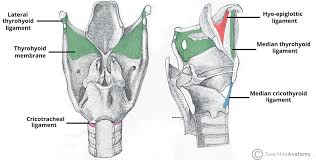
images-1

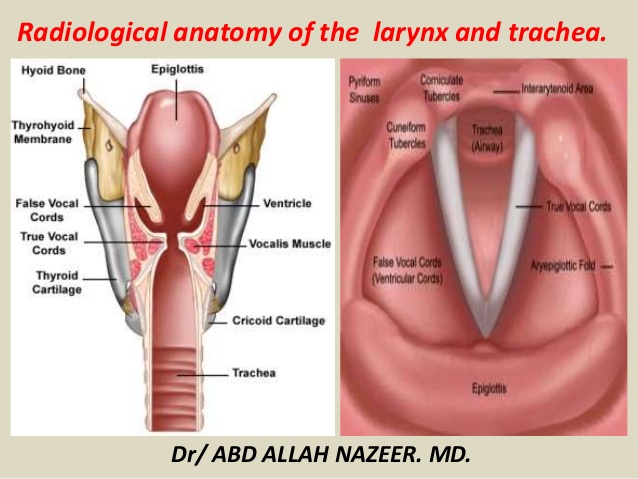
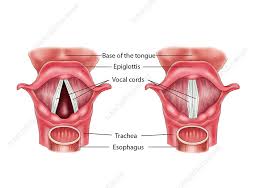
  • The larynx is an inferior continuation of the oropharynx:It extends from the epiglottis (namely the glossoepiglottic and pharyngoepiglottic folds) to the inferior aspect / border of the cricoid cartilage. Inferiorly:It continues as the cervical trachea

presentation1pptx-radiological-anatomy-of-the-larynx-and-trachea-1-638Unknown-1Unknown

Staging of Laryngeal Cancer


T Category

T Criteria

  • Reprinted with permission from AJCC: Larynx. In: Amin MB, Edge SB, Greene FL, et al., eds.: AJCC Cancer Staging Manual. 8th ed. New York, NY: Springer, 2017, pp 149–61.
TX Primary tumor cannot be assessed.
Tis Carcinoma in situ.

Supraglottis

T1 Tumor limited to one subsite of supraglottis with normal vocal cord mobility.
T2 Tumor invades mucosa of more than one adjacent subsite of supraglottis or glottis or region outside the supraglottis (e.g., mucosa of the base of the tongue, vallecula, medial wall of pyriform sinus) without fixation of the larynx.
T3 Tumor limited to larynx with vocal cord fixation and/or invades any of the following: post-cricoid area, pre-epiglottic space, para-glottic space, and/or inner cortex of thyroid cartilage.
T4 Moderately advanced or very advanced.
T4a Moderately advanced local disease.    Tumor invades through the outer cortex of the thyroid cartilage and/or invades tissues beyond the larynx (e.g., trachea, soft tissues of the neck including deep extrinsic muscle of the tongue, strap muscles, thyroid, or esophagus).
T4b Very advanced local disease.                Tumor invades prevertebral space, encases carotid artery, or invades mediastinal structures.

Glottis

T1 Tumor limited to the vocal cord(s) (may involve anterior or posterior commissure) with normal mobility.
T1a Tumor limited to one vocal cord.
T1b Tumor involves both vocal cords.
T2 Tumor extends to supraglottis and/or subglottis, and/or with impaired vocal cord mobility.
T3 Tumor limited to the larynx with vocal cord fixation and/or invasion of paraglottic space and/or inner cortex of the thyroid cartilage.
T4 Moderately advanced or very advanced.
T4a Moderately advanced local disease.    Tumor invades through the outer cortex of the thyroid cartilage and/or invades tissues beyond the larynx (e.g., trachea, cricoid cartilage, soft tissues of the neck including deep extrinsic muscle of the tongue, strap muscles, thyroid, or esophagus).
T4b Very advanced local disease.               Tumor invades prevertebral space, encases carotid artery, or invades mediastinal structures.

Subglottis

T1 Tumor limited to the subglottis.
T2 Tumor extends to vocal cord(s) with normal or impaired mobility.
T3 Tumor limited to the larynx with vocal cord fixation and/or invasion of paraglottic space and/or inner cortex of the thyroid cartilage.
T4 Moderately advanced or very advanced.
T4a Moderately advanced local disease.    Tumor invades cricoid or thyroid cartilage and/or invades tissues beyond the larynx (e.g., trachea, soft tissues of the neck including deep extrinsic muscles of the tongue, strap muscles, thyroid, or esophagus).
T4b Very advanced local disease.                Tumor invades prevertebral space, encases carotid artery, or invades mediastinal structures.


prof_739_20190417135234

  • Rodrigo Arrangoiz MS, MD, FACS es especialista en Cirugía de Tumores de Cabeza y Cuello / Cirugía Endocrina y Cirugía Oncológica compleja:
  • Fue egresado como Médico General de la Universidad Anahuac:
  • Graduado Suma Cum Laude. Es miembro de Center for Advanced Surgical Oncology
  • El Doctor Arrangoiz es experto en el manejo del: Cáncer de Tiroides:Cáncer papilar de tiroides
        • Cáncer folicular de tiroides
        • Cáncer medular de tiroides
        • Cáncer anaplásico de tiroides
      • Patología Quirúrgica de Tiroides:Bocio multi nodular no toxico sintomático  Bocio multi nodular toxicoHipertiroidismo
      • Hiperparatiroidismo:Hiperparatiroidismo primarioHiperparatiroidismo secundarioHiperparatiroidismo terciario
      • Tumores de Cabeza y Cuello:Cancer de la cavidad oral
        • Cáncer de faringe:
          • Nasofaringe
          • Orofaringe
          • Hipofaringe
        • Cáncer Laringeo:
          • Cáncer supraglótico
          • Cáncer glótico
          • Cancer subglótico
        • Cáncer de glándulas salivales:
          • Glándula Parótida
          • Glándula submandibular
          • Glándula sublingual
          • Glándulas salivales menores
        • Cáncer de piel de la cabeza y cuello:
          • Melanoma
          • Carcinoma basocelular
          • Carcinoma epidermoide
          • Carcinoma de Merkel
          • Dermatofibrosacroma Protuberans
        • Cáncer de Mama. 
        • Cáncer de piel:
          • Melanoma
          • Carcinoma basocelular
          • Carcinoma epidermoide
          • Carcinoma de Merkel
          • Dermatofibrosacroma Protuberans
    • Fue entrenado en las mejores instituciones académicas de los Estados Unidos.
    • Mantiene certificaciones por los Consejos de Cirugía General y Cirugía Oncológica en México y en los Estados Unidos de América
       
  • Su entrenamiento incluyó:Cirugía General y Gastrointestinal:Michigan State University (2004 – 2010)

image-48


  • Cirugía Oncológica / Tumores de Cabeza y Cuello / Cirugía Endocrina:Fox Chase Cancer Center en Filadelfia (2010 al 2012)

image-44


  • Maestría en Ciencias (Clinical Research for Health Professionals):Drexel University (Filadelfia) (2010 – 2012)

image-35


  • Cirugía de Tumores de Cabeza y Cuello / Cirugía Endocrina (2014 al 2016):IFHNOS / Memorial Sloan Kettering Cancer Center
  • Ha participado en múltiples cursos y congresos como Conferencista y Profesor Invitado, así mismo ha realizado diversas publicaciones y artículos sobre temas relacionados con su especialidad.
  • Fue pionero en México de la:
    • Cirugía minimamente invasive radioguida de paratiroides.
  • Se encuentra certificado por el Consejo Mexicano de Cirugía General y el Consejo Mexicano de Oncología así como es de los pocos mexicanos certificado por, el AMERICAN BOARD OF SURGERY,  el cuál le faculta como cirujano con licencia en los EU.
  • Es miembro de diversas asociaciones médicas como el:American College of Surgeons, American Thyroid Association, American Society of Endocrine Surgeons, American Medical Association, American Society of Clinical Oncology, Association of Academic Surgeons, Society of Surgical Oncology,  The Society of Surgery of the Alimentary Tract, Society of American Gastrointestinal Endoscopic Surgeons, y la American Society of Breast Surgeons, entre otras.
  • Gracias a esto el Dr. Rodrigo Arrangoiz es reconocido como uno de los mejores especialistas en Cirugía de Tumores de Cabeza y Cuello / Cirugía Endocrina y Cirugía Oncológica en México, además de ser galardonado como uno de los 50 mejores médicos de México en los Top Doctors Awards 2018.

#Arrangoiz

#Teacher

#Surgeon

#Cirujano

#ThyroidExpert

#ThyroidSurgeon

#CirujanodeTiroides

#ExpertoenTiroides

#ExpertoenParatiroides

#Paratiroides

#Hiperparatiroidismo

#CancerdeTiroides

#ThyroidCancer

#PapillaryThyroidCancer

#SurgicalOncologist

#CirujanoOncologo

#CancerSurgeon

#CirujanodeCancer

#HeadandNeckSurgeon

#CirugiaEndocrina

#CirujanodeTumoresdeCabezayCuello

#OralCavityCancer

#Melanoma

Scalp Anatomy

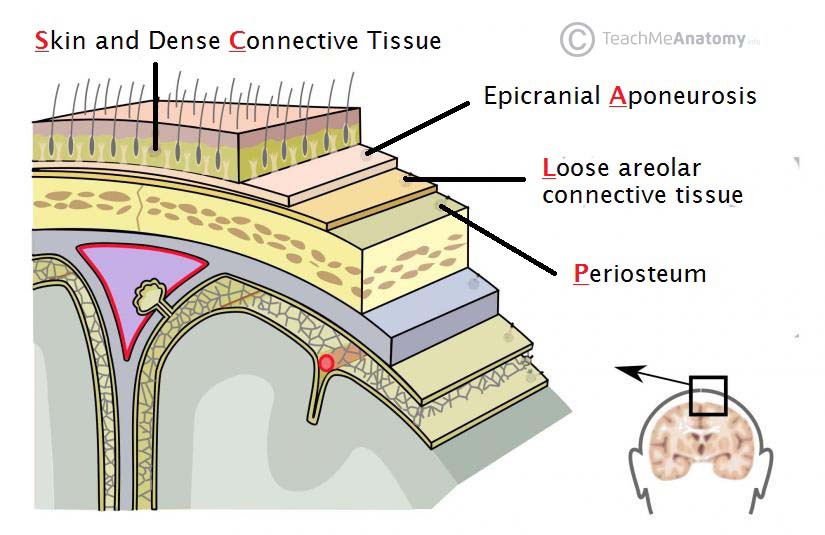
  • The scalp refers to the layers of skin and subcutaneous tissue that cover the bones of cranial vault
  • Layers of the Scalp:
    • The scalp consists of five layers
    • The first three layers are tightly bound together:
      • Move as a collective structure
    • The mnemonic ‘SCALP’ can be a useful way to remember the layers of the scalp:
      • Skin
      • Dense Connective Tissue
      • Epicranial Aponeurosis (Galea Aponeurotica)
      • Loose Areolar Connective Tissue
      • Periosteum
    • Skin:
      • Contains numerous hair follicles and sebaceous glands:
        • Thus a common site for sebaceous cysts
    • Dense Connective tissue:
      • Connects the skin to the epicranial aponeurosis
      • It is richly vascularized and innervated
      • The blood vessels within the layer are highly adherent to the connective tissue:
        • This renders them unable to constrict fully if lacerated:
          • And so the scalp can be a site of profuse bleeding
    • Epicranial Aponeurosis:
      • A thin, tendon-like structure that:
        • Connects the occipitalis and frontalis muscles
    • Loose Areolar Connective Tissue:
      • A thin connective tissue layer that:
        • Separates the periosteum of the skull from the epicranial aponeurosis
      • It contains numerous blood vessels, including emissary veins:
        • Which connect the veins of the scalp to the diploic veins and intracranial venous sinuses
    • Periosteum:
      • The outer layer of the skull bones
      • It becomes continuous with the endosteum at the suture lines
  • Arterial Supply:
    • The scalp receives a rich arterial supply via the:
      • External carotid artery
      • The ophthalmic artery:
        • A branch of the internal carotid
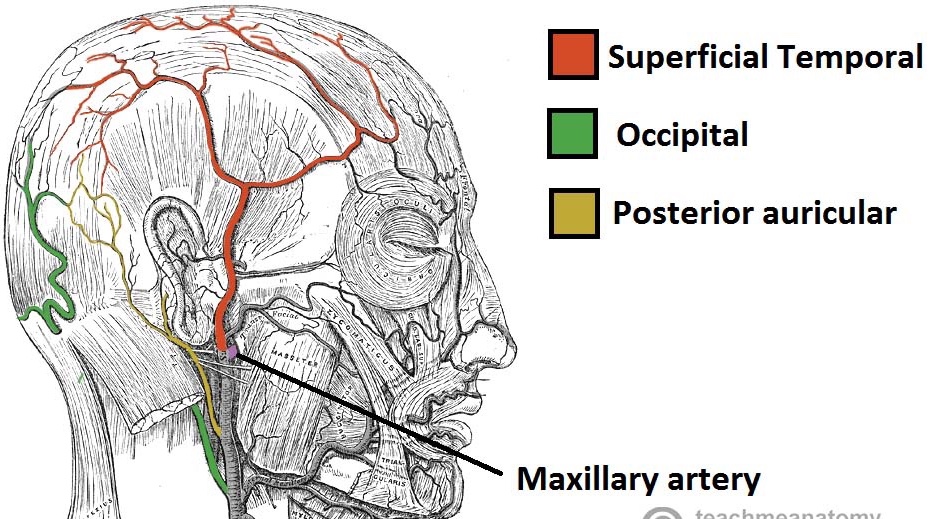
    • There are three branches of the external carotid artery involved:
      • Superficial temporal artery:
        • Supplies the frontal and temporal regions
      • Posterior auricular artery :
        • Supplies the area superiorly and posteriorly to the auricle
      • Occipital artery:
        • Supplies the back of the scalp
    • Anteriorly and superiorly, the scalp receives additional supply from two branches of the ophthalmic artery:
      • The supraorbital and supratrochlear arteries:
        • These vessels accompany the supraorbital and supratrochlear nerves respectively
  • Venous drainage:
    • The venous drainage of the scalp can be divided into:
      • Superficial and deep components
    • The superficial drainage follows the arterial supply:
      • Superficial temporal, occipital, posterior auricular, supraorbital and supratrochlear veins
    • The deep (temporal) region of the skull is drained by:
      • The pterygoid venous plexus:
        • This is a large plexus of veins situated between the temporalis and lateral pterygoid muscles:
          • Drains into the maxillary vein
    • Importantly, the veins of the scalp connect to the diploic veins of the skull:
      • Via valveless emissary veins:
        • This establishes a connection between the scalp and the dural venous sinuses
  • Innervation:
    • The scalp receives cutaneous innervation from branches of the:
      • Trigeminal nerve or the cervical nerve roots
    • Trigeminal Nerve:
      • Supratrochlear nerve:
        • Branch of the ophthalmic nerve:
          • Which supplies the anteromedial forehead
      • Supraorbital nerve:
        • Branch of the ophthalmic nerve:
          • Which supplies a large portion of the scalp between the anterolateral forehead and the vertex
      • Zygomaticotemporal nerve:
        • Branch of the maxillary nerve:
          • This supplies the temple
      • Auriculotemporal nerve:
        • Branch of the mandibular nerve:
          • Which supplies skin anterosuperior to the auricle
    • Cervical Nerves:
      • Lesser occipital nerve:
        • Derived from the anterior ramus (division) of C2 and supplies the skin posterior to the ear
      • Greater occipital nerve:
        • Derived from the posterior ramus (division) of C2 and supplies the skin of the occipital region
      • Great auricular nerve:
        • Derived from the anterior rami of C2 and C3 and supplies the skin posterior to the ear and over the angle of the mandible.
      • Third occipital nerve:
        • Derived from the posterior ramus of C3 and supplies the skin of the inferior occipital region

#Arrangoiz #HeadandNeckSurgeon #CancerSurgeon #SCALP #ScalpAnatomy #SkinCancer #CASO #CenterforAdvancedSurgicalOncology

Lateral Mandibulotomy

👉A lateral mandibulotomy has several disadvantages:

  • First, the muscular pull on the two segments of the mandible is unequal:
    • Putting the mandibulotomy site under significant stress and causing a delay in healing:
      • For this reason, intermaxillary fixation may be required.
  • Second, the ability to gain access to the suture line to maintain cleanliness following surgery in the oral cavity is hampered as a result of intermaxillary fixation:
    • Leading to poor oral hygiene and the potential risk for sepsis of the suture line.
  • In addition, a lateral mandibulotomy poses several anatomic disadvantages:
    • Leading to denervation of the teeth distal to the mandibulotomy site and the skin of the chin:
      • As a result of transection of the inferior alveolar nerve.
  • A lateral mandibulotomy also causes devascularization of the distal teeth and the distal segment of the mandible:
    • From its endosteal blood supply.
  • The exposure provided by a lateral mandibulotomy is limited.
  • If the patient needs postoperative radiation therapy:
    • The mandibulotomy site is directly within the lateral portal of radiation therapy:
      • Leading to delayed healing and complications at the site of the mandibulotomy.

👉For these reasons, a lateral mandibulotomy is not recommended.

#Arrangoiz #Teacher #HeadandNeckSurgeon #CancerSurgeon #SurgicalOncologist #OralCancer #PharyngealCancer

Median Mandibulotomy

👉By placing the site of the mandibulotomy in the anterior midline, all the disadvantages of a lateral mandibulotomy are avoided.

  • However, splitting the mandible in the anterior midline:
    • Requires extraction of one central incisor tooth to avoid exposure of the roots of both central incisor teeth, which are at risk of extrusion:
      • Extraction of one central incisor tooth to avoid this situation alters the aesthetic appearance of the lower dentition.
  • In addition, a midline mandibulotomy requires division of muscles arising from the genial tubercle:
    • That is, the geniohyoid and genioglossus, leading to a delayed recovery of the functions of mastication and swallowing:
      • Therefore a median mandibulotomy also is not preferred for these reasons.

#Arrangoiz #Teacher #Surgeon #CancerSurgeon #HeadandNeckSurgeon #SurgicalOncologist #HeadandNeckCancer #OralCavityCancer #PharyngealCancer

Post Thyroidectomy Hypocalcemia

👉Even if you are sure to identify #parathyroid glands, why do you still have postoperative #hypocalcemia?

👉Thinking that the parathyroid glands may have been localized is nice, but being sure is better.

👉In order to localize the parathyroid glands, even before your expert eyes, use #autofluorescence #imaging in early stages during #thyroidectomy.

👉Early localization of parathyroid glands helps to improve the early postoperative hypocalcemia rate significantly and increase parathyroid preservation after total thyroidectomy.

👉Nice article about this topic:

https://pubmed.ncbi.nlm.nih.gov/31693081/

#Arrangoiz #ThyroidSurgeon #ThyroidExpert #Hypocalcemia #PostOperativeHypocalcemia #Hypoparathyroidism #AutoFluorescence #CASO #CenterforAdvancedSurgicalOncology

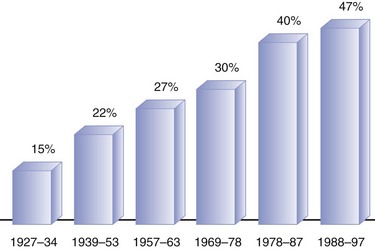
The rising Incidence of Tongue Cancer in Women.

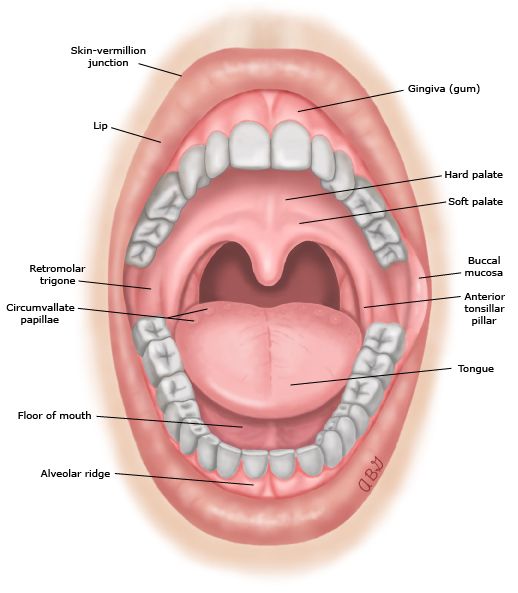
Most patients with cancer in the oral cavity are men, although the incidence of tongue cancer in women in the United States has progressively increased from 15% in the years 1927 – 1934 to 47% in the years 1988 – 1997.

B9780323055895000081_f008-004-9780323055895

Excerpt From: Jatin P. Shah, Snehal G. Patel & Bhuvanesh Singh. “Jatin Shah’s Head and Neck Surgery and Oncology.” iBooks. https://itunes.apple.com/us/book/jatin-shahs-head-and-neck-surgery-and-oncology/id535088692?mt=11

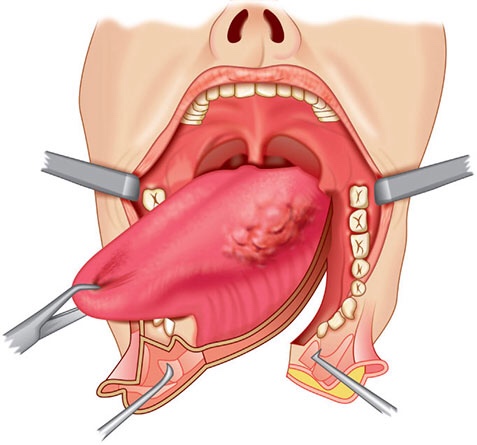
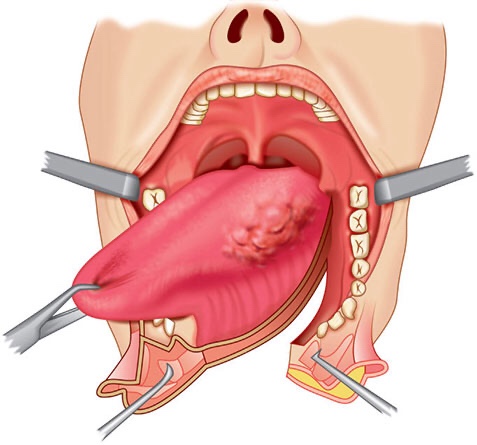
In the Western world, the tongue and floor of the mouth are the most common sites of origin for primary squamous cell carcinomas in the oral cavity.

  • However, the retromolar trigone and buccal mucosa are the most frequently encountered primary sites in areas of the world where the chewing of tobacco and/or betel nuts is common.


14699.myextj


Rodrigo Arrangoiz MS, MD, FACS, FSSO
Cirugía General y Gastrointestinal
Michigan State University
Cirugía Oncológica
Fox Chase Cancer Center
Tumores de Cabeza y Cuello / Cirugía Endocrina
Fox Chase Cancer Center
Tumores de Cabeza y Cuello / Cirugía Endocrina
IFHNOS / Memorial Sloan Kettering Cancer Center
Maestría en Ciencias de Investigación
Drexel University
Certificado por el Colegio Americano de Cirugía
Fellow del Colegio Americano de Cirugía
Fellow de la Society of Surgical Oncology
www.Arrangoizmd.com

Embryology of the Parathyroid Glands

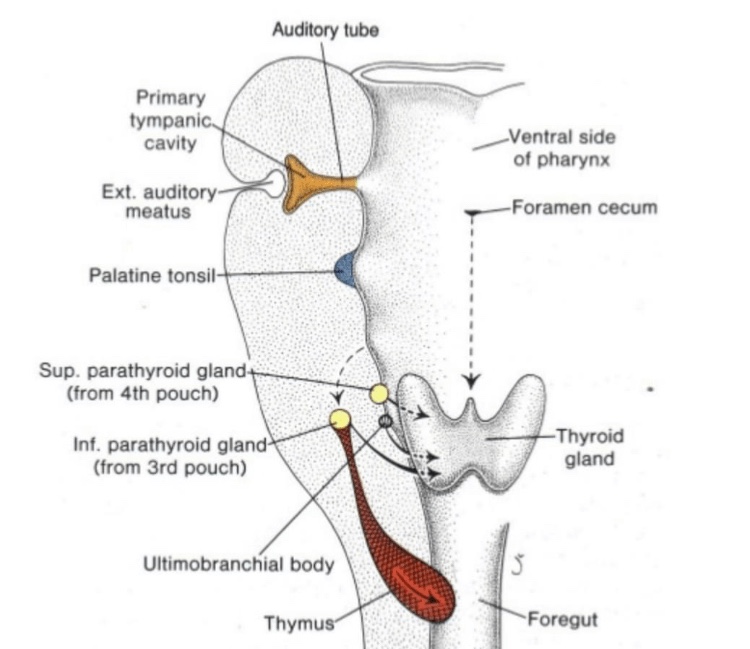
👉The parathyroid glands arise from the 3rd (inferior) and 4th (superior) pharyngeal pouches and follow distinct paths as they descend into their normal locations. A thorough knowledge of the anatomy and embryology of the parathyroid glands is crucial to the parathyroid surgeon and will guide the search for ectopic glands when aberrant anatomy is encountered.

👉For example, when a missing inferior gland is noted, the thymus is a common ectopic location that should be investigated, as this structure also arises from the 3rd pouch. In addition to the thymus, ectopic parathyroids may be found high in the neck (undescended), in the chest, embedded in the thyroid gland or in the sheath surrounding the carotid artery and jugular vein.

#Arrangoiz #ParathyroidSurgeon #ThyroidSurgeon #HeadandNeckSurgeon #CancerSurgeon #CASO #CenterforAdvancedSurgicalOncology #EndocrineSurgery