My name is Rodrigo Arrangoiz I am a breast surgeon/ thyroid surgeon / parathyroid surgeon / head and neck surgeon / surgical oncologist that works at Center for Advanced Surgical Oncology in Miami, Florida.
I was trained as a surgeon at Michigan State University from (2005 to 2010) where I was a chief resident in 2010. My surgical oncology and head and neck training was performed at the Fox Chase Cancer Center in Philadelphia from 2010 to 2012. At the same time I underwent a masters in science (Clinical research for health professionals) at the University of Drexel. Through the International Federation of Head and Neck Societies / Memorial Sloan Kettering Cancer Center I performed a two year head and neck surgery and oncology / endocrine fellowship that ended in 2016.
Mi nombre es Rodrigo Arrangoiz, soy cirujano oncólogo / cirujano de tumores de cabeza y cuello / cirujano endocrino que trabaja Center for Advanced Surgical Oncology en Miami, Florida.
Fui entrenado como cirujano en Michigan State University (2005 a 2010 ) donde fui jefe de residentes en 2010. Mi formación en oncología quirúrgica y e n tumores de cabeza y cuello se realizó en el Fox Chase Cancer Center en Filadelfia de 2010 a 2012. Al mismo tiempo, me sometí a una maestría en ciencias (investigación clínica para profesionales de la salud) en la Universidad de Drexel. A través de la Federación Internacional de Sociedades de Cabeza y Cuello / Memorial Sloan Kettering Cancer Center realicé una sub especialidad en cirugía de cabeza y cuello / cirugia endocrina de dos años que terminó en 2016.
👉Primary hyperparathyroidism as first manifestation in MEN 2A: an international multicenter study. Larsen LV, Mirebeau-Prunier D, Imai T, Alvarez-Escola C, Hasse-Lazar K, Censi S, Castroneves LA, Sakurai A, Kihara M, Horiuchi K, Barbu VD, Borson-Chazot F, Gimenez-Roqueplo AP, Pigny P, Pinson S, Wohllk N, Eng C, Aydoğan Bİ, Saranath D, Dvorakova S, Castinetti F, Attila P, Bergant D, Links TP, Peczkowska M, Hoff AO, Mian C, Dwight T, Jarzab B, Neumann HPH, Robledo M, Uchino S, Barlier A, Godballe C, Mathiesen JS. Endocr Connect. 2020 May 1. PMID: 32375120 https://www.ncbi.nlm.nih.gov/pubmed/32375120
👉Increasing trend of bilateral neck exploration in primary hyperparathyroidism. Khokar AM, Kuchta KM, Moo-Young TA, Winchester DJ, Prinz RA. Am J Surg. 2020 Mar;219(3):466-470. PMID: 31630823 https://www.ncbi.nlm.nih.gov/pubmed/31630823 American Association of Clinical Endocrinologists Endocrine Society
Should be delivered with post-surgical RT for patients with:
Positive surgical margins and/or
Extracapsular extension
Weekly cisplatin may be delivered to post-operative patients:
Who are unable to tolerate high-dose intermittent cisplatin:
Post-operative patients who are unable to tolerate cisplatin-based chemoradiotherapy:
Should not routinely receive concurrent chemotherapy:
Existing prospective data do not support the use of cetuximab, concurrent weekly carboplatin or routine concurrent weekly docetaxel with post-operative RT, although clinical trials are underway to examine these alternative agents
Adjuvant therapy for lower-risk patients:
Concurrent chemoradiation:
Should not be routinely used in intermediate-risk disease
Adjuvant RT is strongly recommended for post-operative OPSCC patients:
At significant risk of locoregional recurrence but only conditionally recommended in scenarios:
Pathologic N1 disease
Perineural invasion
Lymphovascular invasion
With a more uncertain risk of locoregional failure:
Adjuvant radiotherapy may be delivered to patients:
Without conventional adverse pathologic risk factors:
Only if the clinical and surgical findings imply a particularly significant risk of locoregional recurrence
The guideline also outlines optimal dosing and fractionation schedules based on treatment approach, disease profile and risk of recurrence:
Recommendations by treatment setting are as follows:
Definitive RT:
Patients with stage III to IV OPSCC should receive:
A cumulative dose of 70 Gray (Gy):
Delivered to the primary tumor site and positive nodes:
Over seven weeks
As well as an equivalent dose of 50 Gy delivered in 2-Gy daily fractions:
To the regions at risk for tumor spread
For stage IVA to IVB patients not receiving concurrent systemic therapy:
Altered fractionation schedules (either accelerated or hyperfractionated):
Are recommended
For Stage IVA – IVB patients undergoing concurrent CRT:
Either standard or accelerated fractionation may be implemented
Altered fractionation also should be used for patients:
With T3 N0 to N1 disease not receiving concurrent chemoradiation, and
It may be used for patients with T1 to T2, N1 or T2 N0 disease:
At high risk for recurrence
Post-surgical / Adjuvant RT:
Post-operative OPSCC patients at high risk for recurrence:
Those with positive surgical margins should receive:
A total dose of 60 to 66 Gy delivered to the positive margins and region of extranodal extension in 2-Gy daily fractions:
High-risk patients:
Not undergoing concurrent systemic therapy:
Should receive the upper limit of this range
While the 60-Gy total dose is recommended for:
Patients with negative margins following surgery
Early T-stage tonsillar carcinoma:
Ipsilateral RT:
Which involves treating only one side of the oropharyngeal area:
Is strongly recommended for the subset of OPSCC patients with early-stage tonsillar cancer:
Specifically well-lateralized T1 to T2 N0 to N1 tumors
It is conditionally recommended for patients with:
Lateralized T1 to T2 N0 to N2a disease without evidence of extra-capsular extension
References:
Smith BD, Haffty BG, Wilson LD et al. Smith BD, Haffty BG, Wilson LD et al. The future of radiation oncology in the United States from 2010 to 2020: will supply keep pace with demand? J Clin Oncol.2010 Dec 10; 28(35): 5160-5.
Chaturvedi AK, Engels EA, Pfeiffer RM, et al. Human papillomavirus and rising oropharyngeal cancer incidence in the United States. J Clin Oncol. Nov 10 2011;29(32):4294-4301.
Gillison ML, D’Souza G, Westra W, et al. Distinct risk factor profiles for human papillomavirus type 16-positive and human papillomavirus type 16-negative head and neck cancers. J Natl Cancer Inst.Mar 19 2008;100(6):407-420.
– The thyroid gland is located in front of the neck below the thyroid cartilage. – The average weight of the thyroid gland, in healthy adults, is 15–30 g. – It consists of two lobes connected by an isthmus in the middle. – The pyramidal lobe, which ascends from the isthmus or the adjacent part of either lobe up to the hyoid bone, can be seen in 20 % of the patients.
Arterial blood supply of the Thyroid gland
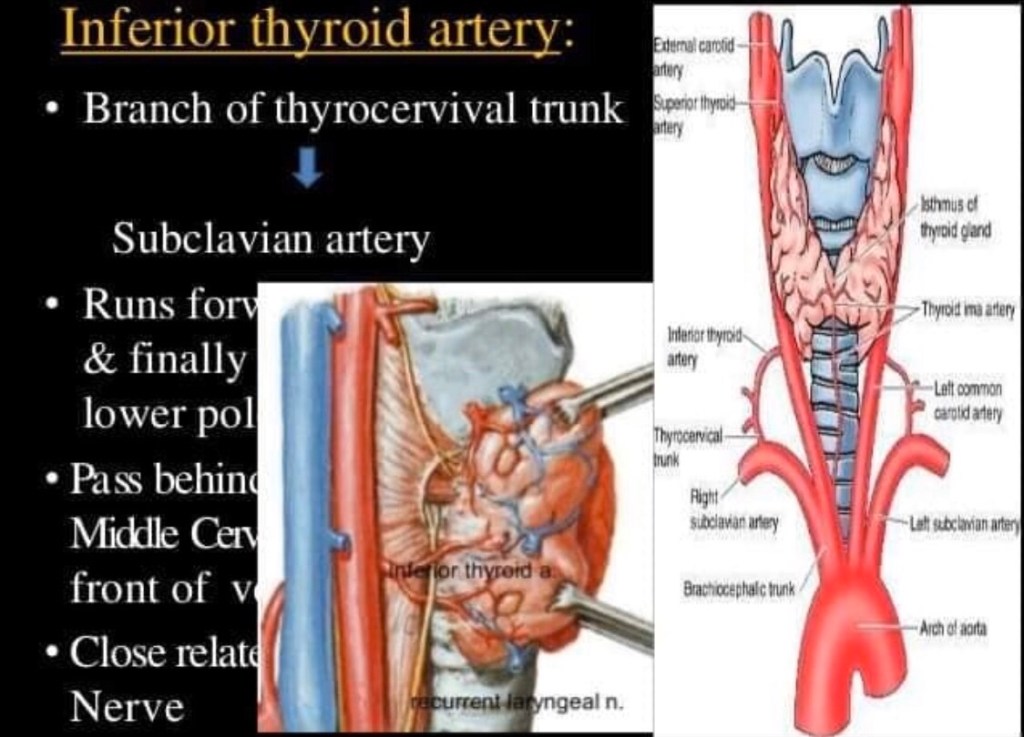
The main arterial blood supplies of the thyroid gland come from:
Superior Thyroid Artery The first branch of the external carotid artery, it enters the upper pole of the thyroid on its anterosuperior surface.
Inferior Thyroid Artery Usually arises from the thyrocervical trunk upward in front of the vertebral artery and Longus Colli to the lower pole of the thyroid gland. Before entering the thyroid, the artery usually divides into 2–3 branches.
The inferior thyroid artery and its terminal branches are closely associated with the recurrent laryngeal nerve at the insertion of the thyroid gland, and innumerable variations have been described, so care must be taken in all cases to avoid injuring the nerve.
Thyroid IMA Artery An unpaired artery in the anterior surface of the trachea, which can be seen in 3–10 % of patients. It usually arises from the brachiocephalic trunk (innominate artery), and occasionally it may arise from the aorta, the right common carotid, the subclavian, or the internal thoracic artery. It supplies the lower part of the thyroid gland.
Venous drainage of the Thyroid gland
– A well-developed thyroid venous plexus usually drains through the inferior thyroid vein to the left brachiocephalic (innominate) vein.
– The superior and middle thyroid veins drain to the internal jugular vein.
Nerves must be aware of during thyroidectomy During thyroidectomy, Care must be taken to preserve the right and left recurrent laryngeal nerves in addition to the superior laryngeal nerves.
– The left recurrent laryngeal nerve branches from the vagus nerve, and loops under the arch of the aorta. It usually ascends along the tracheoesophageal groove with a straight course.
– The right recurrent laryngeal nerve loops around the right subclavian artery. It courses more obliquely and more lateral than left.
– The superior laryngeal nerve, which is a branch of the vagus nerve, takes part in the pitch of the voice. It descends, by the side of the pharynx, behind the internal carotid artery and divides into two branches: external laryngeal nerve as a motor nerve and internal laryngeal nerve as a sensory nerve.
There is a close relationship between the superior thyroid artery and the external branch of the superior laryngeal nerve; therefore, it is recommended to ligate the superior thyroid arteries as low as possible on the thyroid gland to avoid injuring the external branch of the superior laryngeal nerve.
Parathyroid Glands
Usually, there are four parathyroid glands, which are located on the rear surface of the thyroid gland.
The regular size of the parathyroid gland is less than 1 cm and weighs 25–40 mg.
They are yellowish-brown and may be distinguishable from the thyroid gland.
The superior parathyroid glands are normally located on the dorsal aspect of the upper pole of the thyroid gland.
The inferior parathyroid glands are usually located posteriorly to the lower pole of the thyroid but are commonly found within the thymus in the neck or upper mediastinum.
The inferior parathyroid gland is anterior and medial to the recurrent laryngeal nerve, while the superior parathyroid gland is located posterior to this plane.
The principal arterial blood supply to both superior and inferior parathyroid glands is described as the inferior thyroid artery; there are also other blood supplies from the superior thyroid artery or anastomotic vessels of superior and inferior thyroid arteries.
Lymphatic drainage of the Thyroid gland
In the first place, immediate lymphatic drainage is to the periglandular nodes. And it courses to the prelaryngeal (Delphian), pretracheal, and paratracheal lymph nodes. These lymph node groups are called central lymph nodes or central neck compartment; (levels IA, IB, and VI), and they are the most common site of metastasis from thyroid cancer. The central neck compartment boundaries are: the hyoid bone superiorly, the suprasternal notch inferiorly, and the medial border of common carotid artery laterally.
The second part of lymphatic drainage is the lateral neck region, levels IIA, IIB, III, IV, VA, VB.
References
1. Youn Y-K, Lee KE, Choi JY. Surgical Anatomy of the Thyroid Gland. In: Color Atlas of Thyroid Surgery. Berlin, Heidelberg: Springer Berlin Heidelberg; 2014:1-10. doi:10.1007/978-3-642-37262-9_1