Blog

With more than 2 million breast cancer survivors in the United States, breast cancer has a higher cost than other prevalent cancers, with the greatest proportion of the cost related to follow-up care after active treatment.

For patients with breast cancer who have been treated with curative intent, there is no evidence-based data showing that routine measurement of serum tumor markers, CT, or bone scans provide earlier detection of recurrence, or survival benefit, in asymptomatic patients.

Similarly, there are no data to support routine PET scans to assess for metastatic disease in an asymptomatic patient.

The Choosing Wisely campaign has specifically advocated that routine blood tests and imaging with CT, bone or PET scans not be performed routinely in patients who present with early-stage disease and who are treated with curative intent.

Both the American Society of Clinical Oncology and the National Comprehensive Cancer Network recommend annual mammography for all women treated with breast-conservation therapy.

Referecnes:

Khatcheressian JL, Wolff AC, Smith TJ, et al. American Society of Clinical Oncology 2006 update of the breast cancer follow-up and management guidelines in the adjuvant setting.

J Clin Oncol. 2006;24:5091-5097. Lewis JL, Tartter PI. The value of mammography within 1 year of conservative surgery for breast cancer. Ann Surg Oncol. 2012;19:3218-3222.

Locker GY, Hamilton S, Harris J, et al. ASCO 2006 update of recommendations for the use of tumor markers in gastrointestinal cancer. J Clin Oncol. 2006;24:5313-5327.

Mariotto AB, Yabroff KR, Shao Y, Feuer EJ, Brown ML. Projections of the cost of cancer care in the United States: 2010-2020. J Natl Cancer Inst. 2011;103:117-128.

National Comprehensive Cancer Network NCCN Clinical Practice Guidelines in Oncology. Breast Cancer. Available at http://www.nccn.org.

American Society of Clinical Oncology. Ten Things Physicians and Patients Should Question. Released April 4, 2012 (1-5) and October 29, 2013 (6-10).

#Arrangoiz #BreastSurgeon #CancerSurgeon #BreastCancer #MountSinaiMedicalCenter #MSMC #Miami #Mexico #SurgicalOncoloigist

Chemotherapy for Breast Cancer

Taxanes bind free tubulin and stabilize microtubules.

This inhibits the spindle apparatus needed for mitosis.

Cyclophosphamide is an alkylating agent, which forms DNA cross-linkages

Doxorubicin interferes with topoisomerase II.

Fluorouracil acts as a nucleotide analog

Trastuzumab targets the epidermal growth factor receptor.

References
Abal M, Andreu JM, Barasoain I. Taxanes: microtubule and centrosome targets, and cell cycle dependent mechanisms of action. Curr Cancer Drug Targets. 2003;3:193-203.

Priestman T. The theoretical basis of cancer chemotherapy. In Cancer Chemotherapy in Clinical Practice. 2nd ed. London, UK: Springer-Verlag London; 2012:1-43.

Cancer Surgeon
Surgical Excellence / Excelencia Quirúrgica

RAS Gene Mutations in Thyroid Cancer

The RAS genes (HRAS, KRAS and NRAS) encode highly related G-proteins that play a central role in the intracellular transduction of signals arising from cell membrane receptors.

In its inactive state, RAS protein is bound to GDP. Upon activation, it releases GDP and binds GTP, thereby activating the MAPK and other signaling pathways, such as PI3K / AKT. Normally, the activated RAS-GTP protein becomes quickly inactive due to its intrinsic GTPase activity and the action of cytoplasmic GTPase-activating proteins.

Point mutations in the discrete domains of the RAS gene either increase its affinity for GTP (mutations in codons 12 and 13) or inactivate its autocatalytic GTPase function (mutation in codon 61). As a result, the mutant protein becomes permanently switched in the active position and continuously activates its downstream targets.

Point mutations involving several specific sites (codons 12, 13 and 61) of the NRAS, HRAS or KRAS genes are found in 10% to 20% of papillary thyroid carcinomas. Papillary thyroid carcinomas harboring RAS mutation almost always have follicular variant histology; this mutation also correlates with significantly less prominent nuclear features of papillary thyroid carcinoma, more frequent encapsulation and low rate of lymph node metastases.

Some studies have reported the association between RAS mutations and more aggressive behavior of papillary thyroid carcinoma, such as a higher frequency of distant metastases. Mutations of the RAS gene are not restricted to papillary thyroid carcinoma and also found in other benign and malignant thyroid neoplasms, as well as in tumors from other tissues.

The molecular pathogenesis of thyroid cancer involves dysregulation of the mitogen-activated protein kinase (MAPK) and phosphatidylinositol-3 kinase (PI3K)/AKT pathways. Common activating mutations in the MAPK pathway include RET / PTC and NTRK rearrangements, and RAS and BRAF mutations. Common genetic alterations in the PI3K pathway include RAS mutations, PTEN mutations or deletions, PIK3K mutations or amplifications, and AKT1 mutations. PAX8 / PPARG fusions are common in FTC. Activation of Wnt/b-catenin pathway, inactivating mutations in TP53, and activating mutations in TERT promoter are frequent in undifferentiated thyroid cancer.
#Arrangoiz #ThyroidSurgeon
  • The BI-RADS lexicon was developed by the American College of Radiology (ACR) and was mandated by the Mammographic Quality and Standard Act of 1992. This act pertains only to mammography.
  • Since this lexicon was successful, ACR has now developed a similar lexicon for breast ultrasound and breast MRI.
  • The 5th edition of the BI-RADS system for mammography is the most current edition.
  • Mammographic findings are grouped into seven categories including masses, calcifications, architectural distortion, asymmetries, intramammary lymph node, skin lesions, and solitary dilated duct (see the table).
  • A group of calcifications is defined as 5 calcifications within a 1-cm area of tissue but less than 2 cm.
  • BI-RADS is reported on a scale from 0 to 6, with BI-RADS 0 indicating further work-up is needed and BI-RADS 6 indicating biopsy-proven malignancy.
  • BI-RADS 3 indicates that a short-term follow-up is needed.
  • The table shows the term associated with each of the six BI-RADS categories, the recommended action, and the likelihood of malignancy.
  • References:
  • D’Orsi CJSE, Mendelson EB, Morris EA, et al. ACR BI RADS Atlas, Breast Imaging Reporting and Data System. Reston, VA: American College of Radiology. 2013.
  • Sedgwick EL, Ebuoma L, Hamame A, et al. BI-RADS update for breast cancer caregivers. Breast Cancer Res Treat. 2015;150:243-254.
  • Tomosynthesis is a newer imaging modality:
    • That allows for reconstruction of planes from breast tissue volume:
      • Which overcomes the limitations of 2-dimensional imaging caused by overlapping normal and pathologic breast tissue
  • Tomosynthesis has been shown to increase the detection of invasive cancer:
    • By more than a third compared with 2D mammography alone and reduces false-positive results by 15%
  • Screening mammography does reduce mortality:
    • Pooled estimates from multiple trials demonstrate a reduction of 20%
  • MRI is recommended for screening in high-risk women:
    • High-risk is defined as:
      • A lifetime risk of 20%
  • There is a national trend toward adopting legislation:
    • That requires the reporting of breast density to women undergoing mammography:
      • As well, there is a need for supplemental screening for this group of women with dense breasts
    • Automated ultrasound may be a good alternative for these patients:
      • In one study of patients with 50% breast density, automated ultrasound detected 12.3 cancers per 1,000 breast cancers compared with 4.6 per 1,000 by mammography alone
  • Imaging with all three modalities has not been validated
  • References:
    • Friedewald SM, Rafferty EA, Rose SL, et al. Breast cancer screening using tomosynthesis in combination with digital mammography. JAMA.
    • Giuliano V, Giuliano C. Improved breast cancer detection using automated whole breast ultrasound and mammography in radiographically dense breasts. Clin Imaging. 2013;20:480-
    • Smith RA, Duffy SW, Gabe R, Tabar L, Yen AM, Chen TH. The randomized trials of breast cancer screening: what have we learned? Radiol Clin North Am. 2004;42:793-806.486.2014;311:2499-2507.
    • Smith RA, Duffy SW, Gabe R, Tabar L, Yen AM, Chen TH. The randomized trials of breast cancer screening: what have we learned? Radiol Clin North Am. 2004;42:793-806.

#Arrangoiz #BreastSurgeon #CancerSurgeon #SurgicalOncologist #BreastCancer #Mammography #MountSinaiMedicalCenter #MSMC

Hyperparathyroidism during Pregnancy

  • Hyperparathyroidism during pregnancy:
    • Is often unrecognized:
      • Is associated with a 3.5-fold increase in miscarriage
  • Loss of the pregnancy:
    • Most often occurs during the late second trimester
  • The incidence of hyperparathyroidism in pregnancy is:
    • 0.7%
  • Maternal complications include:
    • Hyperemesis
    • Nephrolithiasis
    • Pancreatitis
  • Fetal complications include:
    • Spontaneous abortion
    • Growth retardation
  • In those who reach delivery, neonatal complications include:
    • Hypocalcemic crisis:
      • Within the first few days of life
  • Calcimimetic medications:
    • Have not been used in the setting of hyperparathyroidism in pregnancy
  • Calcitonin:
    • Has no role in the management of hyperparathyroidism

Low vitamin D levels increase chances of developing low parathyroid hormone levels after thyroid surgery

BACKGROUND
Surgery to remove all, or part, the thyroid gland is commonly needed to treat some types of thyroid disease. One problem that can happen after thyroid surgery is development of low calcium levels due to damage to the parathyroid glands. The parathyroid glands are four very small structures (each about the size of a grain of rice) that live in the neck on the surface of the thyroid gland. Their job is to make a single hormone (parathyroid hormone), which works with vitamin D in the body to control a person’s calcium levels. When calcium levels are low, parathyroid hormone levels are increased to help increase calcium levels.

It is critical that the parathyroid glands work normally after thyroid surgery. If they do not, which can happen if the parathyroid glands are damaged, removed or irritated during surgery, calcium levels will be too low. This can cause serious side effects, including severe muscle cramps and seizures. For this reason, understanding how best to preserve parathyroid gland function after thyroid surgery is very important.

The research described here studied people who had surgery to remove all, or part, of their thyroid to learn if low vitamin D levels before thyroid surgery increases the risk of low parathyroid hormone levels after surgery.

THE FULL ARTICLE TITLE
Vaitsi K et al 2021 Pre-operative vitamin D deficiency is a risk factor for post-thyroidectomy hypoparathyroidism: A systematic review and meta-analysis of observational studies. J Clin Endocrinol Metab. Epub 2021 Jan 23:dgab039. PMID: 33484571.

SUMMARY OF THE STUDY
In order to better understand the possible effect of low vitamin D levels on parathyroid gland function after thyroid surgery, the authors of this study collected information published between 2009 and 2020 on the relationship between parathyroid gland activity, thyroid surgery and vitamin D levels. They then used mathematical testing (statistics) to see if low vitamin D levels before thyroid surgery increased the risk that the parathyroid glands would not work well after surgery (hypoparathyroidism, or low parathyroid hormone levels).

Overall, the authors included 755,585 people who underwent thyroid surgery. They found that mild or moderately low vitamin D levels before thyroid surgery increased the risk of temporary (lasting less than 6 months) low parathyroid hormone levels after thyroid removal. If very low vitamin D levels were present before thyroid surgery, patients also had an increased risk of having permanent low parathyroid hormone levels after surgery.

WHAT ARE THE IMPLICATIONS OF THIS STUDY?
The study authors found that low vitamin D levels before thyroid surgery increased the risk that the parathyroid glands would not work well after surgery, which could cause significant health problems. For this reason, the authors suggest that people who are planning to undergo thyroid surgery should have their vitamin D levels checked and, if these levels are low, should take a vitamin D supplement before surgery. This might decrease the risk of having a low parathyroid hormone level, and associated side effects, after thyroid surgery.

Localization of Parathyroid Glands Preoperatively

  • Routine preoperative localization in patients with PHPT includes:
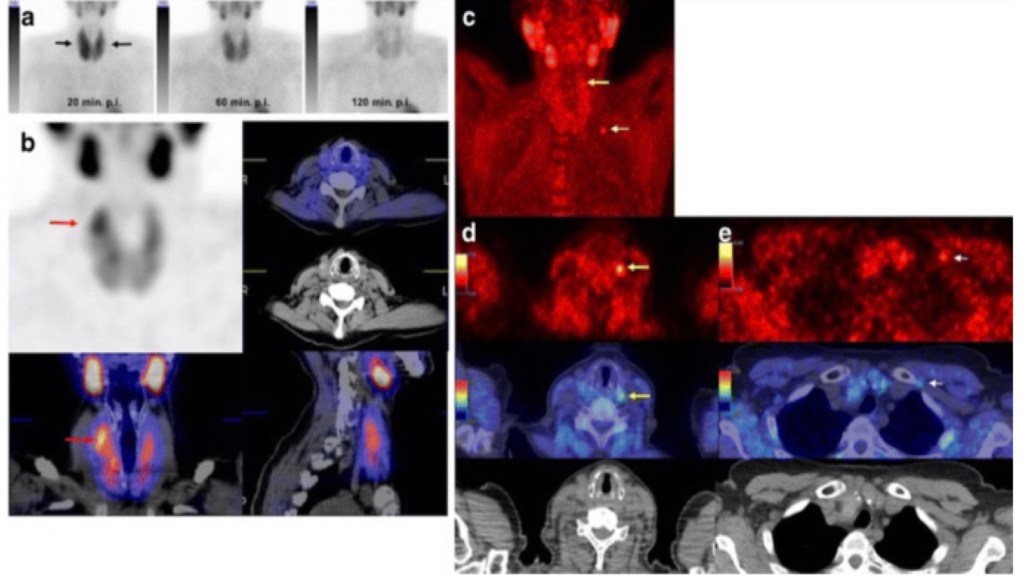
    • Neck ultrasound and technetium-99m– labeled sestamibi scan
  • Sestamibi scan:
    • Has a reported sensitivity as high as:
      • 90%
  • Ultrasound:
    • Is slightly less sensitive:
      • 75%
    • But the ease of in-office use:
      • Makes it a useful tool for the head and neck surgeon
  • SPECT:
    • When used with planar sestamibi:
      • Is very good at locating potential ectopic glands such as those in the mediastinum
  • 4D-CT:
    • Incorporates contrast perfusion:
      • In hyperfunctioning parathyroid tissue over time:
        • This additional layer provides functional information in addition to the anatomic information provided by a standard CT scan
    • In a recent study, 4D-CT has shown improved sensitivity over all other modalities:
      • Especially when used in combination with ultrasound

#Arrangoiz #ParathyroidSurgeon #ParathyroidExpert #Hypercalcemia #PHPT #Hyperparathyroidism #PrimaryHyperparathyroidism #EndocrineSurgery #HeadandNeckSurgeon #CancerSurgeon #Surgeon #Teacher #Miami #Mexico #MountSinaiMedicalCenter #MSMC

Classification of Thyroid Tumors

The conventional classification based on morphology and clinical features is largely supported by molecular data currently available. Genetic profiles of four main categories appear distinctly different from each other with a few areas of overlap.

The classification of thyroid tumors modified from WHO classification (2004) is as follows:

Tumors of Follicular Epithelium:
■„Follicular adenoma (including Hurthle cell adenoma)
■„Hyalinizing trabecular adenoma ■„Follicular carcinoma (including Hurthle cell carcinoma)
– Minimally invasive – – Widely invasive
■„Papillary carcinomas
■„Poorly differentiated carcinoma ■„Anaplastic carcinoma
■„Squamous cell carcinoma ■„Mucoepidermoid carcinoma ■„Sclerosing mucoepidermoid carcinoma with eosinophilia ■„Mucinous carcinoma

Tumors with C Cell Differentiation
Medullary carcinoma

Tumors with Mixed Differentiation
■„Collision tumor—follicular/papillary or follicular/medullary
■„Mixed differentiated carcinoma intermediate type

Tumors Showing Thymic or Related Branchial Pouch Differentiation
■„Ectopic thymoma
■„Spindle epithelial tumor with thymus-like
element (SETTLE)
■„Carcinoma showing thymus-like element (CASTLE).

Tumors of Lymphoid Cells
■„Malignant lymphoma ■„Plasmacytoma


Mesenchymal Tumors
■„Smooth muscle tumors ■„Peripheral nerve sheath tumors ■„Paragangliomas
■„Solitary fibrous tumors ■„Follicular dendritic cell tumors ■„LCH
■„Angiosarcoma.

Teratomas

Secondaries

Thyroid Tumors

Thyroid tumors account to 1% of all malignancies in developed countries and 0.2% of cancer deaths. They are the most common malignancies of the endocrine system and pose a significant challenge to pathologists, surgeons, and oncologists. Most of the carcinomas affect young and middle-aged adults and are indolent malignancies with a 10-year survival that exceeds 90%. There has been an increase in the incidence rate of these tumors worldwide which can be largely attributed to more sophisticated diagnostic methods and a change in diagnostic practices with an increasing number of smaller tumors being detected of late. Thyroid tumor pathology is an area replete with diagnostic challenges. Though there are typical morphological patterns described, overlaps with non-neoplastic entities pose diagnostic difficulties. Updates in this field include ancillary and research aiming at techniques that can further narrow down our diagnosis from the different “indeterminate/gray zone” lesions detected on screening.