- Two Distinct Disease Entities:
- OPSCC is now classified as two biologically and prognostically distinct diseases:
- Based on high-risk HPV status:
- HPV-associated (p16-positive) and HPV-independent (p16-negative) carcinoma:
- A division formalized in the WHO classification and the AJCC 8th edition staging system
- HPV-associated (p16-positive) and HPV-independent (p16-negative) carcinoma:
- Based on high-risk HPV status:
- HPV-associated tumors:
- Carry a markedly better prognosis:
- With 8-year overall survival of 70.9% versus 30.2% for HPV-negative disease in RTOG 0129:
- HR 0.30; 95% CI 0.21–0.42
- With 8-year overall survival of 70.9% versus 30.2% for HPV-negative disease in RTOG 0129:
- Carry a markedly better prognosis:
- OPSCC is now classified as two biologically and prognostically distinct diseases:
- Histopathology:
- HPV-Associated (
- ) OPSCC:
- These tumors arise from the specialized reticulated epithelium lining the tonsillar crypts rather than the surface mucosa
- Characteristic features include:
- Nonkeratinizing growth:
- Lobules and sheets of immature basaloid cells with high nuclear-to-cytoplasmic ratios and hyperchromatic nuclei; absent or minimal keratinization
- Basaloid cytology:
- Resembling deep crypt epithelium, with lobular / endophytic growth and smooth pushing borders
- Permeating tumor-infiltrating lymphocytes:
- Within and around tumor nests
- Absence of surface dysplasia:
- Dysplasia is confined to crypts
- Cystic nodal metastases:
- Which can mimic branchial cleft cysts
- Nonkeratinizing growth:
- In a 4-year prospective study of 435 OPSCCs:
- Strictly defined nonkeratinizing morphology had a 99.1% positive predictive value for p16 positivity and 100% PPV for HR-HPV mRNA positivity
- A “nonkeratinizing with maturation” (hybrid) intermediate pattern is p16-positive in ~92% of cases
- HPV-Independent (Keratinizing) OPSCC:
- These resemble conventional keratinizing SCC of the upper aerodigestive tract:
- With keratin pearl formation
- Individual cell keratinization
- Intercellular bridges
- Progressive squamous maturation
- Origin from dysplastic surface epithelium
- Molecularly they are characterized by high rates of:
- TP53 mutation
- CCND1 (cyclin D1) copy-number gains
- 9p21 / CDKN2A loss
- These resemble conventional keratinizing SCC of the upper aerodigestive tract:
- A Note on Grading:
- Although HPV-associated tumors appear “poorly differentiated” by conventional criteria:
- They paradoxically carry the best prognosis:
- Westra has argued they may be best viewed as well-differentiated given their resemblance to native crypt epithelium
- They paradoxically carry the best prognosis:
- Both the 2018 CAP guideline and its 2025 update recommend against providing traditional grade / differentiation status for HPV-associated OPSCC:
- Instead recommend reporting the WHO histologic subtype
- Conventional grading (G1 to G4) still applies to HPV-independent OPSCC
- Certain morphologic features retain prognostic value even within p16-positive disease:
- Tumor cell anaplasia (nuclei ≥ 5 lymphocyte diameters) and multinucleation:
- Independently predicted worse disease-specific survival (HR 9.9 and 11.9, respectively), and “non-classic” HPV-positive morphology was associated with poorer 5-year survival (58.4% vs 83.9%)
- Keratinization:
- Independently predicts worse survival
- Tumor cell anaplasia (nuclei ≥ 5 lymphocyte diameters) and multinucleation:
- Although HPV-associated tumors appear “poorly differentiated” by conventional criteria:
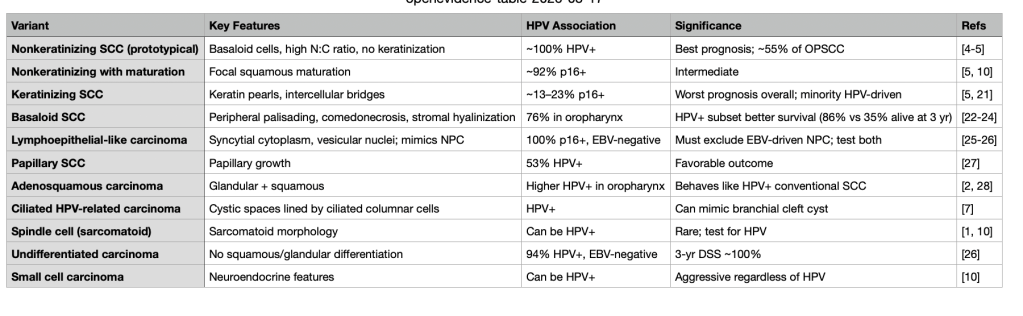
- Histologic Variants:
- Basaloid SCC:
- Is a mixed entity resolvable by HPV status:
- HPV-positive:
- Younger patients
- p16+ / p53−
- Prognosis – favorable
- HPV-negative:
- Older patients
- Tobacco / alcohol-related
- p53 overexpression
- Biology – aggressive
- HPV-positive:
- Is a mixed entity resolvable by HPV status:
- Lymphoepithelial-like carcinoma:
- Requires mandatory dual HPV and EBV testing:
- As it closely mimics metastatic nasopharyngeal carcinoma
- Requires mandatory dual HPV and EBV testing:
- Basaloid SCC:
- HPV / p16 Testing:
- Who to Test:
- All patients with newly diagnosed OPSCC should undergo HR-HPV testing, regardless of histologic subtype:
- A strong CAP recommendation, endorsed by ASCO and listed as required in NCCN workup
- Testing may be performed on the:
- Primary tumor, a nodal metastasis, or FNA of a cervical node
- Routine testing is not recommended for:
- Nonsquamous oropharyngeal or non-oropharyngeal head and neck carcinomas (except sinonasal)
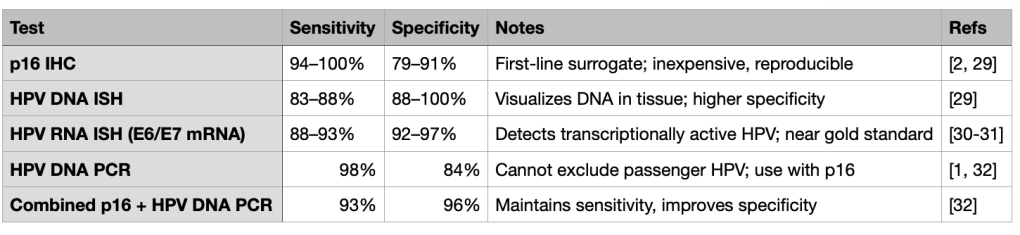
- p16 IHC — the First-Line Test:
- p16 immunohistochemistry is the recommended primary test:
- Positivity requires:
- ≥ 70% nuclear AND cytoplasmic expression with at least moderate-to-strong intensity:
- Typically in a confluent / block-like pattern
- ≥ 70% nuclear AND cytoplasmic expression with at least moderate-to-strong intensity:
- Positivity requires:
- The E6H4 clone is most widely used and validated
- With these criteria:
- Sensitivity for transcriptionally active HR-HPV approaches 100% with specificity of ~ 85% to 95% in the oropharynx
- Cases with 50% to 70% staining are equivocal and warrant HPV-specific testing
- p16 and HPV may be used interchangeably only within the oropharynx
- p16 immunohistochemistry is the recommended primary test:
- HPV-Specific (Direct) Testing:
- The 2025 CAP update expanded indications for confirmatory HPV-specific testing beyond p16 IHC:
- All patients with newly diagnosed OPSCC should undergo HR-HPV testing, regardless of histologic subtype:
- Who to Test:
- HPV-specific testing should be performed in:
- Low-prevalence geographic regions
- Equivocal p16 staining
- Discrepancy between p16 and morphology (e.g., p16+ but keratinizing)
- Large multisite tumors
- Non-tonsillar / non-base-of-tongue subsites
- Clinical trials
- SCC of unknown primary
- Discordant Results:
- p16+ / HPV− discordance occurs in ~ 4% to 20% of cases:
- In the multinational HNCIG-EPIC-OPC analysis (n=7,654):
- Discordant patients had intermediate prognosis:
- Significantly worse than double-positive and better than double-negative:
- Discordant patients had intermediate prognosis:
- In the multinational HNCIG-EPIC-OPC analysis (n=7,654):
- p16+ / HPV− discordance occurs in ~ 4% to 20% of cases:
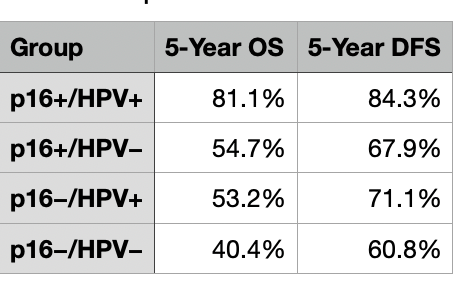
- This has direct implications for de-escalation:
- As p16+ / HPV− tumors may be misclassified and inappropriately de-escalated
- AJCC 8th Edition Staging:
- The 8th edition established separate staging systems for p16-positive (HPV-mediated) and p16-negative OPSCC, based on the ICON-S validation study:
- T Classification
For p16+:- T0 is included, Tis is excluded, and T4 is a single category (no T4a / T4b:
- Because T4a and T4b survival curves were indistinguishable
- T0 is included, Tis is excluded, and T4 is a single category (no T4a / T4b:
- For p16−:
- Tis is included, T0 is excluded, and T4 is subdivided into T4a (moderately advanced) and T4b (very advanced)
- N Classification — The Most Divergent Element:
- p16+ OPSCC uses separate clinical and pathological N criteria, and ENE is not part of either:
- p16+ clinical N (laterality / size):
- cN1 = ipsilateral node(s) ≤ 6 cm
- cN2 = contralateral / bilateral ≤ 6 cm
- cN3 = any node > 6 cm
- p16+ pathological N (node count):
- pN1 = ≤ 4 positive nodes
- pN2 = > 4 positive nodes
- p16+ clinical N (laterality / size):
- p16− uses the traditional detailed system incorporating size, number, laterality, and ENE (N3b = clinically overt ENE)
- p16+ OPSCC uses separate clinical and pathological N criteria, and ENE is not part of either:
- T Classification
- Prognostic Stage Groups:
- For p16+, only Stages I to IV exist, and Stage IV is reserved for M1 disease only:
- Clinical:
- Stage I (T0 to T2 N0 to N1)
- Stage II (T0 to T2 N2 or T3 N0 to N2)
- Stage III (N3 or T4)
- Stage IV (M1)
- Pathological:
- Stage I (T0 to T12 pN0 to N1)
- Stage II (T0 to T2 pN2 or T3 to T4 pN0 to N1)
- Stage III (T3 to T4 pN2)
- Stage IV (M1)
- Clinical:
- For p16−, the traditional Stage 0 to IVC framework is retained
- For p16+, only Stages I to IV exist, and Stage IV is reserved for M1 disease only:
- The complete AJCC 8th edition staging tables from the NCCN Guidelines for both p16+ and p16− disease are shown below:
 Table 4: American Joint Committee on Cancer (AJCC) TNM Staging System for HPV-Mediated (p16+) Oropharyngeal Cancer (8th ed., 2017) — NCCN Guidelines® — Head and Neck Cancers p. 135 (v2.2026)
NCCNMay 11, 2026
 Table 3: TNM Staging System for the Oropharynx (p16-) and Hypopharynx (8th ed., 2017) — NCCN Guidelines® — Head and Neck Cancers p. 132 (v2.2026)
 TNM Staging System for the Oropharynx (p16-) and Hypopharynx (8th ed., 2017) — NCCN Guidelines® — Head and Neck Cancers p. 134 (v2.2026)
Prognostic Impact
The 8th edition downstages ~93% of HPV+ patients, with most Stage IVA (7th edition) patients reclassified as Stage I. [37]Prognostic discrimination improved substantially (concordance index 0.621→0.656 clinical; 0.640→0.663 pathological). [38]The validation Kaplan-Meier curves demonstrate that overlapping 7th-edition survival curves separate cleanly under the 8th edition:
Figure 3. Observed 3‐year overall survival for patients with human papillomavirus (HPV)‐positive oropharyngeal cancer based on seventh and eighth edition staging manual. - Stages I and II in p16+ disease do not consistently separate on survival, and > 80% of pathologically staged cases fall into Stage I, creating wide within-group hazard variance
- ENE — omitted from the formal p16+ classification — remains prognostically important (HR 3.40 for OS) and an NCCN adverse feature guiding adjuvant therapy
- The proposed AJCC 9th edition (AJCC9V) reincorporates pathological ENE and refines node-count thresholds
- p16+ non-tonsillar / non-base-of-tongue tumors may be inappropriately downstaged, as their favorable prognosis is less well established
- The 8th edition established separate staging systems for p16-positive (HPV-mediated) and p16-negative OPSCC, based on the ICON-S validation study:
- References:
1.Human Papillomavirus Testing in Head and Neck Carcinomas: Guideline Update.Archives of Pathology & Laboratory Medicine. 2025.Lewis JS, Beadle B, Bishop JA, et al.Guideline
2.Human Papillomavirus Testing in Head and Neck Carcinomas: Guideline From the College of American Pathologists.Archives of Pathology & Laboratory Medicine. 2018. Lewis JS, Beadle B, Bishop JA, et al.Guideline
3.Head and Neck Cancer.The New England Journal of Medicine. 2020. Chow LQM.Review
4.HPV-associated Head and Neck Cancer: A Virus-Related Cancer Epidemic.The Lancet. Oncology. 2010. Marur S, D’Souza G, Westra WH, Forastiere AA.Review
5.Histologic Typing in Oropharyngeal Squamous Cell Carcinoma: A 4-Year Prospective Practice Study With P16 and High-Risk HPV mRNA Testing Correlation.The American Journal of Surgical Pathology. 2016. Gondim DD, Haynes W, Wang X, et al.
6.HPV-related Squamous Cell Carcinoma of Oropharynx: A Review.Journal of Clinical Pathology. 2020. Rahimi S.Review
7.Ciliated HPV-related Carcinoma: A Well-Differentiated Form of Head and Neck Carcinoma That Can Be Mistaken for a Benign Cyst.The American Journal of Surgical Pathology. 2015. Bishop JA, Westra WH.Case
8.Comparison of Clinical, Radiological and Morphological Features Including the Distribution of HPV E6/E7 Oncogenes in Resection Specimens of Oropharyngeal Squamous Cell Carcinoma.Oral Oncology. 2018. Channir HI, Kiss K, Rubek N, et al.
9.Association of Cystic Neck Metastases and Human Papillomavirus-Positive Oropharyngeal Squamous Cell Carcinoma.Archives of Pathology & Laboratory Medicine. 2009. McHugh JB.Case
10.Human Papillomavirus-Related Head and Neck Squamous Cell Carcinoma Variants.Seminars in Diagnostic Pathology. 2015. El-Mofty SK.Review
11.Histopathologic Risk Factors in Oral and Oropharyngeal Squamous Cell Carcinoma Variants: An Update With Special Reference to HPV-related Carcinomas.Medicina Oral, Patologia Oral Y Cirugia Bucal. 2014. El-Mofty SK.Review
12.Detection of Human Papillomavirus DNA and Oncoprotein Overexpression Are Associated With Distinct Morphological Patterns of Tonsillar Squamous Cell Carcinoma.The American Journal of Pathology. 1998. Wilczynski SP, Lin BT, Xie Y, Paz IB.
13.Stratification of HPV-associated and HPV-negative Oropharyngeal Squamous Cell Carcinomas Based on DNA Methylation Epigenotypes.International Journal of Cancer. 2020. Nakagawa T, Matsusaka K, Misawa K, et al.
14.Identification of Prognostic Molecular Biomarkers in 157 HPV-positive and HPV-negative Squamous Cell Carcinomas of the Oropharynx.International Journal of Cancer. 2019. Dogan S, Xu B, Middha S, et al.
15.Head and Neck Cancers.
16.Tumor Cell Anaplasia and Multinucleation Are Predictors of Disease Recurrence in Oropharyngeal Squamous Cell Carcinoma, Including Among Just the Human Papillomavirus-Related Cancers.The American Journal of Surgical Pathology. 2012. Lewis JS, Scantlebury JB, Luo J, Thorstad WL.
17.Histological and Genetic Criteria Define a Clinically Relevant Subgroup of HPV-positive Oropharyngeal Carcinoma.Oral Oncology. 2025. Suchan M, Wuerdemann N, Wagner S, et al.
18.Association of Keratinization With 5-Year Disease-Specific Survival in Oropharyngeal Squamous Cell Carcinoma.JAMA Otolaryngology– Head & Neck Surgery. 2015.Cooper T, Biron VL, Adam B, et al.Observational
19.p16 overexpression and Rb loss correlate with high‐risk HPV infection in oropharyngeal squamous cell carcinoma.Histopathology. 2021. Jiromaru R, Yamamoto H, Yasumatsu R, et al.
20.Utility of p16 and HPV testing in oropharyngeal squamous cell carcinoma: An institutional review.Diagnostic Cytopathology. 2021. Abdelhakam DA, Huenerberg KA, Nassar A.
21.Keratinizing-Type Squamous Cell Carcinoma of the Oropharynx: P16 Overexpression Is Associated With Positive High-Risk HPV Status and Improved Survival.The American Journal of Surgical Pathology. 2014. Cai C, Chernock RD, Pittman ME, et al.
22.Basaloid Squamous Cell Carcinoma of the Head and Neck Is a Mixed Variant That Can Be Further Resolved by HPV Status.The American Journal of Surgical Pathology. 2008. Begum S, Westra WH.
23.Human Papillomavirus-Positive Basaloid Squamous Cell Carcinomas of the Upper Aerodigestive Tract: A Distinct Clinicopathologic and Molecular Subtype of Basaloid Squamous Cell Carcinoma.Human Pathology. 2010. Chernock RD, Lewis JS, Zhang Q, El-Mofty SK.
24.Basaloid Squamous Cell Carcinoma of the Head and Neck: Role of HPV and Implication in Treatment and Prognosis.Journal of Clinical Pathology. 2010. Thariat J, Badoual C, Faure C, et al.Review
25.Lymphoepithelial-Like Carcinoma of the Oropharynx: A Morphologic Variant of HPV-related Head and Neck Carcinoma.The American Journal of Surgical Pathology. 2010. Singhi AD, Stelow EB, Mills SE, Westra WH.
26.Undifferentiated Carcinoma of the Oropharynx: A Human Papillomavirus-Associated Tumor With a Favorable Prognosis.Modern Pathology : An Official Journal of the United States and Canadian Academy of Pathology, Inc. 2011. Carpenter DH, El-Mofty SK, Lewis JS.
27.Papillary Squamous Cell Carcinoma of the Head and Neck: Clinicopathologic and Molecular Features With Special Reference to Human Papillomavirus.The American Journal of Surgical Pathology. 2013. Mehrad M, Carpenter DH, Chernock RD, et al.
28.Human Papillomavirus-Related Head and Neck Adenosquamous Carcinoma: A Systematic Review and Individual Patient Data Meta-Analysis.Oral Oncology. 2021. Fiacchini G, Benettini G, Tricò D, et al.SR
29.Human Papillomavirus Testing in Head and Neck Carcinomas: ASCO Clinical Practice Guideline Endorsement of the College of American Pathologists Guideline.Journal of Clinical Oncology : Official Journal of the American Society of Clinical Oncology. 2018. Fakhry C, Lacchetti C, Rooper LM, et al.Guideline
30.In Situ Hybridization for High-Risk HPV E6/E7 mRNA Is a Superior Method for Detecting Transcriptionally Active HPV in Oropharyngeal Cancer.Human Pathology. 2019. Randén-Brady R, Carpén T, Jouhi L, et al.
31.Evaluation of the Efficacy of the 4 Tests (P16 Immunochemistry, Polymerase Chain Reaction, DNA, and RNA in Situ Hybridization) to Evaluate a Human Papillomavirus Infection in Head and Neck Cancers: A Cohort of 348 French Squamous Cell Carcinomas.Human Pathology. 2018. Augustin J, Outh-Gauer S, Mandavit M, et al.
32.Diagnostic Accuracy of P16INK4a Immunohistochemistry in Oropharyngeal Squamous Cell Carcinomas: A Systematic Review and Meta-Analysis.International Journal of Cancer. 2017. Prigge ES, Arbyn M, von Knebel Doeberitz M, Reuschenbach M.SR
33.Prognostic Implications of P16 and HPV Discordance in Oropharyngeal Cancer (HNCIG-EPIC-OPC): A Multicentre, Multinational, Individual Patient Data Analysis.
34.Head and Neck Cancers-Major Changes in the American Joint Committee on Cancer Eighth Edition Cancer Staging Manual.CA: A Cancer Journal for Clinicians. 2017. Lydiatt WM, Patel SG, O’Sullivan B, et al.
35.Development and Validation of a Staging System for HPV-related Oropharyngeal Cancer by the International Collaboration on Oropharyngeal Cancer Network for Staging (ICON-S): A Multicentre Cohort Study.
36.Derivation and Validation of the AJCC9V Pathological Stage Classification for HPV-positive Oropharyngeal Carcinoma: A Multicentre Registry Analysis.
37.Utilizing the AJCC 8th Staging to Discriminate Survival Outcomes in HPV-associated Oropharyngeal Squamous Cell Carcinoma.Anticancer Research. 2024. Kim SI, Lee JW, Eun YG, Lee YC.
38.Validation of the eighth edition American Joint Committee on Cancer staging system for human papillomavirus‐associated oropharyngeal cancer.Head & Neck. 2018. Cramer JD, Hicks KE, Rademaker AW, Patel UA, Samant S.Observational
39.Comparison of the Seventh and Eighth Edition of American Joint Committee on Cancer (AJCC) Staging for Selected and Nonselected Oropharyngeal Squamous Cell Carcinomas.The Oncologist. 2022. Vijayvargiya P, Trivedi S, Rupji M, et al.
40.Extracapsular Extension of Neck Nodes and Absence of Human Papillomavirus 16-Dna Are Predictors of Impaired Survival in P16-Positive Oropharyngeal Squamous Cell Carcinoma.Cancer. 2020. Freitag J, Wald T, Kuhnt T, et al.
41.Survival of Patients With Oropharyngeal Squamous Cell Carcinomas (OPSCC) in Relation to TNM 8 – Risk of Incorrect Downstaging of HPV-mediated Non-Tonsillar, Non-Base of Tongue Carcinomas.European Journal of Cancer. 2020. Marklund L, Holzhauser S, de Flon C, et al.