Blog

ACOSOG Z0011 Trial

  • Background and Rationale:
    • Historically, axillary lymph node dissection (ALND) was performed when sentinel lymph node (SLN) biopsy showed metastasis:
      • For better staging and regional control
    • However, ALND is associated with significant morbidity:
      • Lymphedema, shoulder dysfunction, nerve injury, etc
    • The question:
      • In patients with limited SLN metastasis (1 to 2 positive sentinel nodes):
        • Can ALND be safely omitted (i.e. SLN biopsy alone) without compromising survival or local control?
  • Trial Design and Population:
    • Name / acronym:
      • ACOSOG Z0011 (American College of Surgeons Oncology Group)
    • Type:
      • Phase III randomized noninferiority trial
    • Enrollment period:
      • May 1999 – December 2004 (115 institutions
    • Eligibility:
      • Clinically node-negative:
        • No palpable axillary adenopathy
      • Invasive breast cancer:
        • cT1 or cT2 (≤ 5 cm)
      • Undergoing breast-conserving surgery (lumpectomy) with planned whole-breast tangential irradiation:
        • No third-field axillary radiation
      • 1 or 2 sentinel lymph nodes positive for metastasis detected on standard hematoxylin and eosin (not just by immunohistochemistry) 
    • Exclusions / constraints:
      • Patients undergoing mastectomy (no breast radiation) were not included
      • No neoadjuvant systemic therapy (all patients had primary surgery first) 
      • Third-field / nodal-field radiation of the axilla was prohibited by protocol 
    • Randomization arms:
      • SLND (sentinel lymph node dissection) alone (no further ALND)
      • SLND + completion ALND (standard of care)
      • Patients randomized:
        • 891 total:
          • 856 (96%) completed per-protocol:
            • 446 in SLND-alone
            • 445 in ALND
      • Planned therapies in both arms:
        • Breast irradiation, adjuvant systemic therapy and endocrine therapy per treating physician 
      • Primary endpoint:
        • Overall survival:
          • Noninferiority margin:
            • Hazard ratio ≤ 1.3
      • Secondary endpoints:
        • Disease-free survival, locoregional recurrence, morbidity 
      • Follow-up:
        • Median ~ 9.3 years (IQR ~6.93–10.34) 
        • Final follow-up data locked in 2015
  • In the ACOSOG Z0011 trial:
    • The impact of axillary dissection on the outcomes of both pre- and postmenopausal patients:
      • With clinically T1 to T2, N0 breast cancers was studied
    • Clinically node-negative breast cancer patients:
      • Treated with breast-conserving surgery with 1 to 2 positive SLNs:
        • Were randomized to:
          • Axillary lymph node dissection (ALND) or no additional axillary surgery
    • All women were recommended:
      • For whole-breast irradiation
    • Systemic therapy:
      • Was left to the discretion of the treating physician:
        • But 96% of women in the ALND arm and 97% in the SLN arm:
          • Received some type of systemic therapy
    • Patients were randomized:
      • To receive completion ALND, or
      • No immediate additional axillary surgery
    • Patients were monitored for:
      • Local and regional recurrence, distant recurrence, contralateral breast cancers, and death
    • The study showed that in patients with cT1 to cT2 breast cancers with 1 to 2 positive SLNs:
      • There were no significant differences in:
        • DFS and OS between patients treated with:
          • SLND (DFS: 83.9%, OS: 92.5%)
          • ALND (DFS: 82.2%, OS: 91.8%)
        • 10-year overall survival:
          • SLND – alone: 86.3 %
          • ALND – 83.6 %
            • Hazard ratio (unadjusted) = 0.85 (one-sided 95% CI: 0 – 1.16) — noninferiority P = 0.02 
        • Disease-free survival at 10 years:
          • SLND – alone: 80.2 %
          • ALND – 78.2 %
            • HR = 0.85 (95% CI 0.62 – 1.17), P = 0.32 
      • As anticipated, surgical morbidity was significantly decreased in the SLN-only group, with:
        • Fewer wound infections (P=0.016), paresthesias (P<0.001), and subjective lymphedema (P<0.001)
      • Although approximately:
        • 37% of ALND patients and 45% of SLN only patients had micrometastatic disease only in the sentinel node:
          • The remaining had macrometastasic nodal disease demonstrating that the Z0011 criteria can be applied to both groups of patients
      • Locoregional / Axillary Recurrence:
        • Between year 5 and 10:
          • Only one regional recurrence in the SLND-alone arm (versus none in ALND arm) 
        • 10-year locoregional recurrence rates did not differ significantly between arms
      • Additional findings / observations:
        • The number of nodes removed was vastly different:
          • Median ~ 2 nodes (IQR 1to 4) in SLND-alone vs ~ 17 nodes (IQR 13 to 22) in ALND arm
        • Some patients in the ALND arm had additional non-sentinel nodal metastases:
          • That would not have been known without dissection (~ 27% in ALND group)  
        • Radiation protocol deviations:
          • About 19% of patients received protocol-prohibited nodal field irradiation (some unplanned nodal radiation):
            • But these deviations were balanced between arms, minimizing bias
        • Exploratory subanalyses by hormone receptor status (ER / PR) did not show statistically significant differences in survival by arm
  • Finally, Chung et al:
    • Applied the ACOSOG Z0011 criteria to:
      • High-risk, node-positive breast cancer patients undergoing breast conservation including patients:
        • Younger than age 50 years who were considered by some to be ineligible for management using ACOSOG Z0011 criteria due to poor prognosis
    • Overall, 186 high-risk breast cancer patients with at least 1 positive node were identified:
      • 57 (31%) were HER2-positive
      • 55 (30%) were triple negative
      • 74 (40%) were younger than age 50 years
    • Of the eligible patients who had an ALND (n = 105):
      • 38% had involvement of non-sentinel nodes
      • The median number of positive non-sentinel nodes was only 1 (range 1 to 3)
    • These findings demonstrate that patients with high-risk tumor features:
      • Are not more likely to have a higher burden of residual axillary nodal disease compared to low-risk patients:
        • Confirming that Z0011 criteria can be applied to a heterogeneous breast cancer population with similar results
  • Interpretation and Clinical Implication:
    • The Z0011 data support that, in a selected group of women with clinical T1 to T2, node-negative by palpation, who have 1 to 2 positive sentinel lymph nodes, and who receive breast-conserving surgery + whole-breast irradiation + systemic therapy:
      • Omitting completion ALND does not worsen overall survival, disease-free survival, or regional control (over ~10 years)
    • As such, ALND is no longer considered mandatory in this specific population, reducing surgical morbidity for many patients
    • The additional information gained by ALND (e.g. total number of positive nodes beyond the sentinel ones):
      • Rarely changes systemic therapy decisions in current practice, given that systemic therapy is mostly guided by tumor biology rather than exact nodal count for many patients

#Arrangoiz #Surgeon #BreastSurgeon #CancerSurgeon #SurgicalOncologist #BreastCancer

REFERENCES

  1. Chung A, Gangi A, Mirocha J, Giuliano A. Applicability of the ACOSOG Z0011 criteria in women with high-risk node-positive breast cancer undergoing breast conserving surgery. Ann Surg Oncol. 2015;22:1128-1132.
  2. Giuliano AE, Ballman K, McCall L. Locoregional recurrence after sentinel lymph node dissection with or without axillary dissection in patients with sentinel lymph node metastases: long-term follow-up from the American College of Surgeons Oncology Group (Alliance) ACOSOG Z0011 Randomized Trial. Ann Surg. 2016;264:413-420.
  3. Giuliano AE, McCall L, Beitsch P, et al. Locoregional recurrence after sentinel lymph node dissection with or without axillary dissection in patients with sentinel lymph node metastases. The American College of Surgeons Oncology Group Z0011 Randomized Trial. Ann Surg. 2010;252:426-432.
  4. Latosinsky S, Berrang TS, Cutter CS, et al; for the Members of the Evidence Based Reviews in Surgery Group. CAGS and ACS evidence based reviews in surgery. 40. Axillary dissection versus no axillary dissection in women with invasive breast cancer and sentinel node metastasis. Can J Surg. 2012;55:66-69.
  5. Lucci A, McCall LM, Beitsch PD, et al; American College of Surgeons Oncology Group. Surgical complications associated with sentinel lymph node dissection (SLND) plus axillary lymph node dissection compared with SLND alone in the American College of Surgeons Oncology Group Trial Z0011. J Clin Oncol. 2007;25:3657-3663.

History of Radiation Therapy

  • The use of ionizing radiation in the treatment of cancer has evolved during the past century:
    • Since the discovery of x-rays in 1895 by:
      • Wilhelm Conrad Roentgen:
        • A German physicist
    • Professor Wilhelm Alexander Freund:
      • Demonstrated the disappearance of a hairy mole with the use of x-rays in 1897:
        • Suggesting a potential role for x-rays in treating human disease
    • Antoine Henry Becquerel:
      • Is credited with the discovery of radioactivity:
        • When he found that uranium salts emitted rays:
          • That resembled x-rays in their penetrating power
        • He inadvertently performed the first radiobiology experiments in 1901:
          • After discovering damage to his own skin from a container with radium in his vest pocket
    • Marie Skłodowska-Curie:
      • Was fascinated by Becquerel’s findings
        and, along with her husband Pierre:
        • Initiated her landmark work on radioactivity:
          • Leading to the discovery and isolation of radium and polonium (a breakdown product of radium)
    • Pierre Curie:
      • Validated Becquerel’s radiobiological experiment by:
        • Deliberately producing a radium burn on his own forearm
    • In 1903 Pierre and Marie Curie and Antoine Henry Becquerel:
    • Were awarded the Nobel Prize in physics for:
      • “Joint work concerning investigations of the radiation phenomena described by Henri Becquerel”
  • Marie Curie received a second Nobel Prize in chemistry in 1911:
    • “In recognition of her services to the advancement of chemistry by the discovery of the elements radium and polonium:
      • By the isolation of radium and the study of the nature and compounds of this remarkable element
    • Marie Curie’s contributions included:
      • The standardization of radioactivity:
        • By quantifying the effects of accurately weighed quantities of pure radium salt in 1911:
          • Which continues to serve as the standard to determine the amount of radioactivity in each source
    • During the next few decades:
      • Improved understanding of radiobiology led to the realization that:
        • Radiation response is dependent on oxygenation
        • The fractionation of the radiation dose:
          • Is required for improved efficacy and better tolerance
    • In the latter half of the 20th century:
      • New sources of ionizing radiation were discovered, and treatment delivery systems
        increased in sophistication
      • In the past 20 years:
        • Computerized treatment planning and delivery systems have become the
          standard of care
  • Cell death resulting from ionizing radiation can occur through different mechanisms:
    • The most common cause of cell death is:
      • Deoxyribonucleic acid (DNA) damage:
        • Leading to double-stranded breaks
    • Radiation-induced DNA damage:
      • Occurs either directly or indirectly:
        • By the generation of highly reactive free
          radicals
      • The living cell can repair many of these radiation-induced DNA breaks:
        • Particularly single-stranded breaks, but
          tumors cannot,
          eventually leading to cell death:
          • This damaging effect of radiation may not be evident immediately but it occurs
            when the cell attempts to divide
    • Clinically, the effect of radiotherapy depends on the complex interaction of a multitude
      of factors
    • The therapeutic efficacy of ionizing radiation:
      • In tumors at most head and neck sites has been well documented
    • Although control and cure of the disease:
      • Should be the paramount considerations in choosing the type of therapy:
        • These factors must be balanced against the functional compromise and impact on quality of life
    • As always, a multidisciplinary approach with close cooperation:
      • Not only among the treating team but also with the patient and the family:
        • Is crucial in choosing therapeutic interventions
  • In general, patients with tumors that require extensive surgical resection with sacrifice of organs such as the larynx or the base of tongue:
    • Are now considered candidates for organ-
      preserving approaches:
      • With use of chemoradiation therapy:
        • Reserving surgery for salvage
  • Tumors, especially skin cancers:
    • That are located in areas that are technically difficult to reconstruct:
      • Also may be treated with primary radiation to achieve optimum posttreatment cosmesis
  • For early-staged tumors (T1 or T2):
    • Single-modality treatment (either surgery or radiation therapy):
      • Is chosen for both the primary tumor and the neck (limited low-volume neck metastases) if appropriate
  • For advanced tumors:
    • Surgery combined with radiation and / or chemotherapy or primary chemoradiotherapy are the preferred treatment modalities
  • The key factors that influence choice of treatment are shown in Table

Evidence-Based Management of High-Risk Early Breast Cancer in 2025

  • The evidence-based management of high-risk early breast cancer in 2025:
    • Is highly individualized:
    • It is guided by tumor biology, clinical risk factors, and genomic profiling
  • High-risk features include:
    • Large tumor size (≥ 2 cm)
    • Nodal involvement:
      • Especially ≥ 4 positive nodes or 1 to 3 nodes with additional high-risk features:
        • High grade
        • Lymphovascular invasion
        • High-risk genomic signatures (e.g., 21-gene, 70-gene, PAM50 assays)
  • Multigene assays are routinely used to refine risk stratification and guide chemotherapy decisions, especially in HR-positive / HER2-negative disease:
    • HR-positive / HER2-negative:
      • All patients receive adjuvant endocrine therapy
      • For those with high-risk features (≥ 4 positive nodes, or 1 to 3 nodes with grade 3 or tumor ≥ 5 cm), high Ki-67:
        • A CDK4/6 inhibitor (abemaciclib or ribociclib) is added to endocrine therapy
      • Adjuvant olaparib is considered for patients with germline BRCA mutations and high-risk HER2-negative disease
      • Chemotherapy is recommended for those with high clinical or genomic risk
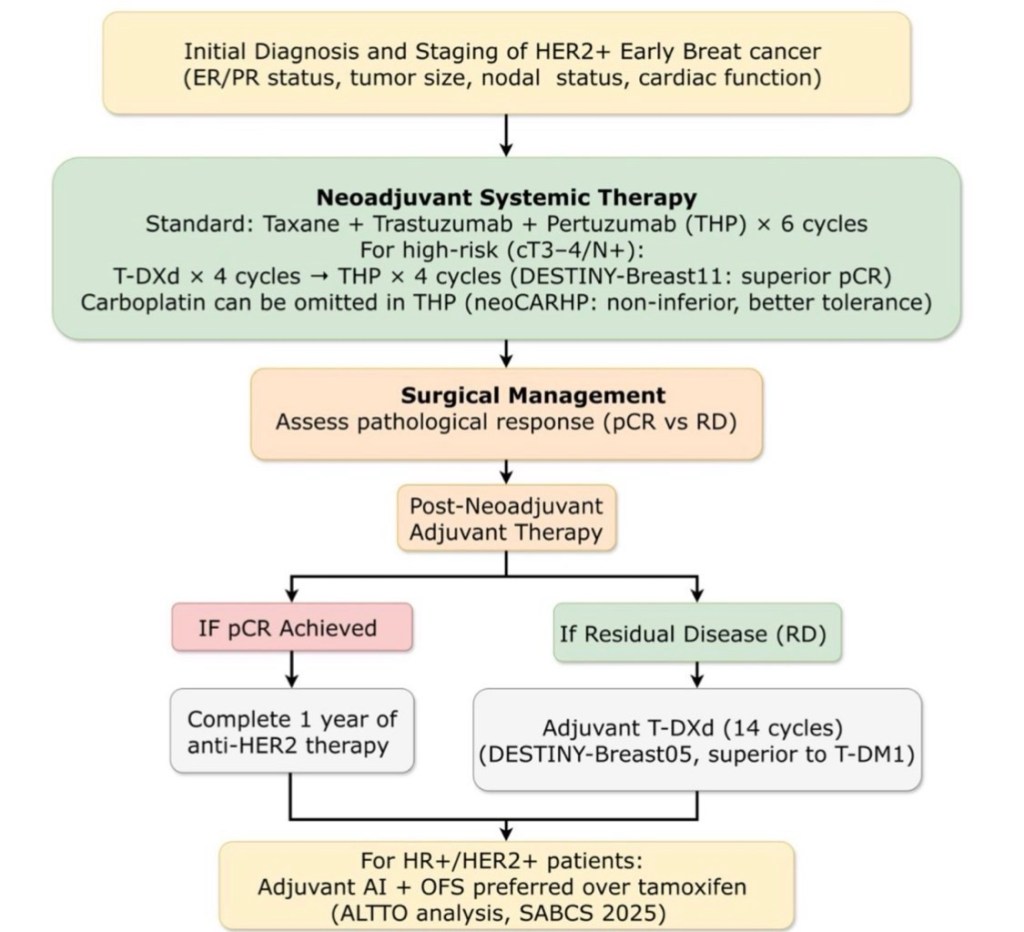
    • HER2-positive:
      • High-risk patients receive neoadjuvant or adjuvant chemotherapy plus trastuzumab ± pertuzumab
      • If residual disease remains after neoadjuvant therapy:
        • Ado-trastuzumab emtansine is indicated
      • Endocrine therapy is added for HR-positive /HER2-positive cases
    • Triple-negative:
      • Neoadjuvant chemotherapy plus pembrolizumab is standard for high-risk disease
      • For residual disease or BRCA mutation, adjuvant pembrolizumab and / or capecitabine or olaparib are considered
  • Radiation therapy (whole breast or postmastectomy) is indicated for:
    • Node-positive or other high-risk features after breast-conserving surgery
    • Axillary surgery is being de-escalated in select low-risk patients:
      • With omission of sentinel lymph node biopsy increasingly supported
  • Supportive care includes:
    • Bisphosphonates or denosumab:
      • For bone health in postmenopausal or high-risk patients
  • Survivorship strategies now include:
    • Emerging liquid biopsy-guided surveillance for earlier detection of recurrence:
      • Though this is still under investigation
  • Areas needing further evidence include:
    • Optimal sequencing and integration of adjuvant targeted therapies (CDK4/6 inhibitors, PARP inhibitors, immunotherapy) and the role of liquid biopsy in routine follow-up
  • References:
    • Breast Cancer. National Comprehensive Cancer Network. Updated 2025-04-17.
    • Outcomes Based on Risk-Adapted Adjuvant Therapy in Postmenopausal Women With Early Breast Cancer: A Nationwide, Prospective Cohort Study by the Danish Breast Cancer Group. Jensen MB, Torpe E, Teunissen Z, et al. The Lancet. Oncology. 2025;26(5):654-662. doi:10.1016/S1470-2045(25)00085-3.
    • Biomarkers for Adjuvant Endocrine and Chemotherapy in Early-Stage Breast Cancer: ASCO Guideline Update. Andre F, Ismaila N, Allison KH, et al. Journal of Clinical Oncology : Official Journal of the American Society of Clinical Oncology. 2022;40(16):1816-1837. doi:10.1200/JCO.22.00069.
    • FDA Orange Book. FDA Orange Book.
      State-of-the-art management of HER2-negative early breast cancer: Treatment patterns among healthcare professionals and concordance with expert recommendations. Becker M, Abraham J, Kalinsky K, et al. Journal of Clinical Oncology. 2023;41(Suppl 16):553. doi:10.1200/JCO.2023.41.16_suppl.553.
    • Current treatment patterns for early breast cancer among healthcare professionals and concordance with expert recommendations: Analysis of an online interactive decision support tool. Timothy Quill, Kristen Rosenthal and Megan Cartwright. Journal of Clinical Oncology. 2025;43(Suppl 16):1550. doi:10.1200/JCO.2025.43.16_suppl.1550.
      Emerging Targeted Therapies for Early Breast Cancer. Schlam I, Tarantino P, Morganti S, et al. Drugs. 2022;82(14):1437-1451. doi:10.1007/s40265-022-01781-5.
    • How We Treat HR-positive, HER2-negative Early Breast Cancer. Lopez-Tarruella S, Echavarria I, Jerez Y, et al. Future Oncology (London, England). 2022;18(8):1003-1022. doi:10.2217/fon-2021-0668.
    • Tailoring Treatment to Cancer Risk and Patient Preference: The 2025 St Gallen International Breast Cancer Consensus Statement on Individualizing Therapy for Patients With Early Breast Cancer. Burstein HJ, Curigliano G, Gnant M, et al. Annals of Oncology : Official Journal of the European Society for Medical Oncology. 2025;:S0923-7534(25)04718-0. doi:10.1016/j.annonc.2025.09.007.
    • Therapy of Early Breast Cancer: Current Status and Perspectives. Tauber N, Amann N, Dannehl D, et al. Archives of Gynecology and Obstetrics. 2025;:10.1007/s00404-025-08028-0. doi:10.1007/s00404-025-08028-0.
    • The SURVIVE study: Standard surveillance vs. intensified liquid biopsy-based surveillance in early breast cancer survivors. Schäffler H, Huesmann S, Friedl T, et al. Journal of Clinical Oncology. 2025;43(Suppl 16):TPS621. doi:10.1200/JCO.2025.43.16_suppl.TPS621.

Breast Cancer Molecular Subtypes

  • Breast cancer:
    • Is a heterogeneous disease:
      • Comprising multiple biological entities:
        • Each with distinct pathology, features, and clinical implications
  • Gene expression profiling in breast cancer:
    • Has identified four or five main molecular subtypes of breast cancer:
      • Recognized as distinct biological entities
  • Molecular subtypes of breast cancer:
    • Luminal A subtype:
      • Estrogen receptor (ER) positive, progesterone receptor [PR] positive and HER-2 negative with low Ki-67 [< 14%]
    • Luminal B subtype:
      • ER positive, PR positive, and HER-2 negative with high Ki-67 [> 14%]
    • Basal-like / triple-negative subtype:
      • ER negative, PR negative, and HER-2 negative
    • HER-2-amplified subtype:
      • Which can be further divided by ER status into:
        • ER negative, HER-2 positive
        • ER positive, HER-2 positive
  • Classifying breast cancer into these subtypes has led to a paradigm shift in how patients are currently stratified and treated

#Arrangoiz #CancerSurgeon #BreastSurgeon #Surgical Oncologist #MountSinaiMedicalCenter #MSMC #BreastCancer #Miami #Mexico

Medullary Breast Carcinoma

👉 Introduction

  • Medullary carcinoma is a very rare and distinct subgroup of breast carcinomas:
    • Accounting for less than 5% (some series 5% to 7%) of all invasive breast cancers
  • This unique histologic subtype has very strict criteria for diagnosis, including:
    • Complete circumscription
    • Syncytial growth pattern of at least 75% of the tumor
    • Intermediate to high nuclear grade
    • An associated diffuse lymphocytic infiltrate
    • A lack of intraductal components or glandular differentiation
  • The 2012 World Health Organization (WHO) updated the classification of medullary carcinoma under an umbrella term of “carcinomas with medullary features”:
    • Which also includes atypical medullary carcinoma and invasive carcinoma of no special type with medullary features:
      • Medullary carcinoma has a favorable prognosis:
        • In spite of its poorly differentiated histologic features and basal-like phenotype

👉 Etiology

  • It has been well established that both medullary carcinoma and invasive ductal carcinoma with medullary features are associated with:
    • Germline mutations in the BRCA1 gene
  • Among BRCA1-associated breast cancers:
    • 7.8% to 19% are medullary carcinomas
    • 35% to 60% show the presence of medullary features:
      • This rate contrasts with the presence of only 2% medullary carcinomas:
        • Among sporadic, non–BRCA-associated tumors
  • Medullary carcinoma:
    • Has been shown to display the basal-like molecular subtype:
      • By gene expression profiling:
    • Which correlates with its immunophenotypic profile:
      • A high incidence of TP53 gene mutation also presents in these tumors
  • Most cases are:
    • Aneuploid with a high S-phase fraction
  • Array-based comparative genomic hybridization analysis:
    • Has demonstrated a recurrent pattern of chromosomal alterations in medullary carcinoma, including:
      • 1q, 8q, 9p, 10p, and 16q gains
      • 4p and X losses
      • 1q, 8p, 10p, and 12p amplifications

👉 Epidemiology

  • The patient’s age at presentation is younger than that for invasive ductal carcinoma NST:
    • With a mean age:
      • Ranging from 45 to 54 years
  • Medullary carcinoma is unicentric in most of the patients:
    • Bilateral carcinomas:
      • Have an incidence ranging from 3% to 18%:
        • Bilateral tumors are common when a family history is present
  • Typical medullary breast carcinoma:
    • Occurs more frequently in patients with mutations of:
      • The tumor suppressor gene BRCA-1

👉 Pathophysiology

  • Medullary carcinoma:
    • Has been shown to contain an increased number of activated cytotoxic lymphocytes and most of the lymphoid infiltrate consists of T cells:
      • This feature reflects an active host response to the tumor and may account for its favorable prognosis

👉 Histopathology

  • Medullary carcinoma is well circumscribed and moderately firm
  • The cut surface is fleshy and gray-tan and may appear lobular or nodular
  • Foci of hemorrhage, necrosis, and even cystic degeneration are not unusual
  • These tumors tend to be smaller than 3 cm:
    • With a median size of 2 cm to 3 cm
  • The histologic criteria for medullary carcinoma:
    • Were first clearly defined by Ridolfi and associates in 1977, and since then, there have been several proposed modified classification schemes
  • The diagnosis of medullary carcinoma in the majority of cases:
    • Is established based on H&E sections using histologic criteria without the need for ancillary studies
  • Medullary carcinoma should meet all of the following five morphologic criteria as defined by the WHO:
    • Syncytial growth pattern in more than 75% of the tumor
    • No glandular or tubular structures, even as a minor component
    • Moderate to marked diffuse lymphoplasmacytic infiltrate in the stroma
    • Moderate to marked nuclear pleomorphism
    • Complete histologic circumscription
    • Mitoses are numerous, and atypical giant cells may be present;
      • The terms ”atypical medullary carcinoma” and ”carcinoma with medullary features” have been proposed for tumors that do not fulfill all these criteria
  • Medullary carcinomas are most often:
    • Negative for estrogen and progesterone receptors and HER2 negative and variably express keratins 5/6 and 14, smooth muscle actin, EGFR, P-cadherin, p53, and caveolin-1
    • They have a high Ki-67 proliferation index
  • P53 mutation:
    • Occurs at an increased level in medullary carcinoma and is considered a biological marker for this tumor type
  • The lymphoid infiltrate show a predominance of CD3+ T-lymphocytes

👉 History and Physical

  • Most of the patients with medullary carcinoma present with a palpable mass:
    • Usually in the upper outer quadrant
  • The tumor is often well-defined clinically and on imaging studies
  • Some patients with this tumor type exhibit axillary lymphadenopathy at the time of presentation, suggesting the presence of metastatic disease

Rodrigo Arrangoiz MS, MD, FACS 

Assistant Professor at the Columbia University Division of Surgical Oncology at Mount Sinai Medical Center:

  • Cancer Surgeon / Breast Surgeon / Surgical Oncologist

 He is a member of the American Society of Breast Surgeons

Training:

• General surgery:

• Michigan State University:

• 2004 al 2010

• Surgical Oncology / Head and Neck Surgery / Endocrine Surgery:

• Fox Chase Cancer Center (Filadelfia):

• 2010 al 2012

• Masters in Science (Clinical research for health professionals):

• Drexel University (Filadelfia):

• 2010 al 2012

• Surgical Oncology / Head and Neck Surgery / Endocrine Surgery:

• IFHNOS / Memorial Sloan Kettering Cancer Center:

• 2014 al 2016

#Arrangoiz #Surgeon #Cirujano #CirujanoOncologo #Surgical Oncologist #BreastSurgeon #CirujanodeMama #CancerSurgeon #CirujanodeCancer #MountSinaiMedicalCenter #Miami #Mexico #MSMC

KEYNOTE-689 for Resectable, Locally Advanced HNSCC

  • What was studied:
    • Design:
      • International, randomized, open-label phase 3 trial (n=714)
      • Adults with resectable stage III to IVA larynx, hypopharynx, or oral cavity SCC, or oropharynx SCC (stage III to IVA p16-negative, or stage III T4 N0 to N2 p16-positive)
      • Randomized 1:1 to standard surgery → pathology-directed adjuvant RT ± high-dose cisplatin with or without perioperative pembrolizumab
      • Regimen (pembro arm):
        • 200 mg q3 weeks × 2 neoadjuvant cycles → surgery → 3 cycles concurrent with postoperative RT ± cisplatin → 15 additional adjuvant cycles (total 17 including neoadjuvant)
      • Primary endpoint:
        • Event-free survival (EFS) with hierarchical testing in PD-L1 CPS ≥10, then CPS ≥1, then ITT
      • Key secondary endpoints included:
        • Major pathologic response (mPR) and overall survival (OS)
  • Key efficacy results:
    • EFS benefit (first interim analysis; median follow-up 38.3 mo):
      • CPS ≥ 10:
        • 36-mo EFS 59.8% vs 45.9%; HR 0.66 (95% CI 0.49–0.88; p=0.004)
      • CPS ≥ 1:
        • 36-mo EFS 58.2% vs 44.9%; HR 0.70 (0.55–0.89; p=0.003)
      • All patients (ITT):
        • 36-mo EFS 57.6% vs 46.4%; HR 0.73 (0.58–0.92; p=0.008). 
        • Reported median EFS (ITT):
          • 51.8 vs 30.4 months, favoring perioperative pembrolizumab
      • Distant metastasis control:
        • DMFS improved:
          • Median 51.8 vs 35.7 months, HR 0.71, 95% CI 0.56–0.90
          • 36-mo DMFS 59.1% vs 49.9%
      • Locoregional control difference:
        • Was modest (HR 0.92, 95% CI 0.61–1.41)
      • Pathologic response:
        • mPR rates were higher with pembrolizumab:
          • In CPS ≥ 10, mPR increased by ~13.7% pre-op
  • Surgical feasibility and downstream treatment:
    • Surgery completion was similar:
      • 88% in both arms
    • Neoadjuvant pembrolizumab did not reduce operability
  • Neoadjuvant / adjuvant pembrolizumab:
    • Was associated with:
      • Fewer high-risk pathologic features (32.5% vs 44.4%)
      • Lower proportion requiring adjuvant high-dose cisplatin (38.9% vs 50.5%)
  • Safety:
    • Grade ≥ 3 treatment-related AEs:
      • 44.6% (pembrolizumab) vs 42.9% (SOC)
    • Treatment-related deaths:
      • 1.1% vs 0.3%
    • Grade ≥ 3 immune-mediated AEs ~ 10%:
      • One grade 5 pneumonitis reported across sources
    • No new safety signals
  • Regulatory status and who qualifies (U.S.):
    • FDA approval (June 13, 2025):
      • Pembrolizumab is approved for resectable, locally advanced HNSCC with PD-L1 CPS ≥1:
        • As neoadjuvant single-agent, continued with postoperative RT ± cisplatin, then continued as adjuvant single-agent:
          • PD-L1 testing is required
  • How to apply in practice (surgeon’s lens):
    • Patient selection:
      • Resectable stage III to IVA HNSCC candidates (non-nasopharynx) with PD-L1 CPS ≥ 1
      • Discuss benefits particularly strong in CPS ≥ 10:
        • But benefit observed across CPS ≥ 1 and ITT
    • Workflow:
      • Two neoadjuvant pembrolizumab cycles → timely surgery (completion comparable to SOC) → risk-adapted RT ± cisplatin with concurrent pembrolizumab → complete remaining adjuvant cycles
      • Coordinate closely with rad oncology /medical oncology for start dates and toxicity monitoring
    • Counseling:
      • Emphasize EFS / DMFS gains and potential reduction in need for high-dose cisplatin due to fewer high-risk pathologic features, balanced against immune-related toxicities (pneumonitis, endocrinopathies, colitis, etc.)
      • OS:
        • Data currently immature; trend favorable but not yet statistically significant
      • Continue guideline-concordant surveillance

Mucinous Carcinoma (Colloid Carcinoma) of the Breast

11843489014_e764b7846e_b

  • Mucinous carcinoma of the breast (also known as colloid carcinoma) is a special type of breast cancer:Presenting with a large amount of extracellular mucin:That is associated with a relatively favorable prognosis
    • These tumors are uncommon:
      • In most series account for approximately 2% of invasive breast carcinomas
  • It is divided into two main subtypes based upon the quantification of cellularity:
    • The pure type:
      • In pure mucinous carcinomas:
        • Over 90% of the tumor is made up of malignant cell clusters floating in pools of mucin (see images)

image.phpimage-1.php

    • Frequently, pure mucinous carcinomas can have posterior enhancement by ultrasound imaging:
      • That can lead to mistaking these lesions for cysts
    • Patients with pure mucinous carcinomas:
      • Tend to be postmenopausal:
        • Between the ages of 59 and 71 years:
          • But it can occasionally occur in patients who are younger than age 40 years:
            • The incidence of mucinous breast cancer in women under 35 years of age is less than 1%

images-4Unknownimages-3

    • The mixed type:
      • Tumors in which 50% to 90% of the mass is composed of malignant cell clusters floating in mucin are considered to be a mixed NOS and mucinous category:
        • Mixed mucinous carcinomas show a less distinct margin, a higher grade, and more mitotically active cytology
      • Their clinicopathologic features:
        • Are similar to those of invasive ductal carcinoma, NOS type
      • Some mucinous breast carcinomas (mainly mixed type) are associated with lobular or ductal neoplasia (in situ or invasive) and some have neuroendocrine differentiation:
        • Mucinous breast carcinoma associated with lobular neoplasia components:
          • Seems to be a biologically distinct subset that frequently shows decreased cell to cell adhesion, loss of cell polarity molecules and lack of neuroendocrine differentiation:
            • Also in this subset of tumors, the neoplastic cells with signet-ring features are most likely to be found
  • Mucinous breast cancer is a slow-growing neoplasm:
    • With an estimated growth rate of one third of invasive breast cancer no special type
    • This malignancy also shows:
      • Fewer axillary lymph node metastases
  • Conventional, pure mucinous carcinomas:
    • Exhibit a rate of metastasis of less than 15%
  • Current studies have shown that a subset of patients diagnosed with mucinous carcinoma:
    • Do not manifest such favorable outcomes:
      • Some authors suggested that specific subtypes of pure mucinous carcinoma :
        • Those with a micropapillary pattern demonstrate significantly worse prognosis:
          • In one  study more than half of the patients with this particular type of pattern were found to have vascular invasion and synchronous axillary lymph nodes
  • A subset of mucinous breast carcinomas shows neuroendocrine differentiation:
    • Defined by cytoplasmic argyrophilia or immunoreactivity to markers such as:
      • Synaptophysin
      • Chromogranin
      • Neuronal specific enolase

Presentation1

    • Although in one study neuroendocrine differentiation:
      • Was associated with a favorable histology and a good outcome others did not find this association

Rodrigo Arrangoiz MS, MD, FACS a surgical oncologist and is a member of Mount Sinai Medical Center in Miami:

  • He is an expert in the management of breast cancer:

    • If you have any questions about breast cancer statistics please fill free to ask Dr. Arrangoiz

Training:

• General surgery:

• Michigan State University:

• 2004 al 2010

• Surgical Oncology / Head and Neck Surgery / Endocrine Surgery:

• Fox Chase Cancer Center (Filadelfia):

• 2010 al 2012

• Masters in Science (Clinical research for health professionals):

• Drexel University (Filadelfia):

• 2010 al 2012

• Surgical Oncology / Head and Neck Surgery / Endocrine Surgery:

• IFHNOS / Memorial Sloan Kettering Cancer Center:

• 2014 al 2016


Breast Cancer Pathology

  • Invasive carcinomas of the breast:
    • Tend to be histologically:
      • Heterogeneous tumors
  • The vast majority are:
    • Adenocarcinomas:
      • That arise from the terminal ductal lobular units
  • There are five common histologic variants of:
    • Mammary adenocarcinoma
  • Invasive ductal carcinoma:
    • Accounts for 75% of all breast cancers
    • This lesion is characterized by:
      • The absence of special histologic features
    • It is firm on palpation and gritty when transected:
      • It is associated with various degrees of fibrotic response
    • Often there is associated ductal carcinoma in situ (DCIS) within the specimen
    • Invasive ductal carcinomas:
      • May metastasize to axillary lymph nodes
    • The prognosis for patients with these tumors is poorer than that for patients with some of the other histologic subtypes:
      • Mucinous, colloid, tubular, and medullary
    • Distant metastases are found most often in the:
      • Bones, lungs, liver, and brain
  • Invasive lobular carcinoma:
    • Accounts for 15% of breast cancers
    • Clinically:
      • This lesion often has an area of ill-defined thickening within the breast
    • Microscopically:
      • Small cells in a single-file pattern are characteristically seen
    • Invasive lobular cancers:
      • Tend to grow around ducts and lobules
      • They have a tendency to present with a radiographically occult infiltrative pattern
    • Multicentricity and bilaterality:
      • Are observed more frequently in invasive lobular carcinoma than in invasive ductal carcinoma
    • The prognosis for invasive lobular carcinoma is similar to that for invasive ductal carcinoma
    • In addition to metastasizing to axillary lymph nodes:
      • Invasive lobular carcinoma is known to metastasize to unusual sites:
        • Example meninges and serosal surfaces:
          • More often than other forms of breast cancer
  • Tubular carcinoma:
    • Accounts for only 2% of breast carcinomas
    • The diagnosis of tubular carcinoma:
      • Is made only when more than 75% of the tumor demonstrates tubule formation
    • Axillary nodal metastases:
      • Are uncommon with this type of tumor
    • The prognosis for patients with tubular carcinoma:
      • Is more favorable than that for patients with other types of breast cancer
  • Medullary carcinoma of the breast:
    • Accounts for 5% to 7% of breast cancers
    • Histologically:
      • The lesion is characterized by poorly differentiated nuclei, a syncytial growth pattern, a well-circumscribed border, intense infiltration with small lymphocytes and plasma cells:
        • Little or no associated DCIS
    • The prognosis for patients with pure medullary carcinoma is favorable:
      • However, mixed variants with invasive ductal components will have prognoses similar to invasive ductal carcinoma
    • Medullary carcinoma:
      • Occurs more frequently in BRCA mutation carriers
  • Mucinous or colloid carcinoma:
    • Constitutes approximately 3% of breast cancers
    • It is characterized by an abundant accumulation of extracellular mucin:
      • Surrounding clusters of tumor cells
    • Colloid carcinoma:
      • Is slow growing and tends to be bulky
    • These tumors are associated with:
      • A favorable prognosis
  • Rare histologic types of breast malignancy include:
    • Papillary, apocrine, secretory, squamous cell and spindle cell carcinomas, and metaplastic carcinoma
  • Invasive ductal carcinomas:
    • Occasionally have small areas containing one or more of these special histologic types
    • Tumors with these mixed histologic appearances:
      • Behave similarly to pure invasive ductal carcinomas

Tubular Carcinoma of the Breast

  • Tubular carcinoma:
    • Is a distinct histopathologic subtype of breast cancer:
      • Representing 1% to 2% of breast cancers diagnosed
    • It is a distinct entity from low-grade ductal carcinoma
  • The literature continues to suggest that it has an excellent prognosis:
    • With a very low likelihood of distant metastasis and excellent disease-free survival
  • In select patients, adjuvant therapies may be omitted:
    • However, there is a still a risk of axillary nodal metastasis:
      • Therefore sentinel lymph node biopsy is still recommended:
        • Due to a 10% to 20% risk of lymphatic spread:
          • Despite this finding, there is likely to be only one node involved and this histopathologic subtype still conveys an excellent prognosis
  • Tubular carcinoma:
    • Is more likely to be identified on screening mammography and is more common in Caucasians than blacks
    • Emerging data suggest that adjuvant systemic therapy can likely be safely omitted, although it should still be discussed with the multidisciplinary team
  • References:
    • Rakha EA, Lee AH, Evans AJ, et al: Tubular carcinoma of the breast: further evidence to support its excellent prognosis. J Clin Oncol. 2010;28(1):99-104.
    • Fedko MG, Scow JS, Shah SS, et al. Pure tubular carcinoma and axillary nodal metastases. Ann Surg Oncol. 2010;17(Suppl 3):338-342.
    • Anderson WF, Chu KC, Chang S, Sherman ME. Comparison of age-specific incidence rate patterns for different histopathologic types of breast carcinoma. Cancer Epidemiol Biomarkers Prev. 2004;13(7): 1128-1135.

Variant of Unknown Significance (VUS) in Hereditary Breast Cancer Tests

  • When patients are told they have a variant of unknown significance (VUS):
    • It can often lead to anxiety and overtreatment
  • It is important to counsel patients that a VUS:
    • Is not clinically actionable and the majority of VUS are reclassified as benign
  • Patients should be counseled to update their genetic counselors:
    • As their family history changes and keep contact information up to date as variantbreclassification does occur
  • The American College of Medical Genetics:
    • Has recommended that genetic testing classify genetic variants using the following classification schema:
      • Deleterious (pathogenic)
      • Suspected deleterious (likely pathogenic)
      • Variant of Uncertain Clinical Significance
      • Genetic variant:
        • Favor polymorphism:
          • Likely benign
      • Polymorphism:
        • Benign
  • While deleterious and suspected deleterious mutations BRCA mutations:
    • Are known to be associated with an increased risk of breast and ovarian cancer:
      • It is unknown whether a BRCA VUS mutation:
        • Is associated with an increased risk due to limited available data
  • As the use of genetic testing increases and as more of the population is tested:
    • The knowledge base regarding variant pathogenicity constantly grows
  • Given the amount of data available from many years of BRCA1 / BRCA 2 testing:
    • The prevalence of VUS among this population has declined to 2% to 5%:
      • However, among moderate and low penetrance genes:
        • The number of VUS continues to rise:
          • As the data expand and knowledge regarding a variant evolves, a variant may be reclassified.
  • In a study reported in the Journal of the American Medical Association:
    • 25.4% of patients initially diagnosed with a VUS were reclassified over a 12-year period:
      • Of these patients:
        • 97% were downgraded to benign or likely benign
      • Three percent of patients (3%):
        • Were upgraded to pathogenic or likely pathogenic variants
    • Given this low risk of reclassification to pathogenic mutation:
      • Risk-reducing mastectomy, salpingo-oophorectomy, or genetic testing of family members are not indicated for this patient
  • There is currently no established effective screening protocol for pancreatic cancer, even among patients with a deleterious BRCA 2 mutation
  • References
    • Richards S, Aziz N, Bale S, Bick D, Das S, Gastier-Foster J, et al. Standards and guidelines for the interpretation of sequence variants: a joint consensus recommendation of the American College of Medical Genetics and Genomics and the Association for Molecular Pathology. Genet Med. 2015;17(5):405-424.
    • Hall MJ, Reid JE, Burbidge LA, Pruss D, Deffenbaugh AM, Frye C, et al. BRCA1 and BRCA2 mutations in women of different ethnicities undergoing testing for hereditary breast-ovarian cancer. Cancer. 2009;115(10):2222-2233.
    • Mersch J, Brown N, Pirzadeh-Miller S, Mundt E, Cox HC, Brown K, et al. Prevalence of variant reclassification following hereditary cancer genetic testing. JAMA. 2018;320(12):1266-1274.
#Arrangoiz #Doctor #Surgeon #CancerSurgeon #SurgicalOncologist #BreastSurgeon #Teacher #MountSinaiMedicalCenter #MSMC #Miami #Mexico