Tissue Harmonic Imaging in Breast Cancer

  • Tissue harmonic imaging:
    • Creates images derived solely from higher frequencies
  • The ultrasound beam:
    • Is transmitted centered at 1 frequency, e.g., 6 MHz
    • Received centered at a multiple of the transmitted frequency, e.g., 12 MHz
  • Different techniques can be used to process the received signals so that only the returning high-frequency harmonic signal is used to produce the image:
    • Whereas echoes from the fundamental / lower frequencies are rejected
  • THI increases signal-to-noise ratio:
    • Resulting in better tissue contrast
  • THI reduces reverberation, clutter, and speckle artifacts:
    • Improving contrast resolution
    • It accentuates real echoes in addition to suppressing artifactual echoes
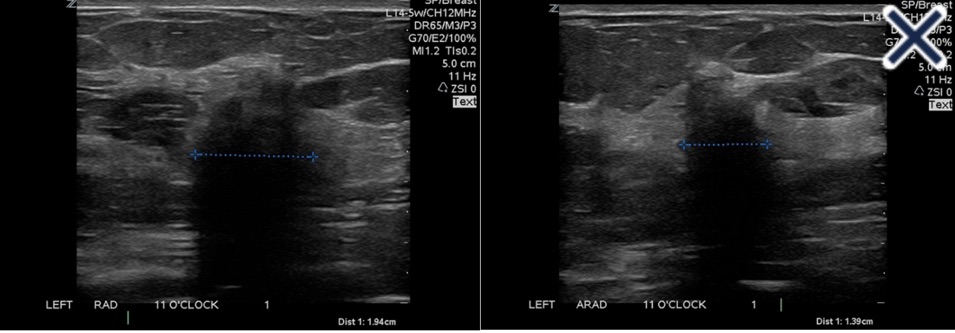
    • The suppression of speckle artifact by coded harmonics makes solid nodules more hypoechoic and conspicuous than they are with fundamental imaging (Images a and b)
A. Infiltrating ductal carcinoma with fundamental imaging.
B. The same infiltrating ductal carcinoma as 2a with coded harmonic imaging.
  • It makes the thin, echogenic capsule that surrounds most benign lesions appear to be thinner, more echogenic and more complete than with fundamental imaging
  • THI cannot be combined with simultaneous color Doppler imaging because the resulting frame rate would be unacceptable:
    • When Doppler is required, the image that is interlaced with Doppler must be constructed at fundamental rather than harmonic frequencies
  • THI is of limited value in differentiating benign from malignant lesions.
  • Another method of reducing artifactual echoes, improving contrast, and making the thin, echogenic capsule more conspicuous is real time spatial compounding of images:
    • In conventional imaging, each frame is created by a single sweep of the beam at a 90 degree angle to the long axis of the transducer
    • In compound imaging, there are multiple sweeps of the beam from different angles, creating a spatially and temporally compounded image from multiple angles over time
    • Among other things, the lateral borders of lesions can be seen better with compound imagin
  • References
    • Mesurolle B, Helou T, El-Khoury M, Edwardes M, Sutton EJ, Kao E. Tissue harmonic imaging, frequency compound imaging, and conventional imaging use and benefit in breast sonography. J Ultrasound Med. 2007;26(8):1041-1051.
    • Cha JH, Moon WK, Cho N, Kim SM, Park SH, Han BK, et al. Characterization of benign and malignant solid breast masses: comparison of conventional US and tissue harmonic imaging. Radiology. 2007;242(1):63-69.
    • Stavros AT. Breast ultrasound equipment requirements. In: Stavros AT. Breast Ultrasound. Philadelphia, PA: Lippincott Williams & Wilkins; 2004:16-41.
#Arrangoiz #BreastSurgeon

Calcifications Identified on Mammogram

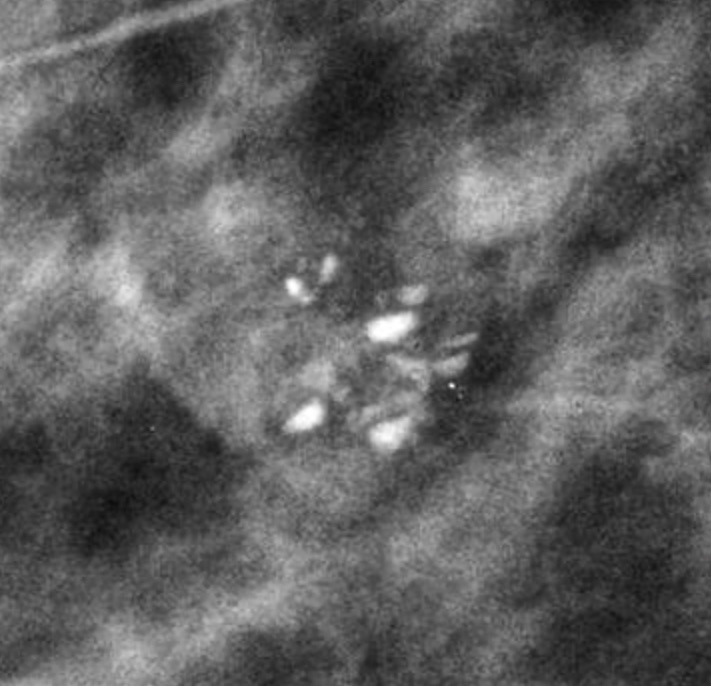
Straight lateral magnification view. “Milk of Calcium” Calcifications.
  • The images clearly show benign “milk of calcium” type calcifications:
    • Which do not warrant biopsy or interval follow-up regardless of how many are present
  • In fibrocystic change:
    • An apocrine metaplastic cell layer lines the cystically dilated acini:
      • Which are filled with fluid and contain numerous psammoma body-like calcifications
    • The appearance of the calcifications on the mammogram:
      • Will depend on the shape of the summation of the calcified particles in the cystically dilated acini
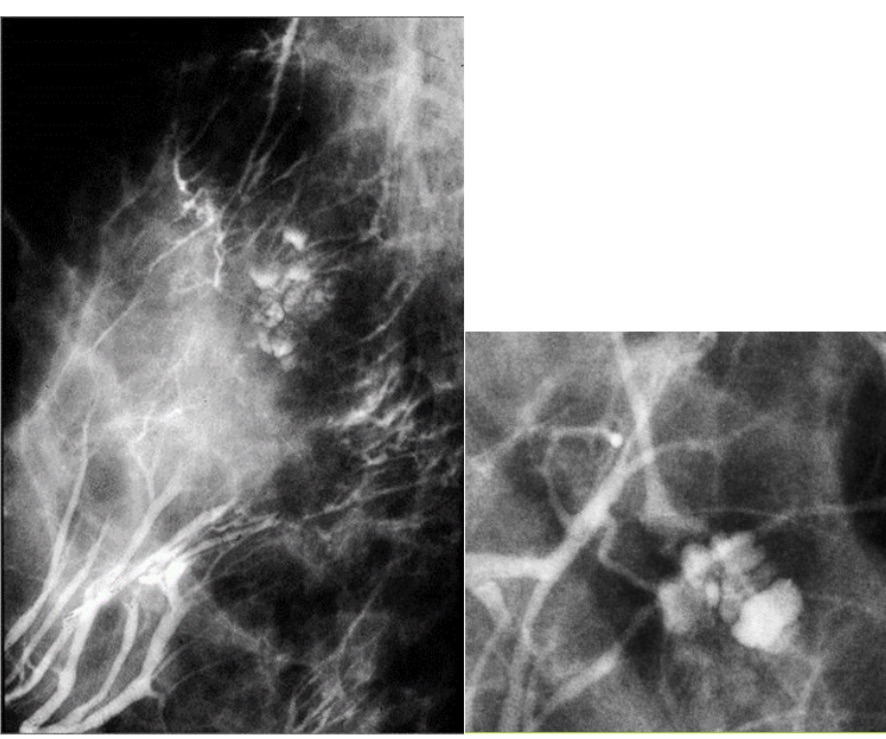
    • When the shape happens to be “teacup-like” (i.e., crescent-shaped on the mediolateral projection and low density, circular/oval on the craniocaudad projection):
      • The diagnosis of fibrocystic change can be made with confidence
Images a and b show a galactogram performed on a woman with greenish cloudy nipple discharge. The ducts are distended by fluid (duct ectasia) and the acini of a single terminal ductal lobular unit are cystically distended. The contrast media shows a teacup-like appearance, seen from the side (Image a) and seen from above (Image b).
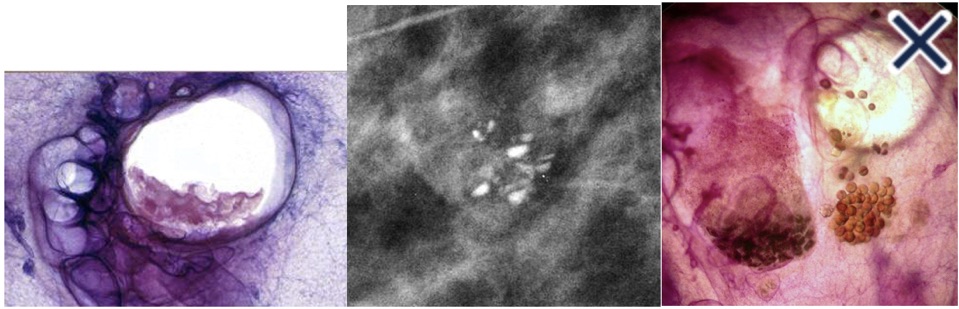
Images a-c show 3D histology images of the aggregate of the psammoma body-like calcification corresponding to the mammogram. The impression is that the teacup-like calcification is a single calcification, but Image c shows that it is the summation / aggregate of many tiny psammoma body-like calcifications.
  • Benign and malignant type calcifications:
    • Can increase or decrease in number and density, or even remain unchanged for years:
      • So changes in the appearance on follow-up examination do not constitute a reliable way to exclude malignancy
  • In general, calcifications should be determined to be benign by:
    • Their appearance and distribution or they should have a large bore core needle biopsy
  • Six month follow-up mammography is not a good way to determine if calcifications are benign
  • In fibrocystic changes:
    • The most frequently occurring calcifications are the psammoma body-like calcifications that float in fluid in microcysts:
      • They should cause little diagnostic confusion
    • When the calcifications are imaged in a craniocaudad projection:
      • The calcifications are spread out over the entire microcyst yielding a smudgy image of the calcifications
    • In a straight lateral image:
      • The microcysts are imaged in a vertically oriented direction, and gravity causes the calcium rich fluid to settle to the bottom of the cysts yielding the teacup-like appearance of the calcifications
        • When these images are present, the diagnosis of benign milk of calcium is secure.
  • Low-grade in situ carcinoma:
    • Would cause powdery calcifications
  • Intermediate grade in situ carcinoma:
    • Would cause crushed stone-type calcifications on the mammogram
  • References
    • Monda LA. Differentiation of breast calcifications. Radiol Technol. 2001;72(6):532-544.
    • Baldwin P. Breast calcification imaging. Radiol Technol. 2013;84(4):383M-404M.

How to Evaluate a Breast Nodule on Ultrasound of the Breast?

  • You first evaluate the lesion for:
    • Any of the 10 malignant signs:
      • Shadowing
      • Hypoechoic echotexture
      • Spiculation
      • Angular margins
      • Thick echogenic halo
      • Microlobulation
      • Taller than wide
      • Duct extension
      • Branching pattern
    • Calcifications
  • Finding none:
    • You move on to the second step in the evaluation process:
      • Specifically look for one of the 3 strictly defined benign signs:
        • If any of them are found:
          • The lesion can be considered BIRADS 3:
            • A 6-month follow-up ultrasound would be appropriate unless the anxiety of the patient makes core biopsy a better option
    • The 3 benign findings defined by Stavros are:
      • A purely hyperechoic lesion:
        • With no hypoechoic area larger than a normal duct or lobule
      • Elliptical, wider than tall, well-circumscribed and thin echogenic capsule
      • Gently lobulated, wider than tall, well-circumscribed and thin echogenic capsule
      • Combining the elliptical or gently lobulated shapes:
        • With the presence of a complete, thin echogenic capsule:
          • Is necessary because many circumscribed carcinomas and most ductal carcinoma in situ are encompassed in a thin, echogenic capsule:
            • However, the shape of circumscribed invasive carcinoma or pure ductal carcinoma in situ:
              • Is rarely elliptical or gently lobulated:
  • References:
    • Madjar H, Mendelson EB. The Practice of Breast Ultrasound. 2nd ed. Thieme; 2008;141-144.
    • Stavros AT. Breast Ultrasound. Philadelphia, PA: Lippincott Williams & Wilkins; 2004.
#Arrangoiz #BreastSurgeon #CancerSurgeon #SurgicalOncologist #Surgeon #Doctor #MountSinaiMedicalCenter #MSMC #Miami #Mexico

Breast Calcifications on Mammogram

  • Screening mammography:
    • Is important in identifying breast cancer at an early stage
  • Calcifications have many forms:
    • The characteristics of the calcifications help identify whether they are associated with a benign or malignant process:
      • Smooth, round, large and layering calcium are generally associated with benign findings
      • Fine, irregular, punctate, linear and branching, and pleomorphic calcifications are characteristics generally associated with malignant findings
  • Magnification views of the calcifications:
    • Are essential in helping to evaluate the calcifications to determine the appearance and to be able to accurately interpret the findings
  • References
    • Brant W, Helms C. Fundamentals of Diagnostic Radiology, 5th Edition. Lippincott, Williams & Wilkins; 2019
    • Baldwin P. Breast calcification imaging. Radiol Technol. 2013;84(4):383M-404M.
#Arrangoiz #Doctor #Surgeon #CancerSurgeon #SurgicalOncologist #BreastSurgeon #BreastCancer #MountSinaiMedicalCenter #MSMC #Miami Mexico

TP53 Mutation in Breast Cancer

  • The TP53 gene:
    • Is a key tumor-suppressor gene that acts as a checkpoint control for DNA damage
    • Due to its critical role in controlling cellular damage:
      • A TP53 germline mutation predisposes patients to multiple malignancies, including breast cancer and soft tissue sarcomas:
        • The associated familial syndrome was first observed in 1969 and is known as the Li-Fraumeni syndrome
    • The penetrance of breast cancer related to TP53 mutations:
      • Is higher than seen in the more common BRCA1 or BRCA2 mutations:
        • With a cumulative incidence reported for TP53 of 85% by age 60
      • TP53-associated breast cancers present at an early age (median age of diagnosis is 34) and the majority are hormone receptor positive and / or HER-2 positive.
    • Due to this high penetrance and associated increased risk for a secondary breast cancer:
      • Bilateral prophylactic mastectomy is recommended for management of an early-stage breast cancer in patients with a mutation in TP53
      • This is especially true in younger women as contralateral breast cancer risk inversely correlates with the patient’s age
    • The recommendation for mastectomy is further supported by the concern regarding radiation use in this patient population already at increased risk for soft tissue sarcomas:
      • Radiation should be used with extreme caution and careful consideration of the risk / benefit
  • For patients presenting with a known TP53 germline mutation and without a diagnosis of breast cancer:
    • NCCN guidelines recommend:
      • Annual breast MRI at 20 to 29 years and annual MRI and mammography at 30 to 75 years for high-risk breast cancer screening
    • Consideration of prophylactic risk-reducing mastectomy should be made in context of the age of presentation:
      • As breast cancer risk increases significantly after the second decade of life in these patients:
        • Bilateral mastectomy should be considered starting at age 20
      • The risk of breast cancer peaks at age 40 to 45 and then decreases, and therefore bilateral mastectomy offers significantly less benefit in women over 60 years of age
  • References
    • Mai PL, Best AF, Peters JA, DeCastro RM, Khincha PP, Loud JT, Bremer RC, Rosenberg PS, Savage SA Risks of first and subsequent cancers among TP53 mutation carriers in the National Cancer Institute Li-Fraumeni syndrome cohort. Cancer. 2016 Dec 1; 122(23):3673-3681.
    • Masciari S, Dillon DA et al. Breast cancer phenotype in women with TP53 germline mutations: a Li Fraumeni syndrome consortium effort. Breast Cancer Res Treat. 2012;133(3):1125–1130.
    • Schon, K, Tischkowitz, M. Clinical implications of germline mutations in breast cancer: TP53 Breast Cancer Res Treat. 2018; 167(2): 417–423.
    • National Comprehensive Cancer Network (2014) Genetic/familial high risk assessment: breast and ovarian. Li Fraumeni syndrome management. NCCN Clinical Practice Guidelines in Oncology. Version 1.2023.
#Arrangoiz #Doctor #Surgeon #CancerSurgeon #SurgicalOncologist #BreastSurgeon #MountSiniaMedicalCenter #MSMC #Miami #Mexico #BreastCancer

Hormone Replacement Therapy After Risk Reducing Bilateral Salpingo Ooforectomy (BSO) in Young Women

  • BRCA mutation carriers:
    • Are recommended to undergo prophylactic BSO to decrease risk of developing ovarian cancer
  • Risk-reducing surgery:
    • Should be performed after completion of childbearing and is recommended at:
      • Ages of 35 to 40 years for BRCA1 mutation carriers
      • Ages of 40 to 45 years for BRCA2 mutation carriers
  • Women who undergo BSO at a young age:
    • Are at increased risk of premature menopausal symptoms including:
      • Vasomotor symptoms
      • Sexual dysfunction
      • Vulvo-vaginal atrophy
    • In addition, premature menopause:
      • May be associated with decreased bone density and cardiovascular disease
  • Short-term hormone replacement therapy (HRT):
    • Can be beneficial to alleviate the symptoms of estrogen deprivation:
      • A literature review on the use of HRT among BRCA mutation carriers following risk-reducing BSO:
        • Summarized data supporting the use of HRT for improvement in menopausal symptoms, quality of life, and sexual function, and suggests an improvement in bone health, cardiovascular health, and cognitive function
  • When assessing breast cancer risk with HRT in this population:
    • The summary of available literature does not show an increase in breast cancer risk with short-term HRT use following risk-reducing BSO:
      • However, there is notable concern regarding increased breast cancer risk with the use of combination estrogen and progesterone HRT compared to estrogen alone:
        • Kotsopoulos and colleagues reported a prospective, longitudinal cohort study of BRCA1 mutation carriers who underwent risk-reducing BSO from 80 centers in 17 countries 1995-2017:
          • BRCA1 carriers with a follow-up of 7.6 years following BSO were included
          • Of the population, 43% of women used some form of HRT following BSO for a mean duration of 3.9 years
          • The authors did not find an associated increase in breast cancer risk with the use of HRT in this population of BRCA1 carriers post-BSO (HR 0.97, p=.89 for any HRT use vs. none)
          • In this cohort, most women took estrogen alone (69%) while 18% took combination estrogen plus progesterone and 32% used another formulation of hormone therapy
          • While there was no significant difference in the 10-year actuarial risk for any HRT regimen compared to none (p=0.72), there was a difference in women who used estrogen alone, with a reported breast cancer incidence of 12% compared with 22% in those who used estrogen plus progesterone (p=0.04)
          • In general, estrogen-alone HRT is recommended for women who have undergone a hysterectomy, while combination estrogen plus progesterone is recommended for women with an intact uterus to reduce the risk of endometrial hyperplasia and cancer (a risk with unopposed estrogen)
          • Given these differences in risk, a thoughtful discussion is necessary to balance the risks and benefits of HRT with appropriate gynecologic surgery.
  • While premature menopause symptoms are a common concern among young women undergoing risk reducing BSO, few BRCA mutation carriers are currently recommended to consider HRT for symptom management:
    • A study reporting on BRCA mutation carriers from the ‘Facing Our Risk of Cancer Empowered’ group found that 81% of the postmenopausal population became menopausal prematurely secondary to surgery or medications
    • Of this group, the majority reported concerns of libido /sexuality (78%), cardiovascular disease (78%), and osteoporosis (65%), but HRT use was reported in only 13% of women with no prior cancer history with only 26% of women reporting that this was favored by their healthcare provider
    • Continued provider and patient education is needed to educate patients that short-term hormone replacement therapy is safe in BRCA1 mutation carriers following risk reducing bilateral salpingo-oophorectomy
  • References
    • Gordhandas S, Norquist BM, Pennington KP, Yung RL, Laya MB, Swisher EM. Hormone replacement therapy after risk reducing salpingo-oophorectomy in patients with BRCA1 or BRCA2 mutations; a systematic review of risks and benefits. Gynecol Oncol. 2019;153(1):192-200.
    • Kotsopoulos J, Gronwald J, Karlan BY, Huzarski T, Tung N5, Moller P, et al. Hormone replacement therapy after oophorectomy and breast cancer risk among BRCA1 mutation carriers. JAMA Oncol. 2018;4(8):1059-1065.
    • Birrer N, Chinchilla C, Del Carmen M, Dizon DS. Is Hormone Replacement Therapy Safe in Women With a BRCA Mutation?: A Systematic Review of the Contemporary Literature. Am J Clin Oncol. 2018 Mar;41(3):313-315.
#Arrangoiz #Doctor #Surgeon #CancerSurgeon #SurgicalOncologist #BreastSurgeon #MountSiniaMedicalCenter #MSMC #Miami #Mexico #BreastCancer

Atypical Lobular Hyperplasia (ALH) of the Breast

  • Atypical lobular hyperplasia (ALH):
    • Is generally an incidental finding on core needle biopsy without specific defining characteristics on mammography, ultrasound, or MRI
  • A palpable breast mass which yields ALH at core needle biopsy:
    • Is discordant and should prompt further diagnostic work-up with a second biopsy, either core or excisional
  • ALH should only be considered for observation:
    • When there is radiologic, pathologic, and clinical concordance:
      • As the risk of upstaging to carcinoma in this scenario:
        • Is less than 5%
  • ALH alone confers a 4 to 5-fold increased risk of future breast cancer
  • Relevant indications for genetic testing include:
    • A personal history of breast cancer ≤ age 45
    • Triple negative breast cancer ≤ age 60
    • A first-degree relative with breast cancer ≤ age 50
    • Two or more first- or second-degree relatives with breast cancer at any age
    • Patient or relative with bilateral breast cancer
    • Male breast cancer in a relative at any age
  • Risk-reducing mastectomy can be considered in patients with very high lifetime breast cancer risk:
    • Usually reserved for women with high-penetrance gene mutations, such as BRCA 1 or 2
  • References
    • Morrow M, Schnitt SJ, Norton L. Current management of lesions associated with an increased risk of breast cancer. Nat Rev Clin Oncol. 2015;12(4):227–238.
    • Smart CE, Furnival CM, Lakhani SR. Chapter 17. High-Risk Lesions: ALH/LCIS/ADH. In: Kuerer HM ed. Kuerer’s Breast Surgical Oncology. New York, NY: McGraw-Hill, 2010.
    • Murray MP, Luedtke C, Liberman L, Nehhozina T, Akram M, Brogi E. Classic lobular carcinoma in situ and atypical lobular hyperplasia at percutaneous breast core biopsy: outcomes of prospective excision. Cancer. 2013;119(5):1073-1079.
    • The American Society of Breast Surgeons (2016). Consensus Guideline on Concordance Assessment of Image-Guided Breast Biopsies and Management of Borderline or High-Risk Lesions https://www.breastsurgeons.org/docs/statements/Consensus-Guideline-on-Concordance-Assessment-of-Image-Guided-Breast-Biopsies.pdf. Accessed February 23, 2020.
#Arrangoiz #Doctor #Surgeon #CancerSurgeon #SurgicalOncologist #BreastSurgeon #MountSiniaMedicalCenter #MSMC #Miami #Mexico #BreastCancer

Breast Cancer Risk in Identical Twins

  • Lifetime breast cancer risk is 13% for identical twins of breast cancer patients compared to 9% for dizygotic twins
  • Twin studies are important because they help us understand the contribution of genetics to risk stratification in various populations
  • Other twin studies have estimated that:
    • 12% to 30% of breast cancer is primarily genetic in origin
  • In a recent update on cancer risk in the population of twins in Nordic countries:
    • The familial breast cancer risk was 28% for monozygotic twins and 20% for dizygotic twins at a median follow-up of 32 years
  • Thus, a minority of breast cancers are directly attributed to germline genetics and only 5% to 10% are thought to be due to inheritance of mutations in major autosomal dominant breast cancer predisposition genes
  • References
    • Baker SG, Lichtenstein P, Kaprio J, Holm N. Genetic susceptibility to prostate, breast, and colorectal cancer among Nordic twins. Biometrics. 2005;61(1):55-63.
    • Lichtenstein P, Holm NV, Verkasalo PK, Iliadou A, Kaprio J, Koskenvuo M, et al. Environmental and heritable factors in the causation of cancer–analyses of cohorts of twins from Sweden, Denmark, and Finland. N Engl J Med. 2000;343(2):78-85.
    • Locatelli I, Lichtenstein P, Yashin AI. The heritability of breast cancer: a Bayesian correlated frailty model applied to Swedish twins data. Twin Res. 2004;7(2):182-191.
    • Mucci LA, Hjelmborg JB, Harris JR, Czene K, Havelick DJ, Scheike T, et al. Nordic Twin Study of Cancer (NorTwinCan) collaboration. familial risk and heritability of cancer among twins in Nordic countries. JAMA. 2016;315(1):68-76.
#Arrangoiz #BreastSurgeon

Phyllodes Tumors

  • Introduction
    • Phyllodes tumors (PTs) of the breast are considered a rare fibroepithelial neoplasms of the breast and are considered a challenging for both pathologists and surgeons
    • The World Health Organization (WHO) has classified PTs histologically as:
      • Benign
      • Borderline
      • Malignant
    • PTs can be detected in all ages:
      • However, the median age of presentation is 45 years
    • PTs can mimic fibroadenoma in clinical presentations
    • Breast imaging is also similar to fibroadenomas
    • Cytological diagnosis of PTs by biopsy is usually unreliable:
      • However, a core needle biopsy is superior to fine-needle aspiration
    • Surgery is considered the mainstay treatment for PTs of the breast:
      • With a goal of achieving negative margins
    • Adjuvant chemotherapy and radiation therapy use for malignant PTs are controversial

Screening for Breast Cancer in Women with A History of Mantle Radiation Prior to the Age of 30

  • Women who receive thoracic (i.e., mantle) radiation prior to age 30:
    • Are at increased risk of breast cancer:
      • Although standardized incidence ratios vary from 13 to 55 based on patient, disease, and treatment factors
  • In the Late Effects Study Group trial:
    • The relative risk of breast cancer varied by follow-up interval and was greatest at 15 to 19 years after radiation exposure
  • Screening guidelines for those under age 25 include:
    • An annual clinical exam beginning 10 years after the radiation exposure
  • Screening guidelines for those over age 25:
    • Include an annual clinical exam beginning 8 to 10 years after the radiation exposure, with the addition of annual screening mammogram for patients ≥ age 30
    • Annual MRI is recommended for patients ≥ age 25
  • Recent studies reporting the persistence of gadolinium deposits in the brain following serial contrast MRI scans have led to a related FDA safety alert:
    • However, deposition is associated with only some gadolinium based contrast agents, and there is no clinical data that this results in detrimental long-term cognitive effects
  • There is currently no evidence that biannual MRI is more valuable than annual MRI for screening.
  • References
    • Henderson TO, Amsterdam A, Bhatia S, Hudson MM, Meadows AT, Neglia JP, et al. Systematic review: surveillance for breast cancer in women treated with chest radiation for childhood, adolescent, or young adult cancer. Ann Intern Med.2010;152(7):444-454.
    • van Leeuwen FE, Klokman WJ, Stovall M, Dahler EC, van’t Veer MB, Noordijk EM, et al. Roles of radiation dose, chemotherapy, and hormonal factors in breast cancer following Hodgkin’s disease. J Natl Cancer Inst. 2003;95(13):971-980.
    • National Comprehensive Cancer Network. Breast Cancer Screening and Diagnosis, Version 1.2019. https://www.nccn.org/professionals/physician_gls/pdf/breast-screening.pdf. Accessed February 23, 2020.
    • Ramalho J, Ramalho M, Jay M, Burke LM, Semelka RC. Gadolinium toxicity and treatment. Magn Reson Imaging. 2016;34(10):1394-1398.
    • Stojanov D, Aracki-Trenkic A, Benedeto-Stojanov D. Gadolinium deposition within the dentate nucleus and globus pallidus after repeated administrations of gadolinium-based contrast agents-current status. Neuroradiology. 2016;58(5):433-441.
    • Olchowy C, Cebulski K, Lasecki M, et al. The presence of the gadolinium-based contrast agent depositions in the brain and symptoms of gadolinium neurotoxicity – A systematic review. PLoS One. 2017;12(2):e0171704.
#Arrangoiz #Doctor #Surgeon #CancerSurgeon #BreastSurgeon #SurgicalOncologist #BreastCancer #Miami #Mexico #MountSinaiMedicalCenter #MSMC