My name is Rodrigo Arrangoiz I am a breast surgeon/ thyroid surgeon / parathyroid surgeon / head and neck surgeon / surgical oncologist that works at Center for Advanced Surgical Oncology in Miami, Florida.
I was trained as a surgeon at Michigan State University from (2005 to 2010) where I was a chief resident in 2010. My surgical oncology and head and neck training was performed at the Fox Chase Cancer Center in Philadelphia from 2010 to 2012. At the same time I underwent a masters in science (Clinical research for health professionals) at the University of Drexel. Through the International Federation of Head and Neck Societies / Memorial Sloan Kettering Cancer Center I performed a two year head and neck surgery and oncology / endocrine fellowship that ended in 2016.
Mi nombre es Rodrigo Arrangoiz, soy cirujano oncólogo / cirujano de tumores de cabeza y cuello / cirujano endocrino que trabaja Center for Advanced Surgical Oncology en Miami, Florida.
Fui entrenado como cirujano en Michigan State University (2005 a 2010 ) donde fui jefe de residentes en 2010. Mi formación en oncología quirúrgica y e n tumores de cabeza y cuello se realizó en el Fox Chase Cancer Center en Filadelfia de 2010 a 2012. Al mismo tiempo, me sometí a una maestría en ciencias (investigación clínica para profesionales de la salud) en la Universidad de Drexel. A través de la Federación Internacional de Sociedades de Cabeza y Cuello / Memorial Sloan Kettering Cancer Center realicé una sub especialidad en cirugía de cabeza y cuello / cirugia endocrina de dos años que terminó en 2016.
Patients with large breasts can be a challenge for the delivery of adjuvant radiation therapy:
As they have typically had higher acute and late toxicity as well as inferior cosmesis:
One potential explanation for this is that they may have larger hot spots of increased radiation dose compared to patients with smaller breasts
Several techniques have been devised to reduce these hot spots and thereby reduce toxicity:
Intensity-modulated radiation therapy has been shown in randomized trials to reduce acute and chronic toxicity, with institutional data demonstrating reductions in toxicity in women with large breasts by reducing hot spots and improving homogeneity
Proton therapy is not widely utilized to deliver WBI as there are no data supporting improvement in toxicity in women with large breasts with WBI
Electrons are typically utilized in treating the chest wall or as part of a tumor bed boost, but are not utilized to deliver WBI
Neutron therapy is limited in its availability and is not routinely used to deliver WBI
References
Donovan E, Bleakley N, Denholm E, et al; Breast Technology Group. Randomised trial of standard 2D radiotherapy (RT) versus intensity modulated radiotherapy (IMRT) in patients prescribed breast radiotherapy. Radiother Oncol. 2007;82(3):254-264.
Hille-Betz U, Baske B, Bremer M, et al. Late radiation side effects, cosmetic outcomes, and pain in breast cancer patients after breast-conserving surgery and three-dimensional conformal radiotherapy: risk modifying factors. Strahlenther Onkol. 2016;192(1):8-16.
Pignol JP, Olivotto I, Rakovitch E, et al. A multicenter randomized trial of breast intensity modulated radiation therapy to reduce acute radiation dermatitis. J Clin Oncol. 2008;26(13):2085-2092.
Shah C, Wobb J, Grills I, Wallace M, Mitchell C, Vicini FA. Use of intensity modulated radiation therapy to reduce acute and chronic toxicities of breast cancer patients treated with traditional and accelerated whole breast irradiation. Pract Radiat Oncol. 2012;2(4):e45-e51.
Accounts for approximately 10% of all salivary gland neoplasms
This is the most common malignant disorder:
To arise in the submandibular, the sublingual, and the minor salivary glands
More than two thirds (65%) of them arise from the:
Minor salivary glands
ACC are most commonly located within:
The oral cavity (palate) followed by:
The nasal cavity and nasopharynx
They were considered the most common malignant salivary gland tumor to involve the palate:
But they are now outnumbered at this site:
Polymorphous low-grade adenocarcinoma
ACC arise more often in:
Women than in men
ACC tend to affect adults:
In their fifth through seventh decades of life
ACC often present as
An otherwise asymptomatic mass
Its natural history demonstrates a paradox:
First:
Tumor growth is slow:
But its clinical course is unyielding and progressive
Second:
Operative intervention is usually possible:
But multiple local recurrences are the norm
Third:
Metastatic spread to regional lymph nodes is rare:
But distant spread to the lungs and bones is common:
40% to 50% of the cases
Fourth:
5-year survival rates are expectantly high:
But 10 to 20-year survival rates are dismally low [29]
Tumor stage is considered the most reliable indicator of overall outcome:
But some authors have questioned the importance of histologic subtyping
There is a strong positive correlation between site of origin and prognosis:
The more favorable outcome with major (relative to minor) salivary gland ACC:
Is attributed to the earlier discovery of the neoplasm at these more accessible locations
ACC is not encapsulated or partially encapsulated:
Infiltrates the surrounding tissue:
The risk of local failure is:
Approximately 50% with surgery alone
Histologically:
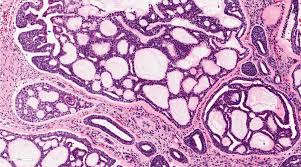
They have a basaloid epithelium clustered in nests in a hyaline stroma
ACC can be categorized into three growth patterns:
Cribriform pattern
Tubular pattern
Solid pattern
The most common histologic subtype is:
The cribriform type (44% of the cases)
Characterized by a “Swiss cheese” pattern of vacuolated areas
The prognosis for the cribriform subtype:
Is intermediate
The tubular subtype (35% of the cases):
Carries the best prognosis
Characterized by cords and nests of malignant cells
The solid subtype (21% of the cases):
Has the worst prognosis in terms of distant metastasis and long-term survival
Solid sheets of adenoid malignant cells characterize this subtype
A sole feature of ACC is:
The propensity for perineural invasion:
50% to 70% of the cases:
Even with early stage tumors
It can spread centripetally through the skull base and peripherally along both named and unnamed nerves
For this reason, adjuvant radiation that includes the anatomic course of the regional named nerves is often recommended
Lymphatic spread is uncommon:
Consequently neck dissection or wide-field radiation to regional lymphatics:
Is rarely recommended
Skip metastasis are known to occur despite clear surgical margins
This malignancy is graded according to Szanto et al:
Cribriform or tubular (grade I)
Less than 30% solid (grade II)
Greater than 30% solid (grade III)
In patients treated by similar modalities:
The cribriform and tubular variants of ACC demonstrated:
No difference in the rate of distant metastases and overall survival:
The cribriform variant demonstrated a:
Significantly worse prognosis in terms of local recurrence rate (up to 47%)
References:
Spiro, R.H. and A.G. Huvos, Stage means more than grade in adenoid cystic carcinoma. American journal of surgery, 1992. 164: p.623-8.
Bradley, P.J., Adenoid cystic carcinoma of the head and neck: a review. Curr Opin Otolarngol Head Neck Surg. Vol. 12. 2004: Lippincott Williams and Wilkins.
Martinez-Rodriguez, N., et al., Epidemiology and treatment of adenoid cystic carcinoma of the minor salivary glands: A meta-analytic study. Medicina oral, patologia oral y cirugia bucal, 2011.
Szanto, P.A., et al., Histologic grading of adenoid cystic carcinoma of the salivary glands. Cancer, 1984. 54(6): p. 1062-9.
Kumar, P.P., et al., Intracranial skip metastasis from parotid and facial skin tumors: mechanism, diagnosis, and treatment. Journal of the National Medical Association, 85(5): p. 369-
Gnepp, D.R., Malignant mixed tumors of the salivary glands: a review. Pathology annual, 1993. 28 Pt 1: p. 279-328.
The distance between the tangential radiation beam edge and heart typically increases:
Reducing cardiac dose
Intensity modulated radiation therapy (IMRT):
Utilizes a computerized multi-leaf collimator to control the dose distribution throughout the radiation beam:
This helps conform the dose to the target breast (and lymph node regions, as appropriate) and away from organs at risk, such as the heart and lung
Treatment in the prone position:
Is generally less useful for small breasts, because large, pendulous breasts fall away from the chest wall, thus increasing the distance between the majority of the target breast tissue and the heart and lungs
Treatment planning studies suggest that heart doses are reduced when treating women with large breasts but not reduced (and even increased) when treating women with small breasts
Additionally, axillary lymph node coverage may be compromised when treating in the prone position
Accelerated partial breast irradiation targets the tumor bed with a limited margin of surrounding breast tissue and may decrease integral dose to the heart and lungs in select women, but is not suitable for women with node-positive breast cancer
References
Shah C, Badiyan S, Berry S, et al. Cardiac dose sparing and avoidance techniques in breast cancer radiotherapy. Radiother Oncol. 2014;112(1):9-16.
Mulliez T, Veldeman L, Speleers B, et al. Heart dose reduction by prone deep inspiration breath hold in left-sided breast irradiation. Radiother Oncol.2015;114(1):79-84.
Osa EO, DeWyngaert K, Roses D, et al. Prone breast intensity modulated radiation therapy: 5-year results. Int J Radiat Oncol Biol Phys. 2014;89(4):899-906.
Mulliez T, Speleers B, Mahjoubi K, et al. Prone left-sided whole-breast irradiation: significant heart dose reduction using end-inspiratory versus end-expiratory gating. Cancer Radiother. 2014;18(7):672-677.
The American Society of Clinical Oncology (ASCO) and American Society for Radiation Oncology (ASTRO):
Recommend PMRT for:
Tumor size greater than 5 cm with any number of involved axillary nodes
Smaller cancers with four or more involved
Locally advanced breast cancer
Locally advanced breast cancer:
Is defined as:
A tumor greater than 5 cm in size
Tumor extending to chest wall:
Not including pectoralis major muscle
Tumor extending to skin in the form of:
Nodules
Ulcerations
Edema
These patient populations have a risk of local recurrence greater than 20%:
After mastectomy, irradiation of the chest wall and regional lymph node basins improves local-regional control in these patient populations
PMTR in T1 to T2 tumors and 1 to 3 positive nodes:
Remains much more controversial
Many authors suggest that looking at the total number of risk factors in an individual patient:
Would be useful to determine if PMRT may be clinically beneficial
In addition to tumor size and the degree of nodal involvement, such factors include:
Ages less than 35 to 40
Lymphovascular invasion
High tumor grade
Close or positive surgical margins
Hormone receptor status
Lymph node ratio
Lack of receipt of systemic therapy
The data in the literature on these variables are conflicting however, and there is no consensus on how to integrate these factors.
ASCO, ASTRO, and SSO recently released an updated consensus statement regarding the role of PMRT in women with 1 to 3 positive lymph nodes:
The consensus panel unanimously agreed that PMRT in this subset of patients reduces local-regional failure, any recurrence, and breast cancer mortality:
In patients with T1 to T2 breast cancer with 1 to 3 positive lymph nodes
They agreed that the decision for PMRT should be made in a multidisciplinary setting and with the involvement of the patient after she is presented with all available data
The panel went on to acknowledge that in some subsets of patients, the risk of local-regional failure may be so low that the absolute benefit of PMRT is outweighed by its toxicities
Further, even if axillary lymph node dissection (ALND) is omitted in the setting of positive lymph nodes:
PMRT should only be used if there is already significant evidence justifying the benefit of PMRT without knowing the status of any additional axillary nodes
When given, PMRT should include:
The internal mammary, supraclavicular, and apical axillary nodes, and the chest wall or reconstructed breast
All patients with a positive axillary node after receipt of neoadjuvant chemotherapy should receive PMRT
References
Recht A, Comen EA, Fine RE, et al. Postmastectomy radiotherapy: an American Society of Clinical Oncology, American Society for Radiation Oncology, and Society of Surgical Oncology focused guideline update. Ann Surg Oncol. 2017;24(1):38-51.
EBCTCG (Early Breast Cancer Trialists’ Collaborative Group), McGale P, Taylor C, et al. Effect of radiotherapy after mastectomy and axillary surgery on 10-year recurrence and 20-year breast cancer mortality: meta-analysis of individual patient data for 8135 women in 22 randomised trials. Lancet. 2014;383(9935):2127-2135.
Khan AJ, Haffty BG. Postmastectomy radiation therapy. In: Kuerer HM, ed. Kuerer’s Breast Surgical Oncology. New York, NY: McGraw-Hill; 2010:995-1008.
McBride A, Allen P, Woodward W, et al. Locoregional recurrence risk for patients with T1,2 breast cancer with 1-3 positive lymph nodes treated with mastectomy and systemic treatment. Int J Radiat Oncol Biol Phys. 2014;89(2):392-398.
Offersen BV, Brodersen HJ, Nielsen MM, Overgaard J, Overgaard M. Should postmastectomy radiotherapy to the chest wall and regional lymph nodes be standard for patients with 1-3 positive lymph nodes? Breast Care. 2011;6(5):347-351.
Sharma R, Bedrosian I, Lucci A, et al. Present-day locoregional control in patients with t1 or t2 breast cancer with 0 and 1 to 3 positive lymph nodes after mastectomy without radiotherapy. Ann Surg Oncol. 2010;17(11):2899-2908.
Accelerated partial breast irradiation includes multiple techniques, including:
Interstitial brachytherapy
Applicator brachytherapy
External beam radiation therapy
The Groupe Européen de Curiethérapie of European Society for Radiotherapy and Oncology (GEC-ESTRO) trial:
Randomized 1,184 patients with low-risk invasive carcinoma or ductal carcinoma in situ (DCIS) treated with breast-conserving surgery to either whole-breast irradiation (WBI) or APBI using multicatheter brachytherapy
The cumulative incidence of local recurrence at 5 years was 1.44% with APBI and 0.92% with WBI
The Florence trial:
Randomized 520 patients to either WBI or APBI with intensity-modulated radiation therapy
With a mean followup of 5 years
The rate of local recurrence was 1.5% in both arms
Similarly, long-term outcomes from the American Society of Breast Surgeons’ Mammosite Registry:
Found that 5-year rates were less than 4%
An older randomized trial from Hungary:
Using interstitial APBI and electrons had a 5-year local recurrence rate of 4.7%
Current ASTRO APBI guidelines:
Suitable:
Any patient > 50 years, with T1 (margins at least 2 mm) or Tis (if screen-detected, < 2.5cm, low-intermediate grade, margins > 3 mm)
Cautionary:
40‒49 years old or > 50 years old with at least one pathological higher risk factor
Unsuitable:
Less than 40 years old, positive margins, tumor > 3 cm, and N+
American Brachytherapy Society guidelines:
Consider candidates appropriate if age > 45, invasive or DCIS, tumors < 3 cm, N0, ER+ or ER–, no lymph-vascular space invasion, and negative margins
References
Livi L, Meattini I, Marrazzo L, et al. Accelerated partial breast irradiation using intensity modulated radiotherapy versus whole breast irradiation: 5-year survival analysis of a phase 3 randomised controlled trial. Eur J Cancer. 2015;51(4):451-463.
Polgár C, Fodor J, Major T, Sulyok Z, Kásler M. Breast-conserving therapy with partial or whole breast irradiation: ten-year results of the Budapest randomized trial. Radiother Oncol. 2013;108(3):197-202.
Shah C, Badiyan S, Ben Wilkinson J, et al. Treatment efficacy with accelerated partial breast irradiation (APBI): final analysis of the American Society of Breast Surgeons MammoSite breast brachytherapy registry trial. Ann Surg Oncol.2013;20(10):3279-3285.
Strnad V, Ott OJ, Hildebrandt G, et al; Groupe Européen de Curiethérapie of European Society for Radiotherapy and Oncology (GEC-ESTRO). 5-year results of accelerated partial breast irradiation using sole interstitial multicatheter brachytherapy versus whole-breast irradiation with boost after breast-conserving surgery for low-risk invasive and in-situ carcinoma of the female breast: a randomised, phase 3, non-inferiority trial. Lancet. 2016;16(10015);387:229-238.
Correa C, Harris EE, Leonardi MC, et al. Accelerated partial breast irradiation: executive summary for the update of an ASTRO evidence-based consensus statement. Pract RadiatOncol. 2017;7(2):73-79.
Shah C, Vicini F, Shaitelman SF, et al. The American Brachytherapy Society consensus statement for accelerated partial-breast irradiation. Brachytherapy.2018;17(1):154-170.
Radiation therapy represents an effective treatment for painful bone metastases:
With pain control rates around 60%:
Radiation would be a good option for pain relief for the rib and humeral lesions
Lytic metastases in weight-bearing bones:
Portend impending fracture and should have surgical stabilization to prevent fracture
Whole brain radiation or stereotactic radiosurgery:
Can be considered for brain metastases
If there are symptoms of mass effect that may be improved with surgical resection:
Then the resection should precede radiation therapy
References
Chow E, Wu JS, Hoskin P, Coia LR, Bentzen SM, Blitzer PH. International consensus on palliative endpoints for future clinical trials in bone metastases. Radiother Oncol.2002;64(3):275-280.
Mirels H. Metastatic disease in long bones. A proposed scoring system for diagnosing impending pathologic fractures. Clin Orthop Relat Res. 1989;249:256-264.
Morris PG, Reiner AS, Szenberg OR, et al. Leptomeningeal metastasis from non-small cell lung cancer: survival and the impact of whole brain radiotherapy. J Thorac Oncol. 2012;7(2):382-385.
Leal T, Chang JE, Mehta M, Robins HI. Leptomeningeal metastasis: challenges in diagnosis and treatment. Curr Cancer Ther Rev. 2011;7(4):319-327.
Linskey ME, Andrews DW, Asher AL, et al. The role of stereotactic radiosurgery in the management of patients with newly diagnosed brain metastases: a systematic review and evidence-based clinical practice guideline. J Neurooncol. 2010;96(1):45-68.
Increasing data are available evaluating the role of adjuvant radiation therapy in older patients undergoing breast-conserving surgery with small, ER positive tumors
CALGB 9343 trial:
Enrolled 636 women over the age of 70 with T1, N0, ER positive tumors
Randomizing patients to adjuvant endocrine therapy (tamoxifen) with or without radiation therapy
At 12 years, the risk of local-regional recurrence was 9% without radiation and 2% with radiation, confirming the initial 5-year results
No differences in breast cancer-specific survival or overall survival were noted
More recently, results from the PRIME II trial were published:
The trial enrolled 1,326 patients 65 years or older with T1 to T2 (< 3 cm), node negative tumors and clear margins
Following breast-conserving surgery, patients received endocrine therapy, and were randomized to adjuvant radiation therapy or no further treatment
At 5 years, those undergoing radiation demonstrated a reduction in local recurrence (4.1% vs. 1.3%) with no difference in survival noted
References
Hughes KS, Schnaper LA, Bellon JR, et al. Lumpectomy plus tamoxifen with or without irradiation in women age 70 years or older with early breast cancer: long-term follow-up of CALGB 9343. J Clin Oncol. 2013;31(19):2382-2387.
Kunkler IH, William LJ, Jack WJ, et al. Breast-conserving surgery with or without irradiation in women aged 65 years or older with early breast cancer (PRIME II): a randomised controlled trial. Lancet Oncol. 2015;16(3):266-273.
The definitive indications for postoperative radiotherapy are:
Positive margins
Multiple positive nodes with metastatic disease
Extra capsular nodal extension
Less certain indications include:
Lymphovascular space invasion
Perineural spread
Single encapsulated positive lymph node greater than 3 cm
Thick tumors
Tumors with a thickness between 3 mm to 9 mm have 44% subclinical node positivity and a 7% local recurrence rate
Tumors with a thickness greater than 9 mm thickness have 53% subclinical node positivity and a 24% local recurrence rate
Postoperative radiotherapy (60 to 70 Gy in 6 to 7 weeks) reduces the rate of local and regional recurrence from 50% to 15% for tumors with pathologic features that predict a high local and regional failure rates
The indications for postoperative radiotherapy are well established:
Close or positive margins
An affected lymph node greater than 3 cm
Multiple lymph nodes involved
Extra capsular extension (ECE)
Patients who had an open biopsy of a suspicious neck node and did not undergo neck dissection at the time
Perineural invasion
Lymphovascular space invasion
Invasion of cartilage, bone or deep soft tissues
Recommendation of the surgeon due to intraoperative findings
Which manifests as axillary lymph node metastasis:
Without the evidence of a primary breast tumor on clinical examination or mammography
It accounts for 0.3% to 1.0% of all breast cancers
The American College of Radiology:
Recommends the use of MRI for occult breast cancer patients:
Who do not have evidence of a breast primary on traditional radiological examination (mammogram and ultrasound) and clinical examination
Level I evidence has shown MRI is significantly more sensitive in detecting a primary lesion than mammography or ultrasound:
Identifying a primary tumor in 72% of cases that were originally deemed occult
Patients with occult breast cancer who have abnormalities demonstrated on MRI should then undergo evaluation with:
Targeted ultrasound plus ultrasound-guided needle biopsy or MRI-guided needle biopsy and receive treatment according to the clinical stage of the breast cancer
Treatment recommendations for those with negative MRI results and occult breast cancer presenting as isolated axillary metastases:
Are based on nodal status and breast cancer subtype
Most patients with axillary metastasis from an unknown breast primary:
Are candidates for neoadjuvant therapy
A meta-analysis reported outcomes for occult breast cancer in patients undergoing axillary lymph node dissection (ALND) (with or without radiation therapy [RT]) versus mastectomy:
It included 7 international studies, with 241 patients presenting between 1973 and 2011
The mean follow up was 62 months
There was no difference in survival, locoregional recurrence rate, or distant metastatic rate between those occult breast cancer patients who underwent mastectomy versus those who underwent ALND + breast RT (without breast surgery)
Radiotherapy improves locoregional recurrence and possibly mortality rates of patients undergoing ALND
Based on this meta-analysis, combined ALND and RT is an acceptable approach
The current National Comprehensive Cancer Network guidelines:
Recommend that patients with negative MRI results should be treated with mastectomy plus axillary lymph node dissection (modified radical mastectomy) OR ALND plus whole-breast irradiation
Approximately 40% of patients undergoing neoadjuvant chemotherapy for clinically node-positive disease:
Are successfully down staged in the axilla, and may be able to avoid ALND
Although this may prove to be safe for patients with primary occult breast cancer, there are no studies that have specifically addressed the safety of sentinel lymph node biopsy with targeted axillary dissection in this highly select subset
Treatment gold standard for occult breast cancer presenting with axillary metastases which remain clinically positive after neoadjvuant chemotherapy, remains ALND
References 1. Ge L-P, Liu X-Y, Xiao Y, et al. Clinicopathological characteristics and treatment outcomes of occult breast cancer: a SEER population-based study. Cancer Manag Res. 2018;10:4381-4391. doi: 10.2147/CMAR.S169019 2. Ofri A, Moore K. Occult breast cancer: where are we at? Breast. 2020;54:211-215. doi: 10.1016/j.breast.2020.10.012 3. American College of Radiology. ACR practice parameter for the performance of contrast-enhanced magnetic resonance imaging (MRI) of the breast. Accessed April 7, 2023. https://www.acr.org/-/media/ACR/Files/Practice-Parameters/MR-Contrast-Breast.pdf?la1⁄4en. 4. de Bresser J, de Vos B, van der Ent F, Hulsewé K. Breast MRI in clinically and mammographically occult breast cancer presenting with an axillary metastasis: a systematic review. Eur J Surg Oncol. 2010;36(2):114-119. doi: 10.1016/j.ejso.2009.09.007 5. Macedo FIB, Eid JJ, Flynn J, Jacobs MJ, Mittal VK. Optimal surgical management for occult breast carcinoma: a meta-analysis. Ann Surg Oncol. 2016;23(6):1838-1844. doi: 10.1245/s10434-016-5104-8 6. National Comprehensive Cancer Network. Breast Cancer. Version: 3.2023. Accessed April 7, 2023. https://www.nccn.org/professionals/physician_gls/pdf/breast.pdf 7. American Society of Breast Surgeons. Consensus Statement on Axillary Management for Patients With In-Situ and Invasive Breast Cancer: a concise overview. Accessed April 17, 2023. https://www.breastsurgeons.org/docs/statements/management-of-the-axilla.pdf