- The main trunk of the maxillary artery:
- Is divided into three parts:
- Which are named according to related structures along the artery’s course
- These three parts are:
- The mandibular division (1st part / bony part):
- Named as such because it winds around deep to the neck of the mandible
- The pterygoid division (2nd part / muscular part):
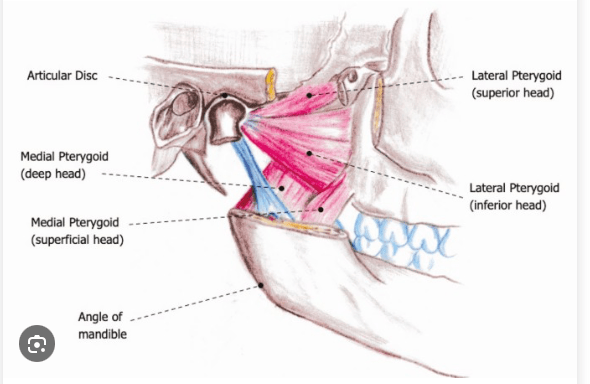
- It has this name because it travels between the two heads of the lateral pterygoid muscle
- The pterygopalatine division (3rd part):
- This part derived its name from the pterygopalatine fossa, into which it enters
- The mandibular division (1st part / bony part):
- Conventionally, these three parts are described as the:
- Part before-, part on-, and part beyond the lateral pterygoid muscle
- This is also useful since out of the 15 branches of the maxillary artery:
- The five branches from the second part (part on the lateral pterygoid muscle):
- Are regarded as branches to soft tissues:
- That do not course through foramina in bones
- Are regarded as branches to soft tissues:
- However, the remaining 10 branches:
- From the first and third parts:
- Go through foramina in bones
- From the first and third parts:
- The five branches from the second part (part on the lateral pterygoid muscle):
- Is divided into three parts:
- Course:
- The maxillary artery:
- Continues as one of the terminal divisions of the external carotid artery:
- At the level of the neck of the mandible:
- Passing forward between the neck of the mandible and the sphenomandibular ligament
- It continues its path by running deeply to the lower head and passes forward between the two heads of the lateral pterygoid muscle:
- To break into its terminal branches at the pterygopalatine fossa
- At the level of the neck of the mandible:
- Continues as one of the terminal divisions of the external carotid artery:
- The maxillary artery:
- Maxillary artery branches:
- Branches of the first (mandibular) division:
- The deep auricular artery:
- Is the first branch of the mandibular part:
- This branch runs upwards to enter the ear and courses superficially to the tympanic membrane, passing between the cartilage and bone
- It supplies the external acoustic meatus of the ear and the deep surface of the tympanic membrane
- The anterior tympanic artery:
- Is the second branch that courses near the tympanic membrane
- It passes deep to the membrane:
- Through the petrotympanic fissure to the middle ear:
- To join the circular anastomosis around the tympanic membrane
- Through the petrotympanic fissure to the middle ear:
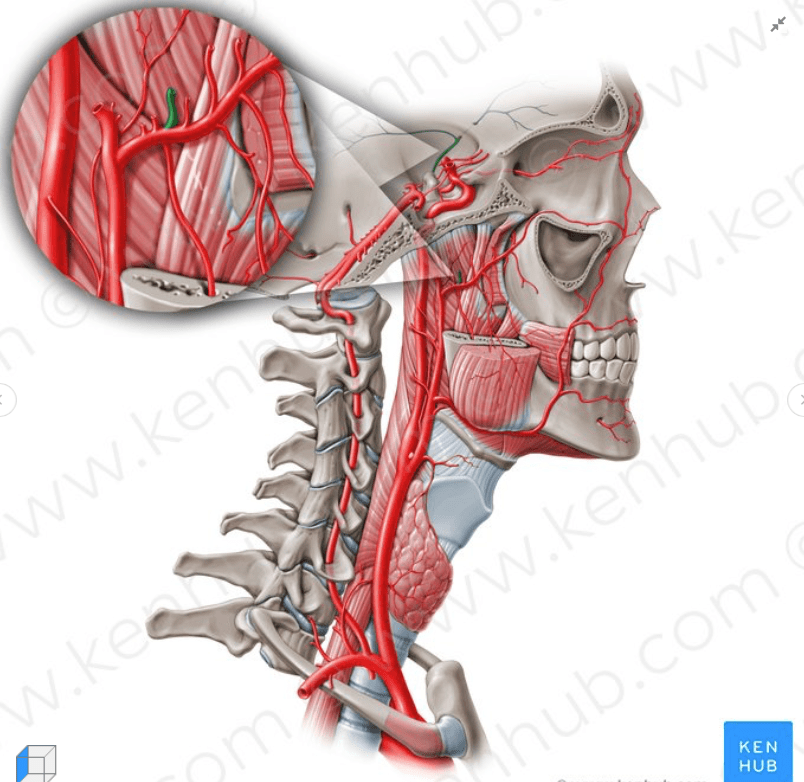
- The middle meningeal artery:
- Passes straight upwards through the foramen spinosum:
- To join the two roots of the auriculotemporal nerve
- It supplies bones of the skull (calvaria) and the dura mater
- Passes straight upwards through the foramen spinosum:
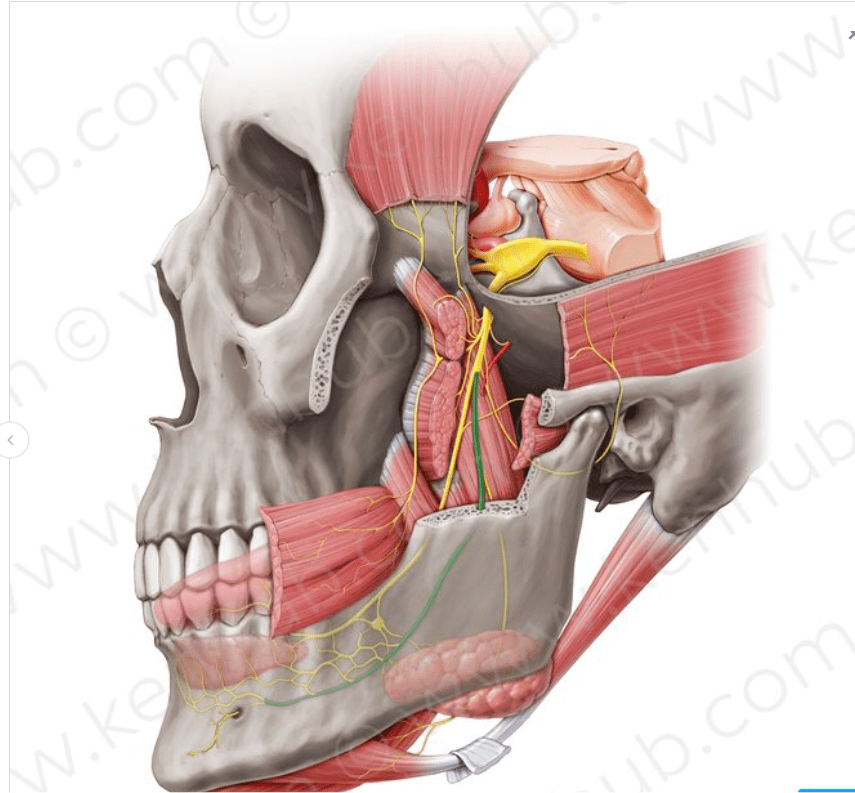
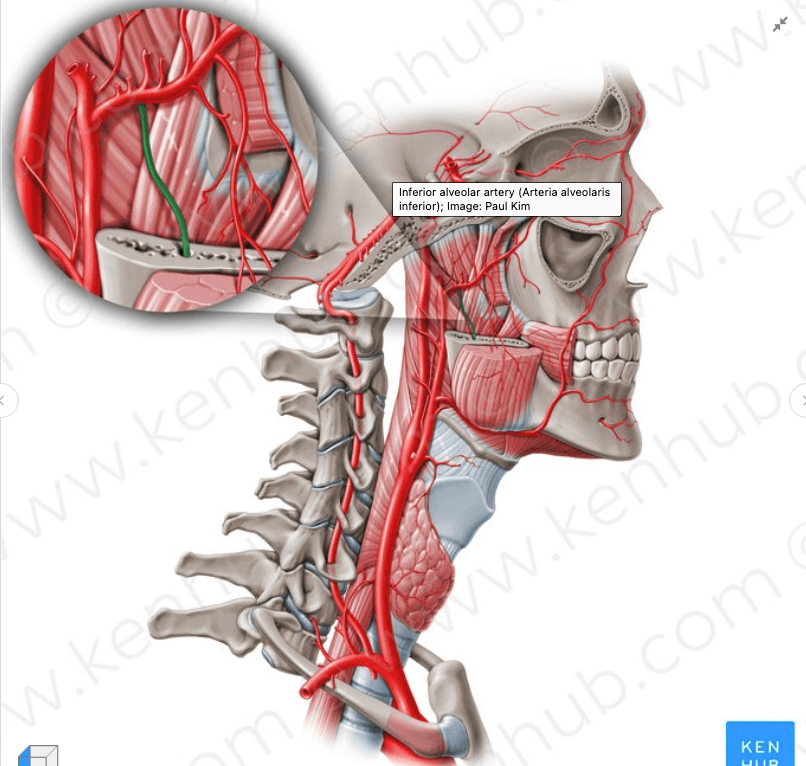
- The inferior alveolar artery:
- Runs inferiorly and anteriorly towards the inferior alveolar nerve:
- To meet the nerve at the inferior alveolar (a.k.a. mandibular) foramen
- The artery runs further anteriorly in the mandible:
- Supplying the pulps of the mandibular teeth (with its dental branches) and the body of the mandible
- Its other branch, the mental branch:
- Emerges from the mental foramen and supplies the lower lip and skin of the chin
- Runs inferiorly and anteriorly towards the inferior alveolar nerve:
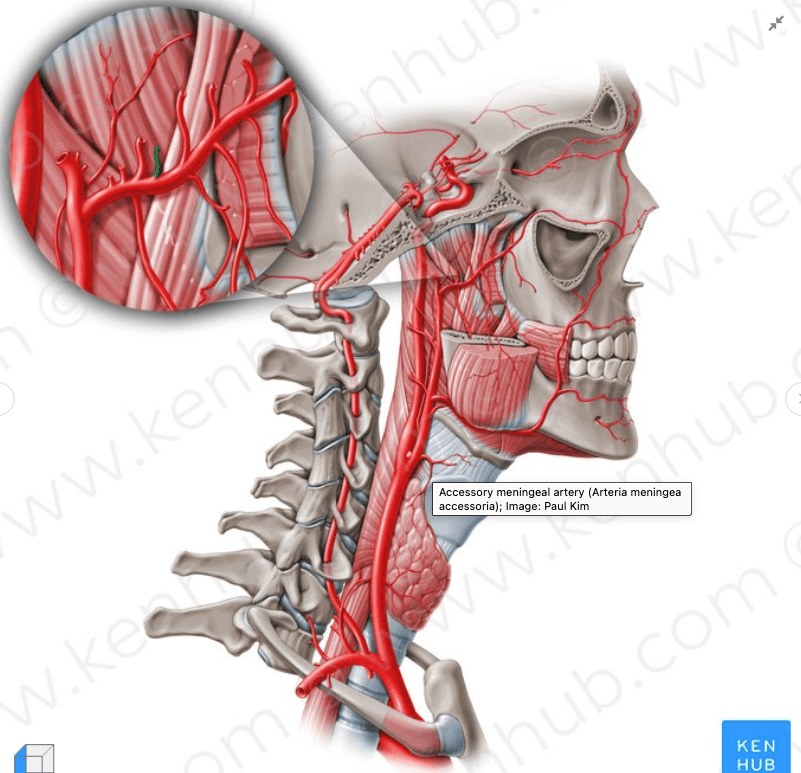
- The accessory meningeal artery:
- Is the main source of blood supply to the trigeminal ganglion
- It passes upwards through the foramen ovale to supply the dura mater of the floor of the middle fossa and of the trigeminal cave (Meckel’s cave)
- Is the first branch of the mandibular part:
- The deep auricular artery:
- Branches from the 2nd (pterygoid / muscular) segment:
- All branches from the pterygoid part supply only soft tissues
- The masseteric artery:
- Accompanies the lingual nerve
- It is small, and passes laterally through the mandibular notch to the deep surface of the masseter muscle
- The pterygoid arteries:
- Are small branches that vary in number
- They supply the lateral pterygoid muscle and medial pterygoid muscle
- The deep temporal arteries:
- Course between the temporalis muscle and the pericranium
- The main function of this branch is to:
- Provide arterial supply to the temporalis muscle
- The buccal (buccinator) artery:
- Runs obliquely forward, between the medial pterygoid muscle and the insertion of the temporalis muscle, to the outer surface of the buccinator muscle
- It mainly supplies the:
- Buccinator muscle
- Along its course, it forms anastomoses with branches of the facial and infraorbital arteries
- Branches from the 3rd (pterygopalatine) segment:
- The sphenopalatine artery:
- Mainly supplies the nasal cavity:
- Which is why it is also referred to as the nasopalatine artery
- It passes through the sphenopalatine foramen and enters the nasal cavity
- Here it gives off its posterior lateral nasal branches
- Crossing the inferior surface of the sphenoid:
- The sphenopalatine artery ends on the nasal septum giving off the posterior septal branches
- Mainly supplies the nasal cavity:
- The descending palatine artery:
- Descends through the greater palatine canal:
- With the greater and lesser palatine branches:
- Of the pterygopalatine ganglion
- It terminates by dividing into the greater and lesser palatine arteries:
- That provide blood supply for the hard palate and soft palate, respectively
- With the greater and lesser palatine branches:
- Descends through the greater palatine canal:
- The infraorbital artery:
- Passes forwards through the inferior orbital fissure:
- Along the floor of the orbit and infraorbital canal:
- To emerge with the infraorbital nerve on the face.
- Along the floor of the orbit and infraorbital canal:
- Passes forwards through the inferior orbital fissure:
- The posterior superior alveolar artery:
- Supplies the maxillary teeth
- It gives branches that accompany the corresponding nerves through foramina in the posterior wall of the maxilla
- The middle superior alveolar artery:
- Is most often a branch of the infraorbital artery
- It arises within the infraorbital canal:
- Where it descends to supply the maxillary sinus and plexus at the level of the canine tooth
- The pharyngeal artery:
- Supplies structures such as the pharynx and roof of the nose
- The anterior superior alveolar artery:
- Is branch of the infraorbital artery.
- The artery of the pterygoid canal:
- Runs into the pterygoid canal:
- It passes backwards along the pterygoid canal with the corresponding nerve
- It supplies the upper part of the pharynx, and sends a small division into the tympanic cavity to anastomose with the tympanic arteries
- Runs into the pterygoid canal:
- The sphenopalatine artery:
- Branches of the first (mandibular) division: