Blog

Risk-Stratification Considerations for Thyroid Lobectomy

  • The 2015 ATA guidelines:
    • Now accept a minimalistic surgical approach (thyroid lobectomy without neck dissection):
      • To treat intrathyroidal papillary thyroid carcinomas < 4 cm in properly selected patients
    • Careful peri-diagnosis, preoperative, and intraoperative risk stratification:
      • Are the keys to successful use of thyroid lobectomy:
        • Without having to perform an unacceptable rate of early-completion thyroidectomies
  • Patients classified as being ideal for lobectomy:
    • Would have papillary microcarcinomas:
      • That appeared to be confined to the thyroid in the setting of an otherwise normal thyroid ultrasound and clinical N0 neck
  • We classify patients as appropriate for lobectomy:
    • If the tumor is 1 to 4 cm in maximum dimension, if the contralateral lobe is normal, or if there are other abnormalities on the ultrasound, such as thyroiditis or benign-appearing nodules (again, in the setting of the clinical N0 neck)
  • Patients with extrathyroidal extension, clinical N1 disease, or distant metastasis:
    • Would be considered inappropriate for thyroid lobectomy as initial therapy
  • In addition to the relevance of peri-diagnostic and preoperative risk stratification with respect to the selection of thyroid lobectomy as initial therapy:
    • It is important to recognize that there are intraoperative findings that should alter that recommendation and lead to an immediate total thyroidectomy:
      • We encourage patients to find a surgeon who they trust and to empower the surgeon to make a final decision in the operating room regarding the extent of initial surgery that should be performed, which can vary from lobectomy to total thyroidectomy, with or without neck dissection
      • However, even with appropriate preoperative and intraoperative risk stratification:
        • As many as 6% to 20% of patients will have unexpected findings on the final pathology report:
          • That may lead to a completion thyroidectomy and usually, radioactive iodine
        • An additional 5% to 10% may require completion thyroidectomy:
          • At some later point during follow-up for diagnostic or therapeutic purposes
        • The rate of early-completion thyroidectomy, performed following review of the initial pathology report, will vary, depending on how aggressive each management team is with regard to the use of radioactive iodine for either remnant ablation or adjuvant treatment
        • If minor factors, such as minor extrathyroidal extension, very small-volume lymph node metastasis, or small tumors with aggressive histologic features usually lead to radioactive iodine therapy, then the completion thyroidectomy rate may be as high as 20%
        • In our hands, the completion thyroidectomy rate is much lower, as we have a much more restricted use of radioactive iodine:
          • The most common reason for completion thyroidectomy in our hands is unanticipated, extensive vascular invasion documented on the pathology report that obviously could not be visualized preoperatively or intraoperatively
  • Thus, patients need to understand that the final determination of whether a thyroid lobectomy is the appropriate initial therapy can only be achieved by:
    • The integration of preoperative, intraoperative, and postoperative risk stratification
  • Patients who are uncomfortable with this approach will often choose a total thyroidectomy as initial therapy
  • Patients motivated to keep part of the thyroid will often accept that uncertainty, recognizing that the final decision regarding the completeness of initial therapy cannot be completely known until several weeks after the surgery is completed when more complete risk stratification can be accomplished
  • References:
    • Tuttle RM, Zhang L, Shaha A. A clinical framework to facilitate selection of patients with differentiated thyroid cancer for active surveillance or less aggressive initial surgical management. Expert Rev Endocrinol Metab. 2018;13(2):77–85. 
    • Carty SE, Doherty GM, Inabnet WB III, Pasieka JL, Randolph GW, Shaha AR, Terris DJ, Tufano RP, Tuttle RM; Surgical Affairs Committee Of The American Thyroid Association. American Thyroid Association statement on the essential elements of interdisciplinary communication of perioperative information for patients undergoing thyroid cancer surgery. Thyroid. 2012;22(4):395–399.

Beahrs Triangle or Riddle’s Triangle

Beahrs Triangle or Riddle’s triangle

  • This is one of the most important triangles in relation with thyroid surgery
  • This triangle is named after O.H. Beahrs:
    • Its synonymous with Riddle’s triangle
  • Baehr’s triangle is bounded by:
    • Base:
      • Common carotid artery
    • Superior:
      • Inferior thyroid artery
    • Medial:
      • Recurrent laryngeal nerve
  • The triangle lies:
    • Posterior to the thyroid gland:
      • In the tracheo-esophageal groove
  • Boundaries of Baehr’s triangle:
    • Can be identified after retracting the ipsilateral thyroid lobe medially:
      • To safe guard the recurrent laryngeal nerve
#Arrangoiz #CancerSurgeon #HeadandNeckSurgeon #SurgicalOncologist #Surgeon #Doctor #MD #MSCM #MountSinaiMedicalCenter #ThyroidSurgeon #EndocrineSurgery #ParathyroidSurgeon

RLN Triangle and Triangle of Concern

  • RLN Triangle:
    • This is an inverted triangle with:
      • Apex formed inferiorly by:
        • Thoracic inlet
      • Medially:
        • Trachea
      • Lateral Margin:
        • The medial edge of retracted strap muscles
      • The superior border is:
        • The lower edge of the inferior pole of the gland
  • Recurrent laryngeal nerve exits as a single trunk here at thoracic inlet
  • Triangle of Concern:
    • The commonest site for bleeding in thyroidectomy:
      • Is the ‘triangle of concern’, comprising the:
        • Trachea medially
        • RLN nerve laterally
        • With the thyrothymic ligament and loose fat above the sternum at the base
        • Berry’s ligament at the apex
  • This triangle has the small branches of the inferior thyroid artery that require meticulous hemostasis with in the vicinity of RLN, which can cause injury to nerve
#Arrangoiz #CancerSurgeon #HeadandNeckSurgeon #SurgicalOncologist #Surgeon #Doctor #MD #MSCM #MountSinaiMedicalCenter #ThyroidSurgeon #EndocrineSurgery #ParathyroidSurgeon

Simon’s Triangle

  • Classically, the RLN is identified intraoperatively in Simon’s triangle, which  is formed by:
    • The common carotid artery laterally
    • The esophagus medially
    • The inferior thyroid artery superiorly
  • The recurrent laryngeal nerve  crosses the triangle
#Arrangoiz #CancerSurgeon #HeadandNeckSurgeon #SurgicalOncologist #Surgeon #Doctor #MD #MSCM #MountSinaiMedicalCenter #ThyroidSurgeon #EndocrineSurgery #ParathyroidSurgeon

Molecular Classification and Histopathological Correlates in Follicular Cell-Derived Thyroid Neoplasms

  • Thyroid neoplasms are classified as two or three molecular groups based on the mutational and gene expression profiles:
    • Two molecular groups:
      • BRAF V600E-like
      • RAS-like
    • Three molecular groups:
      • BRAF V600E-like
      • RAS-like
      • Non-BRAF V600E / non-RAS-like
  • The BRAF V600E group:
    • Is most commonly represented by:
      • Papillary thyroid carcinoma (PTC)
  • The BRAF V600E-like molecular profile includes:
    • The BRAF V600E mutation
    • Gene fusions involving:
      • BRAF, RET, and neurotrophic receptor tyrosine kinase 1/3 (NTRK1/3)
  • RAS-like molecular profiles include:
    • NRAS, HRAS, KRAS, EIF1AX, enhancer of zeste 1 polycomb repressive complex 2 subunit (EZH1), Dicer 1, ribonuclease III (DICER1), phosphatase and tensin homolog (PTEN) mutations, BRAF K601E, and gene fusions involving peroxisome proliferator-activated receptor gamma (PPARG) and THADA
  • When the three-group molecular classification is applied:
    • PAX8::PPARG gene fusion and mutations of EIF1AX, EZH1, IDH1, SOS1, SPOP, DICER1, and PTEN genes are classified as a non-BRAFV600E-/non-RAS-like group
  • Encapsulated / circumscribed thyroid tumors with a predominant follicular growth pattern:
    • Generally have a RAS-like molecular profile
  • High grade is histologically defined:
    • As the presence of ≥ 5 mitoses per 2 mm2 and / or tumor necrosis.
  • Y, yes; N, no; Q, questionable; PDTC, poorly differentiated thyroid carcinoma; ATC, anaplastic thyroid carcinoma; DHGTC, dif- ferentiated high-grade thyroid carcinoma; IEFVPTC, invasive encapsulated follicular variant of papillary thyroid carcinoma; WDT-UMP, well-differentiated tumor of uncertain malignant potential; NIFTP, non-invasive follicular thyroid neoplasm with papillary-like nuclear fea- tures; FT-UMP, follicular tumor of uncertain malignant potential; FTC, follicular thyroid carcinoma; OCA, oncocytic carcinoma of the thy- roid; TERT, telomerase reverse transcriptase; TP53, tumor protein p53; PAX8, paired box 8
#Arrangoiz #ThyroidSurgeon #HeadandNeckSurgeon #CancerSurgeon #SurgicalOncologist #ComplexSurgicalOncology #EndocrineSurgery #MountSinaiMedicalCenter #MSMC #Miami #Mexico

Invasive Lobular Carcinoma (ILC) of the Breast IV

  • Patients with ILC have worse surgical outcomes compared to patients with invasive ductal carcinoma (IDC):
    • Measured by positive margin rates
    • Mastectomy rates
    • Axillary dissection rates
  • Many potential causes:
    • Higher stage at presentation
    • Higher discordance between clinical stage and pathologic stage
    • Lower sensitivity of standard imaging tools
  • Patients with ILC have higher positive margin rates compared to patients with IDC:
    • Secondary to:
      • Diffuse growth pattern
      • Low Imaging Sensitivity:
        • Leading to higher positive margin rates
  • Positive margins have negative consequences:
    • Significant lower breast satisfaction and sexual well-being at two years among those who require re-excision after breast conservation surgery (BCS)
    • Significant higher rates of surgical site infection (SSI), seroma / hematoma, and fat necrosis
    • Healthcare costs increased 4-fold for patients requiring re-excision
    • Increased risk of recurrence if two addressed
  • ILC:
    • Mammographically occult disease
    • MRI significantly underestimates size
    • Positive margins
  • Should patients with ILC always choose mastectomy?
    • Historically mastectomy was recommended for ILC specifically because of the diffuse growth pattern
    • More modern series show similar rates of recurrence between BCS with radiation vs. mastectomy for ILC
  • Rates of BCS for ILC have increased over time:
    • However the rate for BCS for ILC is lower that for IDC:
      • This is despite large series showing improved outcomes with breast conservation surgery compared to mastectomy:
        • US National Cancer Database Analysis of > 160,000 patients showed same or better overall survival (OS) with BCS compared to mastectomy
        • A Swedish study of nearly 50,000 patients showed improved OS with BCS compared to mastectomy (included 5,893 patients with ILC)
        • The higher rates of nodal positivity in ILC leads to increased likelihood of needing postmastectomy radiation:
          • Implications for radiation and reconstructive complications
  • BCS for patients with ILC > 4 cm:
    • BCS trial excluded patients with tumors > 4 cm
    • Retrospective analysis have shown BCT to be safe in IDC greater than 4 cm:
      • But not studied in ILC
    • Patients with ILC are more likely to present with larger tumors than IDC
  • In multivariable logistic regression model having larger tumors, higher N stage, HER2+ or triple negative subtype:
    • Were associated with significantly higher risk of recurrence:
      • The type of surgery does not affect these long-term outcomes
    • If negative margins are achieved:
      • There is no difference in recurrence rates for BCT vs mastectomy in ILC cases > 4 cm:
        • Important to note that over 50% of BCT group had positive margins and needed re-excision
  • Surgical approaches to reduce positive margin rates in ILC:
    • Oncoplastic surgery:
      • Level 1: local tissue rearrangement only
      • Level 2: parenchymal flaps and skin resection
    • Selective shave margins
  • Success rates for re-excision of positive margins after BCS in ILC:
    • Roughly 75%
  • Factors associated with successful re-excison
  • Positive margins after mastectomy for ILC

Immediate Surgery Can Improve Long-Term Outcomes in Older Breast Cancer Patients

  • Immediate surgery can improve outcomes among women age 70 and older who have operable breast cancer and are not receiving radiotherapy:
  • Results of the meta-analysis showed that patients who had immediate surgery:
    • Had lower rates of local recurrence early on, when compared to patients who had delayed surgery:
      • With longer follow-up, patients who had undergone surgery immediately also had lower rates of distant recurrence and breast cancer death
  • The meta-analysis included data from three trials encompassing 1082 women with breast cancer who were at least 70 years of age and had a median of 5 years on study:
    • The trials were all designed to compare immediate surgery to deferral of surgery until after progression, in the absence of radiotherapy
  • Results showed that, among patients with node-negative disease:
    • The rate of local recurrence at 5 years was 14.4% in patients who received tamoxifen plus surgery and 45.4% in patients who received tamoxifen alone (rate ratio [RR], 0.25; 95% CI, 0.19-0.34; P <.00001).
  • Among patients with node-positive disease:
    • The rate of local recurrence at 5 years was 6.8% in those treated with tamoxifen plus surgery and 48.1% in patients receiving tamoxifen alone (RR, 0.18; 95% CI, 0.11-0.29; P <.00001)
  • Immediate surgery leads to a very great reduction in the rates of local recurrence, and the curves separate immediately:
    • So that benefit is seen immediately, irrespective of nodal status, with really quite large absolute differences at 5 years
  • The study also found lower rates of distant recurrence and breast cancer death among patients who received immediate surgery:
    • However, those benefits only became apparent with longer follow-up:
      • The rate of distant recurrence at 15 years was 37.0% in patients who received tamoxifen plus surgery and 51.3% in patients who received tamoxifen alone (RR, 0.72; 95% CI, 0.57-0.90; P =.003)
      • The rate of breast cancer death at 15 years was 34.2% in patients who received tamoxifen plus surgery and 48.9% in those who received tamoxifen alone (RR, 0.68; 95% CI, 0.54-0.86; P =.002).
  • References:

Practice-Changing Insights from the SUPREMO Trial at the San Antonio Symposium

Practice-Changing Insights from the SUPREMO Trial at the San Antonio Symposium

The SUPREMO trial (Selective Use of Postoperative Radiotherapy After Mastectomy) presented its long-term results at the recent San Antonio Breast Cancer Symposium, marking a significant moment in the management of intermediate-risk breast cancer. As the only practice-changing presentation at the symposium, this trial provides robust evidence for the de-escalation of chest wall irradiation (CWI) in specific patient populations following mastectomy.

About the Trial:

SUPREMO is a phase III international, multicenter trial designed to assess whether CWI improves overall survival (OS) or reduces recurrence in intermediate-risk breast cancer patients. This group includes patients with tumors exhibiting certain characteristics that make the need for postoperative radiotherapy uncertain【1】【2】.

Key Findings (Median Follow-Up: 9.6 Years):

• Overall Survival (OS):

No statistically significant difference was observed in 10-year OS between patients receiving CWI (81.4%) and those who did not (82.0%). This confirms that CWI does not confer a survival advantage in this population【1】【2】【3】.

• Local Recurrence:

While CWI reduced the relative risk of chest wall recurrence by more than 50%, the absolute reduction in recurrence was less than 2%, deemed clinically insignificant for most patients【2】【3】.

• Subgroup Analysis:

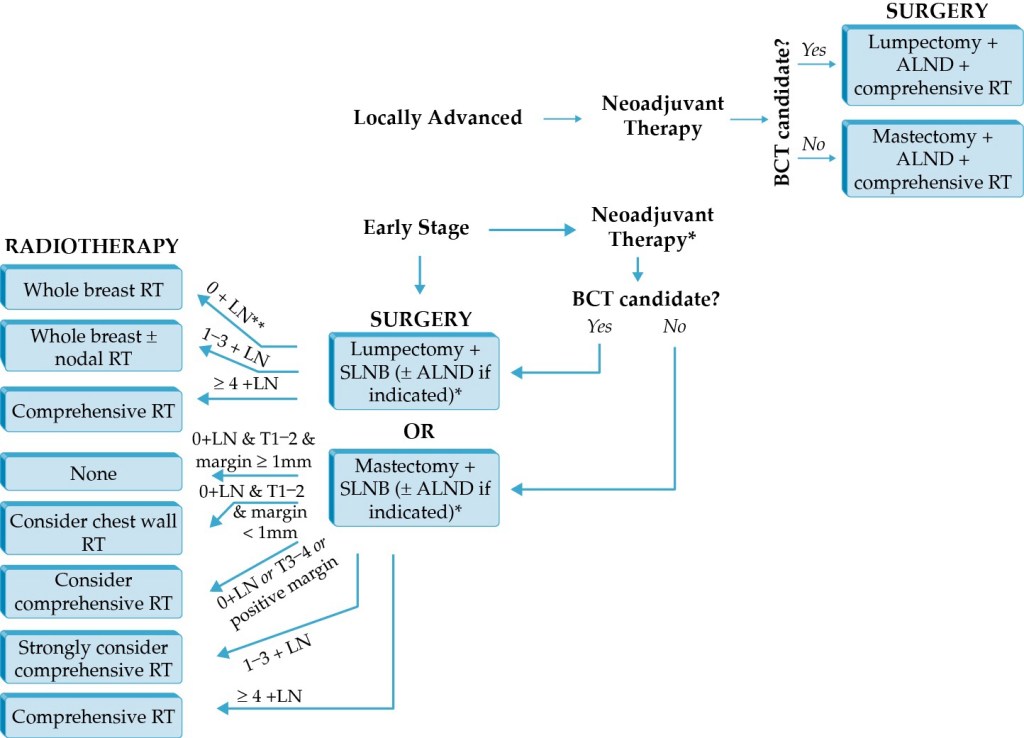
Both node-negative patients (N0) and those with T1-T2 tumors with 1-3 positive lymph nodes (N1) demonstrated no OS advantage with CWI. This suggests that many intermediate-risk patients, previously considered candidates for postoperative radiotherapy, may safely omit this treatment【1】【3】.

Clinical Implications:

The SUPREMO trial supports a tailored, de-escalated approach to radiation therapy in intermediate-risk breast cancer patients. By identifying subgroups unlikely to benefit from CWI, clinicians can reduce treatment-related morbidity while maintaining excellent oncologic outcomes. Patients meeting the following eligibility criteria may particularly benefit from this evidence【1】【2】:

1. pT1-2, N1 Disease: Tumors ≤50 mm with 1-3 positive axillary lymph nodes.

2. pT3, N0 Disease: Tumors >50 mm with no nodal involvement.

3. High-Risk Features in Node-Negative Disease: Tumors >20 mm but ≤50 mm with grade 3 histology and/or lymphovascular invasion (LVI).

Context and Broader Impact:

These findings align with an ongoing shift toward de-escalation strategies in oncology, prioritizing individualized treatment plans that balance efficacy and quality of life. The trial provides additional support for reducing overtreatment, especially in light of advancements in systemic therapies, which may further mitigate recurrence risk in intermediate-risk breast cancer【3】【4】.

Future Directions:

While SUPREMO guides practice for intermediate-risk patients, further research is needed to refine the role of radiotherapy in other subgroups, including those with high-risk features or specific molecular subtypes. Additionally, long-term follow-up beyond 10 years will provide further clarity on late recurrences and survival outcomes【4】.

References:

1. Kunkler, I. H., et al. Postmastectomy Radiotherapy for Intermediate-Risk Breast Cancer: Results from the SUPREMO Trial. Lancet Oncology, 2023.

2. San Antonio Breast Cancer Symposium 2023. SUPREMO Trial Results. [Conference Abstracts and Presentations].

3. Kunkler, I. H., et al. Radiotherapy De-Escalation in Breast Cancer: Lessons from SUPREMO. Journal of Clinical Oncology, 2023.

4. Smith, B. D., et al. Tailored Radiotherapy Approaches in Breast Cancer. Nature Reviews Clinical Oncology, 2023.

Absolute Benefit for Adjuvant Chemotherapy in Early Breast Cancer

  • Data from the Early Breast Cancer Trialists’ Collaborative Group:
    • Meta-analysis of adjuvant systemic therapy trials begun in or before 1995:

      • Show a 30% relative reduction:
        • In breast cancer-related mortality:
          • Associated with adjuvant hormonal therapy and with adjuvant chemotherapy
      • Reduced rates of ipsilateral local recurrence, contralateral cancers, and distant metastases in treated patients:
        • Suggest there is eradication of occult residual disease in many patients
      • The absolute survival benefit of adjuvant therapy:
        • Is greater in node-positive than in node-negative patients
      • The absolute survival benefit of chemotherapy:
        • Is greater for younger (less than 50 years of age) than for older women (50 to 69 years of age)
  • References:
    • Early Breast Cancer Trialists’ Collaborative Group (EBCTCG). Effects of chemotherapy and hormonal therapy for early breast cancer on recurrence and 15-year survival: an overview of the randomized trials. Lancet. 2005;365(9472):1687-1717.
    • Berry DA, Cronin KA, Plevritis SK, et al. Effect of screening and adjuvant therapy on mortality from breast cancer. N Engl J Med. 2005;353(17):1784-1792.

Predicting Survival Outcomes: The Updated AJCC/TNM Staging System

  • In October 2016:
    • The AJCC (www.cancerstaging.org) published the eighth edition of the AJCC / TNM cancer staging system:
      • Which replaced the seventh edition that had been used by clinicians, cancer registries, and researchers since 2009
    • On January 1st, 2018:
      • Tumor registries officially began using the eighth edition for tumor staging
  • Whereas the staging tables for medullary thyroid cancer and anaplastic thyroid cancer:
    • Showed only minimal changes:
      • The rules for the staging of well-differentiated thyroid cancer underwent substantial modifications
  • These included the following:
    • An increase of the age cutoff from 45 years to 55 years of age at diagnosis
    • Removal of microscopic extrathyroidal extension as a key component of the staging system
    • No longer mandating assignment of stage III to older patients with microscopic extrathyroidal extension or lymph node metastases
    • Establishment of a new T3b category for tumors of any size that demonstrate gross extrathyroidal extension involving only the surrounding strap muscles
  • The AJCC Differentiated Thyroid Cancer Committee carefully considered the possibility of inclusion of molecular markers (specifically, BRAFV600E and TERTpromoter mutations) in the AJCC prognostic staging definitions:
    • Whereas both of these mutations, particularly when present together, have been shown to be predictors of poor clinical outcomes:
      • They appeared to add only marginal benefit to the traditional anatomic staging factors:
        • Thus, molecular characterization of differentiated thyroid cancers, although providing some prognostic information, were not powerful enough factors to merit upstaging tumors to prognostic stages above those mandated by TNM risk factors
        • Nonetheless, similar to the approach used in the ATA risk-stratification system, molecular results can be used to refine further and individualize risk within risk categories or stages
  • The three critical factors that determine the prognostic stage groups of the eighth edition AJCC / TNM cancer staging system include the:
    • Age at diagnosis
    • The presence or absence of distant metastases
    • The presence or absence of gross extrathyroidal extension
  • Rather than the use of the standard TNM staging tables provided in the AJCC / TNM manual:
    • Tuttle el al find it easier to use the flow diagram in Figure 1 to stage patients rapidly based on the key clinical risk factors:
      • Age at diagnosis
      • Distant metastasis
      • Gross extrathyroidal extension
      • Lymph node metastases
  • In patients age < 55 years:
    • This figure rapidly classifies patients as either:
      • Stage I (any T, any N, M0)
      • Stage II (any T, any N, M1)
  • In patients age > 55 years:
    • In the older patients, additional factors, such as the presence or absence of distant metastasis, invasion of strap muscles, and extent of gross extrathyroidal extension, are also used to define the prognostic stage groups
  • In the eighth edition of the AJCC / TNM cancer staging system:
    • It was anticipated that the majority of patients would be classified as stage I or stage II:
      • Reflecting the excellent outcomes expected in the majority of thyroid cancer patients
      • A smaller number of patients, particularly the older patients with either distant metastases or gross extrathyroidal extension:
        • Were anticipated to do worse and are therefore classified as stage III or IV
  • Multiple publications have demonstrated that the eighth edition of the AJCC / TNM cancer staging system:
    • Moved a substantial number of patients into lower prognostic stage groups without affecting the overall survival of those lower-stage groups
    • The patients who remained in the higher-stage groups had poorer prognoses, as expected
    • This resulted in a much better separation of the four prognostic stage groups with respect to survival:
      • Such that 5- to 10-year disease-specific survival (DSS) was:
        • 99% in stage I patients
        • 88% to 97% in stage II patients
        • 72% to 85% in stage III patients
        • 67% to 72% in stage IV patients
  • Unlike previous editions of the AJCC / TNM staging system in which there was substantial overlap in survival in patients with stage I, II, and III disease:
    • The eighth edition provides meaningful separation among the prognostic stage groups that appear to be clinically relevant
    • The differences in predicted and published ∼10-year survival rates are best seen when analyzed based on age group (age <55 years vs age ≥55 years):
      • The predicted 10-year DSS has been validated for all age and stage groups, with only the younger (age < 55 years) stage II patients appearing to do more poorly than anticipated
      • The lower-than-anticipated 10-year DSS in the younger patients (age < 55 years) with stage II disease was the result of the stage migration of patients in the 45- to 55-year age group from seventh edition AJCC stage IV to eighth edition AJCC stage II
Figure 1: A simplified approach to AJCC staging in differentiated thyroid cancer, emphasizing the critical decision nodes, which include age at diagnosis, distant metastasis, and gross extrathyroidal extensions.