The first generation of larynx preservation chemotherapy trials:
Appeared in the 1990s:
They randomized patients into surgery and radiotherapy or to induction chemotherapy cycles of cisplatin / 5FU:
Patients who responded to chemotherapy then received radiotherapy:
With possible salvage surgery
If they did not respond to the chemotherapy:
They received surgery and postoperative radiotherapy
Generally, the results of these studies showed:
No significant difference in survival:
Between the two treatment arms
The larynx was preserved in:
56% of patients undergoing the experimental chemoradiotherapy arm
In 2000, Pignon et al:
Published a meta-analysis of the first generation of laryngeal preservation chemoradiotherapy trials:
They included T3 laryngeal and hypopharyngeal cancers
There was no statistically significant difference in overall survival:
However, it is important to note:
That there was a trend to benefit from surgery:
Hazard ratio 1.19 intervals (0.97–1.46)
Surgery ± radiotherapy:
Resulted in overall survival of 45%:
Compared to an overall survival from chemoradiotherapy of:
39%
56% of those who survived with chemoradiotherapy:
Managed to avoid laryngectomy:
Giving an overall laryngectomy survival rate of:
23% at five years
Patients treated with chemoradiotherapy:
Had almost double the local recurrence rate:
But less distant metastases than the patients treated with surgery
Analysis of laryngeal cancer patients separately from hypopharyngeal cancer patients:
Showed that laryngeal cancer patients in the surgical arm:
Demonstrated a risk reduction of 32%:
This suggests that advanced laryngeal tumors would be better treated with surgery than chemoradiotherapy:
On the other hand, hypopharyngeal cancer patients showed no difference in survival between the two modalities of treatment
The meta-analysis showed that the overall survival benefit from chemotherapy in addition to radiotherapy:
Was 4% at five years
Concomitant chemotherapy:
Resulted in an 8% overall survival benefit:
Compared to a 4% overall survival benefit from neoadjuvant chemoradiotherapy
Adjuvant chemoradiotherapy:
Resulted in no overall survival benefit
These findings have resulted in the adoption of concomitant chemoradiotherapy as the standard regimen for delivery of chemotherapy when treating laryngeal and pharyngeal cancers:
Recently, an update of this meta-analysis confirmed an overall survival effect of 6.5% for concomitant chemoradiotherapy
References:
The Department of Veterans Affairs Laryngeal Cancer Study Group. Induction chemotherapy plus radiation compared with surgery plus radiation in patients with advanced laryngeal cancer. New England Journal of Medicine 1991; 324: 1685–90.
Pignon JP, Bourhis J, Domenge C, Designé L. Chemotherapy added to locoregional treatment for head and neck squamous-cell carcinoma: three meta-analyses of updated individual data. MACH-NC Collaborative Group. Meta-Analysis of Chemotherapy on Head and Neck Cancer. Lancet 2000; 355: 949–55.
Pignon JP, le Maítre A, Maillard E et al. Meta-analysis of chemotherapy in head and neck cancer (MACH-NC): an update on 93 randomised trials and 17,346 patients. Radiotherapy and Oncology 2009; 92: 4–14.
Forastiere AA, Goepfert H, Maor M et al. Concurrent chemotherapy and radiotherapy for organ preservation in advanced laryngeal cancer. New England Journal of Medicine 2003; 349: 2091–8.
Management of the axilla continues to evolve in the setting of neoadjuvant therapy
Sentinel lymph node biopsy (SLNB) in clinically node-negative patients after neoadjuvant chemotherapy;
Is feasible and accurate:
A recent systematic review reported a pooled identification rate of:
96% and false negative rate of 6%
These data do not differ from studies evaluating SLNB in early breast cancer without neoadjuvant chemotherapy
Neoadjuvant chemotherapy can result in:
Downstaging of the axilla
Performing the SLNB after chemotherapy:
Decreases the rate of finding a positive sentinel lymph node and subsequent axillary dissection
The ACOSOG / Alliance Z1071 trial involved patients with initially node-positive disease and sought to determine the false negative rate for sentinel lymph node surgery following neoadjuvant chemotherapy in this group of patients:
The false negative rate for the entire cohort was 12%:
But on additional analysis, retrieval of at least two sentinel nodes and the previously biopsied node:
Was associated with a false negative rate of 6.8%:
Therefore, marking the biopsied node with a clip and documenting excision at time of SLNB is recommended
References:
Geng C, Chen X, Pan X, Li J. The feasibility and accuracy of sentinel lymph node biopsy in initially clinically node-negative breast cancer after neoadjuvant chemotherapy: a systematic review and meta-analysis. PLoS One.2016;11(9):e0162605.
Hunt KK, Yi M, Mittendorf EA et al. Sentinel lymph node surgery after neoadjuvant chemotherapy is accurate and reduces the need for axillary dissection in breast cancer patients. Ann Surg. 2009;250(4):558-566.
Boughey JC, Suman VJ, Mittendorf EA, et al. Sentinel lymph node surgery after neoadjuvant chemotherapy in patients with node-positive breast cancer: the ACOSOG Z1071 (Alliance) clinical trial. JAMA. 2013;310(14):1455-1461.
Boughey JC, Ballman KV, Le-Petross HT et al. identification and resection of clipped node decreases the false-negative rate of sentinel lymph node surgery in patients presenting with node-positive breast cancer (T0-T4, N1-N2) who receive neoadjuvant chemotherapy: results from ACOSOG Z1071 (Alliance). Ann Surg.2016;263(4):802-807.
Platelet transfusion can overcome irreversible blockade (earlier works better for aspirin than ticagrelor); weigh thrombosis risk
DDAVP for vWD Type 1 or uremic dysfunction (watch Na⁺; tachyphylaxis after 1 to 2 doses)
Post-op:
Control blood pressure, avoid NSAIDs, continue local antifibrinolytics when helpful (e.g., pledgets / mouthwash in mucosal cases), and reassess platelet count / function if oozing persists
Quick differentials when the field won’t dry:
Normal PT / PTT, low platelets or recent antiplatelet use → primary hemostasis problem
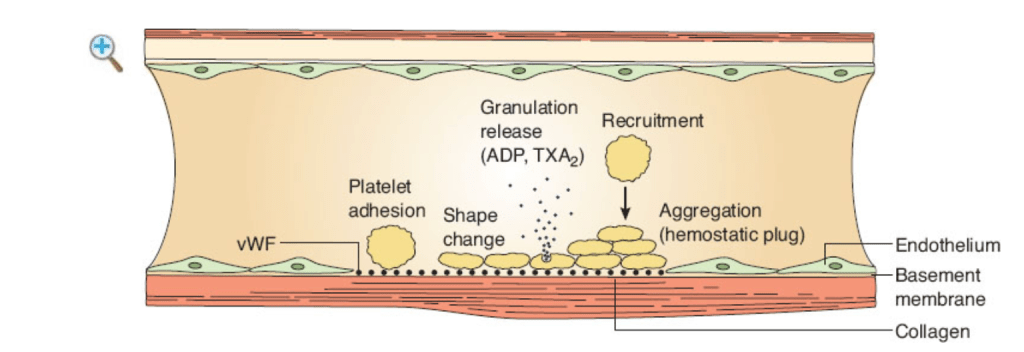
Primary hemostasis is achieved initially with a platelet aggregation as illustrated. Note that platelet adhesion, shape change, granule release followed by recruitment, and the hemostatic plug at the area of subendothelial collagen and collagen exposure are the initial events for thrombus formation.
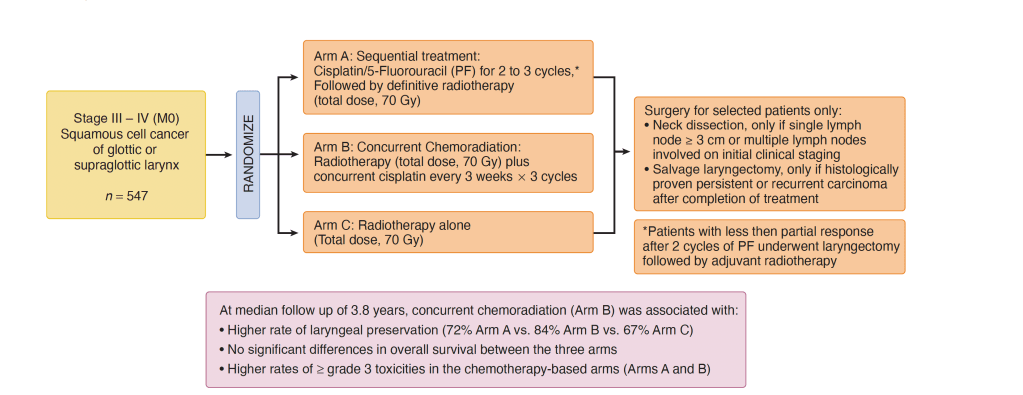
The intergroup Radiation Therapy Oncology Group (RTOG 91–11) trial for advanced larynx cancer established:
Concurrent bolus cisplatin with radiation as a standard of care
I mentioned that the study was open to patients with squamous cell carcinoma of the glottic or supraglottic larynx:
Patients with T1 disease or large-volume T4 disease were excluded
Patients were randomly assigned to one of three larynx preservation strategies:
Induction cisplatin plus 5-FU followed by radiotherapy
Radiotherapy with concurrent cisplatin
Radiotherapy alone
I mentioned that the dose of radiotherapy to the primary tumor and clinically positive nodes was:
70 Gy in all treatment groups
Severe or life-threatening mucositis in the radiation field was:
Almost twice as common in the concurrent treatment group compared with either the radiotherapy alone group or the sequential treatment group
The primary endpoint of the study was:
Preservation of the larynx
The rate of laryngeal preservation was:
84% for patients receiving radiotherapy with concurrent cisplatin versus 72% or patients receiving induction chemotherapy followed by radiation and 67% for patients receiving radiation therapy alone:
At a median follow-up of 3.8 years
Distant metastases were reduced:
In patients who received either concurrent chemoradiotherapy or induction chemotherapy followed by radiotherapy compared with patients who received radiotherapy alone
Overall survival:
Was not significantly different among the three treatment groups
The lack of an overall survival difference between the three groups:
May be due to the contribution of salvage laryngectomy in all groups, as well as a 2% increase in the incidence of death that may have been related to treatment in the concurrent chemoradiotherapy group compared with the other two treatment groups:
It is important to recognize that the primary endpoint of the study was larynx preservation:
Not overall survival
The current standard of care for larynx preservation remains:
Concurrent high-dose cisplatin and radiation for patients who fit the eligibility criteria that were used in RTOG 91–11
Design and results of Radiation Therapy Oncology Group trial 91–11. (Adapted from Forastiere AA, Goepfert H, Maor M, et al. Concurrent chemotherapy and radiotherapy for organ preservation in advanced laryngeal cancer. N Engl J Med 2003;349:2091–2098.)
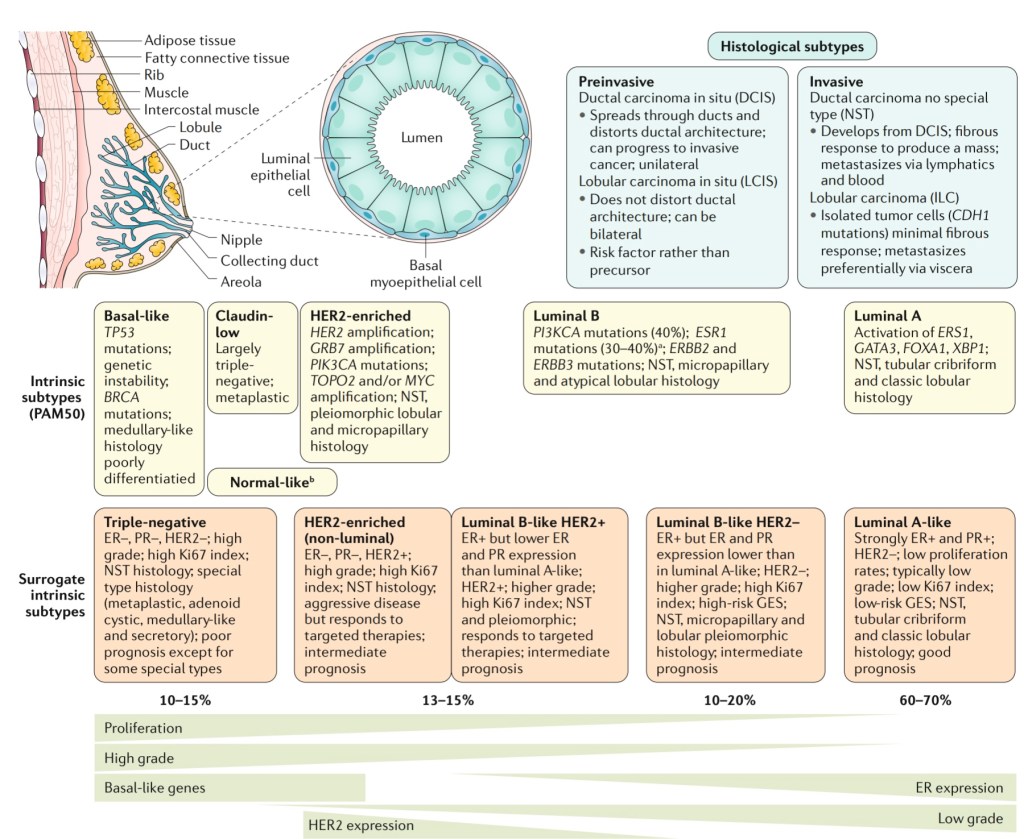
Perhaps one of the most striking advances in breast cancer management and understanding:
Came with the molecular profiling of breast cancer:
Characterizing four distinct subtypes:
Based on the landmark paper by Perou et al., in 2000
These define tumor biology and correlate with outcome and are broadly described as:
Luminal A, luminal B, human epidermal growth factor receptor 2 (HER2)-enriched, and basal like:
According to the most common profiles for each subtype:
However, not all tumors within each subtype contain all features
The estrogen receptor (ER), progesterone receptor (PR), and HER2 receptor:
Are used as surrogates to approximate these subtypes and guide clinical care and management decisions
Luminal A:
Most (80% to 85%) of breast cancers express the estrogen receptor (ER-positive) and / or the progesterone receptor (PR+) (75% to 80%) but not HER2:
These cancers tend to be more indolent than other subtypes
Luminal A tumors are associated with the most favorable prognosis:
Particularly in the short term:
In part because expression of hormone receptors:
Is predictive of a favorable response to hormonal therapy
Luminal B:
These breast cancers are ER-positive and / or PR+:
They are further defined by either:
HER2 amplification, or high Ki-67 (an indicator of cellular proliferation)
They tend to have higher grade and more aggressive features than luminal A breast cancers
HER2-enriched:
These breast cancers produce excess HER2 and do not express hormone receptors
These cancers tend to grow and spread more aggressively than other breast cancers and are associated with poorer short-term prognosis compared to ER-positive breast cancers:
However, the recent widespread use of targeted therapies for HER2-positive cancers:
Has reversed much of the adverse prognostic impact of HER2 overexpression:
With 40% to 70% of women achieving a pathologic complete response to combination chemotherapy and targeted anti-HER2 therapies
Basal like:
These tumors are more biologically aggressive:
They are typically characterized by the lack of the ER, PR, and HER2 receptor
These cancers are often found in:
Premenopausal women
Those with a BRCA1 gene mutation
They are nearly two times more common:
In Black women than White women in US
The majority (> 70%) of triple negative breast cancers:
Fall into the basal-like subtype
Triple negative breast cancers:
Have a poorer short-term prognosis than other breast cancer types:
In part because there are currently no targeted therapies for these tumors:
However, a proportion of these tumors are very chemosensitive, exhibiting a pathologic complete response in up to a third of patients
Furthermore, several molecular subtypes of triple negative breast cancer have been described:
These may provide further insights into the varying biologic response and assist in development of therapeutic targets in addition to chemotherapy
737 patients were randomized to either undergo Halsted mastectomy or extended mastectomy with IM node dissection
After 30 years of follow-up:
There was no difference in overall survival or disease-specific survival:
For the patients eligible with T1, T2, T3, N0, and N1 disease:
Who underwent IM node dissection vs. no IM dissection
A 2019 retrospective review of 95 breast cancer patients with clinically detected IM nodes (IMNs) at diagnosis:
Were treated with surgery and radiation, with median follow-up of 43 months:
77 received neoadjuvant chemotherapy:
With IMN normalization in 67.5%
Partial IMN response in 24.6%
The 5-year IMN failure-free survival, disease-free survival, and overall survival were:
96%, 70%, and 84%, respectively
IMN failure-free survival:
Was significantly affected by:
Resection margin status
Size of IMN
Receipt of IMN boost radiation
A recently published meta-analysis in the Annals of Surgery found that axillary staging following neoadjuvant chemotherapy:
Is best performed with a combination approach of sentinel lymph node biopsy (SLNB) with excision of the pre-chemotherapy-marked positive node:
With a false negative rate of 2% to 4%:
The identification rate was 100%
ACOSOG Z1071:
Reported an overall false negative rate of 12.6% when SLNB was performed after neoadjuvant chemotherapy with documented node-positive disease prior to treatment:
The false-negative rate decreased to 6.8%:
When both sentinel node(s) and the clipped node were retrieved at the time of surgery
References:
Veronesi U, Marubini E, Mariani L, Valagussa P, Zucali R. The dissection of internal mammary nodes does not improve the survival of breast cancer patients. 30-year results of a randomised trial. Eur JCancer. 1999;35(9):1320-1325.
Kim J, Chang JS, Choi SH, et.al. Radiotherapy for initial clinically positive internal mammary nodes in breast cancer. Radiat Oncol J. 2019;37(2):91-100.
Simons JM, van Nijnatten TJA, van der Pol CC, Luiten EJT, Koppert LB, Smidt ML. Diagnostic accuracy of different surgical procedures for axillary staging after neoadjuvant systemic therapy in node-positive breast cancer: a systematic review and meta-analysis. Ann Surg. 2019;269(3):432-442.
Boughey JC, Ballman KV, Le-Petross HT, et al. Identification and resection of clipped node decreases the false-negative rate of sentinel lymph node surgery in patients presenting with nodepositive breast cancer (T0-T4, N1-N2) who receive neoadjuvant chemotherapy: results from ACOSOG Z1071 (Alliance). Ann Surg. 2016;263(5):802-807.
547 patients with stage III to IV (cT2 bulky to cT4) resectable squamous cell carcinoma of the larynx(supraglottic or glottic):
Who were candidates for total laryngectomy
Randomization (3 arms):
Induction PF → RT (Control):
Three cycles cisplatin 100 mg / m² day 1 + 5-FU 1 g/m²/day × 5, followed by definitive RT (66 to 76 Gy) for responders
Concurrent CRT:
RT (70 Gy) + cisplatin 100 mg / m² q3wk ×3
RT Alone:
70 Gy definitive radiation
Primary endpoint:
Laryngectomy-free survival (LFS) and larynx preservation without loss of overall survival (OS)
Interpretation:
Concurrent cisplatin-RT produced the highest larynx-preservation rate and superior laryngectomy-free survival compared with both RT alone and induction PF
No OS advantage for any arm:
Survival curves overlapped
Long-Term and Late Toxicities (Forastiere et al., JCO 2013 update):
Non–cancer deaths:
Cardiopulmonary, treatment-related:
More frequent in the concurrent CRT arm after year 5
Late swallowing dysfunction and chronic aspiration:
Higher with CRT
Highlights need for lifelong surveillance and aggressive supportive care:
Has a mammographic appearance of diffuse architectural distortion:
Usually involving a large area, often larger than a lobe:
With no central tumor mass and no calcifications:
It sometimes has the appearance of a “spider’s web” as shown in the Image
The diffusely infiltrating cancer:
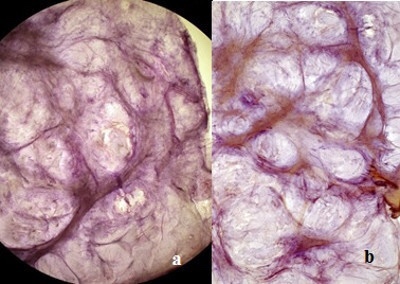
Forms concave contours with the surrounding fat in a manner similar to normal fibroglandular tissue (Images)
Mastectomy slice radiographs (a) and large format 3D histology image (b) showing concave contours similar to normal breast tissue
The imaging findings of diffusely infiltrating breast cancer are strikingly different:
From the imaging findings of breast cancers originating either from the terminal ductal lobular units (TDLUs) or the lactiferous ducts:
Suggesting that it may have a different site of origin
It has been recently proposed that diffusely infiltrating breast cancers:
May originate from mesenchymal stem cells (progenitors):
Through a complex process of both:
Epithelial-mesenchymal transformation and more frequently, mesenchymal-epithelial transformation
The clinical presentation:
Is typically a recently detected, extensive, firm lesion:
Often appearing as an interval cancer following a previous mammogram which was interpreted as normal
On clinical breast examination:
The cancer does not have a distinct tumor mass or focal skin retraction seen in other cancers:
But rather an indistinct “thickening” and eventually a shrinkage of the breast.
In order to make the diagnosis before the development of a palpable mass and a decrease in size of the breast:
The radiologist and breast surgeon must have a high level of suspicion and a thorough knowledge of the underlying pathophysiology
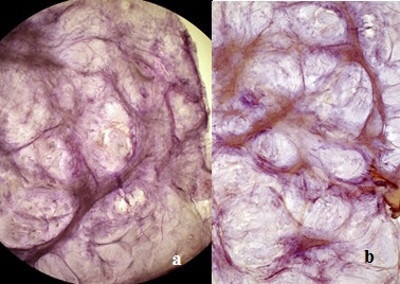
The subgross (3D) histopathology images show how growth of the mesenchymal tissue:
Distorts the normal, harmonious connective tissue framework:
By causing nonuniform thickening of the fine sheets of connective tissue (Images):
Large format subgross (3D) histology images of a diffusely infiltrating breast cancer
The predominance of mesenchyme in the diffusely infiltrating breast malignancy:
Allows it to be imaged with greater sensitivity by ultrasound than by mammography:
The thin sheets or veils of tissue reflect the ultrasound waves:
But are relatively easily penetrated by x-rays
The structural / architectural distortion:
While difficult to detect mammographically:
Is readily detectable on 2-mm thick coronal sections of automated breast ultrasound (Image)
3D automated ultrasound images
The 2-mm thick multi-slice series demonstrate the extensive architectural distortion, corresponding to the 3D histology:
Large format subgross (3D) histology images of a diffusely infiltrating breast cancer
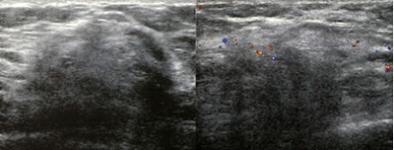
The hypoechoic changes can also usually be seen on hand held ultrasound, Image:
Hand-held ultrasound of diffusely infiltrating carcinoma
The growth pattern and cell type of diffusely invasive breast cancer:
Is very similar to that of diffuse gastric carcinoma (linitis plastica), and both of these diseases can be associated with:
A deleterious mutation in the CDH1 gene:
Which is located on chromosome 16q22 and codes for e-cadherin protein (Image):
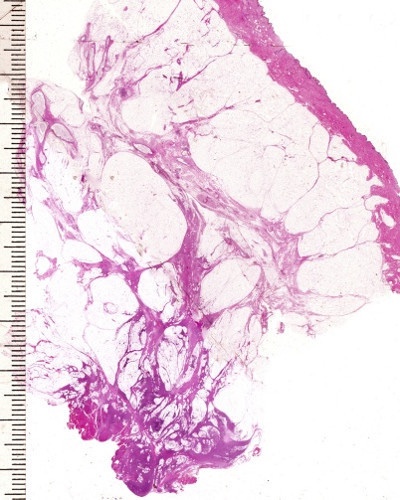
Large format histology slide of diffusely infiltrating breast cancer similar to growth pattern of linitis plastica
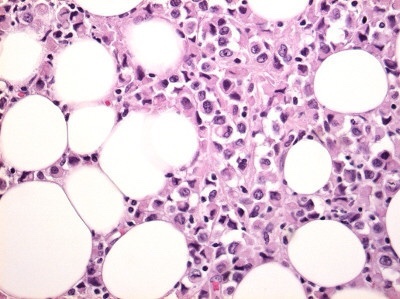
High-power histology of pleomorphic infiltrating breast cancer with cell type similar to linitis plastica.
Stain negative for e-cadherin.
CDH1 was initially known as a susceptibility gene for diffuse gastric cancer (linitis plastica)
The histopathologic characteristics of diffuse gastric cancer:
Show similarities with e-cadherin negative:
Diffusely infiltrating breast cancer (infiltrating “lobular” carcinoma)
The neoplastic cells permeate the mucosa and wall as scattered individual signet-ring cells or small clusters of cells in an infiltrative growth pattern
Since there are no TDLUs in the stomach:
If the similar cells in both conditions associated with CDH1 have a common origin, it could not be a TDLU:
Raising the possibility that they could result from mesenchymal cell transformation in both organs
👉Rodrigo Arrangoiz MS, MD, FACS, FSSO cirujano oncology y cirujanode mamáde en Mount Sinai Medical Center:
Es experto en el manejo del cáncer de mama
👉Esmiembrode la American Society of Breast Surgeons:
Training:
• General surgery:
• Michigan State University:
• 2004 al 2010
• Surgical Oncology / Head and Neck Surgery / Endocrine Surgery:
• Fox Chase Cancer Center (Filadelfia):
• 2010 al 2012
• Masters in Science (Clinical research for health professionals):
• Drexel University (Filadelfia):
• 2010 al 2012
• Surgical Oncology / Head and Neck Surgery / Endocrine Surgery:
• IFHNOS / Memorial Sloan Kettering Cancer Center:

















 Rodrigo Arrangoiz MS, MD, FACS, FSSO