• The National Cancer Institute of Canada Clinical Trials Group (NCIC-CTG) MA.20 trial:
    • Randomized 1,832 high-risk women:
      • Who were treated with breast-conserving surgery and sentinel node biopsy (SLNB) or axillary lymph node dissection (ALND):
        • To either WBI alone or WBI plus regional nodal irradiation (RNI)
    • Axillary lymph node dissection:
      • Was required for any patients with a positive SLN
    • RNI included:
      • The internal mammary, supraclavicular, and high axillary nodes
    • The trial enrolled patients with:
      • Node-positive or high-risk node-negative disease:
        • 85% of patients had 1 to 3 positive nodes
        • 5% had more than 4 positive nodes
        • 10% were node negative
    • Node-negative patients with tumors greater than or equal to 2 cm who had fewer than 10 axillary nodes removed were considered high risk if they had at least one of the following:
      • ER negative
      • Lymphovascular invasion
      • Nuclear grade 3
    • All patients had systemic therapy
  • With a median follow-up of 10 years:
    • The addition of RNI improved:
      • Locoregional DFS from:
        • 92.2% to 95.2% (P=0.009)
      • Distant DFS from:
        • 82.4% to 86.3% (P=0.03)
    • There was no difference in OS from:
      • 81.8% to 82.8% (P=0.38)
    • The addition of RNI to WBI was associated with:
      • An increase in:
        • Grade 2 or greater pneumonitis from:
          • 0.2% to 1.2% (P=0.01)
        • Lymphedema from:
          • 4.5% to 8.4% (P=0.001)
  • Similarly, European Organisation for Research and Treatment of Cancer (EORTC) 22922:
    • Randomized 4004 women undergoing breast-conserving surgery or mastectomy and ALND for histological stage I, II, or III breast cancer to:
      • RNI (supraclavicular and internal mammary nodal irradiation) or no regional nodal irradiation
    • At a median follow-up of 10.9 years:
      • The addition of regional nodal irradiation improved:
        • DFS from:
          • 69.1% to 72.1% (P=0.04)
        • Again, there was a non-significant trend toward improvement in OS from:
          • 80.7% to 82.3% (P=0.06 among the RNI group
  • The results of NCIC CTG MA.20 have led many to conclude that:
    • All patients with axillary nodal metastases, regardless of tumor size or extent of nodal involvement:
      • Should receive comprehensive nodal radiation therapy (RT)
  • A major conundrum in current practice is resolving the apparently contradictory findings of American College of Surgeons Oncology Group (ACOSOG) Z0011 and After Mapping of the Axilla, Radiation or Surgery? (AMAROS) with those of NCIC CTG MA.20:
    • The modest benefit in DFS with nodal RT in NCIC CTG MA.20:
      • May reflect differences in patient populations between the studies:
        • Patients with clinically positive nodes were excluded from ACOSOG Z0011 and AMAROS (and not MA.20)
        • In addition, fewer than 10 nodes were removed in one-third of patients in the NCIC CTG MA.20 study and the median node count was 12:
          • Compared to a median of 17 in the ALND arms of Z0011 and AMAROS:
            • The benefit of nodal RT therefore may be limited to higher risk patients with more extensive nodal disease and perhaps more limited axillary surgery

References

1. Poortmans PM, Collette S, Kirkove C, Limbergen EV, Budach V, Struikmans H, et al. Internal mammary and medial supraclavicular irradiation in breast cancer. N Engl J Med. 2015;37(4)3:317-327.

2. Pepels MJ, de Boer M, Bult P, van Dijck A, van Deurzen CH, Menke-Pluymers MB, et al. Regional recurrence in breast cancer patients with sentinel node micrometastases and isolated tumor cells. Ann Surg. 2012;255(1):116-121.

3. Whelan TJ, Olivotto IA, Parulekar WR, Ackerman I, Chua BH, Nabid A, et al; MA.20 Study Investigators. Regional nodal irradiation in early-stage breast cancer. N Engl J Med. 2015;373(4):307-316.

Cancer Surgeon
Surgical Excellence / Excelencia Quirúrgica
  • The ACOSOG Z1071 trial:
    • Was designed to determine the false negative rate (FNR) of sentinel lymph node biopsy (SLNB) after neoadjuvant chemotherapy (NAC) in women initially presenting with cN1 disease
  • The trial enrolled women from 136 institutions who had clinical T0 through T4, N1 through N2, M0 breast cancer who received neoadjuvant chemotherapy
  • Patients enrolled had pre-chemotherapy axillary nodal disease confirmed by fine-needle aspiration or core needle biopsy
  • Following NAC, patients underwent both SLNB, followed by a back-up axillary lymph node dissection
  • SLNB with dual tracer using both blue dye (isosulfan blue or methylene blue) and a radiolabeled colloid mapping agent was encouraged
  • Rates of detection of at least one SLN were:
    • 92.9% in patients with cN1 disease and 89.5% in patients with cN2 disease
  • Overall, the FNR of SLNB after NAC was 12.6%
  • Bivariable analyses found that the likelihood of a false-negative SLN finding was significantly decreased:
    • When the mapping was performed with the combination of blue dye and radiolabeled colloid (P=.05; FNR, 10.8% combination vs 20.3% single agent) and by removal of at least 3 SLNs (P=.007; FNR, 9.1% for ≥3 SLNs vs 21.1% for 2):
      • A clip was placed at initial node biopsy prior to NAC in 203 patients:
        • In the 170 (83.7%) patients with cN1 disease and at least 2 SLNs resected, clip location was confirmed in 141 cases
        • In 107 (75.9%) patients where the clipped node was within the SLN specimen;
          • The FNR was 6.8% (confidence interval [CI]: 1.9%-16.5%)
      • If the clipped node was found in the ALND specimen:
        • The FNR was 19.0% (CI: 5.4%-41.9%)
      • In cases where a clip was not placed (n = 355) and in those where the clipped node location was not confirmed at surgery (n = 29):
        • The FNR was 13.4% and 14.3%, respectively
  • While the FNR overall exceeded the 10% threshold considered to be clinically acceptable, the authors concluded that with modifications to the SLN technique (i.e., dual tracer mapping and retrieval of at least 3 negative SLNs):
    • To the FNR was less than 10% and supported the use of SLN surgery as an alternative to axillary lymph node dissection in this patient population
  • Subsequently, Caudle et al have reported a separate registry of 191 patients and showed that removing the clipped positive node in addition to SLN had an FNR as low as 2.0%
  • References
    • Boughey JC, Suman VJ, Mittendorf EA, Ahrendt GM, Wilke LG, Taback B, et al.; Alliance for Clinical Trials in Oncology. Sentinel lymph node surgery after neoadjuvant chemotherapy in patients with node-positive breast cancer: the ACOSOG Z1071 (Alliance) clinical trial. JAMA. 2013;310(14):1455-1461.
    • Boughey JC, Ballman KV, Le-Petross HT, McCall LM, Mittendorf EA, Ahrendt GM, et al. Identification and resection of clipped node decreases the false-negative rate of sentinel lymph node surgery in patients presenting with node-positive breast cancer (T0-T4, N1-N2) who receive neoadjuvant chemotherapy: results from ACOSOG Z1071 (Alliance). Ann Surg. 2016;263(4):802-807.
    • Caudle AS, Yang WT, Krishnamurthy S, Mittendorf EA, Black DM, Gilcrease MZ, et al. Improved axillary evaluation following neoadjuvant therapy for patients with node-positive breast cancer using selective evaluation of clipped nodes: implementation of targeted axillary dissection. J Clin Oncol. 2016;34(10):1072-1078.
#Arrangoiz #CancerSurgeon #SurgicalOncologist #BreastSurgeon #MountSinaiMedicalCenter #MSMC #Miami #Mexico

Postoperative Seroma Following Inguinal Lymphadenectomy

  • Seroma:
    • Is the most common complication following inguinal lymphadenectomy
  • Closed-suction drains:
    • Are recommended in an attempt to prevent seroma formation
  • Guidelines do not exist for duration of drainage:
    • However, most literature suggests keeping drains in place until output decreases to less than 30 cc/day:
      • Which usually occurs 1 to 2 weeks following surgery
  • References:
    • Delman KA, Mansfield PF, Lee JE. Indications and techniques of regional lymphadenectomy. In: Curley SA, Pollock RE, Ross MI, eds. Advanced Therapy in Surgical Oncology. Hamilton, Ontario: BC Decker Inc, 2008:771-782.
    • Operative Standards for Cancer Surgery: Volume 2. Ch. 10: Neck, Axillary, Ilioinguinal, and Other Lymph Node Dissections.

Margins after Breast Conserving Surgery for Invasive Breast Cancer and DCIS

  • In 2013 the Society of Surgical Oncology (SSO) and American Society for Radiation Oncology (ASTRO):
    • Convened a multidisciplinary expert panel to review the available evidence regarding margin width and Ipsilateral breast tumor recurrence (IBTR) in patients with invasive cancer having breast conservation therapy
  • Meta-analysis and secondary data from prospective and retrospective trials led them to conclude that:
    • Positive margins (defined as ink on invasive cancer) is associated with:
      • At least a 2-fold increase in IBTR
    • Among patients with negative margins:
      • A margin width of no ink on tumor represent the optimal margin width to minimize the risk of IBTR:
        • Notably the routine practice of obtaining wider negative margins than no ink on tumor is not indicated
    • While younger age is associated with both:
      • Increased IBTR after breast-conserving therapy as well as increased local chest wall relapse after mastectomy:
        • There is no evidence that increased margin width (over no ink on tumor) nullifies this increased risk of IBTR in younger patients
  • In 2016, margin guidelines related to the treatment of non-invasive breast cancer (DCIS) in the setting of breast conservation therapy were developed by the SSO, ASTRO, and American Society of Clinical Oncology (ASCO) in a similar manner
    • A consensus statement released by a multidisciplinary panel included the optimal margins for pure ductal carcinoma in situ (DCIS) and mixed tumors (invasive and non-invasive components within the same tumor) in the setting of breast conservation
    • Results from the meta-analysis showed that:
      • A 2 mm margin decreases the risk of IBTR in pure DCIS compared to closer negative margins
    • This differs from the previous margin recommendation for invasive cancer, which remains no ink on tumor:
      • However, in the setting of mixed tumors (invasive cancer with a DCIS component) the recommendation for negative margins remains no ink on tumor:
        • As patients with mixed disease are treated as invasive cancer and therefore receive systemic therapy more often than pure DCIS patients
      • In the setting of DCIS with micro-invasion (no focus of invasive disease larger than 0.1 cm):
        • The multidisciplinary panel recommends a 2 mm margin:
          • As these lesions have similar rates of IBTR as pure DCIS
  • References
    • Moran MS, Schnitt SJ, Giuliano AE, Harris JR, Khan SA, Horton J, et al. Society of Surgical Oncology-American Society for Radiation Oncology consensus guideline on margins for breast-conserving surgery with whole-breast irradiation in stages I and II invasive breast cancer. Int J Radiat Oncol Biol Phys. 2014;88(3):553-564.
    • Morrow M, Van Zee KJ, Solin LJ, Houssami N, Chavez-MacGregor M. et al. Society of Surgical Oncology-American Society for Radiation Oncology-American Society of Clinical Oncology Consensus Guideline on margins for breast-conserving surgery with whole-breast irradiation in ductal carcinoma in situ. J Clin Oncol. 2016;34(33):4040-4046.

ACOSOG Z1071 Trial


  • The ACOSOG Z1071 trial:

    • Was designed to determine the false negative rate (FNR) of:

      • Sentinel lymph node (SLN) surgery after chemotherapy:
        • 
In women initially presenting with cN1 disease
    • It enrolled women from 136 institutions:

      • Who had clinical:
        • T0 through T4
        • N1 through N2
        • M0 breast cancer
      • Who received neoadjuvant chemotherapy
      • Patients enrolled had:
        • Pre-chemotherapy axillary nodal disease confirmed by:
          • Fine-needle aspiration or
          • Core needle biopsy
      • Following chemotherapy:
        • Patients underwent:
          • Both SLN surgery and axillary lymph node dissection
        • Sentinel lymph node surgery was using both:
          • Blue dye (isosulfan blue or methylene blue) and a radiolabeled colloid mapping agent:
            • Was encouraged
      • Rates of detection of at least:
        • One SLN were:
          • 92.9% in patients:
            • With cN1 disease and
          • 89.5% in patients:
            • With cN2 disease
      • Overall the FNR of SLN:
        • After neoadjuvant chemotherapy was:
          • 12.6%, 90% Bayesian Credible Interval, 9.85%–16.05%
      • Bi-variable analyses found that:
        • The likelihood of a false-negative SLN finding was significantly decreased – when the mapping was performed:
            • With the combination of blue dye and radiolabeled colloid:
              • P=.05; FNR:
                • 10.8% combination vs 20.3% single agent and
              • By examination of at least 3 SLNs:
                • P=.007; FNR:
                  • 9.1% for ≥3 SLNs vs 21.1% for 2
      • While the study overall did not meet the predetermined acceptability threshold of:
        • Post-neoadjuvant SLN biopsy FNR being 10% or less:
          • The authors concluded that:

            • Changes in approach and patient selection:
  • Resulted in a greater sensitivity that would be necessary to support the use of SLN surgery as an alternative to axillary lymph node dissection in this patient population
  • References:
    • Boughey JC, Suman VJ, Mittendorf EA, et al; Alliance for Clinical Trials in Oncology. Sentinel lymph node surgery after neoadjuvant chemotherapy in patients with node-positive breast cancer: the ACOSOG Z1071 (Alliance) clinical trial. JAMA. 2013;310:1455-1461.
#Arrangoiz #CancerSurgeon #BreastSurgeon #SurgicalOncologist #Miami #MSMC #MountSinaiMedicalCenter #Mexico

Clinically Evident Nodal Metastatic Melanoma

  • The Multicenter Selective Lymphadenectomy Trial 2 (MSLT-2) was published in June 2017:
    • Which evaluated completion lymphadenectomy versus active surveillance (with dissection if disease were identified):
      • Following positive sentinel lymph node biopsies for metastatic melanoma
    • It is important to remember this was for clinically-occult nodal disease only
  • The standard of care for clinically-evident (palpable or radiographic) nodal metastatic melanoma is:
    • Lymphadenectomy
  • References:
    • van Akkooi CJA. Surgical and Anatomic Considerations of Malignancies Affecting the Groin: Consideration for Melanoma. In: Delman K, Master V, eds. Malignancies of the Groin. Cham, Switzerland: Springer, 2018:63-74.
    • Song Y, Karakousis GC. Melanoma of Unknown Primary. J Surg Oncol. 2019; 119 (2) 232-241.

In Transit Metastasis as the Presentation of Cutaneous Melanoma

  • Patients presenting with this scenario:
    • Have a 50% to 75% chance of having other distant metastatic disease:
      • So the first step in management:
        • Is to assess for distant disease
      • In the absence of distant disease:
        • In patients with low-volume disease:
          • Resection is indicated:
            • If SNLB has not been performed:
              • SLNB should be strongly considered for prognostic and possible therapeutic benefit (Beasley)
        • Adjuvant treatment with PD-1:
          • Therapy should also be considered:
            • Given results of checkmate 238:
              • Which demonstrated 12-month recurrence-free survival of:
                • 70.5% in resected stage III melanoma patients receiving nivolumab (Weber).
  • References:
    • Beasley GM, Hu Y, Youngwirth L, et al. Sentinel lymph node biopsy for recurrent melanoma: A multicenter study. Ann Surg Oncol. 2017;24:2728-2733.
    • Weber J, Mandala M, Del Vecchio M, et al. Adjuvant nivolumab versus ipilimumab in resected stage III or IV melanoma. N Engl J Med. 2017;Sept 10.

Preoperative vs Postoperative Chemotherapy

  • The NSABP B-18 trial:
    • Evaluated whether four cycles of doxorubicin and cyclophosphamide (AC) given preoperatively:
      • Improved DFS and OS when compared with the same regimen given postoperatively
    • Results showed no statistically significant differences in DFS or OS between the two groups
    • Secondary aims included:
      • The evaluation of preoperative chemotherapy in down staging the primary breast tumor and involved axillary lymph nodes:
        • With preoperative chemotherapy:
          • 13% of patients achieved pCR
          • Patients who received preoperative chemotherapy were more likely to receive breast-conserving surgery (67% vs. 60%, P=0.002) than patients receiving postoperative chemotherapy
  • The NSABP B-27 trial:
    • Evaluated the addition of docetaxel (T) either preoperatively or postoperatively to preoperative AC chemotherapy
    • These results showed that the addition of T:
      • Did not significantly impact DFS or OS, but when given preoperatively:
        • Significantly increased the number of patients who achieved a pathologic complete response (pCR) (26% v 13%, p<0.0001)
  • In both studies, patients who achieved a pCR had significantly improved DFS and OS compared to those who did not (P=0.0001).4
  • References:
    • Fisher B, Brown A, Mamounas E, Wieand S, Robidoux A, Margolese RG, et al. Effect of preoperative chemotherapy on local-regional disease in women with operable breast cancer: findings from National Surgical Adjuvant Breast and Bowel Project B-18. J Clin Oncol. 1997;15(7):2483- 2493.
    • Wolmark N, Wang J, Mamounas E, Bryant J, Fisher B. Preoperative chemotherapy in patients with operable breast cancer: nine-year results from National Surgical Adjuvant Breast and Bowel Project B-18. J Natl Cancer Inst Monogr. 2001(30):96-102.
    • Bear HD, Anderson S, Smith RE, Geyer CE, Mamounas EP, Fisher B, et al. Sequential preoperative or postoperative docetaxel added to preoperative doxorubicin plus cyclophosphamide for operable breast cancer: National Surgical Adjuvant Breast and Bowel Project Protocol B-27. J Clin Oncol. 2006;24(13):2019-2027.
    • Rastogi P, Anderson SJ, Bear HD, Geyer CE, Kahlenberg MS, Robidoux A, et al. Preoperative chemotherapy: updates of National Surgical Adjuvant Breast and Bowel Project Protocols B-18 and B-27 J Clin Oncol. 2008;26(5):778-785.

What is the Best Way to Administer Chemotherapy in Breast Cancer Patients?

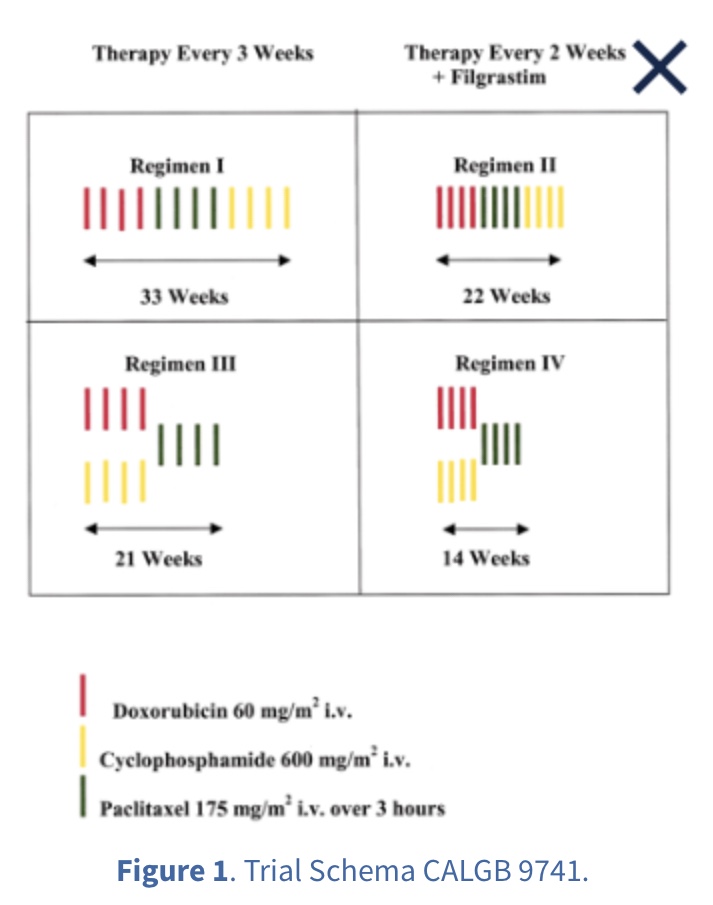
  • The National Cancer Institute’s Breast Intergroup INT C9741 and CALGB 9741 trial published in 2003:
    • Evaluated combination chemotherapy for breast cancer given by both dose dense and sequential therapy
    • The goal of the study was to evaluate the best way to administer the chemotherapy regimen:
      • Doxorubicin (A), cyclophosphamide (C) followed by paclitaxel (T)
    • The study assessed chemotherapy administration in a:
      • Dose dense fashion (2 weeks vs. 3 weeks) and treatment sequence (concurrent versus sequential)
  • Dose-dense chemotherapy refers to:
    • Decreasing the interval between cycles of treatment without the need of increasing doses and toxicity
  • Sequential therapy refers to:
    • The administration of treatments one at a time rather than concurrently
  • National Cancer Institute’s Breast Intergroup INT C9741 and CALGB 9741 trial:
    • Was a prospective, randomized trial designed to study adjuvant chemotherapy treatment regimens in women with axillary node-positive breast cancer conducted from September 1997 to March 1999
    • Doxorubicin (A), paclitaxel (T), and cyclophosphamide (C) were chosen for this study
    • Using a 2 x 2 factorial design, patients were assigned to receive one of the following four regimens:
      • Sequential A then C followed by T x 4 cycles every 3 weeks,
      • Dose-dense, sequential A then C then T x 4 cycles every 2 weeks with filgrastim
      • Concurrent AC x 4 cycles followed by T x 4 cycles every 3 weeks
      • Dose-dense, concurrent AC x 4 cycles followed by T x 4 cycles every 2 weeks with filgrastim
    • Results showed that dose-dense treatment improved the primary endpoints of disease-free survival (DFS) and overall survival (OS):
      • Four-year DFS was 82% for dose-dense regimens and 75% for other groups (risk ratio, 0.74, P=0.01)
      • Three-year OS was 92% for dose-dense regimens and 90% in other groups (risk ratio, 0.69, P=0.013)
      • There was no difference in either DFS or OS between the concurrent and sequential schedules
      • Severe neutropenia was less common in patients who received the dose-dense regimens
      • As a result of this study:
        • Dose-dense and concurrent AC chemotherapy has become one of the standard components of breast cancer therapy

References

1. Citron ML, Berry DA, Cirrincione C, Hudis C, Winer EP, Gradishar WJ, et al. Randomized trial of dose-dense versus conventionally scheduled and sequential versus concurrent combination chemotherapy as postoperative adjuvant treatment of node-positive primary breast cancer: first report of Intergroup Trial C9741/Cancer and Leukemia Group B Trial 9741. J Clin Oncol. 2003;21(8):1431-1439.

2. Orzano JA, Swain SM. Concepts and clinical trials of dose-dense chemotherapy for breast cancer. Clin Breast Cancer. 2005;6(5):402-411

PRIME II Trial Omission of Adjuvant Radiation Therapy after BCT in Women ≥ 65 years

  • The phase III PRIME II trial has shown a higher risk of local recurrence with the omission of adjuvant radiotherapy after breast-conserving surgery in patients aged ≥ 65 years with hormone receptor–positive, node-negative disease who were receiving adjuvant endocrine therapy.
  • No difference in the risk of distant recurrence as the first recurrence event or overall survival was observed.
  • Study Details: The trial included 1,326 patients from sites in the United Kingdom (n = 1,263), Greece, Australia, and Serbia with T1 or T2 primary breast cancer (with tumors ≤ 3 cm in the largest dimension) who received breast-conserving surgery with clear excision margins and adjuvant endocrine therapy.
  • Patients were randomly assigned between April 2003 and December 2009 to whole-breast irradiation at 40 to 50 Gy in 20 to 25 fractions (n = 658) or no irradiation (n = 668).
  • Tamoxifen at 20 mg per day for 5 years was recommended as standard adjuvant endocrine therapy.
  • The primary endpoint was local breast cancer recurrence.
  • Key Findings: Median follow-up was 9.1 years. At 10 years, the cumulative incidence of local recurrence was 9.5% (95% confidence interval [CI] = 6.8%–12.3%) in the no-radiotherapy group vs 0.9% (95% CI = 0.1%–1.7%) in the radiotherapy group (hazard ratio = 10.4, 95% CI = 4.1–26.1, P < .001).
  • The 10-year cumulative incidence of distant recurrence as the first recurrence event was 1.6% (95% CI = 0.4%–2.8%) in the no-radiotherapy group vs 3.0% (95% CI = 1.4%–4.5%) in the radiotherapy group.
  • For the no-radiotherapy group vs the radiotherapy group, 10-year rates were:
  • 68.9% (95% CI = 64.7%–73.0%) vs 76.3% (95% CI = 72.5%–80.2%) for disease-free survival
  • 80.8% (95% CI = 77.2%–84.3%) vs 80.7% (95% CI = 76.9%–84.3%) for overall survival
  • 97.4% (95% CI = 96.0%–98.8%) vs 97.9% (95% CI = 96.5%–99.2%) for breast cancer–specific survival.
  • The investigators concluded: Omission of radiotherapy was associated with an increased incidence of local recurrence but had no detrimental effect on distant recurrence as the first event or overall survival among [patients] 65 years of age or older with low-risk, hormone receptor–positive early breast cancer.