Risk Reducing Salpingo-Oophorectomy (RRSO) in BRCA Carriers

  • BRCA 1 carriers:
    • Are at increased risk of:
      • Breast
      • Ovarian
      • Prostate
      • Pancreatic cancer
      • Melanoma
  • RRSO is recommended between:
    • Ages 35 to 40 in BRCA 1
    • Ages 40 to 45 in BRCA2 carriers, or
      • When done having children
  • RRSO has been shown to reduce the risk of breast cancer:
    • In premenopausal women by about 50%
  • RRSO has also been shown to reduce the risk of ovarian cancer by 80%
  • In women who have not undergone RRSO, surveillance with CA 125 and pelvic ultrasound:
    • May be considered at the clinician’s discretion beginning ages 30 to 35
  • References
    • NCCN Guideline with NCCN Evidence Blocks™ – Breast Cancer Version 4.2024. National Comprehensive Cancer Network website. https://www.nccn.org/professionals/physician_gls/recently_updated.aspx. Accessed August 16, 2024.
    • Rebbeck TR, Kauff ND, Domchek SM. Meta-analysis of risk reduction estimates associated with risk-reducing salpingo-oophorectomy in BRCA1 or BRCA2 mutation carriers. J Natl Cancer Inst. 2009;101(2):80-87

Interrupting Endocrine Therapy to Attempt Pregnancyafter Breast Cancer

  • N Engl J Med 2023;388:1645-1656
  • Background:
    • Prospective data on the risk of recurrence among women with hormone receptor–positive early breast cancer who temporarily discontinue endocrine therapy to attempt pregnancy are lacking
  • Methods:
    • They conducted a single-group trial in which they evaluated the temporary interruption of adjuvant endocrine therapy to attempt pregnancy in young women with previous breast cancer
    • Eligible women were who desired to get pregnant were:
      • 42 years of age or younger
      • Had had stage I, II, or III disease
      • Had received adjuvant endocrine therapy for 18 to 30 months
    • The primary end point was the number of breast cancer events:
      • Defined as local, regional, or distant recurrence of invasive breast cancer or new contralateral invasive breast cancer during follow-up
    • The primary analysis was planned to be performed after 1600 patient-years of follow-up
    • The prespecified safety threshold was the occurrence of 46 breast cancer events during this period
    • Breast cancer outcomes in this treatment interruption group were compared with those in an external control cohort consisting of women who would have met the entry criteria for the current trial
  • Results:
    • Among 516 women:
      • The median age was 37 years
      • The median time from breast cancer diagnosis to enrollment was 29 months
      • 93.4% had stage I or II disease
    • Among 497 women who were followed for pregnancy status, 368 (74.0%) had at least one pregnancy and 317 (63.8%) had at least one live birth
    • In total, 365 babies were born
    • At 1638 patient-years of follow-up (median follow-up, 41 months):
      • 44 patients had a breast cancer event, a result that did not exceed the safety threshold
    • The 3-year incidence of breast cancer events was 8.9% (95% confidence interval [CI], 6.3 to 11.6) in the treatment-interruption group and 9.2% (95% CI, 7.6 to 10.8) in the control cohort
  • Conclusions:
  • Among select women with previous hormone receptor–positive early breast cancer, temporary interruption of endocrine therapy to attempt pregnancy did not confer a greater short-term risk of breast cancer events, including distant recurrence, than that in the external control cohort
  • Further follow-up is critical to inform long-term safety

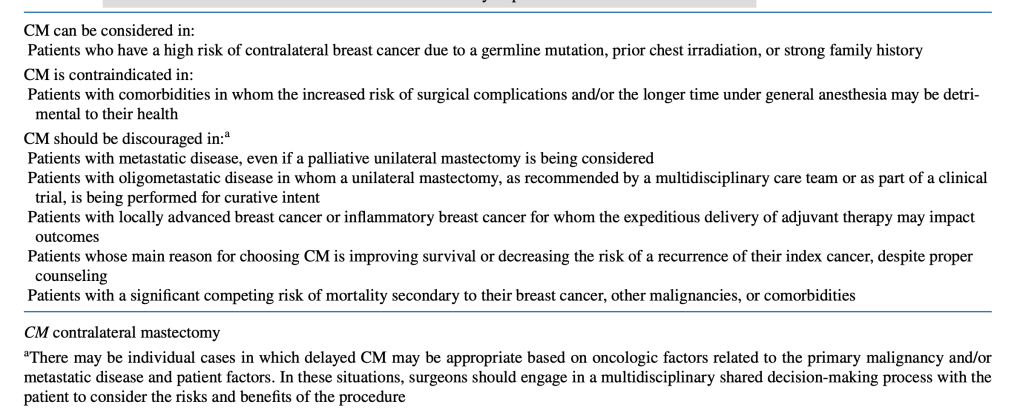
Contralateral Mastectomy (CM) for Breast Cancer Indications

  • Recommendations for the use of contralateral mastectomy in patients with unilateral breast cancer

Subareolar Abscesses

  • Subareolar abscesses:
    • Are a common type of nonlactational abscess
  • The pathophysiology:
    • Is believed to be keratin plugging of the lactiferous ducts:
      • Resulting in squamous metaplasia
    • The periductal inflammation that results can progress to abscess formation
  • A nipple cleft is an anatomic variant that seems to be associated with the condition:
    • Also known as Zuska’s disease
  • Because of their chronic nature including the formation of fistulas:
    • Their management involves different considerations than the management of lactational abscesses
  • Aspiration:
    • Is an appropriate practice for initial management of small non-loculated lactational and nonlactational abscesses
  • When aspiration is possible:
    • More invasive and painful procedures such as incision and drainage with postoperative daily wound packing are less appropriate as an initial step:
      • However, an abscess managed with aspiration may require serial procedures
  • Data from several small studies have demonstrated that:
    • Between 37% and 60% of abscesses will require more than one aspiration procedure
  • Aspiration is less likely to be successful for:
    • Larger abscesses
    • Multiloculated abscesses
    • Abscesses with a delay in presentation greater than 6 days
  • Antibiotics:
    • Should always be prescribed, and the likelihood of MRSA should be taken into account when choosing an initial antibiotic until culture results are available
    • Recurrent subareolar abscesses:
      • May also require anaerobic antibiotic coverage
        • For example, trimethoprim-sulfamethoxazole prescribed with metronidazole may be a good initial choice
    • Only a minority of abscesses are treated successfully with antibiotics alone without a drainage procedures
  • Surgical excision of a chronic subareolar abscess cavity:
    • May be indicated to prevent repeated episodes and there has been debate over the most appropriate specific technique
    • Removal of the terminal ducts appears to be an important step in decreasing recurrences
    • Therefore, procedures that remove only the abscess cavity but do not remove these ducts and the fistula tract will be less successful
    • Radial elliptical incision of the involved ductal tissue and fistula tract, including excision of the central nipple, so as to include the nipple cleft in the excision, has been shown to have a high rate of success
    • Removal of the terminal ducts through a periareolar incision, also called Hadfield’s procedure, has had a higher recurrence rate in small case studies
    • Ultrasound-guided percutaneous needle electrolysis causing tissue ablation within the fistula is an experimental procedure
  • Smoking is a risk factor for development of subareolar abscesses, and smoking cessation should be encouraged:
    • However, smoking is not a contraindication to surgery and should not be a barrier to proceeding
  • References
    • Snider HC. Management of mastitis, abscess, and fistula. Surg Clin North Am. 2022;102(6):1103-1116. doi:10.1016/j.suc.2022.06.007
    • Lam E, Chan T, Wiseman SM. Breast abscess: evidence based management recommendations. Expert Rev Anti Infect Ther. 2014;12(7):753-762. doi:10.1586/14787210.2014.913982
    • Barron AU, Luk S, Phelan HA, Williams BH. Do acute-care surgeons follow best practices for breast abscess management? A single-institution analysis of 325 consecutive cases. Journal of Surgical Research. 2017;216:169-171. doi:https://doi.org/10.1016/j.jss.2017.05.013
    • Naeem M, Rahimnajjad MK, Rahimnajjad NA, Ahmed QJ, Fazel PA, Owais M. Comparison of incision and drainage against needle aspiration for the treatment of breast abscess. Am Surg. 2012;78(11):1224-7. 
    • David M, Handa P, Castaldi M. Predictors of outcomes in managing breast abscesses-a large retrospective single-center analysis. Breast J. 2018;24(5):755-763. doi:10.1111/tbj.13053

Genetic Mutation in Male Breast Cancer

  • Approximately 10% of male breast cancers:
    • Are associated with genetic mutations
  • BRCA2 is the most common among the mutations:
    • With a lifetime risk of 5% to 10% among BRCA2 carriers
  • Klinefelter’s:
    • Is also associated with an increased risk of male breast cancer:
      • With an incidence between 3% and 7%
  • All male breast cancer patients:
    • Should be referred for genetic counseling and testing.
  • References
    • Korde LA, Zujewski JA, Kamin L, et al. Multidisciplinary meeting on male breast cancer: summary and research recommendations. J Clin Oncol. 2010;28(12):2114-2122.
    • Giordano SH. Breast cancer in men. N Engl J Med. 2018;378(24):2311-2320.

Male Breast Cancer

  • Male breast cancer:
    • Accounts for less than 1% of all breast cancers
  • There have been no randomized control trials:
    • For surgical management of breast cancer in men
  • Although breast conservation is increasing:
    • The current surgical management remains:
      • Simple mastectomy with sentinel lymph node biopsy:
      • Sentinel lymph node biopsy has been demonstrated to be accurate in men
  • There are no data to support staging studies:
    • Such as positron emission tomography (PET) or computed tomography (CT):
      • In early-stage breast cancer in either men or women
  • The role of the 21-gene signature assay:
    • Is an emerging field in male breast cancer
    • There is no role for this assay without nodal evaluation
  • References
    • Fentiman IS. Surgical options for male breast cancer. Breast Cancer Res Treat. 2018;172(3):539-544.
    • Gentilini O, Chagas E, Zurrida S, Intra M, De Cicco C, Gatti G, et al. Sentinel lymph node biopsy in male patients with early breast cancer. Oncologist. 2007;12(5):512-515.
    • Massarweh SA, Sledge GW, Miller DP, McCullough D, Petkov VI, Shak S. Molecular characterization and mortality from breast cancer in men. J Clin Oncol 2018;36:1396-1404.
    • Giordano SH. Breast cancer in men. N Engl J Med. 2018;378(24):2311–2320.

Factors that Could Lead to Omission of Post Mastectomy Radiation Therapy (PMRT)

  • Although there are proven benefits for the application of radiation therapy in patients with node positive disease following their mastectomy:
    • There are subsets of individuals where the risks of radiation (toxicities) must be weighed by the potential benefits
  • As part of a multidisciplinary conversation, there are a number of factors that should be considered prior to the utilization of postmastectomy radiation therapy (PMRT):
    • Factors that could lead to omission of PMRT include:
      • Patient factors:
        • Increased patient age:
          • > 40-45
        • Limited life expectancy:
          • Age or comorbidities
        • Coexisting conditions that could increase radiation related complications
      • Pathologic factors: 
        • Lower tumor burden:
          • T1 tumor size
      • Absence of lymphovascular invasion
      • Presence of only a single positive node and / or small size of nodal metastases
      • Substantial response to neoadjuvant chemotherapy
      • Biologic characteristics: 
        • Low tumor grade
        • Strong hormonal sensitivity
  • References
    • Recht A, Comen EA, Fine RE, et al. Postmastectomy radiotherapy: an American Society of Clinical Oncology, American Society for Radiation Oncology, and Society of Surgical Oncology focused guideline update. Ann Surg Oncol. 2017;24(1):38-51.
    • McBride A, Allen P, Woodward W, et al. Locoregional recurrence risk for patients with T1,2 breast cancer with 1-3 positive lymph nodes treated with mastectomy and systemic treatment. Int J Radiat Oncol Biol Phys. 2014;89(2):392-398.
    • Lai SF, Chen YH, Kuo WH, et al. Locoregional recurrence risk for postmastectomy breast cancer patients with T1-2 and one to three positive lymph nodes receiving modern systemic treatment without radiotherapy. Ann Surg Oncol. 2016;23(12):3860-3869.

Recurrence Rate of Omission of Radiation Therapy in Women with Breast Cancer Older Than 70 Years

  • Previous studies evaluating the omission of radiation therapy following breast-conserving surgery:
    • Found rates of local recurrence to be significantly higher
  • The CALGB 9343 study:
    • Evaluated women 70 years or older with T1N0 estrogen positive cancers undergoing breast-conserving surgery with tamoxifen and randomized women to radiation or no radiation:
      • At 10 years, the omission of radiation therapy increased the rate of local recurrence:
        • 10% vs. 2% with no difference in overall survival noted
  • References
    • Fyles AW, McCready DR, Manchul LA, et al. Tamoxifen with or without breast irradiation in women 50 years of age or older with early breast cancer. N Engl J Med.2004;351(10):963-970.
    • Fisher B, Bryant J, Dignam JJ, et al. Tamoxifen, radiation therapy, or both for prevention of ipsilateral breast tumor recurrence after lumpectomy in women with invasive breast cancers of one centimeter or less. J Clin Oncol. 2002;20(2):4141-4149.
    • Hughes KS, Schnaper LA, Bellon JR, et al. Lumpectomy plus tamoxifen with or without irradiation in women age 70 years or older with early breast cancer: long-term follow-up of CALGB 9343. J Clin Oncol. 2013;31(19):2382-2387.

Ipsilateral Neck Radiation in Lateralized Oropharynx Cancer

  • O’Sullivan et al:
    • Reported the results of a large retrospective review which identified oropharyngeal tumors that could be spared by contralateral ENI
  • Two hundred twenty-eight (280) patients with tonsillar carcinomas were treated with ipsilateral radiotherapy at Princess Margaret Hospital
  • Eligible patients typically had T1 or T2 tumors (191 T1 to T2, 30 T3, 7 T4) with N0 (133 N0, 35 N1, 27 N2 to N3) disease
  • Radiation was typically delivered with wedged pair Cobalt beams and ipsilateral low anterior neck field delivering 50 Gy in 4 weeks to the primary volume
  • At a median follow-up of 5.7 years:
    • The 3-year local control rate was 77%
    • Regional control rate was 80%
    • Cause-specific survival was 76%
    • Contralateral neck failure occurred in 3% (8/228)
    • All patients with T1 lesions or N0 neck status:
      • Had 100% contralateral neck control
    • Patients with a 10% or greater risk of contralateral neck failure included those with:
      • T3 lesions, lesions involving the medial one-third of the hemi-soft palate, tumors invading the middle third of the ipsilateral base of tongue, and patients with N1 disease
      • In the presence of ipsilateral node metastases:
        • The risk for contralateral neck failure was 9.5%, 14%, and 21% (all crude rates) for involvement of the soft palate, the base of tongue, and both structures, respectively
    • However, the authors appropriately note the limitations of these observations as they included patients with uncontrolled primaries and involved a total of only eight patients with contralateral neck failures
    • Despite this, the report provides confidence in the selection of patients with T1 N0 tonsil carcinomas (as well as selected patients with more advanced disease) for only ipsilateral ENI
    • Similar observations were also reported by Jackson et al. further supporting these observations

Recommendations Regarding Elective Treatment of Common Head and Neck Cancer Sites

  • Given the significant risk for occult nodal involvement in certain sites of the head and neck region:
    • The standard of care has evolved to electively treat such patients:
      • Despite the lack of confirmatory randomized trials
  • Nodal coverage of levels I to III for oral cavity tumors and levels II to IV for oropharyngeal, hypopharyngeal, and laryngeal tumors:
    • Are mandatory as elective treatment
Guidelines for Neck Treatment in Patients with Head and Neck Squamous Cell Carcinomas: Echelons of Lymph Nodes to Be Treated
  • Elective nodal irradiation including the retropharyngeal lymph nodes is added for primary tumors involving the:
    • Nasopharynx, tonsil, pharyngeal wall, and the soft palate
  • Bilateral ENI should be considered for:
    • Tumors arising from or extending to midline structures such as the soft palate, the base of tongue, and the pharyngeal wall
  • Tumor sites such as the hypopharynx and the supraglottic larynx:
    • Require bilateral ENI regardless of the specific tumor stage given high risk for contralateral nodal involvement
  • In contrast, tumor involvement of ipsilateral structures such as the parotid, the buccal mucosa, and selected tonsil cancers warrants consideration of ipsilateral ENI
  • Elective nodal irradiation including level IV lymph nodes:
    • Should be considered in those with tumors involving the tip of the oral tongue:
      • Due direct drainage to this area that bypass the orderly contiguous progression in the anterior jugular nodes
  • Involvement of the ipsilateral level V lymph nodes in node-negative oral cavity tumors is rare:
    • Occurring in less than 1% of the cases , and does not warrant ENI:
      • However, with increasing involvement of levels I to III or the involvement of level IV, the risk for level V involvement increases warranting ENI
  • In contrast, involvement of only the true vocal cords does not warrant ENI due to the paucity of lymphatic drainage