My name is Rodrigo Arrangoiz I am a breast surgeon/ thyroid surgeon / parathyroid surgeon / head and neck surgeon / surgical oncologist that works at Center for Advanced Surgical Oncology in Miami, Florida.
I was trained as a surgeon at Michigan State University from (2005 to 2010) where I was a chief resident in 2010. My surgical oncology and head and neck training was performed at the Fox Chase Cancer Center in Philadelphia from 2010 to 2012. At the same time I underwent a masters in science (Clinical research for health professionals) at the University of Drexel. Through the International Federation of Head and Neck Societies / Memorial Sloan Kettering Cancer Center I performed a two year head and neck surgery and oncology / endocrine fellowship that ended in 2016.
Mi nombre es Rodrigo Arrangoiz, soy cirujano oncólogo / cirujano de tumores de cabeza y cuello / cirujano endocrino que trabaja Center for Advanced Surgical Oncology en Miami, Florida.
Fui entrenado como cirujano en Michigan State University (2005 a 2010 ) donde fui jefe de residentes en 2010. Mi formación en oncología quirúrgica y e n tumores de cabeza y cuello se realizó en el Fox Chase Cancer Center en Filadelfia de 2010 a 2012. Al mismo tiempo, me sometí a una maestría en ciencias (investigación clínica para profesionales de la salud) en la Universidad de Drexel. A través de la Federación Internacional de Sociedades de Cabeza y Cuello / Memorial Sloan Kettering Cancer Center realicé una sub especialidad en cirugía de cabeza y cuello / cirugia endocrina de dos años que terminó en 2016.
737 patients were randomized to either undergo Halsted mastectomy or extended mastectomy with IM node dissection
After 30 years of follow-up:
There was no difference in overall survival or disease-specific survival:
For the patients eligible with T1, T2, T3, N0, and N1 disease:
Who underwent IM node dissection vs. no IM dissection
A 2019 retrospective review of 95 breast cancer patients with clinically detected IM nodes (IMNs) at diagnosis:
Were treated with surgery and radiation, with median follow-up of 43 months:
77 received neoadjuvant chemotherapy:
With IMN normalization in 67.5%
Partial IMN response in 24.6%
The 5-year IMN failure-free survival, disease-free survival, and overall survival were:
96%, 70%, and 84%, respectively
IMN failure-free survival:
Was significantly affected by:
Resection margin status
Size of IMN
Receipt of IMN boost radiation
A recently published meta-analysis in the Annals of Surgery found that axillary staging following neoadjuvant chemotherapy:
Is best performed with a combination approach of sentinel lymph node biopsy (SLNB) with excision of the pre-chemotherapy-marked positive node:
With a false negative rate of 2% to 4%:
The identification rate was 100%
ACOSOG Z1071:
Reported an overall false negative rate of 12.6% when SLNB was performed after neoadjuvant chemotherapy with documented node-positive disease prior to treatment:
The false-negative rate decreased to 6.8%:
When both sentinel node(s) and the clipped node were retrieved at the time of surgery
References:
Veronesi U, Marubini E, Mariani L, Valagussa P, Zucali R. The dissection of internal mammary nodes does not improve the survival of breast cancer patients. 30-year results of a randomised trial. Eur JCancer. 1999;35(9):1320-1325.
Kim J, Chang JS, Choi SH, et.al. Radiotherapy for initial clinically positive internal mammary nodes in breast cancer. Radiat Oncol J. 2019;37(2):91-100.
Simons JM, van Nijnatten TJA, van der Pol CC, Luiten EJT, Koppert LB, Smidt ML. Diagnostic accuracy of different surgical procedures for axillary staging after neoadjuvant systemic therapy in node-positive breast cancer: a systematic review and meta-analysis. Ann Surg. 2019;269(3):432-442.
Boughey JC, Ballman KV, Le-Petross HT, et al. Identification and resection of clipped node decreases the false-negative rate of sentinel lymph node surgery in patients presenting with nodepositive breast cancer (T0-T4, N1-N2) who receive neoadjuvant chemotherapy: results from ACOSOG Z1071 (Alliance). Ann Surg. 2016;263(5):802-807.
547 patients with stage III to IV (cT2 bulky to cT4) resectable squamous cell carcinoma of the larynx(supraglottic or glottic):
Who were candidates for total laryngectomy
Randomization (3 arms):
Induction PF → RT (Control):
Three cycles cisplatin 100 mg / m² day 1 + 5-FU 1 g/m²/day × 5, followed by definitive RT (66 to 76 Gy) for responders
Concurrent CRT:
RT (70 Gy) + cisplatin 100 mg / m² q3wk ×3
RT Alone:
70 Gy definitive radiation
Primary endpoint:
Laryngectomy-free survival (LFS) and larynx preservation without loss of overall survival (OS)
Interpretation:
Concurrent cisplatin-RT produced the highest larynx-preservation rate and superior laryngectomy-free survival compared with both RT alone and induction PF
No OS advantage for any arm:
Survival curves overlapped
Long-Term and Late Toxicities (Forastiere et al., JCO 2013 update):
Non–cancer deaths:
Cardiopulmonary, treatment-related:
More frequent in the concurrent CRT arm after year 5
Late swallowing dysfunction and chronic aspiration:
Higher with CRT
Highlights need for lifelong surveillance and aggressive supportive care:
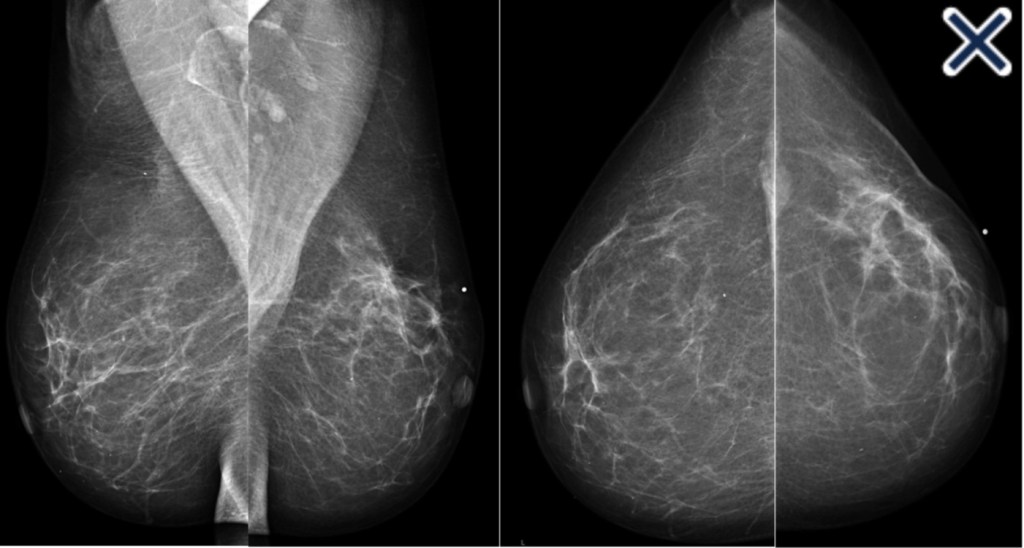
Has a mammographic appearance of diffuse architectural distortion:
Usually involving a large area, often larger than a lobe:
With no central tumor mass and no calcifications:
It sometimes has the appearance of a “spider’s web” as shown in the Image
The diffusely infiltrating cancer:
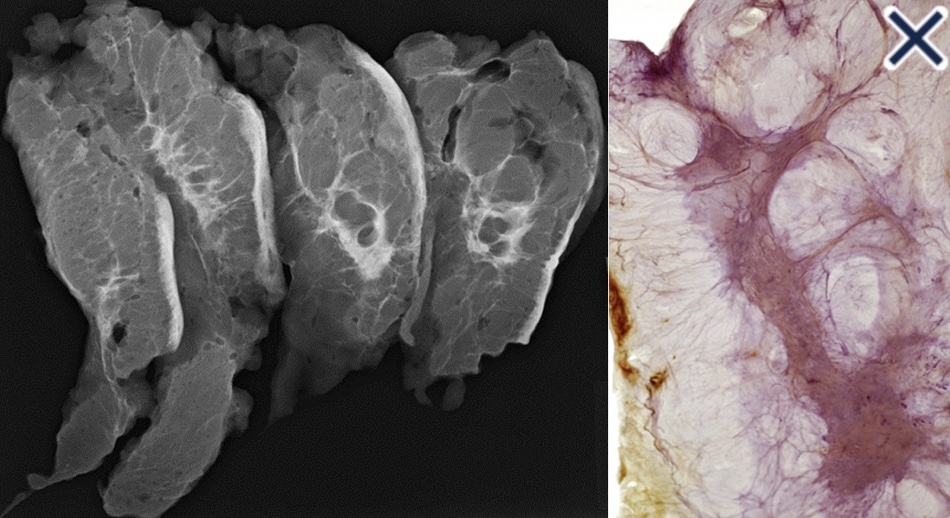
Forms concave contours with the surrounding fat in a manner similar to normal fibroglandular tissue (Images)
Mastectomy slice radiographs (a) and large format 3D histology image (b) showing concave contours similar to normal breast tissue
The imaging findings of diffusely infiltrating breast cancer are strikingly different:
From the imaging findings of breast cancers originating either from the terminal ductal lobular units (TDLUs) or the lactiferous ducts:
Suggesting that it may have a different site of origin
It has been recently proposed that diffusely infiltrating breast cancers:
May originate from mesenchymal stem cells (progenitors):
Through a complex process of both:
Epithelial-mesenchymal transformation and more frequently, mesenchymal-epithelial transformation
The clinical presentation:
Is typically a recently detected, extensive, firm lesion:
Often appearing as an interval cancer following a previous mammogram which was interpreted as normal
On clinical breast examination:
The cancer does not have a distinct tumor mass or focal skin retraction seen in other cancers:
But rather an indistinct “thickening” and eventually a shrinkage of the breast.
In order to make the diagnosis before the development of a palpable mass and a decrease in size of the breast:
The radiologist and breast surgeon must have a high level of suspicion and a thorough knowledge of the underlying pathophysiology
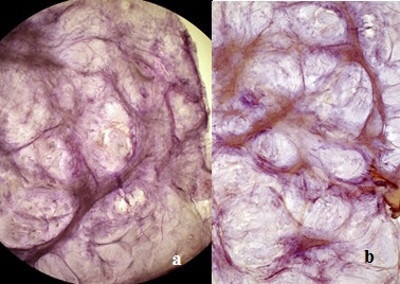
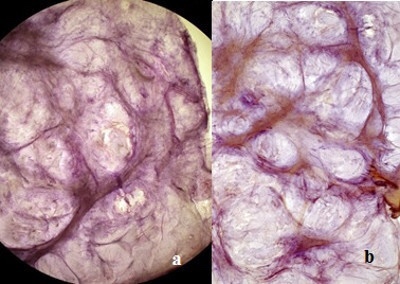
The subgross (3D) histopathology images show how growth of the mesenchymal tissue:
Distorts the normal, harmonious connective tissue framework:
By causing nonuniform thickening of the fine sheets of connective tissue (Images):
Large format subgross (3D) histology images of a diffusely infiltrating breast cancer
The predominance of mesenchyme in the diffusely infiltrating breast malignancy:
Allows it to be imaged with greater sensitivity by ultrasound than by mammography:
The thin sheets or veils of tissue reflect the ultrasound waves:
But are relatively easily penetrated by x-rays
The structural / architectural distortion:
While difficult to detect mammographically:
Is readily detectable on 2-mm thick coronal sections of automated breast ultrasound (Image)
3D automated ultrasound images
The 2-mm thick multi-slice series demonstrate the extensive architectural distortion, corresponding to the 3D histology:
Large format subgross (3D) histology images of a diffusely infiltrating breast cancer
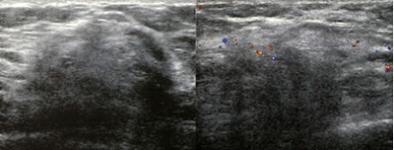
The hypoechoic changes can also usually be seen on hand held ultrasound, Image:
Hand-held ultrasound of diffusely infiltrating carcinoma
The growth pattern and cell type of diffusely invasive breast cancer:
Is very similar to that of diffuse gastric carcinoma (linitis plastica), and both of these diseases can be associated with:
A deleterious mutation in the CDH1 gene:
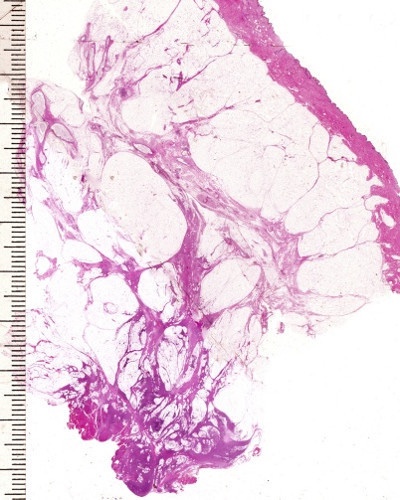
Which is located on chromosome 16q22 and codes for e-cadherin protein (Image):
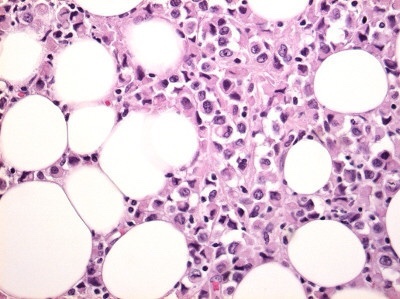
Large format histology slide of diffusely infiltrating breast cancer similar to growth pattern of linitis plastica
High-power histology of pleomorphic infiltrating breast cancer with cell type similar to linitis plastica.
Stain negative for e-cadherin.
CDH1 was initially known as a susceptibility gene for diffuse gastric cancer (linitis plastica)
The histopathologic characteristics of diffuse gastric cancer:
Show similarities with e-cadherin negative:
Diffusely infiltrating breast cancer (infiltrating “lobular” carcinoma)
The neoplastic cells permeate the mucosa and wall as scattered individual signet-ring cells or small clusters of cells in an infiltrative growth pattern
Since there are no TDLUs in the stomach:
If the similar cells in both conditions associated with CDH1 have a common origin, it could not be a TDLU:
Raising the possibility that they could result from mesenchymal cell transformation in both organs
👉Rodrigo Arrangoiz MS, MD, FACS, FSSO cirujano oncology y cirujanode mamáde en Mount Sinai Medical Center:
Es experto en el manejo del cáncer de mama
👉Esmiembrode la American Society of Breast Surgeons:
Training:
• General surgery:
• Michigan State University:
• 2004 al 2010
• Surgical Oncology / Head and Neck Surgery / Endocrine Surgery:
• Fox Chase Cancer Center (Filadelfia):
• 2010 al 2012
• Masters in Science (Clinical research for health professionals):
• Drexel University (Filadelfia):
• 2010 al 2012
• Surgical Oncology / Head and Neck Surgery / Endocrine Surgery:
• IFHNOS / Memorial Sloan Kettering Cancer Center:
When to perform sentinel lymph node mapping and biopsy?
cT1N0, 65 y, HR+/HER2–, tumor 1.5 cm, negative axillary US, breast-conserving surgery (BCS). SLNB or omit?
Omission of SLNB is reasonable per ASCO 2025 criteria:
Low-risk, ≥ 50 years, HR+ / HER2-, ≤ 2 cm, negative pre-op axillary imaging, BCS:
After shared decision-making
Same patient as #1 but undergoing mastectomy. SLNB?
Perform SLNB:
Even if cN0, mastectomy removes future SLNB opportunity:
Most guidelines advises SLNB at mastectomy in case invasive disease or nodal information will alter RT /systemic therapy
Define the standard indications for SLNB in invasive cT1 to T2, cN0 disease:
SLNB is standard for staging in clinically node-negative invasive cancers:
Exceptions include specific low-risk cohorts where omission is now endorsed
Omission is reasonable per ASCO 2025 criteria:
Low-risk, ≥ 50 y, HR+/HER2–, ≤ 2 cm, negative pre-op axillary imaging, BCS, after shared decision-making
Pure DCIS having lumpectomy – do you stage the axilla?
No:
Pure DCIS treated with BCS does not need SLNB
DCIS requiring mastectomy – do you add SLNB?
Yes:
Perform SLNB at mastectomy because later mapping is unreliable and occult invasion risk exists
Role of pre-op axillary ultrasound (US) before SLNB?
US triages patients:
If suspicious nodes, biopsy to confirm cN+:
If negative and tumor low-risk, supports SLNB omission in ASCO-defined cohorts
SOUND trial bottom line for small tumors with negative axillary US:
In cT1 ≤ 2 cm, cN0 with negative US, no axillary surgery was non-inferior to SLNB for 5-year distant DFS
INSEMA trial bottom line (NEJM 2025):
Among cT1 to cT2, cN0 undergoing BCS, omitting axillary surgery was non-inferior to SLNB for invasive DFS, with less morbidity
Does NCCN acknowledge de-escalation of axillary surgery in select early-stage cases?
Yes – NCCN endorses risk-adapted axillary management; details in current NCCN Breast Cancer Guideline
Key counseling points when considering SLNB omission
Ensure negative axillary imaging, small HR+ / HER2-tumor, BCS with adjuvant therapy, and that nodal information won’t change systemic / RT plans; use shared decision-making
Omission of SLNB in Early Breast Cancer – ASCO 2025 / SOUND / INSEMA Trials;
ASCO 2025 Guideline Update (“Sentinel Lymph Node Biopsy in Early-Stage Breast Cancer”) provides formal recommendations to omit routine SLNB in select patients:
The criteria include:
Age ≥ 50 and postmenopausal status
HR positive
HER2 negative
Tumor grade 1 to 2
≤ 2 cm size
Clinically node negative (by exam)
Negative on preoperative axillary ultrasound (or a suspicious node that is benign on biopsy)
Undergoing breast-conserving therapy with whole-breast irradiation (WBRT) ideally (for patients < 65; for older patients there is more flexibility)
Trials supporting this omission:
SOUND trial – randomized patients with T1 (≤ 2 cm), cN0 breast cancer and negative axillary ultrasound to SLNB vs no axillary surgery:
At 5 years, distant disease-free survival was similar in both arms
INSEMA trial – included clinically node-negative invasive breast cancer ≤ 5 cm undergoing BCS:
This trial found omission of axillary surgery was non-inferior to SLNB in terms of invasive disease-free survival
Morbidity / Quality of life data:
In the INSEMA trial, omitting SLNB led to lower rates of persistent lymphedema:
~ 1.8% in omission vs 5.7% in SLNB group
Other arm morbidity measures like restricted shoulder / arm movement and pain were significantly less in the omission group
These differences are clinically significant, especially considering the trade-off between morbidity and marginal gain in prognostic information in low-risk patients
Risks / caveats:
Even in SOUND and INSEMA trials, almost all patients still got radiotherapy (WBRT) which likely contributed to controlling any microscopic nodal disease
The longer follow-up is needed to ensure late recurrences in HR+ disease are not missed:
ASCO guidelines recognize that.
Positive sentinel nodes: who still needs ALND?
Z0011 scenario:
BCS + whole-breast RT, 1 to 2 positive SLNs (no gross ECE). ALND needed?
No. Omit ALND – no OS / DFS detriment at 10 years
IBCSG 23-01:
Micromets (≤ 2 mm) in SLN – ALND?
No:
Omit ALND; 10-year outcomes show safety
AMAROS take-home when SLN positive (mostly macromets):
Axillary RT provides comparable regional control to ALND with less lymphedema – a de-escalation option
Does Z0011 apply to mastectomy?
No:
Z0011 included lumpectomy + whole-breast RT only
If mastectomy and SLN+, decisions differ:
ALND or nodal radiation often considered
> 2 positive SLNs at upfront surgery – what’s recommended?
ALND or nodal RT (RNI) typically indicated
Z0011 criteria not met
Gross extranodal extension (ENE) in SLN on pathology – management?
Generally ALND (or comprehensive RNI) considered:
Most de-escalation trials excluded gross ENE
Under-coverage RT plans (no low-axilla tangents) but 1 to 2 SLN+ after BCS – omit ALND
Be cautious:
Z0011 assumed tangential fields. If axilla not covered, many favor ALND or add nodal RT
Inflammatory breast cancer – axillary staging approach?
Extrapolation to T3 / T4 is not evidence-based – individualize, often favor completion treatment
Do isolated tumor cells (ITCs) in SLN mandate ALND?
No; ITCs (pN0[i+]) do not require ALND
ACOSOG Z0011 – ALND vs No ALND when SLNs positive
Population and design:
Women with clinical T1 or T2 invasive breast cancer, no palpable axillary adenopathy, 1 to 2 sentinel lymph nodes positive by hematoxylin and eosin stain
All underwent lumpectomy + WBRT + adjuvant systemic therapy
Median follow-up ~ 9.3 years
Hazard Ratios / Noninferiority:
The study had a prespecified noninferiority margin of HR = 1.3 for OS:
The observed HR was 0.85 (SLND alone vs ALND) for OS; P = .02 for noninferiority
DFS had HR 0.85 (95% CI 0.62-1.17), i.e. no statistically significant difference
Excluded patients with > 2 positive SLNs, gross extranodal extension, patients undergoing mastectomy without RT, or those not getting WBRT tangents as per protocol:
So results apply only to those meeting Z0011 criteria
Additional / Supporting Data and Real-World Observations:
Risk of lymphedema:
ALND is associated with significantly higher rates of lymphedema, shoulder mobility limitations, and arm pain than SLNB alone
Studies show that lymphedema incidence after SLNB is much lower (e.g., single digits) compared to ALND (where rates may be 20% to 30+% depending on patient, RT, etc.)
The SOUND / INSEMA omission studies show ~ 5% to 6% lymphedema in SLNB arm vs ~1% to 2% when SLNB omitted
Ultrasound negative imaging correlate:
In ASCO guideline and supporting articles, it’s noted that when axillary US is negative preoperatively in low-risk patients, ~85% of the time the SLNB is also negative
So negative US is a strong predictor and helps avoid unnecessary SLNB in selected patients.
Long-term axillary recurrence rates: From Z0011:
Regional recurrence was < 1% over the 10 years in SLNB alone group
Real-world data (e.g. from NSABP, other cohorts) confirm similar low regional recurrence in patients meeting Z0011 criteria with SLNB alone
Putting It All Together: Key Data-Driven Pearls:
For a patient meeting Z0011 criteria (T1 to T2, cN0, 1 to 2 SLNs positive, lumpectomy + WBRT + systemic therapy):
Omitting ALND results in noninferior OS and DFS at 10 years, with very low regional recurrence (< 1%)
In the ASCO 2025 SLNB omission group (SOUND, INSEMA), for low-risk patients (≤2 cm, HR+/HER2-, grade 1-2, ≥ 50 y, negative US):
Omission of SLNB is noninferior in invasive disease–free or distant disease-free survival at 5 years
Also, nodal positivity on SLNB in these patients is relatively uncommon
The trade-off:
Small absolute increase in risk of occult nodal disease vs measurable reduction of morbidity (lymphedema, pain, mobility)
For many patients, quality of life gains are meaningful
Are more likely than both controls and carriers of the BRCA2 mutation to have:
High-grade, receptor-negative tumors (and, in particular, triple-negative tumors):
Containing necrosis, with higher mitotic counts and shorter tumor-doubling times
Carriers of the BRCA1 mutation have lesions that are more likely to have:
Pushing margins and that are less likely to be spiculated:
Making them harder to detect on mammography and more likely to be detected by MRI than mammography
Women with a strong family history of both early-onset breast cancer and ovarian cancer in first-degree relatives:
Is consistent with hereditary breast and ovarian cancer syndrome:
The presence of triple-negative disease is most consistent with the history and diagnosis for a carrier of the BRCA1 deleterious mutation
Although few studies have evaluated preoperative breast MRI in BRCA carriers after breast cancer has already been diagnosed:
Breast MRI has been shown to have a survival benefit in the high-risk screening setting:
The lifetime risk of cancer developing in the contralateral breast (which can also be mammographically occult) is nearly 40% in this population
Breast MRI is a reasonable preoperative option to evaluate the contralateral breast if the woman has:
Dense breasts, risk of being a BRCA carrier, and consequent risk of disease being present or developing in the contralateral breast:
However, for patients who opt for bilateral mastectomy:
Breast MRI preoperatively is not mandatory
Although genetic testing has become more widespread and easier to perform in recent years:
Performing a genetic test without counseling by someone who has genetic training and expertise is not appropriate
As some BRCA mutations are known to be deleterious, others are variants of undetermined significance:
This means, as the name suggests, that it is unclear whether the patient is at any greater risk of cancer, and if so, by how much:
This must be part of the discussion because 5% to 10% of mutations are these variants of undetermined significance, and patient perceptions of their own risk in that setting are high, mandating proper education
Although women with BRCA mutations have bilateral mastectomy as an option to treat a known cancer and prevent a contralateral one:
The American Society of Clinical Oncology / Society of Surgical Oncology consensus statement on prophylactic mastectomy:
Considers a significant family history an appropriate indication for prophylactic mastectomy:
Even in the absence of a diagnosed mutation
Women who have a diagnosed deleterious mutation and those who have not been tested but have a strong family history:
Are also considered appropriate for risk-reducing surgery.
References:
Guillem JG, Wood WC, Moley JF, et al. ASCO/SSO review of current role of risk-reducing surgery in common hereditary cancer syndromes. Ann Surg Oncol. 2006;13:1296-1321.
Kaas R, Kroger R, Peterse JL, Hart AA, Muller SH. The correlation of mammographic and histologic patterns of breast cancers in BRCA1 gene mutation carriers, compared to age-matched sporadic controls. Eur Radiol. 2006;16:2842-2848.
Lakhani SR, Reis-Filho JS, Fulford L, et al. Prediction of BRCA1 status in patients with breast cancer using estrogen receptor and basal phenotype. Clin Cancer Res. 2005;11:5175-5180.
Murray ML, Cerrato F, Bennett RL, Jarvik GP. Follow-up of carriers of BRCA1 and BRCA2 variants of unknown significance: variant reclassification and surgical decisions. Genet Med. 2011;13:998-1005.
Plevritis SK, Kurian AW, Sigal BM, et al. Cost-effectiveness of screening BRCA1/2 mutation carriers with breast magnetic resonance imaging. JAMA. 2006;295:2374-2384.
Is associated with an 80% relative risk reduction:
For the development of ovarian and fallopian tube cancers
BSO causes a decrease in estrogen production:
Which is thought to lead to a 50% risk reduction in the development of future breast cancer:
Particularly among BRCA2 mutation carriers
National Comprehensive Cancer Network (NCCN) guidelines recommend:
That BRCA1 mutation carriers be offered RRSO between the ages of 35 and 40
BRCA2 mutation carriers are recommended to undergo RRSO between the ages of 40 and 45
A recent meta-analysis, which included three prospective studies of BRCA patients undergoing RRSO:
Found that this procedure salpingo-oophorectomy was associated with a decreased ovarian cancer risk, and decreased all-cause mortality:
With the largest risk reduction seen among BRCA1 mutation carriers
RRSO is associated with premature menopause, osteoporosis, cardiovascular disease, in addition to other medical issues which can impact quality of life:
Patients wishing to undergo RRSO should be counseled regarding these risks
References:
Bougie O, Weberpals JI. Clinical Considerations of BRCA1- and BRCA2-mutation carriers: a review. Int J Surg Oncol. 2011;2011:374012.
Domchek SM, Friebel TM, Singer CF, Evans DG, Lynch HT, Isaacs C, et al. Association of risk-reducing surgery in BRCA1 or BRCA2 mutation carriers with cancer risk and mortality. JAMA. 2010;304(9):967-975.
Kauff ND, Domchek SM, Friebel TM, Robson ME, Lee J, Garber JE, et al. Risk-reducing salpingo-oophorectomy for the prevention of BRCA1- and BRCA2-associated breast and gynecologic cancer: a multicenter, prospective study. J Clin Oncol. 2008;26(8):1331-1337.
Finch AP, Lubinski J, Moller P, Singer CF, Karlan B, Senter L, et al. Impact of oophorectomy on cancer incidence and mortality in women with a BRCA1 or BRCA2 mutation. J Clin Oncol. 2014;32(15):1547-1553.
Marchetti C, De Felice F, Palaia I, Perniola G, Musella A, Musio D, et al. Risk-reducing salpingo-oophorectomy: a meta-analysis on impact on ovarian cancer risk and all cause mortality in BRCA 1 and BRCA 2 mutation carriers. BMC Womens Health. 2014;14:150.
Usually involving a large area, often larger than a lobe:
With no central tumor mass and no calcifications
It sometimes has the appearance of a “spider’s web” as shown in Image
Mastectomy slice radiographs (a) and large format 3D histology image (b) showing concave contours similar to normal breast.
The diffusely infiltrating cancer:
Forms concave contours with the surrounding fat in a manner similar to normal fibroglandular tissue (Images Above)
The imaging findings of diffusely infiltrating breast cancer:
Are strikingly different from the imaging findings of breast cancers originating either from the terminal ductal lobular units (TDLUs) or the lactiferous ducts:
Suggesting that it may have a different site of origin
It has been recently proposed that diffusely infiltrating breast cancers:
May originate from mesenchymal stem cells (progenitors):
Through a complex process of both:
Epithelial-mesenchymal transformation and more frequently, mesenchymal-epithelial transformation
The clinical presentation is typically a:
Recently detected, extensive, firm lesion:
Often appearing as an interval cancer following a previous mammogram which was interpreted as normal
On clinical breast examination:
The cancer does not have a distinct tumor mass or focal skin retraction seen in other cancers:
But rather an indistinct “thickening” and eventually a shrinkage of the breast
In order to make the diagnosis before the development of a palpable mass and a decrease in size of the breast:
The radiologist and breast surgeon must have a high level of suspicion and a thorough knowledge of the underlying pathophysiology
The subgross (3D) histopathology images:
Show how growth of the mesenchymal tissue distorts the normal, harmonious connective tissue framework:
By causing nonuniform thickening of the fine sheets of connective tissue
The predominance of mesenchyme in the diffusely infiltrating breast malignancy:
Allows it to be imaged with greater sensitivity by ultrasound than by mammography
The thin sheets or veils of tissue reflect the ultrasound waves:
But are relatively easily penetrated by x-rays
The structural / architectural distortion, while difficult to detect mammographically:
Is readily detectable on 2-mm thick coronal sections of automated breast ultrasound
The hypoechoic changes:
Can also usually be seen on hand-held ultrasound
The growth pattern and cell type of diffusely invasive breast cancer is very similar to that of diffuse gastric carcinoma (linitis plastica):
Both of these diseases can be associated with a deleterious mutation in the CDH1 gene:
Which is located on chromosome 16q22 and codes for e-cadherin protein
References:
Hansford S, Kaurah P, Li-Chang H, Woo M, Senz J, Pinheiro H, et al. Hereditary diffuse gastric cancer syndrome: CDH1 mutations and beyond. JAMA Oncol. 2015;1(1):23-32.
Tot T. The diffuse type of invasive lobular carcinoma of the breast: morphology and prognosis. Virchows Arch. 2003;443(6):718-724.
Tot T. Diffuse invasive breast carcinoma of no special type. Virchows Arch. 2016;468(2):199-206.


















 Rodrigo Arrangoiz MS, MD, FACS, FSSO