Medullary Breast Carcinoma

👉 Introduction

  • Medullary carcinoma is a very rare and distinct subgroup of breast carcinomas:
    • Accounting for less than 5% (some series 5% to 7%) of all invasive breast cancers
  • This unique histologic subtype has very strict criteria for diagnosis, including:
    • Complete circumscription
    • Syncytial growth pattern of at least 75% of the tumor
    • Intermediate to high nuclear grade
    • An associated diffuse lymphocytic infiltrate
    • A lack of intraductal components or glandular differentiation
  • The 2012 World Health Organization (WHO) updated the classification of medullary carcinoma under an umbrella term of “carcinomas with medullary features”:
    • Which also includes atypical medullary carcinoma and invasive carcinoma of no special type with medullary features:
      • Medullary carcinoma has a favorable prognosis:
        • In spite of its poorly differentiated histologic features and basal-like phenotype

👉 Etiology

  • It has been well established that both medullary carcinoma and invasive ductal carcinoma with medullary features are associated with:
    • Germline mutations in the BRCA1 gene
  • Among BRCA1-associated breast cancers:
    • 7.8% to 19% are medullary carcinomas
    • 35% to 60% show the presence of medullary features:
      • This rate contrasts with the presence of only 2% medullary carcinomas:
        • Among sporadic, non–BRCA-associated tumors
  • Medullary carcinoma:
    • Has been shown to display the basal-like molecular subtype:
      • By gene expression profiling:
    • Which correlates with its immunophenotypic profile:
      • A high incidence of TP53 gene mutation also presents in these tumors
  • Most cases are:
    • Aneuploid with a high S-phase fraction
  • Array-based comparative genomic hybridization analysis:
    • Has demonstrated a recurrent pattern of chromosomal alterations in medullary carcinoma, including:
      • 1q, 8q, 9p, 10p, and 16q gains
      • 4p and X losses
      • 1q, 8p, 10p, and 12p amplifications

👉 Epidemiology

  • The patient’s age at presentation is younger than that for invasive ductal carcinoma NST:
    • With a mean age:
      • Ranging from 45 to 54 years
  • Medullary carcinoma is unicentric in most of the patients:
    • Bilateral carcinomas:
      • Have an incidence ranging from 3% to 18%:
        • Bilateral tumors are common when a family history is present
  • Typical medullary breast carcinoma:
    • Occurs more frequently in patients with mutations of:
      • The tumor suppressor gene BRCA-1

👉 Pathophysiology

  • Medullary carcinoma:
    • Has been shown to contain an increased number of activated cytotoxic lymphocytes and most of the lymphoid infiltrate consists of T cells:
      • This feature reflects an active host response to the tumor and may account for its favorable prognosis

👉 Histopathology

  • Medullary carcinoma is well circumscribed and moderately firm
  • The cut surface is fleshy and gray-tan and may appear lobular or nodular
  • Foci of hemorrhage, necrosis, and even cystic degeneration are not unusual
  • These tumors tend to be smaller than 3 cm:
    • With a median size of 2 cm to 3 cm
  • The histologic criteria for medullary carcinoma:
    • Were first clearly defined by Ridolfi and associates in 1977, and since then, there have been several proposed modified classification schemes
  • The diagnosis of medullary carcinoma in the majority of cases:
    • Is established based on H&E sections using histologic criteria without the need for ancillary studies
  • Medullary carcinoma should meet all of the following five morphologic criteria as defined by the WHO:
    • Syncytial growth pattern in more than 75% of the tumor
    • No glandular or tubular structures, even as a minor component
    • Moderate to marked diffuse lymphoplasmacytic infiltrate in the stroma
    • Moderate to marked nuclear pleomorphism
    • Complete histologic circumscription
    • Mitoses are numerous, and atypical giant cells may be present;
      • The terms ”atypical medullary carcinoma” and ”carcinoma with medullary features” have been proposed for tumors that do not fulfill all these criteria
  • Medullary carcinomas are most often:
    • Negative for estrogen and progesterone receptors and HER2 negative and variably express keratins 5/6 and 14, smooth muscle actin, EGFR, P-cadherin, p53, and caveolin-1
    • They have a high Ki-67 proliferation index
  • P53 mutation:
    • Occurs at an increased level in medullary carcinoma and is considered a biological marker for this tumor type
  • The lymphoid infiltrate show a predominance of CD3+ T-lymphocytes

👉 History and Physical

  • Most of the patients with medullary carcinoma present with a palpable mass:
    • Usually in the upper outer quadrant
  • The tumor is often well-defined clinically and on imaging studies
  • Some patients with this tumor type exhibit axillary lymphadenopathy at the time of presentation, suggesting the presence of metastatic disease

Rodrigo Arrangoiz MS, MD, FACS 

Assistant Professor at the Columbia University Division of Surgical Oncology at Mount Sinai Medical Center:

  • Cancer Surgeon / Breast Surgeon / Surgical Oncologist

 He is a member of the American Society of Breast Surgeons

Training:

• General surgery:

• Michigan State University:

• 2004 al 2010

• Surgical Oncology / Head and Neck Surgery / Endocrine Surgery:

• Fox Chase Cancer Center (Filadelfia):

• 2010 al 2012

• Masters in Science (Clinical research for health professionals):

• Drexel University (Filadelfia):

• 2010 al 2012

• Surgical Oncology / Head and Neck Surgery / Endocrine Surgery:

• IFHNOS / Memorial Sloan Kettering Cancer Center:

• 2014 al 2016

#Arrangoiz #Surgeon #Cirujano #CirujanoOncologo #Surgical Oncologist #BreastSurgeon #CirujanodeMama #CancerSurgeon #CirujanodeCancer #MountSinaiMedicalCenter #Miami #Mexico #MSMC

KEYNOTE-689 for Resectable, Locally Advanced HNSCC

  • What was studied:
    • Design:
      • International, randomized, open-label phase 3 trial (n=714)
      • Adults with resectable stage III to IVA larynx, hypopharynx, or oral cavity SCC, or oropharynx SCC (stage III to IVA p16-negative, or stage III T4 N0 to N2 p16-positive)
      • Randomized 1:1 to standard surgery → pathology-directed adjuvant RT ± high-dose cisplatin with or without perioperative pembrolizumab
      • Regimen (pembro arm):
        • 200 mg q3 weeks × 2 neoadjuvant cycles → surgery → 3 cycles concurrent with postoperative RT ± cisplatin → 15 additional adjuvant cycles (total 17 including neoadjuvant)
      • Primary endpoint:
        • Event-free survival (EFS) with hierarchical testing in PD-L1 CPS ≥10, then CPS ≥1, then ITT
      • Key secondary endpoints included:
        • Major pathologic response (mPR) and overall survival (OS)
  • Key efficacy results:
    • EFS benefit (first interim analysis; median follow-up 38.3 mo):
      • CPS ≥ 10:
        • 36-mo EFS 59.8% vs 45.9%; HR 0.66 (95% CI 0.49–0.88; p=0.004)
      • CPS ≥ 1:
        • 36-mo EFS 58.2% vs 44.9%; HR 0.70 (0.55–0.89; p=0.003)
      • All patients (ITT):
        • 36-mo EFS 57.6% vs 46.4%; HR 0.73 (0.58–0.92; p=0.008). 
        • Reported median EFS (ITT):
          • 51.8 vs 30.4 months, favoring perioperative pembrolizumab
      • Distant metastasis control:
        • DMFS improved:
          • Median 51.8 vs 35.7 months, HR 0.71, 95% CI 0.56–0.90
          • 36-mo DMFS 59.1% vs 49.9%
      • Locoregional control difference:
        • Was modest (HR 0.92, 95% CI 0.61–1.41)
      • Pathologic response:
        • mPR rates were higher with pembrolizumab:
          • In CPS ≥ 10, mPR increased by ~13.7% pre-op
  • Surgical feasibility and downstream treatment:
    • Surgery completion was similar:
      • 88% in both arms
    • Neoadjuvant pembrolizumab did not reduce operability
  • Neoadjuvant / adjuvant pembrolizumab:
    • Was associated with:
      • Fewer high-risk pathologic features (32.5% vs 44.4%)
      • Lower proportion requiring adjuvant high-dose cisplatin (38.9% vs 50.5%)
  • Safety:
    • Grade ≥ 3 treatment-related AEs:
      • 44.6% (pembrolizumab) vs 42.9% (SOC)
    • Treatment-related deaths:
      • 1.1% vs 0.3%
    • Grade ≥ 3 immune-mediated AEs ~ 10%:
      • One grade 5 pneumonitis reported across sources
    • No new safety signals
  • Regulatory status and who qualifies (U.S.):
    • FDA approval (June 13, 2025):
      • Pembrolizumab is approved for resectable, locally advanced HNSCC with PD-L1 CPS ≥1:
        • As neoadjuvant single-agent, continued with postoperative RT ± cisplatin, then continued as adjuvant single-agent:
          • PD-L1 testing is required
  • How to apply in practice (surgeon’s lens):
    • Patient selection:
      • Resectable stage III to IVA HNSCC candidates (non-nasopharynx) with PD-L1 CPS ≥ 1
      • Discuss benefits particularly strong in CPS ≥ 10:
        • But benefit observed across CPS ≥ 1 and ITT
    • Workflow:
      • Two neoadjuvant pembrolizumab cycles → timely surgery (completion comparable to SOC) → risk-adapted RT ± cisplatin with concurrent pembrolizumab → complete remaining adjuvant cycles
      • Coordinate closely with rad oncology /medical oncology for start dates and toxicity monitoring
    • Counseling:
      • Emphasize EFS / DMFS gains and potential reduction in need for high-dose cisplatin due to fewer high-risk pathologic features, balanced against immune-related toxicities (pneumonitis, endocrinopathies, colitis, etc.)
      • OS:
        • Data currently immature; trend favorable but not yet statistically significant
      • Continue guideline-concordant surveillance

Breast Cancer Pathology

  • Invasive carcinomas of the breast:
    • Tend to be histologically:
      • Heterogeneous tumors
  • The vast majority are:
    • Adenocarcinomas:
      • That arise from the terminal ductal lobular units
  • There are five common histologic variants of:
    • Mammary adenocarcinoma
  • Invasive ductal carcinoma:
    • Accounts for 75% of all breast cancers
    • This lesion is characterized by:
      • The absence of special histologic features
    • It is firm on palpation and gritty when transected:
      • It is associated with various degrees of fibrotic response
    • Often there is associated ductal carcinoma in situ (DCIS) within the specimen
    • Invasive ductal carcinomas:
      • May metastasize to axillary lymph nodes
    • The prognosis for patients with these tumors is poorer than that for patients with some of the other histologic subtypes:
      • Mucinous, colloid, tubular, and medullary
    • Distant metastases are found most often in the:
      • Bones, lungs, liver, and brain
  • Invasive lobular carcinoma:
    • Accounts for 15% of breast cancers
    • Clinically:
      • This lesion often has an area of ill-defined thickening within the breast
    • Microscopically:
      • Small cells in a single-file pattern are characteristically seen
    • Invasive lobular cancers:
      • Tend to grow around ducts and lobules
      • They have a tendency to present with a radiographically occult infiltrative pattern
    • Multicentricity and bilaterality:
      • Are observed more frequently in invasive lobular carcinoma than in invasive ductal carcinoma
    • The prognosis for invasive lobular carcinoma is similar to that for invasive ductal carcinoma
    • In addition to metastasizing to axillary lymph nodes:
      • Invasive lobular carcinoma is known to metastasize to unusual sites:
        • Example meninges and serosal surfaces:
          • More often than other forms of breast cancer
  • Tubular carcinoma:
    • Accounts for only 2% of breast carcinomas
    • The diagnosis of tubular carcinoma:
      • Is made only when more than 75% of the tumor demonstrates tubule formation
    • Axillary nodal metastases:
      • Are uncommon with this type of tumor
    • The prognosis for patients with tubular carcinoma:
      • Is more favorable than that for patients with other types of breast cancer
  • Medullary carcinoma of the breast:
    • Accounts for 5% to 7% of breast cancers
    • Histologically:
      • The lesion is characterized by poorly differentiated nuclei, a syncytial growth pattern, a well-circumscribed border, intense infiltration with small lymphocytes and plasma cells:
        • Little or no associated DCIS
    • The prognosis for patients with pure medullary carcinoma is favorable:
      • However, mixed variants with invasive ductal components will have prognoses similar to invasive ductal carcinoma
    • Medullary carcinoma:
      • Occurs more frequently in BRCA mutation carriers
  • Mucinous or colloid carcinoma:
    • Constitutes approximately 3% of breast cancers
    • It is characterized by an abundant accumulation of extracellular mucin:
      • Surrounding clusters of tumor cells
    • Colloid carcinoma:
      • Is slow growing and tends to be bulky
    • These tumors are associated with:
      • A favorable prognosis
  • Rare histologic types of breast malignancy include:
    • Papillary, apocrine, secretory, squamous cell and spindle cell carcinomas, and metaplastic carcinoma
  • Invasive ductal carcinomas:
    • Occasionally have small areas containing one or more of these special histologic types
    • Tumors with these mixed histologic appearances:
      • Behave similarly to pure invasive ductal carcinomas

Tubular Carcinoma of the Breast

  • Tubular carcinoma:
    • Is a distinct histopathologic subtype of breast cancer:
      • Representing 1% to 2% of breast cancers diagnosed
    • It is a distinct entity from low-grade ductal carcinoma
  • The literature continues to suggest that it has an excellent prognosis:
    • With a very low likelihood of distant metastasis and excellent disease-free survival
  • In select patients, adjuvant therapies may be omitted:
    • However, there is a still a risk of axillary nodal metastasis:
      • Therefore sentinel lymph node biopsy is still recommended:
        • Due to a 10% to 20% risk of lymphatic spread:
          • Despite this finding, there is likely to be only one node involved and this histopathologic subtype still conveys an excellent prognosis
  • Tubular carcinoma:
    • Is more likely to be identified on screening mammography and is more common in Caucasians than blacks
    • Emerging data suggest that adjuvant systemic therapy can likely be safely omitted, although it should still be discussed with the multidisciplinary team
  • References:
    • Rakha EA, Lee AH, Evans AJ, et al: Tubular carcinoma of the breast: further evidence to support its excellent prognosis. J Clin Oncol. 2010;28(1):99-104.
    • Fedko MG, Scow JS, Shah SS, et al. Pure tubular carcinoma and axillary nodal metastases. Ann Surg Oncol. 2010;17(Suppl 3):338-342.
    • Anderson WF, Chu KC, Chang S, Sherman ME. Comparison of age-specific incidence rate patterns for different histopathologic types of breast carcinoma. Cancer Epidemiol Biomarkers Prev. 2004;13(7): 1128-1135.

Variant of Unknown Significance (VUS) in Hereditary Breast Cancer Tests

  • When patients are told they have a variant of unknown significance (VUS):
    • It can often lead to anxiety and overtreatment
  • It is important to counsel patients that a VUS:
    • Is not clinically actionable and the majority of VUS are reclassified as benign
  • Patients should be counseled to update their genetic counselors:
    • As their family history changes and keep contact information up to date as variantbreclassification does occur
  • The American College of Medical Genetics:
    • Has recommended that genetic testing classify genetic variants using the following classification schema:
      • Deleterious (pathogenic)
      • Suspected deleterious (likely pathogenic)
      • Variant of Uncertain Clinical Significance
      • Genetic variant:
        • Favor polymorphism:
          • Likely benign
      • Polymorphism:
        • Benign
  • While deleterious and suspected deleterious mutations BRCA mutations:
    • Are known to be associated with an increased risk of breast and ovarian cancer:
      • It is unknown whether a BRCA VUS mutation:
        • Is associated with an increased risk due to limited available data
  • As the use of genetic testing increases and as more of the population is tested:
    • The knowledge base regarding variant pathogenicity constantly grows
  • Given the amount of data available from many years of BRCA1 / BRCA 2 testing:
    • The prevalence of VUS among this population has declined to 2% to 5%:
      • However, among moderate and low penetrance genes:
        • The number of VUS continues to rise:
          • As the data expand and knowledge regarding a variant evolves, a variant may be reclassified.
  • In a study reported in the Journal of the American Medical Association:
    • 25.4% of patients initially diagnosed with a VUS were reclassified over a 12-year period:
      • Of these patients:
        • 97% were downgraded to benign or likely benign
      • Three percent of patients (3%):
        • Were upgraded to pathogenic or likely pathogenic variants
    • Given this low risk of reclassification to pathogenic mutation:
      • Risk-reducing mastectomy, salpingo-oophorectomy, or genetic testing of family members are not indicated for this patient
  • There is currently no established effective screening protocol for pancreatic cancer, even among patients with a deleterious BRCA 2 mutation
  • References
    • Richards S, Aziz N, Bale S, Bick D, Das S, Gastier-Foster J, et al. Standards and guidelines for the interpretation of sequence variants: a joint consensus recommendation of the American College of Medical Genetics and Genomics and the Association for Molecular Pathology. Genet Med. 2015;17(5):405-424.
    • Hall MJ, Reid JE, Burbidge LA, Pruss D, Deffenbaugh AM, Frye C, et al. BRCA1 and BRCA2 mutations in women of different ethnicities undergoing testing for hereditary breast-ovarian cancer. Cancer. 2009;115(10):2222-2233.
    • Mersch J, Brown N, Pirzadeh-Miller S, Mundt E, Cox HC, Brown K, et al. Prevalence of variant reclassification following hereditary cancer genetic testing. JAMA. 2018;320(12):1266-1274.
#Arrangoiz #Doctor #Surgeon #CancerSurgeon #SurgicalOncologist #BreastSurgeon #Teacher #MountSinaiMedicalCenter #MSMC #Miami #Mexico

Lymphedema After Axillary Surgery in Breast Cancer

  • Following treatment for breast cancer:
    • The onset of lymphedema is insidious:
      • It is typically characterized by slowly progressive swelling of the upper extremity ipsilateral to the axillary node dissection or radiation treatments
  • The main risk factors for breast cancer-associated lymphedema include:
    • Dissection / disruption of axillary lymph nodes
    • Radiation therapy
    • Local infection
    • Obesity
    • Other factors may also contribute
  • There is no known link between smoking and lymphedema
  • The American College of Surgeons Oncology Group (ACOSOG) Z1071 study:
    • Demonstrated that 40% of women with proven involved axillary nodes who underwent neoadjuvant chemotherapy:
      • Obtain a pathologic complete response in the previously involved nodes
    • Although the study demonstrated an overall false-negative rate of sentinel lymph node biopsy (SLNB) in this setting to be 12%:
      • The authors stratified these results and found that if more than two sentinel lymph nodes (SLNs) were removed in patients with dual tracer mapping (blue dye and radioisotope):
        • The false-negative rate of SLNB then dropped below 10% (6.8%)
  • With these guidelines, if SLNB is negative after neoadjuvant chemotherapy:
    • Consideration can be given to SLNB alone
  • The risk of lymphedema is significantly reduced with SLNB than with a level I / II axillary node dissection:
    • Odds ratio (OR) 0.33 based on Cochrane Review of three studies comparing SLNB to axillary dissection
  • Manual lymphatic drainage:
    • May offer some additional benefit to help with swelling reduction in patients with mild to moderate lymphedema:
      • But not all studies have found a benefit for this technique
  • Data are conflicting with regard to the prophylactic use of compression sleeves, prophylactic manual lymphatic drainage, or timing of arm mobilization following surgery
  • References
    • Hayes SC, Janda M, Cornish B, Battistutta D, Newman B. Lymphedema after breast cancer: incidence, risk factors, and effect on upper body function. J Clin Oncol.2008;26(21):3536-3342.
    • Boughey JC, Suman VJ, Mittendorf EA, et al. Sentinel lymph node surgery after neoadjuvant chemotherapy in patients with node-positive breast cancer: the ACOSOG Z1071 (Alliance) clinical trial. JAMA. 2013;310(14):1455-1461.
    • Bromham N, Schmidt-Hansen M, Astin M, Hasler E, Reed MW. Axillary treatment for operable primary breast cancer. Cochrane Database Syst Rev. 2017;1:CD004561.
    • Patricolo GE, Armstrong K, Riutta J, Lanni T. Lymphedema care for the breast cancer patient: an integrative approach. Breast. 2015;24(1):82-85.
    • Stuiver MM, ten Tusscher MR, Agasi-Idenburg CS, Lucas C, Aaronson NK, Bossuyt PM. Conservative interventions for preventing clinically detectable upper-limb lymphoedema in patients who are at risk of developing lymphoedema after breast cancer therapy. Cochrane Database Syst Rev. 2015;2:CD009765.
    • Brennan MJ, Miller LT. Overview of treatment options and review of the current role and use of compression garments, intermittent pumps, and exercise in the management of lymphedema. Cancer 1998; 83(12 Suppl American):2821-2827.
#Arrangoiz #CancerSurgeon #BreastSurgeon #SurgicalOncologist #MountSinaiMedicalCenter #MSMC #Miami #Mexico

First Generation Laryngeal Carcinoma Preservation Trials

  • The first generation of larynx preservation chemotherapy trials:
    • Appeared in the 1990s:
      • They randomized patients into surgery and radiotherapy or to induction chemotherapy cycles of cisplatin / 5FU:
        • Patients who responded to chemotherapy then received radiotherapy:
          • With possible salvage surgery
      • If they did not respond to the chemotherapy:
        • They received surgery and postoperative radiotherapy
    • Generally, the results of these studies showed:
      • No significant difference in survival:
        • Between the two treatment arms
    • The larynx was preserved in:
      • 56% of patients undergoing the experimental chemoradiotherapy arm
  • In 2000, Pignon et al:
    • Published a meta-analysis of the first generation of laryngeal preservation chemoradiotherapy trials:
      • They included T3 laryngeal and hypopharyngeal cancers
    • There was no statistically significant difference in overall survival:
      • However, it is important to note:
        • That there was a trend to benefit from surgery:
          • Hazard ratio 1.19 intervals (0.97–1.46)
        • Surgery ± radiotherapy:
          • Resulted in overall survival of 45%:
            • Compared to an overall survival from chemoradiotherapy of:
              • 39%
        • 56% of those who survived with chemoradiotherapy:
          • Managed to avoid laryngectomy:
            • Giving an overall laryngectomy survival rate of:
              • 23% at five years
        • Patients treated with chemoradiotherapy:
          • Had almost double the local recurrence rate:
            • But less distant metastases than the patients treated with surgery
        • Analysis of laryngeal cancer patients separately from hypopharyngeal cancer patients:
          • Showed that laryngeal cancer patients in the surgical arm:
            • Demonstrated a risk reduction of 32%:
            • This suggests that advanced laryngeal tumors would be better treated with surgery than chemoradiotherapy:
              • On the other hand, hypopharyngeal cancer patients showed no difference in survival between the two modalities of treatment
  • The meta-analysis showed that the overall survival benefit from chemotherapy in addition to radiotherapy:
    • Was 4% at five years
  • Concomitant chemotherapy:
    • Resulted in an 8% overall survival benefit:
      • Compared to a 4% overall survival benefit from neoadjuvant chemoradiotherapy
  • Adjuvant chemoradiotherapy:
    • Resulted in no overall survival benefit
  • These findings have resulted in the adoption of concomitant chemoradiotherapy as the standard regimen for delivery of chemotherapy when treating laryngeal and pharyngeal cancers:
    • Recently, an update of this meta-analysis confirmed an overall survival effect of 6.5% for concomitant chemoradiotherapy
  • References:
    • The Department of Veterans Affairs Laryngeal Cancer Study Group. Induction chemotherapy plus radiation compared with surgery plus radiation in patients with advanced laryngeal cancer. New England Journal of Medicine 1991; 324: 1685–90.
    • Pignon JP, Bourhis J, Domenge C, Designé L. Chemotherapy added to locoregional treatment for head and neck squamous-cell carcinoma: three meta-analyses of updated individual data. MACH-NC Collaborative Group. Meta-Analysis of Chemotherapy on Head and Neck Cancer. Lancet 2000; 355: 949–55.
    • Pignon JP, le Maítre A, Maillard E et al. Meta-analysis of chemotherapy in head and neck cancer (MACH-NC): an update on 93 randomised trials and 17,346 patients. Radiotherapy and Oncology 2009; 92: 4–14.
    • Forastiere AA, Goepfert H, Maor M et al. Concurrent chemotherapy and radiotherapy for organ preservation in advanced laryngeal cancer. New England Journal of Medicine 2003; 349: 2091–8.
#Arrangoiz #CancerSurgeon #HeadandNeckSurgeon #SurgicalOncologist #Surgeon #Doctor #MD #MSCM #MountSinaiMedicalCenter #ThyroidSurgeon #EndocrineSurgery #ParathyroidSurgeon#Miami #Mexico #LaryngealCancer

Management of the Axilla in the Setting of Neoadjuvant Therapy for Breast Cancer

  • Management of the axilla continues to evolve in the setting of neoadjuvant therapy
  • Sentinel lymph node biopsy (SLNB) in clinically node-negative patients after neoadjuvant chemotherapy;
    • Is feasible and accurate:
      • A recent systematic review reported a pooled identification rate of:
        • 96% and false negative rate of 6%
          • These data do not differ from studies evaluating SLNB in early breast cancer without neoadjuvant chemotherapy
  • Neoadjuvant chemotherapy can result in:
    • Downstaging of the axilla
  • Performing the SLNB after chemotherapy:
    • Decreases the rate of finding a positive sentinel lymph node and subsequent axillary dissection
  • The ACOSOG / Alliance Z1071 trial involved patients with initially node-positive disease and sought to determine the false negative rate for sentinel lymph node surgery following neoadjuvant chemotherapy in this group of patients:
    • The false negative rate for the entire cohort was 12%:
      • But on additional analysis, retrieval of at least two sentinel nodes and the previously biopsied node:
        • Was associated with a false negative rate of 6.8%:
          • Therefore, marking the biopsied node with a clip and documenting excision at time of SLNB is recommended
  • References:
    • Geng C, Chen X, Pan X, Li J. The feasibility and accuracy of sentinel lymph node biopsy in initially clinically node-negative breast cancer after neoadjuvant chemotherapy: a systematic review and meta-analysis. PLoS One.2016;11(9):e0162605.
    • Hunt KK, Yi M, Mittendorf EA et al. Sentinel lymph node surgery after neoadjuvant chemotherapy is accurate and reduces the need for axillary dissection in breast cancer patients. Ann Surg. 2009;250(4):558-566.
    • Boughey JC, Suman VJ, Mittendorf EA, et al. Sentinel lymph node surgery after neoadjuvant chemotherapy in patients with node-positive breast cancer: the ACOSOG Z1071 (Alliance) clinical trial. JAMA. 2013;310(14):1455-1461.
    • Boughey JC, Ballman KV, Le-Petross HT et al. identification and resection of clipped node decreases the false-negative rate of sentinel lymph node surgery in patients presenting with node-positive breast cancer (T0-T4, N1-N2) who receive neoadjuvant chemotherapy: results from ACOSOG Z1071 (Alliance). Ann Surg.2016;263(4):802-807.

Primary Hemostasis

  • The sequence (seconds → minutes):
    • Vascular injury and vasoconstriction:
      • Neurogenic reflexendothelin:
        • Transient narrowing:
          • Slows flow and exposes subendothelial collagen and vWF
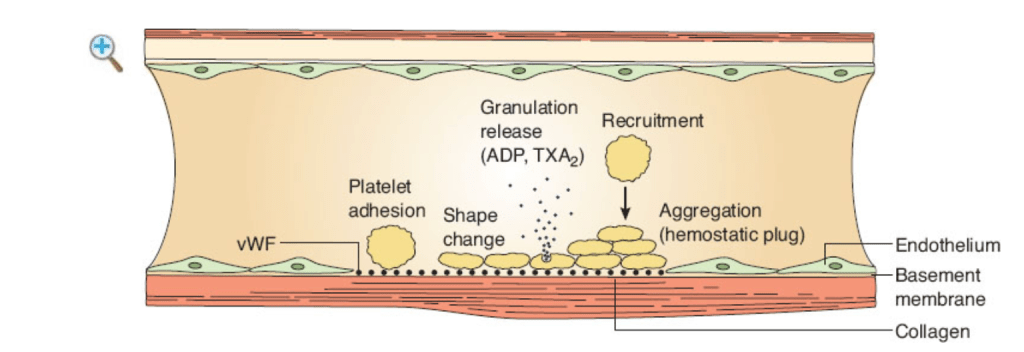
    • Platelet adhesion (to the wound):
      • vWF anchored on exposed collagen binds GP Ib-IX-V on platelets (high-shear arterial beds):
        • Platelet membrane glycoprotein Ib–IX–V complex:
          • The major von Willebrand factor (vWF) receptor:
            • That mediates initial platelet adhesion:
              • At sites of vascular injury (especially high-shear arteries)
      • Direct collagen binding via GP Ia/IIa (α2β1) and GP VI:
        • Complements adhesion
    • Activation and shape change:
      • Cytoskeleton rearranges:
        • Discoid → spiky:
          • surface area:
            • Phosphatidylserine flips outward
      • Platelets synthesize / release mediators:
        • Dense granules: 
          • ADPATPCa²⁺serotonin
        • Alpha granules: 
          • vWFfibrinogenfactor VfibronectinP-selectinPDGFTGF-β
        • TxA₂ is generated via:
          • COX-1 (aspirin target)
    • Recruitment (amplification):
      • ADP → P2Y12/P2Y1TxA₂ (TP receptor)thrombin (PAR-1 / PAR-4):
        • Amplify activation on nearby platelets
      • Ca²⁺ is essential for signaling and integrin activation
    • Aggregation (hemostatic plug formation):
      • Activated GP IIb/IIIa (αIIbβ3) undergoes conformational change:
        • Fibrinogen bridges adjacent platelets:
          • Primary hemostatic plug
      • Leukocytes tether via P-selectin:
        • Adding stability
      • Handoff to secondary hemostasis (minutes):
        • Tissue factor (injured cells) plus factor VII:
          • Activate factor X :
            • Factor X plus factor V:
              • Convert prothrombin (factor II) to thrombin:
                • Converts fibrinogen to fibrin polymer:
                  • Factor XIII crosslinks fibrin:
                    • Stabilizing the platelet plug
  • Why surgeons care (pattern recognition):
    • Primary (platelet) defects: 
      • Mucocutaneous bleeding, oozing from raw surfaces, petechiae, immediate post-incision bleeding
      • PT / PTT often normal
    • Secondary (coagulation) defects: 
      • Delayed re-bleeding, deep tissue / hematoma, hemarthrosis
  • Drugs and diseases mapped to the steps:
    • Adhesion:
      • ↓ vWF (von Willebrand disease) → poor GP Ib-vWF “tether”:
        • DDAVP can ↑ endothelial vWF release (Type 1 vWD, some qualitative defects)
    • Activation:
      • Aspirin / NSAIDs → block COX-1 → TxA₂ (qualitative dysfunction)
      • Uremiahypothermiaacidosishemodilution / CPB:
        • Global platelet dysfunction
        • DDAVP helps in uremia
    • Recruitment:
      • P2Y12 inhibitors (clopidogrel, prasugrel, ticagrelor) blunt ADP signaling
    • Aggregation:
      • Gp IIb/IIIa antagonists (eptifibatide/tirofiban) block fibrinogen bridging
      • Glanzmann thrombasthenia (GP IIb/IIIa deficiency):
        • Severe aggregation defect
      • Bernard–Soulier (GP Ib deficiency):
        • Adhesion failure; giant platelets
  • Practical peri-op numbers (rules of thumb):
    • Platelet count targets (institutional policies vary):
      • Most non-neurosurgical / non-ocular operations: 
        • ≥ 50k/µL
      • Neuraxial, intracranial, posterior eye:
        • ≥ 80 to 100k/µL
      • Ongoing microvascular free-flap or diffuse oozing often needs:
        •  > 75 to 100k/µL and intact function
    • Apheresis platelets: 
      • Typically ↑ count by ~ 30 to 50k/µL in a 70-kg adult
    • Coordinate any antiplatelet interruption with cardiology (especially recent stents):
      • If drugs cannot be stopped, plan local / topical strategies and consider point-of-care testing
  • OR playbook for platelet-type bleeding:
    • Pre-op:
      • Focused history (mucosal bleeding, easy bruising), meds (aspirin, P2Y12), renal function
      • Consider PFA-100/VerifyNow/TEG-PlateletMapping if results will change management
    • Intra-op:
      • Local control: 
        • Meticulous pressure, bipolar, vessel loops; topical hemostats (thrombin, gelatin sponge, oxidized cellulose, collagen matrix, fibrin sealant)
      • Antifibrinolytics: 
        • Tranexamic acid (IV / topical) particularly helpful on mucosal fields (head and neck, oral cavity)
      • Maintain normothermiaionized Ca²⁺pH > 7.2; avoid hemodilution
      • If on aspirin / P2Y12 with urgent bleeding:
        • Platelet transfusion can overcome irreversible blockade (earlier works better for aspirin than ticagrelor); weigh thrombosis risk
      • DDAVP for vWD Type 1 or uremic dysfunction (watch Na⁺; tachyphylaxis after 1 to 2 doses)
    • Post-op:
      • Control blood pressure, avoid NSAIDs, continue local antifibrinolytics when helpful (e.g., pledgets / mouthwash in mucosal cases), and reassess platelet count / function if oozing persists
  • Quick differentials when the field won’t dry:
    • Normal PT / PTT, low platelets or recent antiplatelet use → primary hemostasis problem
    • Prolonged PT / PTT, normal platelets → secondary hemostasis issue (think tissue factor pathway, anticoagulants)
    • Everything “normal,” but diffuse oozing → platelet dysfunction (uremia, hypothermia, CPB, meds) ± hyperfibrinolysis (consider TXA, fibrinogen / cryoprecipitate guided by TEG/ROTEM)
Primary hemostasis is achieved initially with a platelet aggregation as illustrated. Note that platelet adhesion, shape change, granule release followed by recruitment, and the hemostatic plug at the area of subendothelial collagen and collagen exposure are the initial events for thrombus formation.

Normal Coagulation and Normal Anticoagulation

  • Normal coagulation (hemostasis):
    • Three initial responses to vascular injury:
      • Vasoconstriction:
        • Neurohumoral + endothelin
      • Platelet adhesion / activation / aggregation:
        • Primary hemostasis
      • Thrombin generation:
        • That leads to fibrin clot formation:
          • Secondary hemostasis NCBI+1
  • Primary hemostasis – what actually happens:
    • Adhesion: 
      • VWF bridges exposed subendothelial collagen to platelet GPIb-IX-V (high shear)
      • Collagen also signals via:
        • GPVI and α2β1 (GPIa/IIa) NCBI+1
    • Activation + secretion: 
      • Shape change
      • Dense granule:
        • ADP and TxA₂ amplify recruitment
      • Surface phosphatidylserine (PF3) flips out:
        • Creating a catalytic platform for coagulation enzymes NCBI
    • Aggregation: 
      • Inside-out signaling activates:
        • αIIbβ3 (GPIIb/IIIa)
      • Fibrinogen (and later fibrin) bridges adjacent platelets:
    • Key receptors to remember: 
      • ADP → P2Y12 / P2Y1
      • TxA₂ → TP
      • Thrombin → PAR-1 / PAR-4(and also binds GPIbα) NCBI+2PubMed+2
    • Secondary hemostasis – complexes and convergence:
      • Tenase complexes:
        • Extrinsic:
          • Tissue factor (TF) from injured cells – factor VIIa:
            • Plus Ca²⁺, membrane:
              • Activates factor X
        • Intrinsic
          • Exposed collagen + prekallikrein + HMW Kininigen = Factor XII:
            • Activate Factor XI:
              • Activate factor IXa – then add factor VIIIa:
                • Plus Ca²⁺, membrane:
                  • Powerfully activates factor X (major amplifier)
        • Factor X:
          • Is the common convergence point NCBI+1
        • Prothrombinase complex (correct name for what forms on platelets): 
          • Factor Xa + factor Va + Ca²⁺ + anionic phospholipid (PF3):
            • Converts prothrombin (factor II) to thrombin (factor IIa) NCBI
              • Thrombin – central protease (know these):
                • Converts fibrinogen → fibrin,
          • Activates factor V, factor VIII, factor XI, factor XIII
          • Strongly activates platelets via PAR-1 / PAR-4
          • When bound to thrombomodulin:
            • Activates protein C (anticoagulant pathway) NCBI+1
        • Factor XIII: 
          • A transglutaminase that crosslinks fibrin and incorporates α2-antiplasmin into the clot:
            • Producing stability and resistance to fibrinolysis NCBI
  • Fibrin’s role with platelets:
    • Fibrin(ogen) binds αIIbβ3, linking platelets and stabilizing the plug as fibrin polymerizes and is cross-linked Haematologica
  • Normal anticoagulation (checks and balances)
    • Antithrombin (AT-III):
      • Key serpin that neutralizes:
        • Thrombin (IIa), IXa, Xa, XIa, XIIa
    • Heparin / Heparan sulfate:
      • Accelerates AT-III activity dramatically (clinical basis of UFH /LMWH) NCBI+1
    • Protein C / Protein S (vitamin K–dependent):
      • Thrombin – thrombomodulin on endothelium:
        • Activates protein C:
          • Which (with protein S cofactor) proteolytically inactivates Va and VIIIa (not fibrinogen)
    • TFPI (tissue factor pathway inhibitor):
      • Endothelium-derived inhibitor:
        • That inactivates factor Xa and, in an factor Xa – dependent manner:
          • Shuts down TF – FVIIa:
            • The dominant brake on the initiation phase
      • Protein S enhances TFPIα’s factor Xa inhibition:
        • Nuance:
          • TFPI does not simply “inhibit factor X”; it inhibits factor Xa and the TF – FVIIa complex NCBI+2ASA Journals+2
    • Endothelial antithrombotic tone (nice to remember): 
      • PGI₂, NO, and CD39 (ecto-ADPase) limit platelet activation
      • Heparan sulfate potentiates AT
  • Fibrinolysis (clot removal):
    • tPA / uPA (primarily from endothelium) convert plasminogen → plasmin:
      • Preferentially on fibrin-rich surfaces
    • Plasmin:
      • Degrades fibrin and fibrinogen → FDPs (D-dimer reflects cross-linked fibrin breakdown) NCBI+1
    • Major inhibitors / regulators:
      • PAI-1 (± PAI-2):
        • Inhibit tPA / uPA
      • α2-antiplasmin:
        • Neutralizes plasmin and is cross-linked to fibrin by factor XIII
      • TAFI (activated by thrombin – thrombomodulin) trims C-terminal lysines from fibrin, reducing plasminogen / tPA binding and slowing lysis NCBI+2PubMed+2