The Cernea Classification in Thyroid Surgery

  • The Cernea classification:
    • Is used during thyroid surgery to predict the risk of injury to the external branch of the superior laryngeal nerve (EBSLN):
      • Based on its anatomical relation to the superior thyroid artery and the upper pole of the thyroid
    • It includes three types:
      • Type I:
        • The EBSLN crosses more than 1 cm above the upper edge of the thyroid superior pole:
          • The artery-nerve intersection is > 1 cm above the gland
        • Minimal risk during ligation of the superior thyroid vessels
      • Type IIa:
        • The nerve crosses within 1 cm above the superior pole:
          • Distance < 1 cm but above the pole
        • Moderate risk, as it’s close to vascular pedicle
      • Type IIb:
        • The EBSLN crosses below the upper edge of the superior pole:
          • Under the pole
        • Highest risk:
          • Nerve lies within the ligation field
  • Clinical Significance:
    • Intraoperative studies show Type IIa + IIb:
      • Account for ~ 65% of cases:
        • Emphasizing the high chance of encountering the nerve near or below the vascular pedicle
    • Type IIb alone:
      • Occurs in up to 48% of cases in some series 
    • Risk of EBSLN injury rises with more inferior nerve trajectories (IIa / IIb):
      • Injuries lead to altered voice quality:
        • Reduced pitch, vocal fatigue, and weakened projection
  • Surgical Implications:
    • Routine identification:
      • Especially for Type II subtypes:
        • Is key during superior pole dissection
    • Intraoperative neuromonitoring (IONM) helps detect and preserve the EBSLN:
      • Reducing morbidity
    • Transection of overlying muscles (e.g., sternothyroid):
      • Can improve visualization of the nerve

The Anastomoses of the Recurrent Laryngeal Nerve in the Larynx

  • The vagus nerve:
    • Also known as the 10th cranial nerve
    • Gives rise to the superior laryngeal nerve (SLN) and recurrent laryngeal nerve (RLN) in the neck
    • After descending toward the larynx:
      • The SLN divides into:
        • The internal laryngeal nerve (ILN)
        • External laryngeal nerve (ELN)
  • The RLN innervates all of the intrinsic muscles of the larynx:
    • Except the cricothyroid muscle:
      • This muscle, tenses the vocal cords and adducts the vocal cords:
        • Is innervated by the ELN
  • The other branch of the SLN, the ILN:
    • Provides sensory innervation to the laryngeal mucosa
  • There are many exceptions to the normal innervation of the laryngeal muscles:
    • Which can influence the interpretation of laryngoscopy results or voice changes after thyroid surgery
  • A neural anastomosis:
    • That provides additional motor innervation to the muscles of the larynx normally innervated by the injured nerve:
      • Can contribute to an incorrect interpretation of injury during laryngoscopy or stroboscopy
  • According to recent clinical studies:
    • Electrical stimulation of the RLN can cause contraction of the cricothyroid muscle:
      • This suggests that extra-laryngeal branches and or other communications of the RLN:
        • Can sometimes contribute to innervation of this muscle
  • The laryngeal nerves:
    • Can form a great variety of anastomoses:
      • These various connections among the ILN, ELN, and RLN have been investigated by many anatomists over the centuries
  • Claudius Galen:
    • Was the first to describe the communication between the ILN and RLN
    • Currently, Galen’s anastomosis:
      • Is most commonly defined as:
        • The direct communication between the posterior branches of the ILN and the RLN
      • It can occur as:
        • A single trunk
        • A double trunk
        • A plexus
  • Besides Galen’s anastomosis, other communications have been observed and described as follows:
    • The arytenoid plexus:
      • Which links the anterior branch of the RLN with the arytenoid branch of the ILN
The arytenoid plexus and the cricoid communication. AP, arytenoid plexus; CA, cricoid communication; ILN, internal laryngeal nerve; RLN, recurrent laryngeal nerve (a, anterior; p, posterior).
  • The cricoid communication:
    • Which connects branches originating bilaterally from the RLNs with the superior branch from the deep portion of the arytenoid plexus
  • The thyroarythenoid communication:
    • Which is formed by the ascending branch of the RLN and the descending branch from the anterior branch of the ILN
The thyroarytenoid communication and the communication between the external laryngeal nerve (ELN) and the recurrent laryngeal nerve (RLN). CN, communicating nerve; ILN, internal laryngeal nerve; TAC, thyroarytenoid communication
  • The communication between the ELN and RLN:
    • Human communicating nerve
  • The communication between the ILN and ELN
  • The communication between the RLN and the sympathetic trunk
Communications between the internal laryngeal nerve (ILN) and the external laryngeal nerve (ELN) and between the recurrent laryngeal nerve (RLN) and the sympathetic trunk. SLN, superior laryngeal nerve; TF, thyroid foramen.
  • Despite progress in the development of new techniques:
    • Such as intra-operative nerve monitoring:
      • Which help to reduce the risk of iatrogenic injuries during thyroid surgeries and other procedures conducted in close proximity to the laryngeal nerves:
        • The laryngeal muscles are often paralyzed postoperatively due to iatrogenic injury to the laryngeal nerves
  • In view of the complexity and variability of the anatomy in this region:
    • Detailed anatomical knowledge is crucial if surgery is to be both successful and safe, and to reduce the risk of nerve injury
  • Observing an intra-laryngeal anastomosis during laryngeal surgery or an extra-laryngeal communication between laryngeal nerves during thyroid surgery:
    • Can lead to confusion, misidentification, and an increased risk of iatrogenic injury
  • A thorough understanding of the complex anastomoses between the laryngeal nerves is crucial in patients with laryngeal muscle paralysis
    • Paralyzed laryngeal muscles can be spontaneously reinnervated from an anastomosis between laryngeal nerves
    • Additionally, in cases in which surgical reinnervation is required, some of the nerves that form anastomoses can be used as grafts to restore damaged nerve connections
    • On the other hand, variations in the normal anatomy of the laryngeal nerves can disrupt selective surgical laryngeal reinnervation:
      • A procedure based on the assumption that each laryngeal muscle is supplied by only one nerve branch originating from the RLN
    • Anastomoses among laryngeal nerves can result in exceptions to this rule
    • Such anastomoses have been widely described in the literature:
      • However, there is still no consensus about their prevalence and functionality
    • The significant heterogeneity among studies reporting data on anastomoses between the laryngeal nerves is noteworthy:
      • For example, the reported prevalence of the most common communication, Galen’ s anastomosis:
        • Ranges from 25% to 100%
  • Prevalence of Galen’s anastomosis:
    • A total of 14 studies (n = 890 hemilarynges) presented data on the prevalence of Galen’s anastomosis
    • The overall pooled prevalence rate:
      • Was 76.7% (95% confidence interval [CI]: 59.0– 90.0)
    • Subgroup analysis revealed no significant difference in the prevalence of Galen’s anastomosis between the right and left sides
    • Subgroup analyses by gender (males vs females) and geographical origin, and the sensitivity analysis, also revealed no significant differences:
      • However, although the difference was not significant:
        • The prevalence of the anastomosis was highest in Europeans (88.2%) and lowest in North Americans (44.8%)
    • Analysis of the different types of Galen’s anastomosis (two studies, n = 261 anastomoses):
      • Showed a significant difference in the prevalence between single versus double trunk and plexus formation
      • But no significant difference between double trunk and plexus formation
      • The most common type of Galen’s anastomosis was a single trunk:
        • With a pooled prevalence rate 92.3% (95% CI: 84.1–97.5)
      • This was followed by the double trunk anastomosis type:
        • With a pooled prevalence of 4.2% (95% CI: 0.5– 10.7)
      • The plexus formation type with a pooled prevalence of 3.5% (95% CI: 0.2–9.5) (I2: 70.4%, 95% CI: 0–93.3; Co- chran’s Q, value = 0.066
  • Prevalence of a communication between the ELN and RLN
    • A total of eight studies (n = 639 hemilarynges) provided data on the prevalence of the communication between the ELN and RLN
    • The overall meta-analysis revealed that this communication was present in:
      • 21.3% of hemilarynges (95% CI: 3.8–46.0)
    • A subgroup analysis showed no significant difference between left and right sides
    • Although the difference was not statistically significant:
      • The pooled prevalence rate calculated for the North American subgroup (32.0%) was twice that for the European subgroup (14.4%)
  • Prevalence of the arytenoid plexus:
    • Five studies (n = 478 hemilarynges) included data on the prevalence of the arytenoid plexus:
      • The pooled prevalence rate was 79.7% (95% CI: 41.1–100)
    • In the European subgroup:
      • The arytenoid plexus was observed in 96.9% of hemilarynges (95% CI: 83.6–100)
    • Subgroup analysis revealed no significant difference with respect to side
  • Prevalence of the cricoid communication:
    • Two studies (n = 120 hemilarynges) reported prevalence data for the cricoid communication:
      • The pooled prevalence rate was 19.7% (95% CI: 0–100)
    • There was no significant difference in sub- group analysis based on side
  • Prevalence of the thyroarytenoid communication:
    • A total of three studies (n = 430 hemilarynges) presented data on the prevalence of the thyroarytenoid communication:
      • The overall pooled prevalence was 6.3% (95% CI: 0.4–16.9)
    • In subgroup analysis, there was no significant difference in pooled prevalence between the right and left sides:
      • The calculated pooled rate for the left side (15.9%) was almost twice that for the right side (8.8%)
  • Communication between the ILN and ELN:
    • A total of two studies (n = 280 hemilarynges) reported data on a communication between the ILN and ELN
      • The pooled prevalence estimate of this communication in hemilarynges was 8.8% (95% CI: 0–35.3; I2 97.0%, 95% CI: 92.2–98.8; Cochran’s Q, value <0.001)
  • References:
    • Journal of Voice, Vol. 31, No. 4, 2017

#Arrangoiz #HeadandNeckSurgeon #CancerSurgeon #ThyroidSurgeon #ParathyroidSurgeon #ThyroidExpert #ParthyroidExpert #Teacher #Miami #Mexico

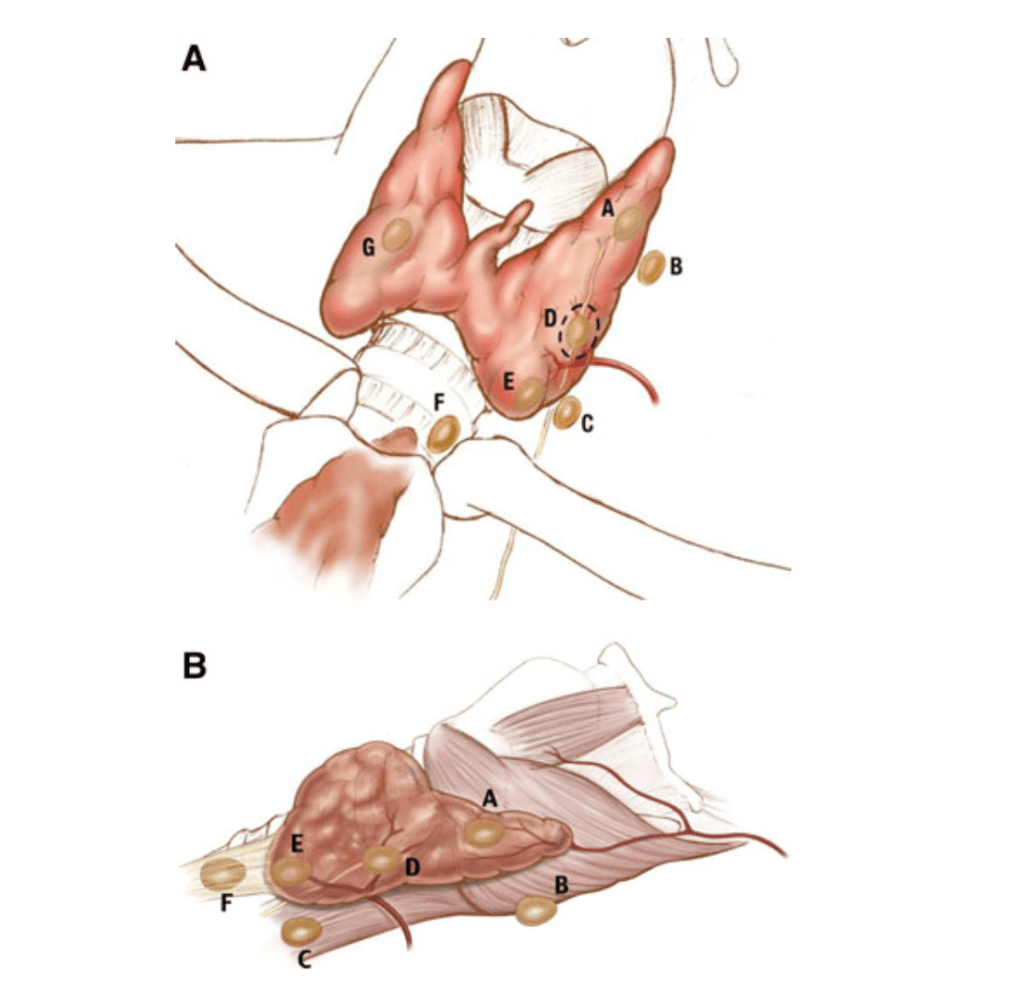
Location of the Parathyroid Glands

  • In 1984 Göran Åkerström, on the basis of 503 necropsies, analysed the location of the parathyroid glands:
    • Together with the work of Gilmour (n=478) and Wang (n=160), they form the foundations of our current knowledge on the subject
  • Dr. Juan M. Rangone modified the diagrams from Åkerström’s original publication to come up with the percentages of location of the “normodescended” parathyroid glands:
  • A. Percentages of the different locations of the superior parathyroid glands:
    • 80% corresponds to the midglandular variant
    • 12% to the cricopharyngeal variant
    • Usually located 1 cm higher than the crossing of the recurrent laryngeal nerve and the inferior thyroid artery
  • B. Percentages of the different locations of the inferior parathyroid glands:
    • Roughly 90% are located at the level, or no more than 1 cm below the inferior pole of the thyroid gland
  • Image:
    • 1- External carotid artery.
    • 2- Superior thyroid artery.
    • 3- Inferior thyroid artery.
    • 4- Upper thyroid pole.
    • 5- Lower thyroid pole.
    • 6- Inferior laryngeal nerve (recurrent laryngeal).
    • 7- Pharynx.
    • 8- Cervical trachea.
    • 9- Larynx (thyroid cartilage).
  • Recommended Bibliography:
    • Åkerström G, Malmaeus J, Bergström R. (1984) Surgical anatomy of human parathyroid glands. Surgery 95(1):14-21.
    • Wang C (1976) The anatomic basis of parathyroid surgery. Ann Surg. 183(3): 271–275.
    • Gilmour JC (1938) The gross anatomy of the parathyroid glands. J Pathol Bacteriol. 46(1): 133-149.

Reeve’s Cricothyroid Space

  • Reeve’s Cricothyroid Space:
    • Synonym:
      • Paralaryngingeal space
      • Pemberton space
      • Inter-laryngeal glandular space
  • The lower and lateral retraction of the upper thyroid pole:
    • Reveals a diamond-shaped avascular space
  • The area is limited:
    • Medially:
      • By the lamina of the thyroid cartilage (superiorly) and cricoid cartilage (inferiorly):
        • Both covered by the cricothyroid muscle
    • Inferolaterally:
      • The space is circumscribed by the medial border of the upper thyroid pole and the upper border of the thyroid isthmus
    • The “roof” of the area:
      • Is covered by 2 or 3 “bridging” blood vessels that must be controlled to access the space
  • The “opening” of this virtual space:
    • Prior to the ligature of the upper thyroid pedicle:
      • Is a safety maneuver to protect the external branch of the superior laryngeal nerve
  • Landmarks:
    1. Thyroid cartilage
    2. Reeve cricothyroid space
    3. Space with “bridging” blood vessels
    4. Upper thyroid pole
    5. Cricothyroid muscle
    6. External branch of the superior larngeal nerve
    7. Superior thyroid artery
    8. Superior thyroid vein
  • Reference:
    • Abdullah H, Bliss R, Reeve T, Delbridge L (2000) Recognition of the avascular space medial to the upper pole of the thyroid and its surgical implications. Asian J. Surg. 23: 86–9.
#Arrangoiz #CancerSurgeon #HeadandNeckSurgeon #SurgicalOncologist #Surgeon #Doctor #MD #MSCM #MountSinaiMedicalCenter #ThyroidSurgeon #EndocrineSurgery #ParathyroidSurgeon #Miami #Mexico

Routine Identification of the External Branch of the Superior Laryngeal Nerve

👉The external branch of the superior laryngeal nerve (EBSLN) has been labelled ‘the neglected nerve’ of thyroid surgery.

👉Most surgeons have simply attempted to avoid this nerve on the assumption that so doing will prevent injury; however, it is now recognized that injury is relatively common and associated with the potential for significant impairment, espe- cially for those who use their voices professionally.

👉I was taught to always attempt to identify the nerve and recommend doing so.

👉Recently Aina and Hisham have shown that the nerve can be routinely identified in over 90% of cases, a level that sets a new benchmark for head and neck surgeons / endocrine surgeons.

👉The key to identifying the nerve is to develop the avascular plane between the cricothyroid muscle and the medial border of the upper pole of the thyroid lobe, a manoeuvre facilitated by lateral retraction of the lobe.

👉Awareness of the various positions of the EBSLN according to the Cernea classification is also essential if the nerve is to be both identified and preserved.

👉Type 1 EBSLN are located well clear of the thyroid, more than 1 cm above the upper pole of the lobe passing directly into the cricothyroid muscle.

👉Type 2a nerves pass in the vicinity of the superior thyroid vessels as they enter the gland substance.

👉Type 2b nerves cross over the anterior surface of the thyroid lobe.

👉Awareness of the anatomic variations, such as the nerve of Galen, a direct communication between the RLN and EBSLN, is important in avoiding injury to the nerve.

#Arrangoiz

#HeadandNeckSurgeon

#ThyroidSurgeon

#ParathyroidSurgeon

#CancerSurgeon

#SurgicalOncologist

#EndocrineSurgery

#Teacher

#MSMC

#MountSinaiMedicalCenter

Vascular anatomy relevant to the surgical approach to the external branch of the superior laryngeal nerve (EBSLN)

The true prevalence of iatrogenic injury to the EBSLN during thyroid surgery remains difficult to quantify, largely due to underdiagnosis and variability in clinical presentation.

– The pathophysiology and anatomical risk stratification of EBSLN injury were elegantly described by Cernea et al. in 1992 [1]. In this landmark study, the variant in which the nerve crosses the superior thyroid pedicle below the plane of the upper pole apex—classified as Cernea type 2B—was identified as carrying a high risk of injury.

– Although this configuration was initially reported in approximately 14% of cadaveric dissections by the University of São Paulo group [1], later clinical series by Gianlorenzo Dionigi et al. demonstrated that this “high-risk” anatomy may be present in up to 54% of patients with large or bulky goiters [2], significantly increasing surgical complexity.

– First popularized by Mossman and DeWeese (1968), Joll’s sterno-thyro-laryngeal triangle remains a valuable anatomical landmark for identifying the EBSLN during superior pole dissection [3].

– In 1986, Michael Friedman provided a detailed description of the surgical approach to the upper thyroid pole that many of us continue to employ in complex cases, particularly when exposure of the EBSLN is critical [4].

– At the supero-external angle of the intermuscular pocket, created to identify the insertion of the sternothyroid muscle on the oblique line of the thyroid cartilage, surgeons frequently encounter a small arterial vessel. While its injury usually causes only minor (though often annoying) bleeding, it serves as an important anatomical landmark.

– These vessels supply the upper portion of the sternohyoid muscle, above the level of the cricoid cartilage.

– According to Wang et al. [5], in approximately 75% of cases, this vessel represents a terminal branch of a common trunk with the cricothyroid artery, originating from the superior thyroid artery. Before bifurcation, this trunk also gives rise to small nourishing branches to the thyrohyoid and omohyoid muscles.

– The so-called “sternohyoid nutrient vessel” is anatomically unique in 56% of cases [5]. After emerging superficially, it enters the (virtual) intermuscular space between the posterior surface of the sternohyoid and the anterior surface of the sternothyroid muscle, following one of two patterns:

✅ coursing along (“hugging”) the lateral border of the sternothyroid muscle, or ✅ directly piercing the most cranial fibers of the sternothyroid muscle.

– Awareness of this vascular anatomy can facilitate safe superior pole dissection, improve EBSLN identification, and ultimately reduce the risk of voice-related complications following thyroid surgery.

References

Cernea CR, et al. Identification of the external branch of the superior laryngeal nerve during thyroidectomy. Am J Surg. 1992. Dionigi G, et al. Surgical anatomy of the external branch of the superior laryngeal nerve. Gland Surg. Mossman HW, DeWeese MS. The surgical anatomy of the larynx. 1968. Friedman M. Surgical management of the superior thyroid pole. Otolaryngol Clin North Am. 1986. Wang C, et al. Vascular supply of the infrahyoid muscles and its surgical relevance. Surg Radiol Anat.

SOUND Trial Findings and Discussion

  • Sentinel Lymph Node Biopsy vs No Axillary Surgery in Patients With Small Breast Cancer and Negative Results on Ultrasonography of Axillary Lymph Nodes:
    • The SOUND Randomized Clinical Trial. Gentilini et al. JAMA Oncol. 2023 Sep 21:e233759. doi: 10.1001/jamaoncol.2023.3759
  • The SOUND trial that was published in JAMA Oncology concluded:
    • That patients with small breast cancer (less than 2 cm) and sonographically normal appearing lymph nodes:
      • Can be safely spared any axillary surgery:
        • Whenever the lack of pathological information does not affect the postoperative treatment plan
  • This study was designed to evaluate whether omission of sentinel lymph node (SLN) surgery in patients with negative axillary ultrasound:
    • Was noninferior to SLN surgery in terms of 5 year distant disease free survival
  • While this trial is unlikely to change practice immediately:
    • It is a thought provoking study that will likely generate multidisciplinary discussion
  • Phase III Randomized Controlled Trial:
    • Conducted at 18 European hospitals from 2012 to 2017:
      • Italy, Spain, Switzerland, and Chile:
        • Recruitment Feb 6, 2012 – Jun 30, 2017
    • Enrolled patients with invasive breast cancer up to 2 cm, cN0, planning for breast conserving surgery (BCT) and adjuvant radiation therapy (XRT) who had an axillary US showing no LN involvement on imaging:
      • If doubtful – FNA performed and had to be negative:
        • 1406 negative AUS, 57 with negative FNA
    • Patients were randomized to SLN surgery vs no axillary surgery
    • Analysis cohort:
      • 1405 women:
        • 708 SLN
        • 697 no axillary surgery
      • Median age 60
      • Tumor size 1.1 (IQR 0.8-1.5cm)
      • ER+ / Her2- disease in 87.8%
      • In the SLN group:
        • 13.7% had positive nodes on SLN:
          • 5.1% macrometases
          • 8.6% micrometastases
        • 2.0% had ≥ 2 positive SLNs, 0.6% had pN2 disease
      • Recommended adjuvant systemic therapy and radiotherapy were similar in the two groups:
        • 20.1% of SLN group and 17.5% of no axillary surgery group received chemotherapy
        • 98.0% of SLN group and 97.6% of no axillary surgery received radiation
        • 83.3% (593 pts) vs 81.1% (565 pts) had whole breast radiation over 3 to 5 weeks
        • 10.7% (76 pts) vs 10.8% (75 pts) had partial breast radiotherapy
        • 3.4% (24 pts) vs 5.6% (39 pts) had intraoperative boost of ELIOT (12 Gy) followed by a hypofractionated course of whole-breast radiotherapy (37.05 Gy in 13 fractions)
  • The study authors concluded that patients with patients with small breast cancer with sonographically normal appearing lymph nodes:
    • Can be safely spared any axillary surgery:
      • Whenever the lack of pathological information does not affect the postoperative treatment plan
  • This study provides further data:
    • Supporting that axillary sentinel lymph node surgery does not provide therapeutic benefit
  • In the no axillary surgery group:
    • The cumulative incidence of lymph node recurrences in the axilla was very low:
      • 0.4% at 5 years:
        • Despite a 13.7% rate of nodal involvement in the SLNB group
  • However, SLN surgery likely still has a role in certain patients for staging to guide adjuvant therapies:
    • In particular in young patients:
      • Where chemotherapy is associated with survival benefit for node positive disease (Rx-Ponder patient)
    • Furthermore, while adjuvant treatment recommendations in terms of rate of chemotherapy was similar between the two groups:
      • Identification of nodal positivity in ER+ breast cancer:
        • Also influences treatment options in terms of:
          • CDK4/6 inhibitor eligibility as well as consideration of extended endocrine therapy (to 10 years)
    • Many patients are interested in potential for omission of radiation therapy:
      • The trial required radiation, with 90% of patients having whole breast radiation and 10% partial breast radiation
      • Some of the patients in this trial with small breast cancers aged > 65 would be candidates for consideration of omission of radiation
      • This creates a dilemma regarding de-escalating axillary surgery leading to potential escalation of adjuvant radiation
    • It should be noted that tumor grade was not an inclusion / exclusion factor:
      • However, 18% had grade 3 disease
      • Patients with grade 3 disease have higher likelihood of nodal positivity:
        • Should omission of SLN surgery be limited to grade 1 and 2 disease at outset
        • Especially as grade 3 disease with 1 to 3 positive nodes:
          • Would make patients eligible for CDK4/6 inhibitor
  • Genomic scores were not included on this trial:
    • Most patients with ER+ / Her2- disease (with tumors > 1 cm in size) would be considered for genomic testing to guide systemic treatment recommendations
  • In summary:
    • Multidisciplinary discussion will be important before implementing any changes in practice as a result of the SOUND trial
  • I look forward to additional data from several other trials evaluating this question over the upcoming years:
    • INSEMA (published)
    • BOOG 2013-08
    • NAUTILUS

ACOSOG Z0011, AMAROS, ACOSOG Z0010 Trial

  • Data from the ACOSOG Z0011 trial:

    • Suggested that completion axillary dissection can be avoided in patients with:
      • cT1 to cT2, cN0 breast cancer with sentinel lymph node (SLN) metastasis:
        • Provided that systemic therapy and whole-breast irradiation (WBI):
          • Are incorporated into the treatment strategy for early-stage breast cancer following breast-conserving surgery (BCS)
    • This trial enrolled:
      • Clinically node-negative patients with:
        • Tumors less than 5 cm in size and with 1 to 2 positive SLNs by hematoxylin and eosin staining who were treated with BCS and planned WBI
    • Patients were randomized to:
      • SLN biopsy alone vs. axillary lymph node dissection (ALND)
    • The 10-year:
      • Overall survival was similar in the SLNB only group compared to the ALND group:
        • 86.3% vs. 83.6%, p = 0.72
      • Disease-free survival was similar in the SLNB only group compared to the ALND group:
        • 80.2% and 78.2%
      • In patients treated with ALND:
        • 27% had additional non-SLN disease found at the time of ALND:
          • Suggesting that patients treated with SLNB alone would have a similar disease burden:

            • Yet, nodal recurrence rates were similar between the SLNB and ALND groups at 10 years:
              • 1.5% vs. 0.5%, p = 0.13
            • Suggesting that systemic therapy and radiation therapy:
              • Provide adequate local control in patients with limited disease burden in the axilla
  • The AMAROS trial:
    • Is a phase III non-inferiority study:
      • Comparing ALND with axillary radiation therapy in patients with:
        • Clinical T1 / T2 N0 breast cancer with a positive sentinel node
    • The trial showed low 5-year rates of regional recurrence:
      • In the ALND and axillary radiation therapy groups:
        • 0.43% vs 1.19%, respectively
      • But the risk of patient perceived (subjective) or measured (objective) lymphedema:
        • Was twice as high in the ALND arm compared to the radiation arm:
          • Subjective
            • 23% vs. 11% after 5 years of follow-up
          • Objective:
            • 13% vs. 5% after 5 years of follow-up
  • The ACOSOG Z0010 trial:
    • Evaluates the incidence and impact of SLN and bone marrow micro-metastases on patients with early-stage breast cancer treated with BCS and radiation
    • It demonstrated that:
      • Identification of occult disease in the SNs with immunohistochemistry was not associated with survival
  • References:

    • Giuliano AE, McCall L, Beitsch P, Whitworth PW, Blumencranz P, Leitch AM, et al. Locoregional recurrence after sentinel lymph node dissection with or without axillary dissection in patients with sentinel lymph node metastases: the American College of Surgeons Oncology Group Z0011 Randomized Trial. Ann Surg. 2010;252(3):426-432.Veronesi U, Cascinelli N, Mariani L, Greco M, Saccozzi R, Luini A, et al. Twenty-year follow-up of a randomized study comparing breast-conserving surgery with radical mastectomy for early breast cancer. N Engl J Med. 2002;347(16):1227-1232.Rutgers EJ, Donker M, Straver ME. Radiotherapy or surgery of the axilla after a positive sentinel node in breast cancer patients: final analysis of the EORTC AMAROS trial (10981/22023). J Clin Oncol. 2013;31 (suppl; abstr LBA1001). Available at: http://meetinglibrary.asco.org/content/109779-132. Accessed November 7, 2013.Straver ME, Meijnen P, van Tienhoven G, et al. Sentinel node identification rate and nodal involvement in the EORTC 10981-22023 AMAROS trial. Ann Surg Oncol. 2010;17:1854-1861.
  • Hunt KK, Ballman KV, McCall LM, et al. Factors associated with local-regional recurrence after a negative sentinel node dissection: results of the ACOSOG Z0010 trial. Ann Surg. 2012;256:428-436.

AMAROS (EORTC 10981-22023)

  • AMAROS (EORTC 10981-22023):
    • If a positive SLN needs axillary treatment, axillary RT (ART) gives equivalent control to ALND with far less lymphedema
  • Design & who it applies to:
    • Population: 
      • cT1 to cT2, clinically node-negative invasive breast cancer with a positive sentinel lymph node (SLN):
        • Patients underwent BCT or mastectomy:
          • Unlike Z0011, which was BCT-only
        • Randomized to ALND (levels I to II) vs axillary radiotherapy (levels I to III ± supraclavicular fossa)
    • Primary endpoint: 
      • Non-inferiority of 5-year axillary recurrence (ARR)
    • Key results:
      • 5-year (primary report, Lancet Oncol 2014):
        • Axillary recurrence: 
          • 0.43% ALND vs 1.19% ART:
            • Non-inferiority test underpowered due to very few events, but absolute ARR was low in both arms
      • Lymphedema at 5 years: 
        • 23% ALND vs 11% ART (significantly less with ART)
    • 10-year update (JCO 2023):
      • Cumulative axillary recurrence: 
        • 0.93% ALND vs 1.82% ART (HR 1.71, 95% CI 0.67–4.39):
          • No meaningful difference
      • Overall survival: 
        • 84.6% ALND vs 81.4% ART (HR 1.17, 95% CI 0.89–1.52):
          • No difference
      • Disease-free survival: 
        • 75.0% ALND vs 70.1% ART (HR 1.19, 95% CI 0.97–1.46):
          • No difference
      • Updated 5-year lymphedema: 
        • 24.5% ALND vs 11.9% ART (P<.001):
          • Quality of life similar
  • Clinical takeaways:
    • For SLN-positive patients who still require axillary treatment:
      • Choose ART over ALND to achieve the same axillary control and survival with substantially less lymphedema:
        • This applies to both BCT and mastectomy cohorts (AMAROS included both):
          • If you’re uncomfortable omitting axillary therapy (e.g., features beyond Z0011 scope):
            • ART is preferred over ALND to minimize morbidity
    • Avoid combined ALND + ART when possible:
      • Stacking treatments markedly raises lymphedema risk:
        • General morbidity data and reviews echo this principle
    • Field/Dose (typical in AMAROS): 
      • Axilla levels I to III ± SCV, ~ 50 Gy in conventional fractions; most modern clinics use tangents / high tangents plus nodal fields as indicated. (Protocol details in trial reports.)
  • Bottom line: 
    • ART = ALND for control, with less arm morbidity:
      • So when axillary therapy is needed after a positive SLN:
        • ART is the preferred option

Giuliano et al., Ann Surg 1994 — “Lymphatic mapping and sentinel lymphadenectomy for breast cancer.”

  • What they asked?
    • Could intraoperative lymphatic mapping with a blue dye–guided sentinel lymphadenectomy accurately reflect axillary status in breast cancer”
      • Is the SLN a reliable surrogate for the entire basin? PubMed
  • Methods (early feasibility):
    • Design / setting: 
      • Prospective feasibility / accuracy series at John Wayne Cancer Institute
    • Technique: 
      • Vital blue dye injected at the primary site
      • Surgeons traced stained lymphatics to the first (“sentinel”) node, excised it, then performed ALND on all patients to verify accuracy
    • Cohort: 
      • 174 mapping procedures PubMed
  • Key performance results:
    • Identification rate: 
      • 65.5% (SLN found in 114 / 174 procedures):
        • Reflecting the learning curve of this first-in-breast series PubMed
    • Accuracy when SLN identified: 
      • 95.6% (SLN status matched final axillary status in 109 / 114)
      • All false-negatives occurred early:
        • In the last 87 cases:
          • SLN status was 100% predictive PubMed
    • Unique value of the SLN: 
      • In 38% (16 / 42) of clinically node-negative but pathologically node-positive axillae:
        • The sentinel node was the only involved node:
          • Limited disease that a blind sample / low-level dissection might have missed PubMed
    • Anatomic insight: 
      • Among the last 54 mapped cases:
        • 10 had level II-only metastases:
          • Underscoring why targeted mapping can outperform low-level sampling PubMed
  • Why it mattered?
    • Provided the first clinical proof-of-concept in breast cancer that a mapped SLN can accurately stage the axilla with far less surgery:
      • Laying the groundwork for later multicenter validation (Krag 1998) and definitive RCTs (NSABP B-32, ACOSOG Z0011) that enabled omission of routine ALND in properly selected patients PubMed
  • Practical pearls / caveats:
    • Learning curve is real: 
      • Early experience showed lower identification and some false-negatives
      • Performance improved to perfect concordance in later cases
      • Training and standardized technique are crucial PubMed
    • Technique used here was blue dye alone (pre-radioisotope era):
      • Subsequent adoption of radiotracer (± dye) further raised identification and lowered FNR, but the 1994 study established the principle