- Background and Rationale:
- Human papillomavirus (HPV)-associated (p16-positive) oropharyngeal squamous cell carcinoma (OPSCC):
- Is a biologically distinct, prognostically favorable disease compared with HPV-negative disease
- Historically, patients received definitive chemoradiation or surgery followed by uniform adjuvant chemoradiation:
- Producing excellent cancer control but substantial long-term toxicity:
- Dysphagia, xerostomia, fibrosis, osteoradionecrosis
- Producing excellent cancer control but substantial long-term toxicity:
- The central question of E3311 was:
- Whether upfront transoral surgery (TOS), by providing accurate surgical pathology:
- Could be used to stratify patients by recurrence risk and thereby safely de-intensify adjuvant therapy:
- Reducing radiation dose (or omitting radiation entirely) in lower-risk patients while reserving full-intensity chemoradiation for high-risk pathology
- Could be used to stratify patients by recurrence risk and thereby safely de-intensify adjuvant therapy:
- A secondary but pivotal aim was:
- To demonstrate that a multi-institutional cooperative-group transoral surgical trial, with formal surgeon credentialing, was feasible (Ferris et al., Journal of Clinical Oncology, 2022)
- Whether upfront transoral surgery (TOS), by providing accurate surgical pathology:
- Study Design:
- Phase:
- II, prospective, multi-institutional (ECOG-ACRIN Cancer Research Group):
- With randomization embedded in the intermediate-risk group
- II, prospective, multi-institutional (ECOG-ACRIN Cancer Research Group):
- Population:
- Resectable, p16+ OPSCC
- AJCC 7th edition T1 to T2
- Clinical stage III / IVa
- No matted nodes
- Candidates for transoral resection
- Surgical quality control:
- Participating surgeons underwent formal credentialing:
- To ensure consistent transoral oncologic technique
- Participating surgeons underwent formal credentialing:
- Intervention:
- All patients underwent primary transoral surgery (robotic or laser) plus neck dissection:
- Followed by assignment to one of four pathology-based arms (Ferris et al., Journal of Clinical Oncology, 2022)
- All patients underwent primary transoral surgery (robotic or laser) plus neck dissection:
- Phase:
- Human papillomavirus (HPV)-associated (p16-positive) oropharyngeal squamous cell carcinoma (OPSCC):
- Risk Stratification and Treatment Arms
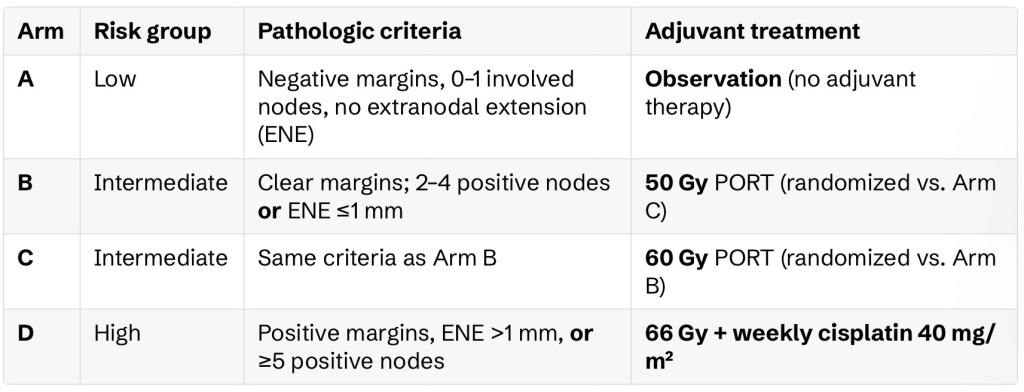
- Key operational definitions used in E3311 (important when comparing with other trials):
- Positive margin = tumor-on-ink
- Close margin = < 3 mm (contrast with ORATOR / MC1675, which used > 5 mm as clear)
- Patients in the intermediate-risk group were randomized between 50 Gy (Arm B) and 60 Gy (Arm C)
- The trial was not powered for a direct head-to-head comparison of B vs. C:
- Instead each arm was independently compared against a historical efficacy benchmark (Ferris et al., Journal of Clinical Oncology, 2022)
- The trial was not powered for a direct head-to-head comparison of B vs. C:
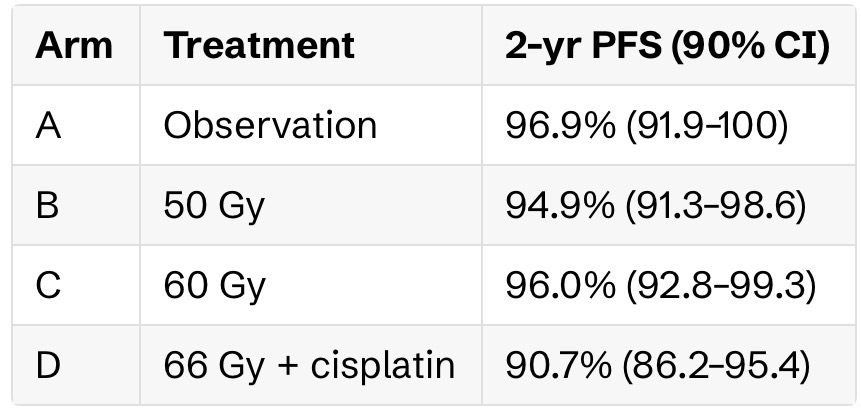
- Primary Results (Ferris et al., Journal of Clinical Oncology, 2022) – see Table 1
- Interpretation:
- Among 359 evaluable patients (median follow-up 35.2 months):
- Approximately 70% of patients were de-intensified relative to standard adjuvant chemoradiation
- Two-year progression-free survival (PFS) was excellent across all arms, and both intermediate-risk arms cleared the prespecified efficacy boundary (lower limit of the 90% CI > 85%)
- Both intermediate-dose arms exceeded the historical benchmark:
- Supporting 50 Gy as an adequate adjuvant dose for intermediate-risk disease
- Functional and quality-of-life measures (FACT-H&N, MD Anderson Dysphagia Inventory):
- Favored the reduced-dose approach, reinforcing the clinical value of de-escalation (Ferris et al., Journal of Clinical Oncology, 2022)
- Both intermediate-dose arms exceeded the historical benchmark:
- Among 359 evaluable patients (median follow-up 35.2 months):
- Interpretation:
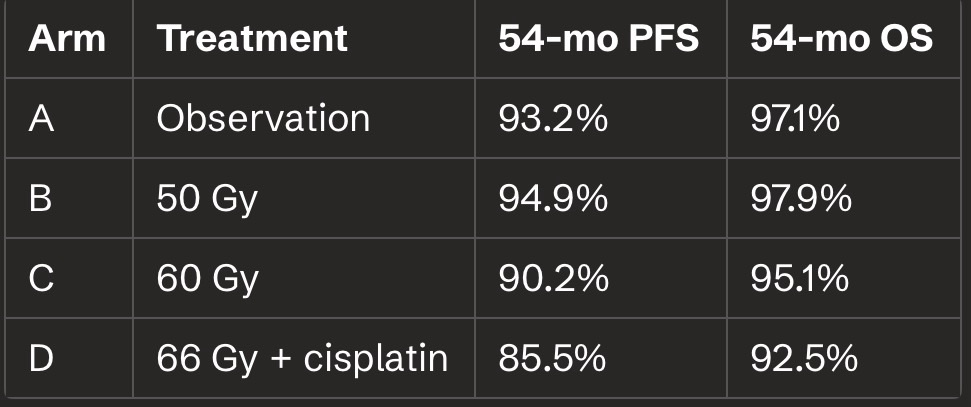
- Long-Term Follow-Up (Burtness et al., Journal of Clinical Oncology, 2025): Table 2
- Mature data at 54 months confirmed durable efficacy across the cohort:
- Overall 54-month PFS 90.6% and OS 95.3%
- Key long-term observations (Burtness et al., Journal of Clinical Oncology, 2025):
- Outcomes did not differ by primary subsite or smoking history
- Among observed (Arm A) patients:
- All 4 recurrences occurred in N1 patients:
- Signaling that patients with N1 disease remain at some risk for late recurrence when radiation is omitted, and warrant careful surveillance or individualized decision-making
- All 4 recurrences occurred in N1 patients:
- Mature data at 54 months confirmed durable efficacy across the cohort:
- Guideline Integration:
- NCCN Head and Neck Cancers Guidelines:
- E3311 is cited to support de-escalation of adjuvant radiotherapy to 50 Gy (category 2B) in p16+ OPSCC with ≤ 4 positive ipsilateral nodes (largest ≤ 6 cm), T1 to T2 resected to negative or close (< 3 mm) margins, and ≤ 1 mm ENE — mirroring the E3311 intermediate-risk criteria (National Comprehensive Cancer Network, Head and Neck Cancers, 2026)
- ASCO Transoral Robotic Surgery (TORS) Guideline (2025):
- E3311 is the largest prospective trial underpinning pathology-driven, risk-adapted adjuvant therapy after TORS
- It supports adding concurrent cisplatin for positive margins (tumor-on-ink) or ENE, and informs the risk-based selection of radiation dose (Holsinger et al., Journal of Clinical Oncology, 2025)
- NCCN Head and Neck Cancers Guidelines:
- Contextual Comparisons and Caveats:
- Definitional heterogeneity:
- E3311’s 3 mm close-margin and tumor-on-ink positive-margin thresholds differ from other de-escalation trials (e.g., ORATOR, MC1675), which affects cross-trial comparison of toxicity and control
- Postoperative vs. definitive setting:
- E3311’s favorable de-escalation outcomes contrast with NRG-HN005, where dose reduction to 60 Gy in the definitive chemoradiation setting did not meet non-inferiority:
- This suggests the smaller tumor volume of the postoperative setting may better tolerate dose reduction (Ma et al., Lancet Oncology, 2025)
- E3311’s favorable de-escalation outcomes contrast with NRG-HN005, where dose reduction to 60 Gy in the definitive chemoradiation setting did not meet non-inferiority:
- Trial scope:
- Phase II design and lack of power for direct B-vs-C comparison mean 50 Gy and 60 Gy were each validated against a benchmark rather than against each other
- Definitional heterogeneity:
- Distinguishing E3311 from E1308:
- If the trial of interest was E1308 (a separate ECOG-ACRIN study):
- The trial tested induction chemotherapy (cisplatin / paclitaxel / cetuximab) followed by reduced-dose IMRT (54 Gy) with cetuximab in HPV-associated resectable OPSCC:
- Among primary-site complete responders, 2-year PFS and OS were 80% and 94%, with improved swallowing at the lower dose (Marur et al., Journal of Clinical Oncology, 2017)
- E1308 uses an induction / organ-preservation strategy, distinct from E3311’s surgery-first, pathology-guided strategy
- The trial tested induction chemotherapy (cisplatin / paclitaxel / cetuximab) followed by reduced-dose IMRT (54 Gy) with cetuximab in HPV-associated resectable OPSCC:
- If the trial of interest was E1308 (a separate ECOG-ACRIN study):
- Key Takeaways:
- E3311 established that upfront transoral surgery can guide risk-based de-intensification of adjuvant therapy in HPV+ OPSCC within a credentialed, multi-institutional framework
- ~ 70% of patients were safely de-intensified, with excellent 2-year and durable 54-month PFS / OS across all arms
- 50 Gy is adequate for intermediate-risk pathology:
- Clear margins, 2 to 4 nodes or ENE ≤ 1 mm)
- Observation alone yielded outstanding control in low-risk disease:
- But N1 patients accounted for the Arm A recurrences and merit vigilance
- E3311 now anchors NCCN (50 Gy, category 2B) and ASCO TORS guidance on adjuvant management after transoral surgery