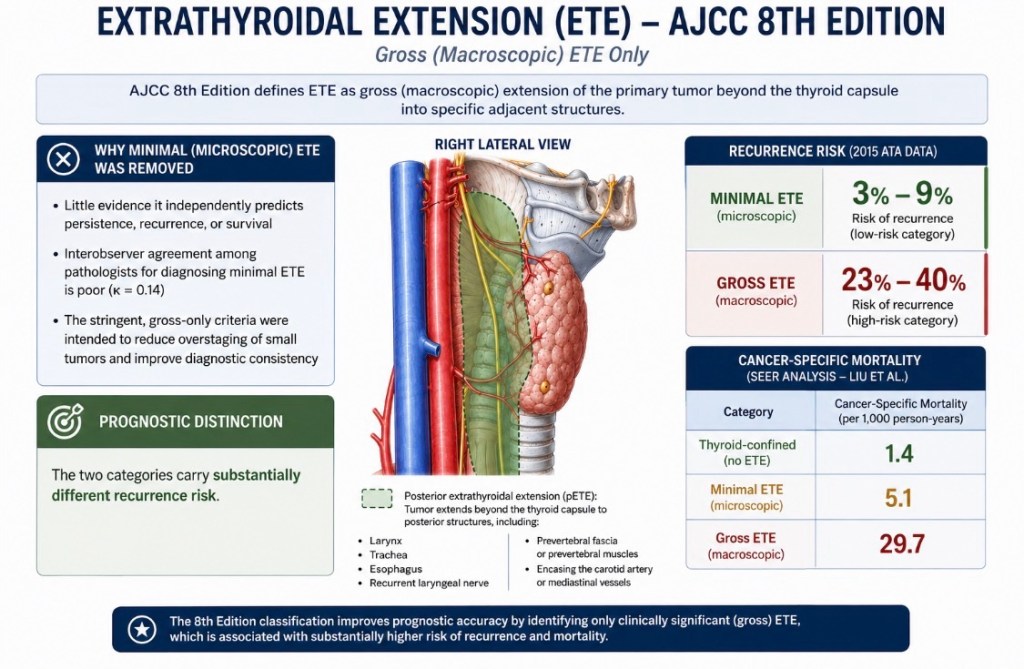
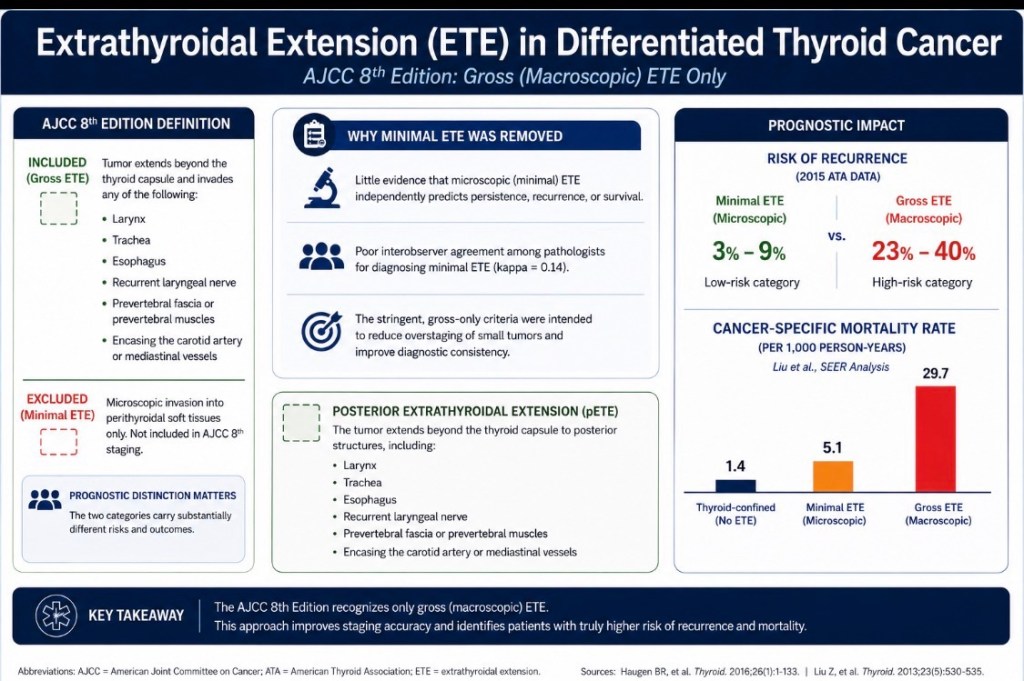
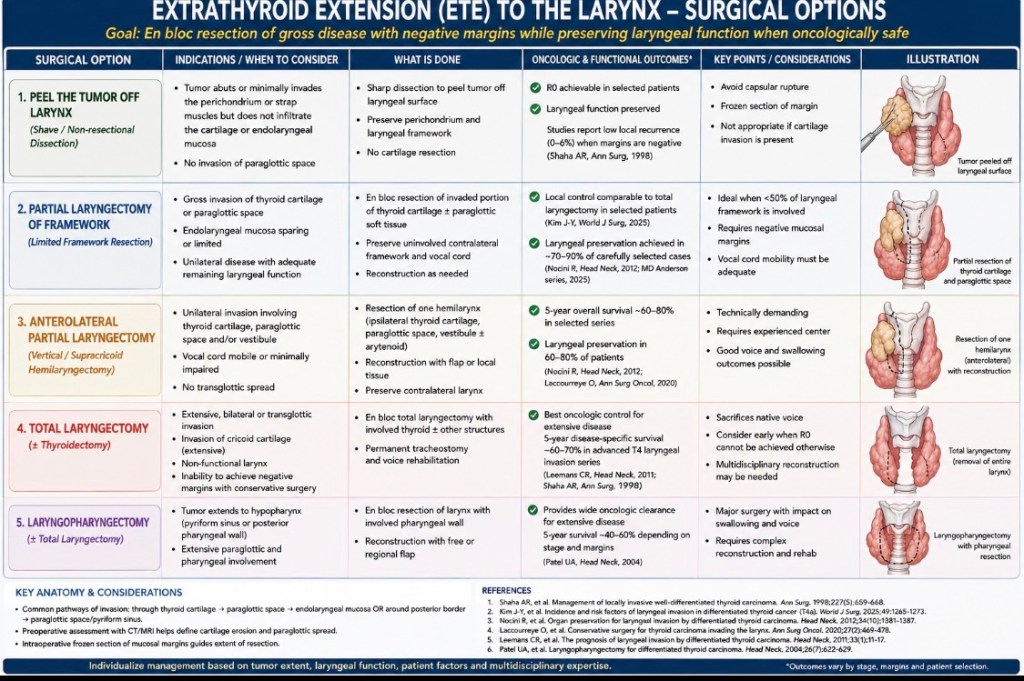
- Gross extrathyroidal extension (ETE):
- Is defined as direct tumor extension beyond the thyroid capsule into perithyroidal structures:
- Identified clinically, on imaging, or on gross pathology:
- This is the defining feature of locally advanced thyroid cancer
- Identified clinically, on imaging, or on gross pathology:
- It must be distinguished from microscopic (minimal) ETE (mETE):
- Which is detected only histologically and, because of poor interobserver reproducibility (kappa ≈ 0.14) and negligible independent prognostic weight:
- Was removed from AJCC 8th edition T-staging in 2017
- Only gross ETE (gETE) now drives T-category and stage
- Which is detected only histologically and, because of poor interobserver reproducibility (kappa ≈ 0.14) and negligible independent prognostic weight:
- Is defined as direct tumor extension beyond the thyroid capsule into perithyroidal structures:
- Management is stratified by which structure is involved:
- Strap muscles vs. recurrent laryngeal nerve (RLN), trachea, larynx, esophagus vs. prevertebral fascia / great vessels:
- With the central principle that complete gross resection with acceptable morbidity, followed by risk-adapted RAI and / or EBRT:
- Offers the best locoregional control
- With the central principle that complete gross resection with acceptable morbidity, followed by risk-adapted RAI and / or EBRT:
- Strap muscles vs. recurrent laryngeal nerve (RLN), trachea, larynx, esophagus vs. prevertebral fascia / great vessels:
- Definitions and classification of ETE
Microscopic (minimal / minor) ETE (mETE):- Tumor extension into immediate perithyroidal soft tissue or skeletal muscle:
- Seen only on histology:
- Not appreciated clinically or grossly
- Seen only on histology:
- Associated with a 3% to 9% recurrence risk:
- With no consistent independent effect on disease-specific (DSS) or overall survival (OS)
- Tumor extension into immediate perithyroidal soft tissue or skeletal muscle:
- Gross (extensive) ETE:
- Macroscopic invasion evident at surgery, on preoperative imaging, or on gross specimen exam:
- Into strap muscles (T3b) or into subcutaneous soft tissue, larynx, trachea, esophagus, RLN (T4a), or prevertebral fascia / carotid / mediastinal vessels (T4b)
- Recurrence risk of 23% to 40%
- Disease-specific mortality of 23% to 52%
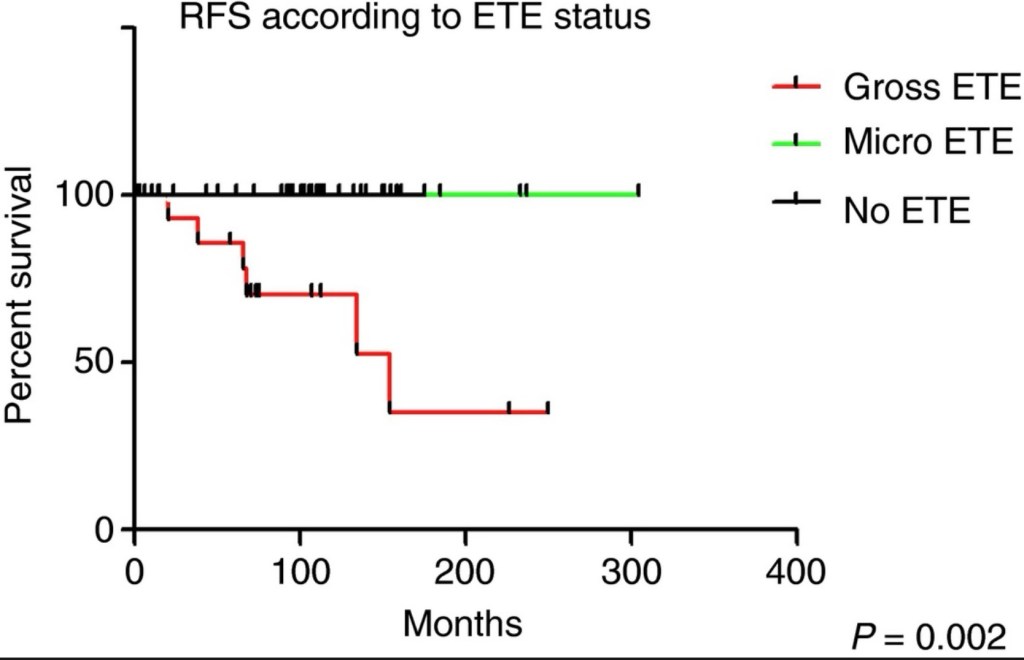
- The following Kaplan-Meier curves illustrate the sharp prognostic divergence:
- Recurrence-free survival for mETE overlaps with no ETE (both near 100%), whereas gETE falls to roughly 35%
- Macroscopic invasion evident at surgery, on preoperative imaging, or on gross specimen exam:
- Epidemiology:
- ETE is present in roughly:
- 10% to 15% of thyroid cancers at presentation:
- Up to ~ 23.5% of papillary carcinomas in some pathologic series:
- Most commonly involving the strap muscles
- Up to ~ 23.5% of papillary carcinomas in some pathologic series:
- 10% to 15% of thyroid cancers at presentation:
- Frank aerodigestive-tract invasion is less common:
- Tracheal invasion occurs in an estimated:
- 1% to 8% of thyroid carcinomas
- RLN is involved in:
- 33% to 61% of the subset of tumors classified as “invasive”
- Overall, roughly 10% to 15% of DTC patients have locoregionally advanced disease:
- Carrying substantially higher recurrence and mortality risk
- Tracheal invasion occurs in an estimated:
- ETE is present in roughly:
- Prognosis:
- Gross ETE (gETE):
- Is an independent predictor of reduced disease-specific survival (DSS), higher local recurrence, and greater risk of nodal and distant metastasis
- In a SEER cohort of > 107,000 patients:
- Cancer-specific mortality rates per 1,000 person-years rose stepwise:
- 1.4 (thyroid-confined)
- 5.1 (mETE)
- 29.7 (gETE)
- Cancer-specific mortality rates per 1,000 person-years rose stepwise:
- Among invaded structures, tracheal invasion carries particular weight:
- In one T4 DTC series it was the only factor significantly associated with recurrence, and airway obstruction from local spread accounts for a substantial share of DTC deaths:
- Coexisting macroscopic extranodal extension further worsens outcomes:
- With unresectable macroscopic ENE dropping 5-year DSS to ~ 82%
- Coexisting macroscopic extranodal extension further worsens outcomes:
- In one T4 DTC series it was the only factor significantly associated with recurrence, and airway obstruction from local spread accounts for a substantial share of DTC deaths:
- Gross ETE (gETE):
- Staging (AJCC 8th edition):
- The T-category is anchored to the depth of gross ETE, and staging is heavily age-dependent (cutoff 55 years):
- Below is the NCCN reproduction of the AJCC 8th edition TNM definitions for differentiated (and anaplastic) carcinoma
- The T-category is anchored to the depth of gross ETE, and staging is heavily age-dependent (cutoff 55 years):
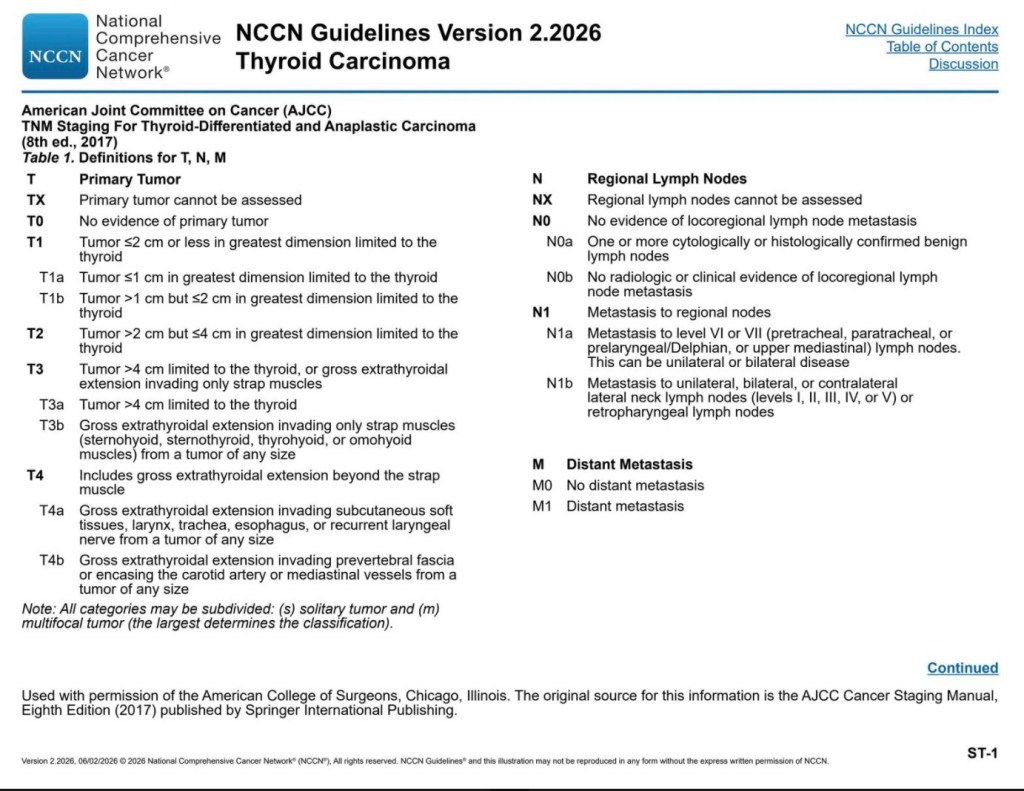
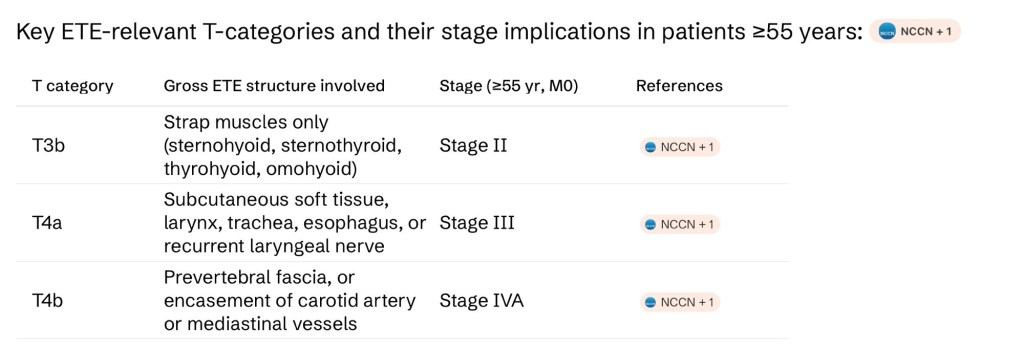
In patients < 55 years, any T with M0 is Stage I regardless of ETE. For anaplastic carcinoma, all disease is Stage IV (IVA /IVB / IVC), with the same T definitions. Note gETE also mandates total thyroidectomy and excludes a patient from active surveillance.
- Management by structure involved:
- Surgery is the mainstay:
- The goal is complete gross tumor removal (R0 / R1) balanced against functional morbidity:
- Followed by risk-adapted adjuvant therapy
- The goal is complete gross tumor removal (R0 / R1) balanced against functional morbidity:
- A multidisciplinary team at a high-volume center:
- Is recommended for bulky or viscerally invasive disease
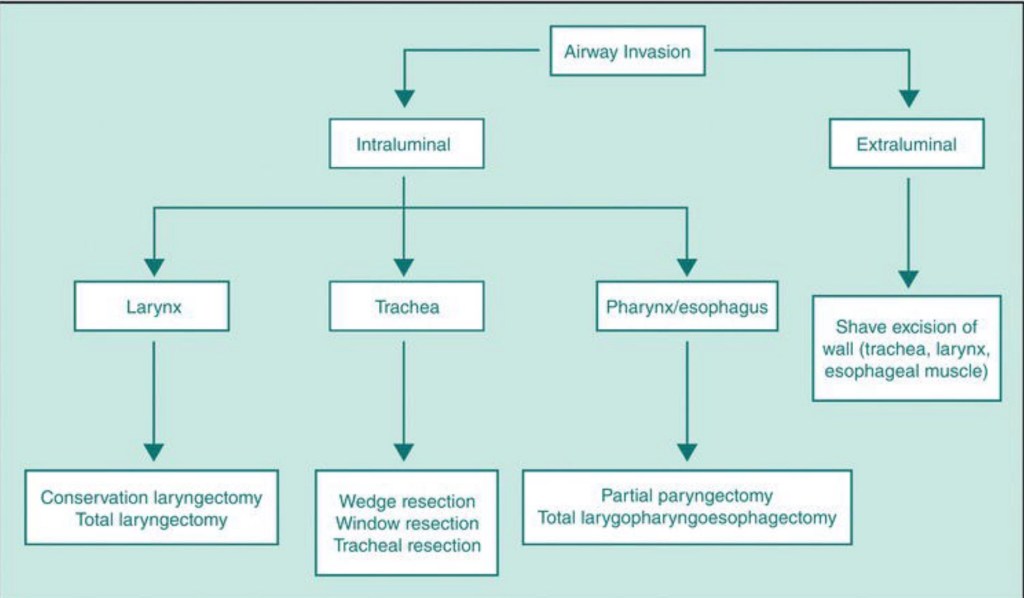
- The overall airway / aerodigestive management framework hinges on:
- Whether invasion is:
- Extraluminal:
- Amenable to shave excision versus
- Intraluminal:
- Requiring formal resection
- Extraluminal:
- Surgery is the mainstay:
- Strap muscles (T3b):
- En bloc resection of the involved strap muscle with the thyroid:
- This is well tolerated and does not compromise function
- En bloc resection of the involved strap muscle with the thyroid:
- Recurrent laryngeal nerve (T4a):
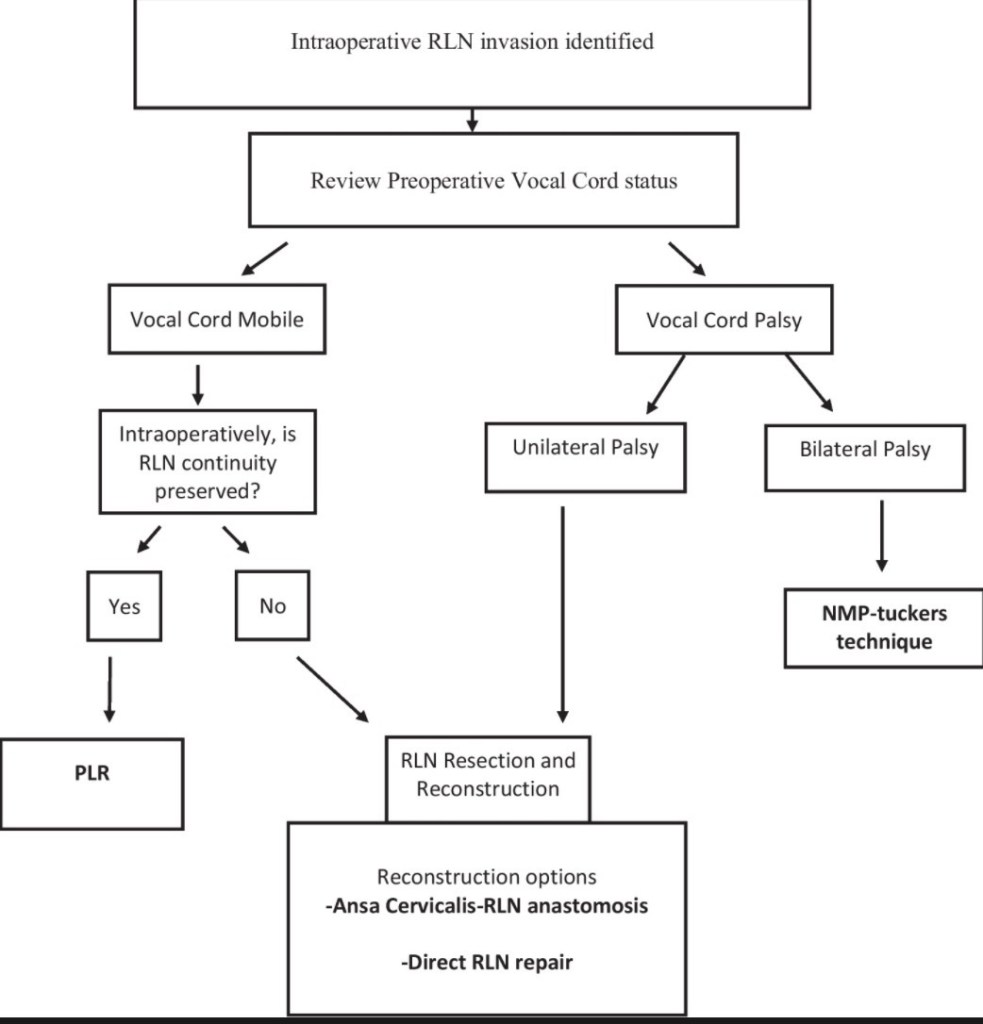
- Management is dictated by preoperative vocal cord function and the extent of invasion:
- Functioning nerve with tumor adherent /encasing but mobile cords:
- Attempt preservation:
- Shave / partial-layer resection to remove all gross disease while keeping neural continuity, followed by adjuvant therapy
- Preserving a functioning nerve, even at the cost of microscopic residual,, does not worsen survival
- Attempt preservation:
- Nonfunctioning nerve (preoperative paralysis) and / or complete encasement:
- Resection of the involved segment is appropriate:
- Ideally with immediate reconstruction (direct / end-to-end anastomosis, ansa cervicalis–to–RLN anastomosis, or nerve grafting) to restore phonatory and swallowing function
- Keep in mind contralateral nerve, want to avoid tracheostomy
- Intraoperative nerve monitoring (NIM) and staged contralateral surgery help avoid bilateral paralysis:
- If signal is lost on the first side during planned total thyroidectomy, defer the contralateral lobe
- Resection of the involved segment is appropriate:
- Functioning nerve with tumor adherent /encasing but mobile cords:
- The following decision algorithm summarizes the RLN approach based on cord mobility and neural continuity:
- Management is dictated by preoperative vocal cord function and the extent of invasion:
- Trachea (T4a):
- Extent of resection follows depth of invasion:
- Shin classification
- Superficial invasion not penetrating perichondrium / cartilage:
- Tangential shave excision achieves local control up to ~ 95%:
- Though positive-margin and recurrence rates are higher:
- So adjuvant therapy is typically added
- Though positive-margin and recurrence rates are higher:
- Tangential shave excision achieves local control up to ~ 95%:
- Intraluminal invasion or significant cartilage involvement:
- Circumferential sleeve resection with end-to-end anastomosis:
- Feasible for defects < ~ 5 cm / up to ~ half circumference)
- Window resection with flap reconstruction is preferred for durable local control
- Systematic review of 656 patients undergoing (crico)tracheal resection reported ~ 2% perioperative mortality, ~ 27% complications (mainly RLN palsy), 4% permanent tracheostomy, and 5-year DSS of 75.8% to 90%
- Circumferential sleeve resection with end-to-end anastomosis:
- Extent of resection follows depth of invasion:
- Larynx / esophagus (T4a):
- Partial-thickness (“shave”) resection of the esophageal muscular wall or partial laryngeal / tracheal windowing is preferred when the lumen / mucosa is not breached
- Transmural esophageal or full laryngeal involvement may require segmental esophageal resection with flap reconstruction, partial / total laryngectomy, or laryngopharyngectomy — reserved for highly selected cases
- Prevertebral fascia / carotid / mediastinal vessels (T4b):
- Often unresectable or borderline resectable:
- Options include cervical exenteration at expert centers in selected patients, or non-surgical management with EBRT ± systemic therapy when curative resection is not feasible or acceptable
- Often unresectable or borderline resectable:
- Adjuvant therapy (RAI and EBRT):
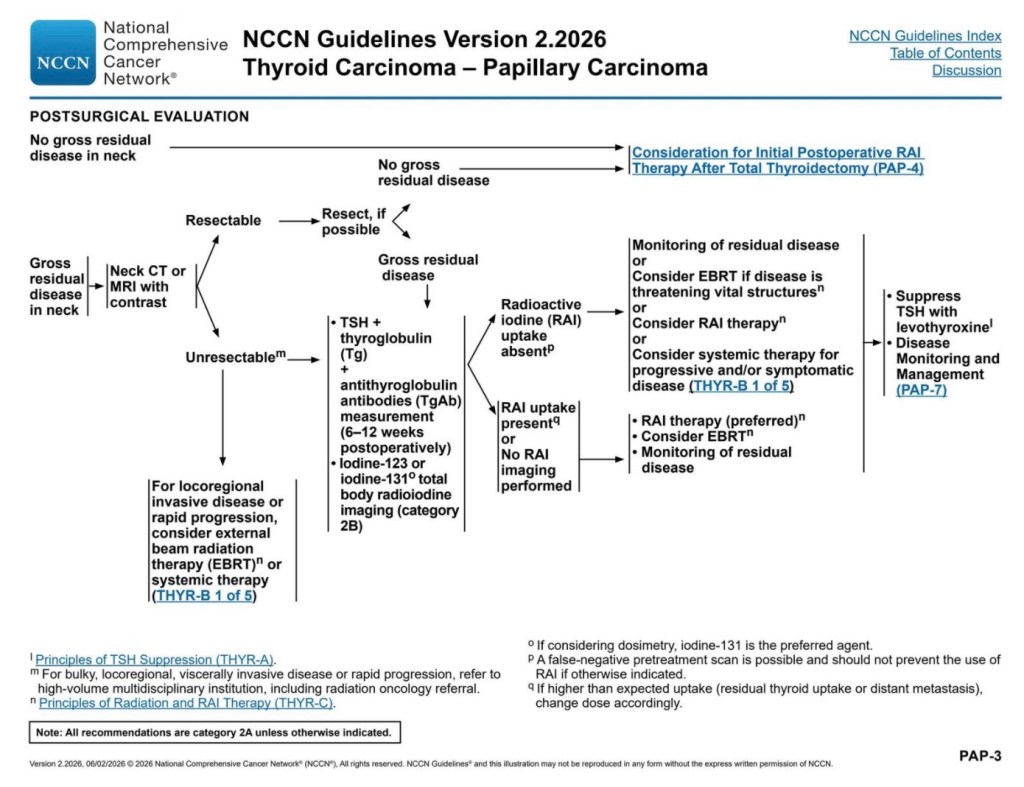
- After surgery, the NCCN algorithm:
- Branches on presence of gross residual disease, resectability, and RAI avidity
- For locoregionally invasive disease or rapid progression:
- EBRT or systemic therapy is considered
- After surgery, the NCCN algorithm:
- RAI:
- Indicated for iodine-avid residual / high-risk disease and is preferred when uptake is present:
- Many invasive tumors, however, are relatively iodine-refractory
- Indicated for iodine-avid residual / high-risk disease and is preferred when uptake is present:
- EBRT:
- The 2025 ATA guidelines state that adjuvant EBRT may be considered in select DTC patients with high-risk features for locoregional progression:
- Aggressive histology
- gETE
- Positive margins
- Visceral / soft-tissue invasion:
- Especially when future progression would not be salvageable surgically:
- Weighing improved locoregional relapse-free survival against toxicity and absence of a demonstrated overall survival benefit
- Especially when future progression would not be salvageable surgically:
- EBRT ± concurrent chemotherapy:
- Is also an option for gross residual or locally advanced unresectable disease
- Retrospective and propensity-matched data show:
- Improved locoregional control:
- e.g., 10-year local failure-free survival 88% for EBRT+RAI vs. 72% RAI alone in pT4a PTC
- LRR reduced from 51% to 8% after tracheal shave without consistent OS gain
- Improved locoregional control:
- Typical adjuvant EBRT doses for non-anaplastic thyroid cancer are:
- 60 to 66 Gy to microscopic disease / thyroid bed
- 50 to 56 Gy to elective nodal regions
- 66 to 70 Gy for gross / unresectable disease:
- Delivered by IMRT
- For BRAF V600E–mutated anaplastic carcinoma:
- Neoadjuvant dabrafenib / trametinib and multimodal EBRT / chemoradiation apply on separate ATC-specific algorithms
- The 2025 ATA guidelines state that adjuvant EBRT may be considered in select DTC patients with high-risk features for locoregional progression:
- References:
Ringel MD, Sosa JA, Baloch Z, et al. 2025 American Thyroid Association Management Guidelines for Adult Patients With Differentiated Thyroid Cancer. Thyroid. 2025.Sessa L, De Crea C, Voloudakis N, et al. Single Institution Experience in the Management of Locally Advanced (pT4) Differentiated Thyroid Carcinomas. Ann Surg Oncol. 2024.Scognamiglio T. Aggressive follicular cell derived thyroid carcinoma: what do you need from the pathologist. Virchows Arch. 2026.Xu B, Ghossein RA. Crucial parameters in thyroid carcinoma reporting – challenges, controversies and clinical implications. Histopathology. 2018.Xu B, Ghossein RA. Crucial parameters in thyroid carcinoma reporting – challenges, controversies and clinical implications. Histopathology. 2018.Shindo ML, Caruana SM, Kandil E, et al. Management of invasive well-differentiated thyroid cancer: An American Head and Neck Society consensus statement. Head Neck. 2014.Li M, Tang Q, Yang X, et al. Application of modified spiral tracheoplasty in thyroid carcinoma with trachea invasion: a retrospective analysis of 15 cases. World J Surg Oncol. 2024.Laskar SG, Mohanty S, Sinha S, et al. Adjuvant External Beam Radiotherapy in Differentiated Thyroid Cancers: An Audit of Clinical Practice, Adapting to New Evidence. Head Neck. 2025.Yuan SS, Zhang XR, Yu XQ, et al. Prediction model for extrathyroidal extension in thyroid papillary carcinoma based on ultrasound radiomics. Sci Rep. 2025.Liu Z, Huang Y, Chen S, et al. Minimal Extrathyroidal Extension Affects the Prognosis of Differentiated Thyroid Cancer: Is There a Need for Change in the AJCC Classification System? PLoS One. 2019. 12.Liu Y, Zhang X, Liu J, et al. Prognostic significance of the extent of extranodal extension in patients with pN1b papillary thyroid carcinoma: a retrospective cohort study. Eur Arch Otorhinolaryngol. 2026.National Comprehensive Cancer Network. Thyroid Carcinoma. NCCN Clinical Practice Guidelines in Oncology. 2026.Perrier ND, Brierley JD, Tuttle RM. Differentiated and Anaplastic Thyroid Carcinoma: Major Changes in the American Joint Committee on Cancer Eighth Edition Cancer Staging Manual. CA Cancer J Clin. 2018.Patel R. Thyroid. In: Essential Cases in Head and Neck Oncology. 2022.Fundakowski CE, Hales NW, Agrawal N, et al. Surgical management of the recurrent laryngeal nerve in thyroidectomy: American Head and Neck Society Consensus Statement. Head Neck. 2018.Perros P, Boelaert K, Colley S, et al. Guidelines for the management of thyroid cancer. Clin Endocrinol (Oxf). 2014.Masuoka H, Miyauchi A. Intraoperative Management of the Recurrent Laryngeal Nerve Transected or Invaded by Thyroid Cancer. Front Endocrinol (Lausanne). 2022.Rai S, Agarwal M, Bansal K, et al. Intraoperative management of recurrent laryngeal nerve invasion in thyroid carcinoma: Oncologic and functional outcomes with a surgical decision algorithm. Eur Arch Otorhinolaryngol. 2026.Wang S, Li S, Yang X, et al. Surgical treatment for patients with papillary thyroid carcinoma invading the cervical trachea. Eur Arch Otorhinolaryngol. 2026.Piazza C, Lancini D, Tomasoni M, et al. Tracheal and Cricotracheal Resection With End-to-End Anastomosis for Locally Advanced Thyroid Cancer: A Systematic Review of the Literature on 656 Patients. Front Endocrinol (Lausanne). 2021.Mercader-Cidoncha E, Zaraín-Obrador L, Lasso JM, Simón-Adiego C. Surgical Resources in Advanced Thyroid Cancer Treatment With Aerodigestive Tract Invasion. Surg Oncol. 2023.Scharpf J, Tuttle M, Wong R, et al. Comprehensive management of recurrent thyroid cancer: An American Head and Neck Society consensus statement. Head Neck. 2016.Piazza C, Lancini D, Paderno A. Cervical Exenteration and Its Variants for Locally Advanced Thyroid Cancer: When, Why, and How? Curr Opin Otolaryngol Head Neck Surg. 2023.Kiess AP, Agrawal N, Brierley JD, et al. External-beam radiotherapy for differentiated thyroid cancer locoregional control: A statement of the American Head and Neck Society. Head Neck. 2016.Kawamoto T, Shikama N, Fukumori T, Hoshi M, Yamada T. Propensity score matching analysis of adjuvant external-beam radiotherapy for the treatment of papillary thyroid carcinoma with other organ invasions. Endocrine. 2023.Laskar SG, Mohanty S, Sinha S, et al. Adjuvant External Beam Radiotherapy in Differentiated Thyroid Cancers: An Audit of Clinical Practice, Adapting to New Evidence. Head Neck. 2025.