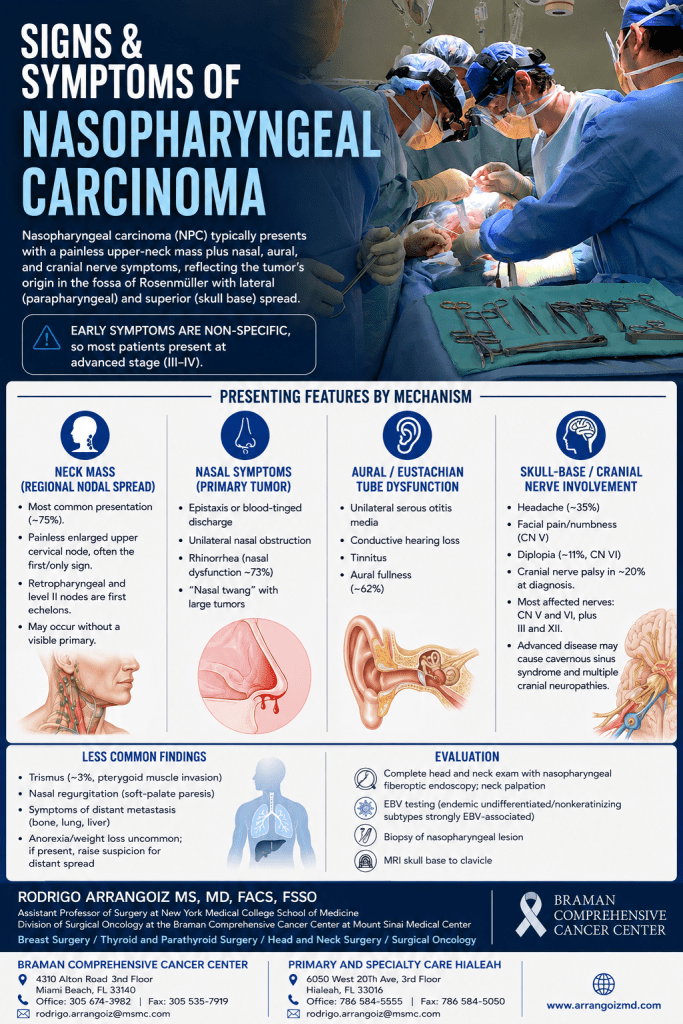
- Overview:
- Nasopharyngeal carcinoma (NPC):
- Typically presents with a painless upper-neck mass plus nasal, aural, and cranial nerve symptoms:
- Reflecting the tumor’s origin in the fossa of Rosenmüller with lateral (parapharyngeal) and superior (skull base) spread
- Typically presents with a painless upper-neck mass plus nasal, aural, and cranial nerve symptoms:
- Early symptoms are non-specific:
- So most patients present at advanced stage (III to IV)
- Nasopharyngeal carcinoma (NPC):
- Presenting features by mechanism:
- Neck mass (regional nodal spread):
- Most common presentation (~75%):
- Painless enlarged upper cervical node:
- Often the first / only sign
- Painless enlarged upper cervical node:
- Retropharyngeal and level II nodes:
- Are first echelons
- May occur without a visible primary
- Most common presentation (~75%):
- Nasal symptoms (primary tumor):
- Epistaxis or blood-tinged discharge
- Unilateral nasal obstruction
- Rhinorrhea (nasal dysfunction ~73%)
- “Nasal twang” or voice change with large tumors
- Aural / eustachian tube dysfunction:
- Unilateral serous otitis media
- Conductive hearing loss
- Tinnitus
- Aural fullness (~62%):
- The feeling of pressure, clogging, or fullness inside the ear:
- Often described as having water or air trapped inside
- The feeling of pressure, clogging, or fullness inside the ear:
- Skull-base / cranial nerve involvement:
- Headache (~35%)
- Facial pain / numbness (CN V)
- Diplopia (~11%, CN VI)
- Cranial nerve palsy in ~20% of the cases at diagnosis
- Most affected nerves:
- CN V and VI, plus III and XII
- Advanced disease may cause cavernous sinus syndrome and multiple cranial neuropathies
- Less common findings:
- Trismus (~3%, pterygoid muscle invasion)
- Nasal regurgitation (soft-palate paresis)
- Symptoms of distant metastasis:
- Bone, lung, liver
- Anorexia / weight loss uncommon:
- If present, raise suspicion for distant spread
- Neck mass (regional nodal spread):
- Evaluation:
- Complete head and neck exam with nasopharyngeal fiberoptic endoscopy; neck palpation
- EBV testing:
- Endemic undifferentiated / nonkeratinizing subtypes strongly EBV-associated
- Biopsy of nasopharyngeal lesion
- MRI skull base to clavicle
- References:
- Wei WI, Sham JS. Nasopharyngeal Carcinoma. Lancet. 2005.
- Chua MLK, Wee JTS, Hui EP, Chan ATC. Nasopharyngeal Carcinoma. Lancet. 2016.
- Ayan I, Kaytan E, Ayan N. Childhood Nasopharyngeal Carcinoma: From Biology to Treatment. Lancet Oncol. 2003.
- Expert Panel on Neurological Imaging, Gule-Monroe MK, Calle S, et al. ACR Appropriateness Criteria® Staging and Post-Therapy Assessment of Head and Neck Cancer. J Am Coll Radiol. 2023.
- Kumari B, Goyal MK, Lal V. Pearls & Oy-Sters: Bilateral Cavernous Sinus Syndrome as Presenting Manifestation of Nasopharyngeal Carcinoma. Neurology. 2014.
- Brennan B. Nasopharyngeal Carcinoma. Orphanet J Rare Dis. 2006.
- Her C. Nasopharyngeal Cancer and the Southeast Asian Patient. Am Fam Physician. 2001.
- Albilali A, Alotaibi NH, Alfadley A, Alqarni KM, Alhajlah A. Extensive Locally Invasive Nasopharyngeal Carcinoma Involving 10 Cranial Nerves Palsies: An Interesting Case Report. Front Oncol. 2024.
- Kumari B, Goyal MK, Lal V. Pearls & Oy-Sters: Bilateral Cavernous Sinus Syndrome as Presenting Manifestation of Nasopharyngeal Carcinoma. Neurology. 2014.
- Kumari B, Goyal MK, Lal V. Pearls & Oy-Sters: Bilateral Cavernous Sinus Syndrome as Presenting Manifestation of Nasopharyngeal Carcinoma. Neurology. 2014.
- Zhou P, Zhu Y, Xu B, et al. Cavernous Sinus Syndrome in a Patient With Occult Nasopharyngeal Carcinoma: A Diagnostic Challenge. Oral Oncol. 2025.
- National Comprehensive Cancer Network. Head and Neck Cancers. 2026.
- Chad Zender. Nasopharynx. Essential Cases in Head and Neck Oncology. 2022.