
- The paraglottic space (PGS):
- Is a bilateral, deep fascial compartment of the larynx:
- Filled with fat and loose connective tissue
- Definition:
- The paraglottic space (PGS) is a fat- and muscle-containing connective tissue compartment of the larynx:
- Whose greatest clinical importance is:
- As a preferential pathway for the spread of laryngeal cancers:
- Particularly transglottic tumors
- As a preferential pathway for the spread of laryngeal cancers:
- As a prognostic and surgical planning determinant
- Whose greatest clinical importance is:
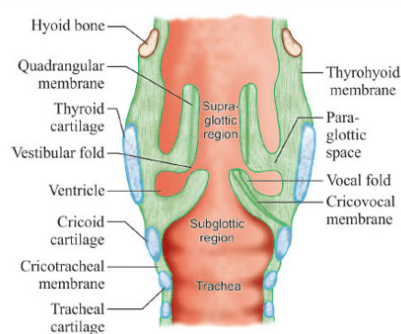
- It surrounds the laryngeal ventricle:
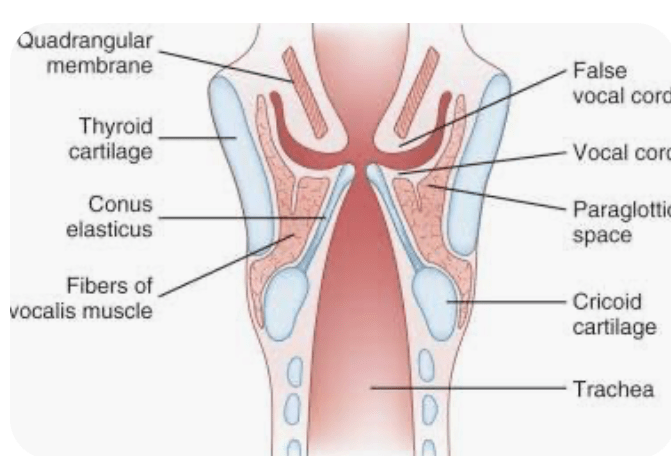
- Lies deep to the true and false cords:
- Between the mucosa and inner surface of the thyroid cartilage:
- It communicates directly with the preepiglottic space:
- Allowing tumor to move rapidly between compartments
- It communicates directly with the preepiglottic space:
- Between the mucosa and inner surface of the thyroid cartilage:
- Lies deep to the true and false cords:
- It spans the supraglottic, glottic, and subglottic regions:
- Playing a critical role in clinical oncology:
- Because it acts as a primary, hidden pathway for the “transglottic” spread of laryngeal cancers
- Playing a critical role in clinical oncology:
- The paraglottic space (PGS) is a fat- and muscle-containing connective tissue compartment of the larynx:
- Is a bilateral, deep fascial compartment of the larynx:
- Anatomical Boundaries
- It was first described by:
- Tucker and Smith in 1962
- The paraglottic space is a tetrahedral-shaped compartment bounded by several cartilaginous and fibroelastic structures:
- Anterolaterally:
- The inner surface of the thyroid cartilage
- Superomedially:
- The quadrangular membrane:
- Which separates it from the false vocal folds
- The space is continuous with (or, in some specimens, separated by a collagenous septum from) the preepiglottic space
- The quadrangular membrane:
- Inferomedially:
- The conus elasticus:
- Which separates it from the subglottis
- The conus elasticus:
- Posteriorly / Posterolaterally / Dorsally:
- The mucosal lining of the piriform sinus
- Anteriorly:
- It communicates directly with the pre-epiglottic space
- Anterolaterally:
- It was first described by:
- Content of the Space:
- The paraglottic space houses several vital neurovascular and muscular structures embedded within its protective layer of loose areolar and adipose tissue:
- Adipose tissue:
- Abundant fat:
- That makes the space highly visible on CT and MRI scans
- Abundant fat:
- Intrinsic laryngeal muscles:
- Including the thyroarytenoid, lateral cricoarytenoid, and posterior cricoarytenoid muscles
- Blood vessels and nerves:
- Glands, blood vessels, and branches of the superior and inferior laryngeal nerves
- Adipose tissue:
- The paraglottic space houses several vital neurovascular and muscular structures embedded within its protective layer of loose areolar and adipose tissue:
- Clinical Significance:
- The primary clinical importance of the paraglottic space:
- Lies in laryngeal oncology and tumor staging:
- Transglottic Spread:
- Because the PGS crosses the level of the laryngeal ventricle without physical barriers:
- A squamous cell carcinoma originating in the true vocal cords can easily migrate vertically through this space into the false vocal cords (or vice versa):
- This is known as transglottic spread
- A squamous cell carcinoma originating in the true vocal cords can easily migrate vertically through this space into the false vocal cords (or vice versa):
- Because the PGS crosses the level of the laryngeal ventricle without physical barriers:
- Cancer Staging:
- Invasion of the inferior paraglottic space can limit vocal fold mobility
- In the TNM staging system, tumor invasion into the paraglottic space:
- Automatically elevates a glottic or supraglottic laryngeal cancer to a T3 stage:
- Altering the treatment trajectory from localized therapy to systemic options or extensive surgery
- Automatically elevates a glottic or supraglottic laryngeal cancer to a T3 stage:
- Surgical Planning:
- Knowledge of the paraglottic space borders is vital for performing voice-sparing, partial laryngectomies
- If a tumor completely infiltrates this space:
- A total laryngectomy may be required to ensure clean margins
- Transglottic Spread:
- Lies in laryngeal oncology and tumor staging:
- The primary clinical importance of the paraglottic space:
- References:
- Joo YH, Park JO, Cho KJ, Kim MS. Relationship between paraglottic space invasion and cervical lymph node metastasis in patients undergoing supracricoid partial laryngectomy. Head Neck. 2012.
- Tamaki A, Miles BA, Lango M, Kowalski L, Zender CA. AHNS Series: Do you know your guidelines? Review of current knowledge on laryngeal cancer. Head Neck. 2018.
- Reidenbach MM. The Paraglottic Space and Transglottic Cancer: Anatomical Considerations. Clin Anat. 1996.
- Reidenbach MM. Borders and Topographic Relationships of the Paraglottic Space. Eur Arch Otorhinolaryngol. 1997.
- Joo YH, Park JO, Cho KJ, Kim MS. Relationship between paraglottic space invasion and cervical lymph node metastasis in patients undergoing supracricoid partial laryngectomy. Head Neck. 2012.
- Ferrari M, Schreiber A, Mattavelli D, et al. Surgical anatomy of the parapharyngeal space: Multiperspective, quantification-based study. Head Neck. 2019.
- Wang XR, Wang H, Gao Y, et al. Study on the Ultrasonic Characteristics of the Paraglottic Space at the Glottic Level in Normal Adults. Head Neck. 2026.
- Virós Porcuna D, Pollán Guisasola CM, Viña Soria C, et al. Transoral robotic parapharyngeal space dissection. Head Neck. 2024.
- Mohamed A, Paleri V, George A. A cadaveric study quantifying the anatomical landmarks of the facial artery and its parapharyngeal branches for safe transoral surgery. Head Neck. 2019.
- Hearn MW, Vogel CT, Laughlin RM, et al. Review of Spaces. Atlas of Operative Oral and Maxillofacial Surgery. 2022.
- Dammann F, Wartenberg J. Diseases of the Head and Neck. Radiology-Nuclear Medicine Diagnostic Imaging. 2023.


