
- WHO Classification:
- Keratinizing Squamous Cell Carcinoma (formerly WHO Type I):
- Shows squamous differentiation with intercellular bridges and / or keratinization over most of its extent
- More common in non-endemic areas:
- Accounts for > 75% of NPC in the non-Asian US population (Caucasian)
- Typically found in older adults:
- Associated with smoking / alcohol
- Carries the worst prognosis among the subtypes
- Not typically associated with EBV:
- HPV has emerged as a potential factor in this subtype
- Non-Keratinizing Carcinoma (formerly WHO Types II and III):
- The dominant subtype worldwide:
- Constituting > 95% of cases in endemic regions:
- Southern China
- Southeast Asia
- Constituting > 95% of cases in endemic regions:
- Strongly associated with:
- EBV infection
- More radiosensitive than the keratinizing subtype
- Subdivided into:
- Differentiated (formerly WHO Type II):
- Cells show a maturation sequence without evident squamous differentiation on light microscopy
- Fusiform or oval nuclei with scant cytoplasm
- Display a stratified appearance and distinct cell margins
- Undifferentiated (formerly WHO Type III):
- Oval or round vesicular nuclei with prominent nucleoli, scant eosinophilic cytoplasma
- Indistinct cell margins with a syncytial rather than pavemented appearance
- Often called lymphoepithelioma (Schminke tumor) due to prominent admixed non-malignant lymphoid infiltrate
- Most common subtype in endemic areas (~ 95% in southern China) and in children (~ 90%)
- Basaloid Squamous Cell Carcinoma (added in 2005 WHO classification):
- A rare subtype:
- Also associated with EBV infection
- Comprises a minimal subset of patients
- A rare subtype:
- Differentiated (formerly WHO Type II):
- The dominant subtype worldwide:
- Keratinizing Squamous Cell Carcinoma (formerly WHO Type I):
- Evolution of the Classification:
- The original 1978 WHO system:
- Used a numerical scheme:
- Types I, II, III
- Used a numerical scheme:
- In 1991:
- Types II and III were combined into a single “non-keratinizing carcinoma” category:
- The numerical designations were dropped
- Types II and III were combined into a single “non-keratinizing carcinoma” category:
- The basaloid squamous cell carcinoma category:
- Was added in the 2005 WHO classification
- The original 1978 WHO system:
- Geographic Distribution of Subtypes:
- North America:
- ~25% type I, 12% type II, 63% type III
- Southern China:
- 2% type I, 3% type II, 95% type III
- In the US:
- Non-keratinizing subtypes:
- Predominate in East / Southeast Asian populations
- The discrepancy is explained by the racial /ethnic composition of the study populations:
- In the US, disproportionately develop non-keratinizing (type III) NPC:
- Which skews the overall North American numbers toward type III
- When restricted to White / non-Asian patients, keratinizing SCC predominates
- In the US, disproportionately develop non-keratinizing (type III) NPC:
- Non-keratinizing subtypes:
- North America:
- References:
- Chen YP, Chan ATC, Le QT, et al. Nasopharyngeal Carcinoma. Lancet. 2019.
- KO, Mazul AL, Skillington SA, et al. The prognostic significance of race in nasopharyngeal carcinoma by histological subtype. Head Neck. 2021.
- Alsavaf MB, Marquardt M, Abouammo MD, et al. Patient Characteristics and Treatment Outcomes of Nasopharyngeal Carcinoma in Nonendemic Regions. JAMA Netw Open. 2025.
- Wei WI, Sham JS. Nasopharyngeal Carcinoma. Lancet. 2005.
- Ayan I, Kaytan E, Ayan N.

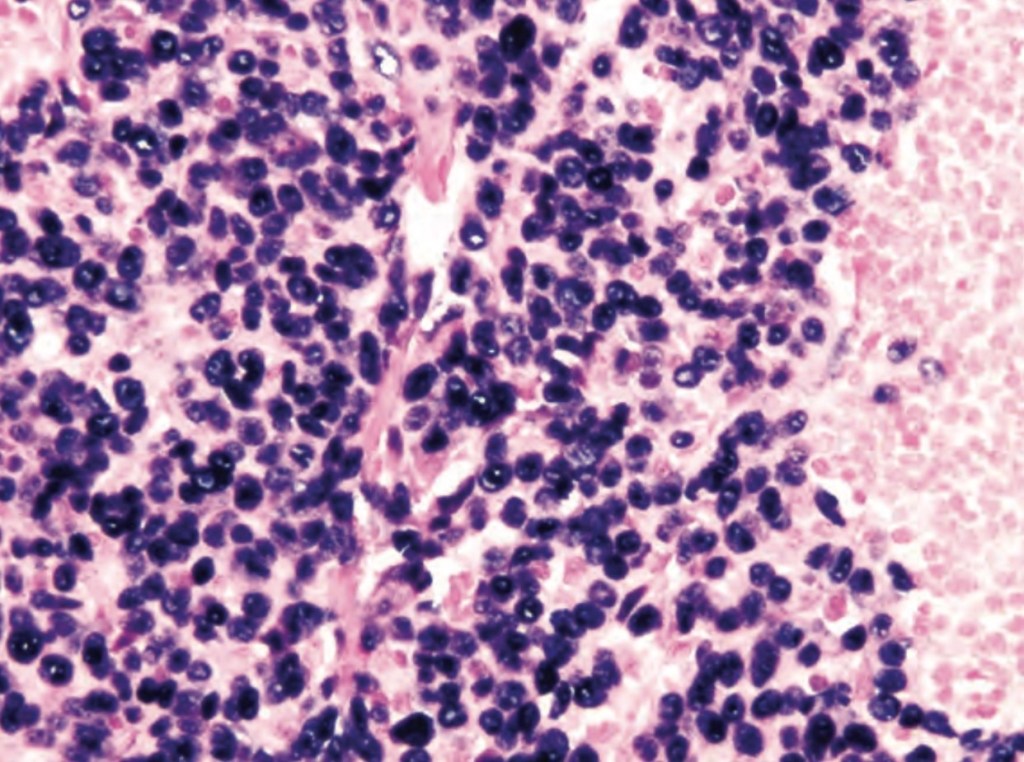
hybridization showing strong nuclear labeling of tumor for Epstein-Barr
virus in nasopharyngeal carcinoma.
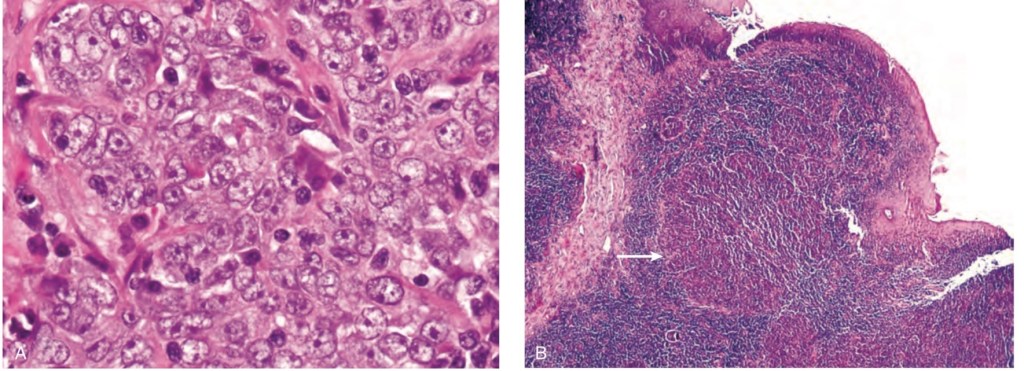
chromatin, and prominent nucleoli. (Hematoxylin-eosin stain; ×400.) B, Abundant lymphoid infiltrate that obscures nests of tumor cells (arrow).
(Hematoxylin-eosin stain; ×100.)


 Rodrigo Arrangoiz MS, MD, FACS, FSSO