
- A variety of surgical approaches:
- Are available for resection of primary tumors of the oral cavity
- The choice of a particular approach will depend on factors such as:
- The size and site of the primary tumor:
- Anterior versus posterior
- As well as its depth of invasion
- Proximity to the mandible or maxilla
- The size and site of the primary tumor:
- Factors such as dentition, size of the oral aperture, trismus, and the size and mobility of the tongue:
- Also influence selection of the surgical approach
- The various surgical approaches such as:
- Peroral, mandibulotomy, lower cheek flap approach, visor flap approach, and upper cheek flap approach are shown in Figure
- The transoral approach has wider applications with technologic advances using:
- Lasers (transoral laser microsurgery [TLM]) and robotics (transoral robotic surgery [TORS])
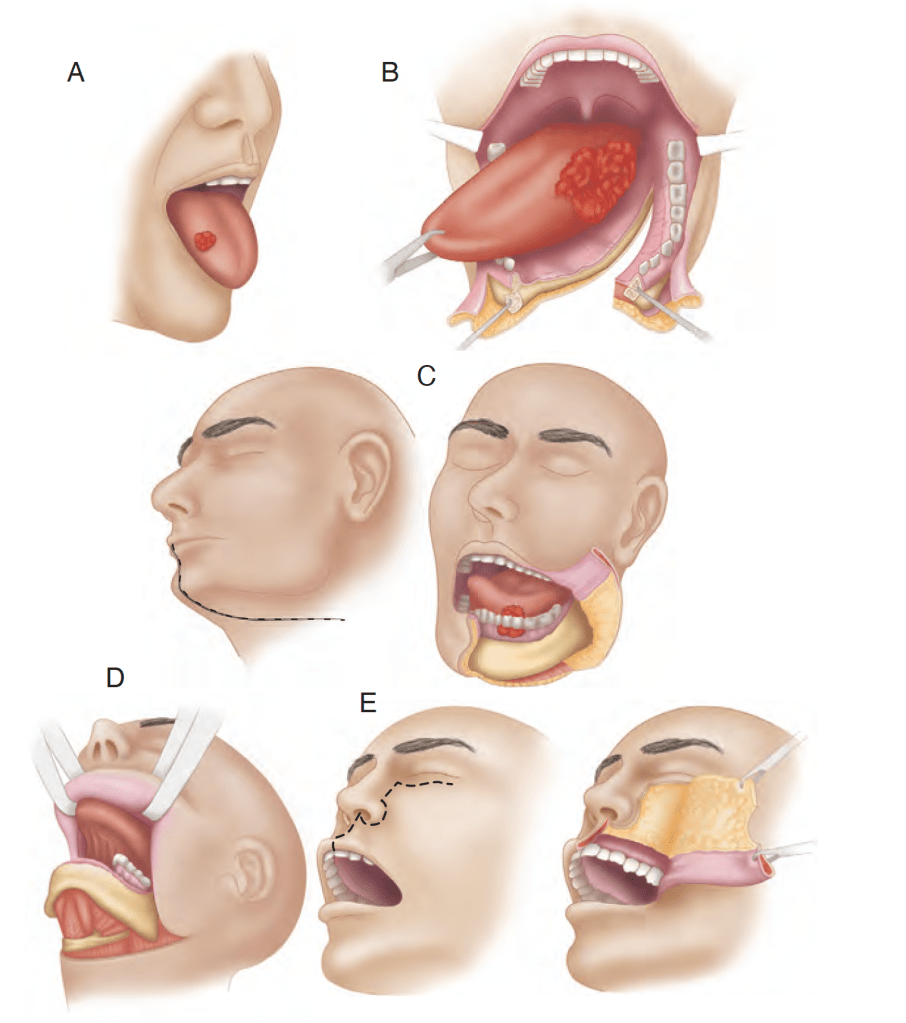
C, Lower cheek flap. D, Visor flap. E, Upper cheek flap.
- When the peroral approach does not offer adequate exposure:
- The visor flap or cheek flap approaches (upper or lower) become necessary
- The visor flap approach:
- Provides sufficient exposure for anteriorly located lesions:
- But is not satisfactory for tumors located in the posterior oral cavity
- The benefit of this approach is that it avoids a lower lip–splitting incision:
- But produces permanent numbness of the chin:
- Because the mental nerves need to be transected for adequate mobilization of the flap
- It also may cause sagging of the lower lip and drooling:
- Because of a loss of support and sensation:
- Thus its utility is limited
- Because of a loss of support and sensation:
- But produces permanent numbness of the chin:
- Provides sufficient exposure for anteriorly located lesions:
- The lower cheek flap approach:
- Requires a midline lip–splitting incision that is continued laterally into the neck for exposure and neck dissection:
- This approach provides excellent exposure for nearly all tumors of the oral cavity:
- Except those of the upper gum and hard palate
- This approach provides excellent exposure for nearly all tumors of the oral cavity:
- Mandible resection (marginal or segmental) and reconstruction:
- Require the lower cheek flap approach in most instances
- Requires a midline lip–splitting incision that is continued laterally into the neck for exposure and neck dissection:
- The lower cheek flap approach:
- Is required for marginal or segmental mandibulectomy of tumors adjacent to the body of the mandible
- The upper cheek flap approach (the Weber-Ferguson incision and its modifications):
- Is required for resection of larger tumors of the hard palate and upper alveolus:
- Particularly if they are posteriorly located
- Is required for resection of larger tumors of the hard palate and upper alveolus:
- Access to larger tumors of the tongue, particularly those closer to the base of the tongue where the mandible is not involved:
- Requires wider exposure for resection:
- A mandibulotomy or mandibular osteotomy is an excellent mandible sparing surgical approach:
- Designed to gain access to the oral cavity or oropharynx for resection of primary tumors otherwise not accessible through the open mouth or by the lower cheek flap approach (Figure)
- A mandibulotomy or mandibular osteotomy is an excellent mandible sparing surgical approach:
- Requires wider exposure for resection:
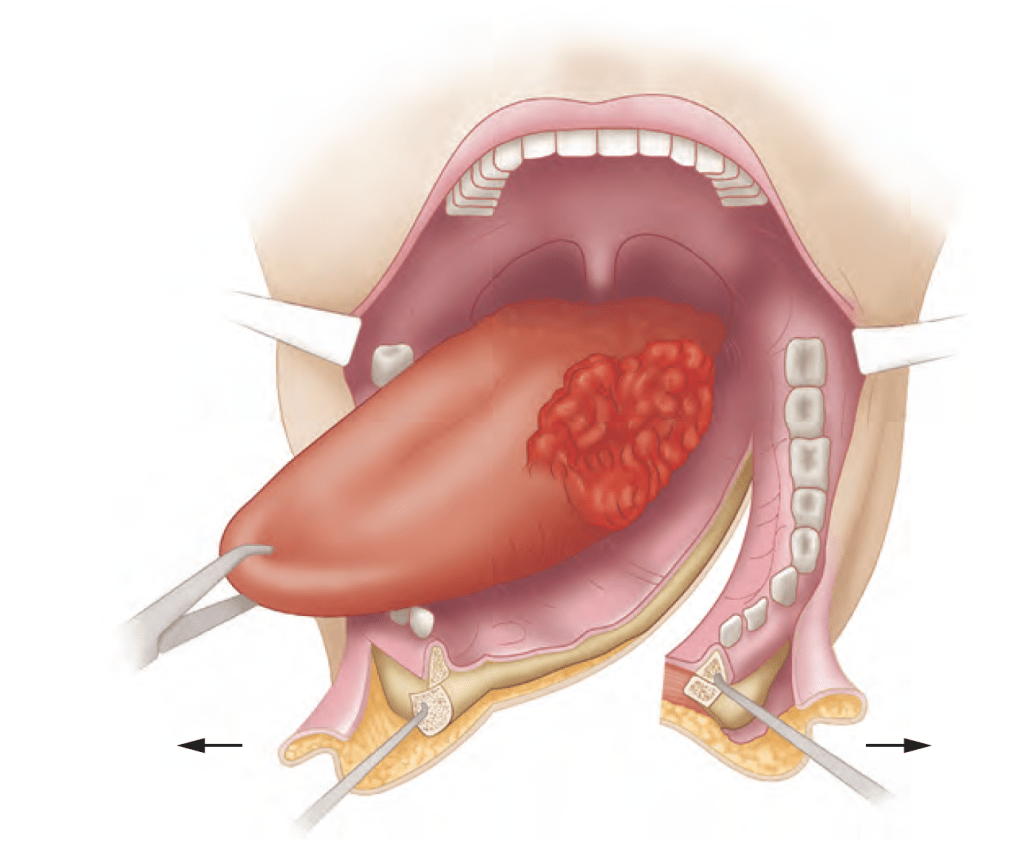
approach to gain access to bulky tumors of the oral cavity or
oropharynx.

#Arrangoiz #CancerSurgeon #SurgicalOncologist #HeadandNeckSurgeon #MountSinaiMedicalCenter #MSMC #HeadandNeckCancer #OralCavityCancer #SCC @SquamousCellCarcinoma #Miami #Mexico #BramanComprehensiveCancerCenter #BCCC


