
- This diagram represents a normal cluster of alveoli with a normal capillary:
- Delivering carbon dioxide (CO2) and picking up oxygen (O2)
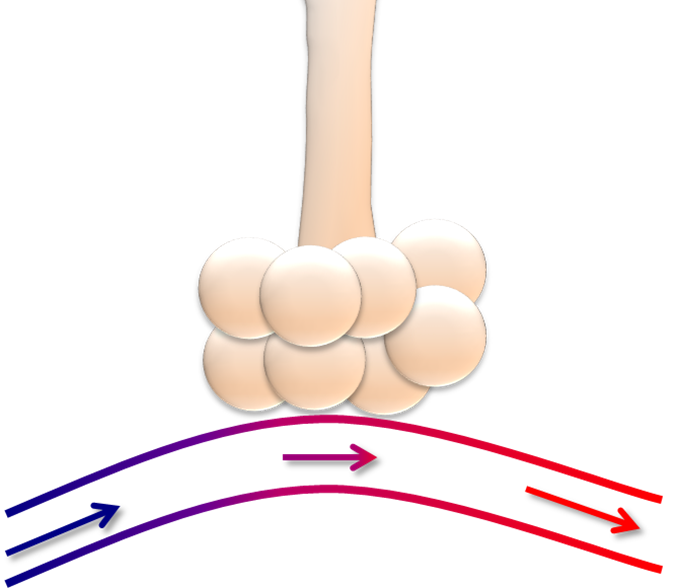
- Carbon dioxide:
- Travels dissolved in the blood
- Approaching the alveolus:
- The CO2:
- Easily crosses through the blood:
- Across the capillary wall, and into the alveolus
- Easily crosses through the blood:
- The CO2:
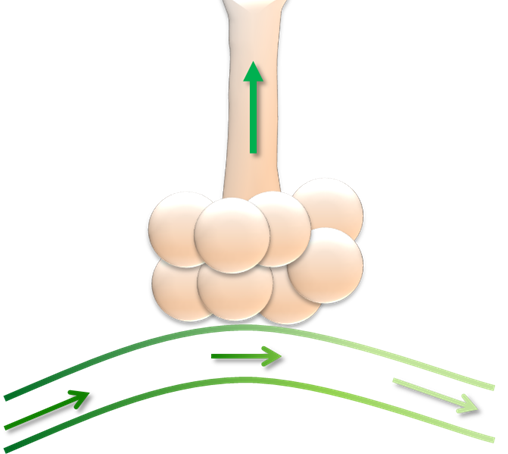
- Because CO2 crosses so readily into the alveolus from the serum:
- Ventilation occurs readily:
- This means that the major determinants of CO2 in the blood are:
- The rate of production:
- Increased with:
- Elevated metabolic demand:
- Such as in:
- Sepsis
- Exercise
- Such as in:
- Elevated metabolic demand:
- Increased with:
- The rate of elimination:
- Largely determined by:
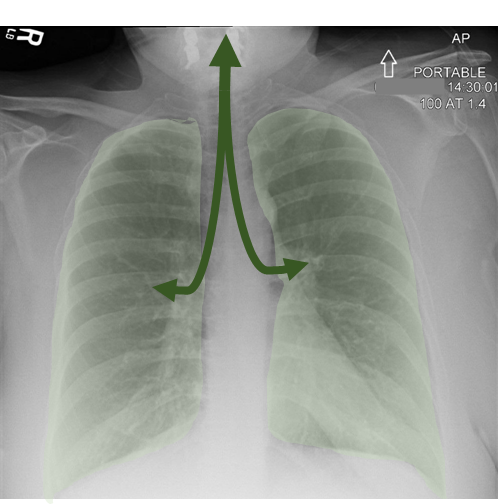
- The minute ventilation:
- Which is the amount of air moving through the lungs in one minute:
- Quantified as:
- The tidal volume:
- Green shaded arrows and
- The respiratory rate:
- Represented by the back and forth arrows
- The tidal volume:
- Quantified as:
- The higher the minute ventilation:
- The lower the CO2
- Normal minute ventilation is about:
- 6 to 8 L/min
- In times of stress:
- With increased CO2 production:
- The minute ventilation may be:
- 10 to 15 L/min
- The minute ventilation may be:
- With increased CO2 production:
- Which is the amount of air moving through the lungs in one minute:
- The minute ventilation:
- Largely determined by:
- The rate of production:
- This means that the major determinants of CO2 in the blood are:
- Ventilation occurs readily:
- Conversely:
- The pathway for oxygen is less simple:
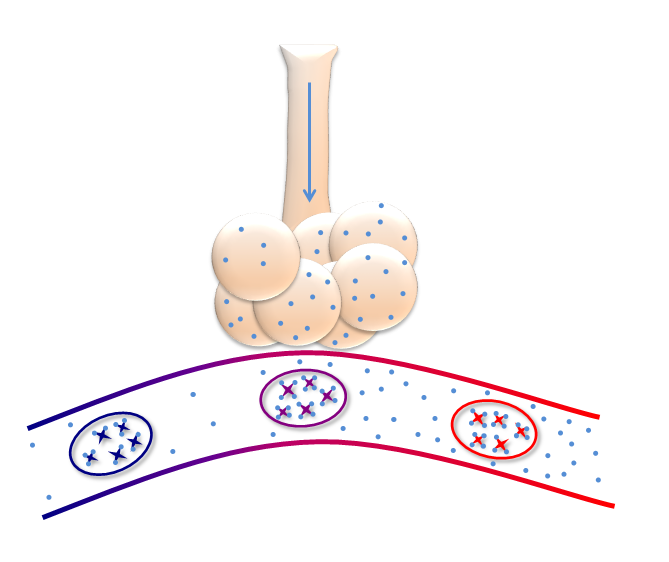
- Oxygen is transported largely bound to:
- Hemoglobin inside the red blood cells:
- The hemoglobin in this schematic:
- Demonstrates the four binding sites per hemoglobin molecule inside the red blood cells
- Oxygen is represented by small blue dots
- The concentration of oxygen is high in the alveoli, and:
- It diffuses down the concentration gradient:
- Into the capillary:
- Into the RBC, and
- Binds with Hgb
- Into the RBC, and
- Into the capillary:
- It diffuses down the concentration gradient:
- The hemoglobin in this schematic:
- Hemoglobin inside the red blood cells:
- Oxygen is transported largely bound to:
- The pathway for oxygen is less simple:
- While this binding allows for great efficiency in carrying oxygen:
- The multiple steps for oxygen transport:
- As compared to the simplicity of CO2:
- Explains some of the differential clinical effects seen with ventilation and oxygenation
- As compared to the simplicity of CO2:
- The multiple steps for oxygen transport:
- A small amount of oxygen is carried dissolved in the plasma, but compared to the amount bound to hemoglobin, this amount is trivial:
- The oxygen-carrying capacity of the blood is described by the equation:
- Delivery of Oxygen = Cardiac Output x (Hgb x 1.39 x Oxygen Saturation) + (PaO2 x 0.003):
- This equation intuitively makes sense:
- As the more Hgb available to carry oxygen:
- The more oxygen that can be delivered
- As the more Hgb available to carry oxygen:
- This equation intuitively makes sense:
- Delivery of Oxygen = Cardiac Output x (Hgb x 1.39 x Oxygen Saturation) + (PaO2 x 0.003):
- The oxygen-carrying capacity of the blood is described by the equation:
#Arrangoiz #Surgeon #Teacher

 Rodrigo Arrangoiz MS, MD, FACS, FSSO