
- Individuals with colorectal adenocarcinoma are at increased risk for developing small bowel adenocarcinoma:
- Suggesting a possible common molecular pathway
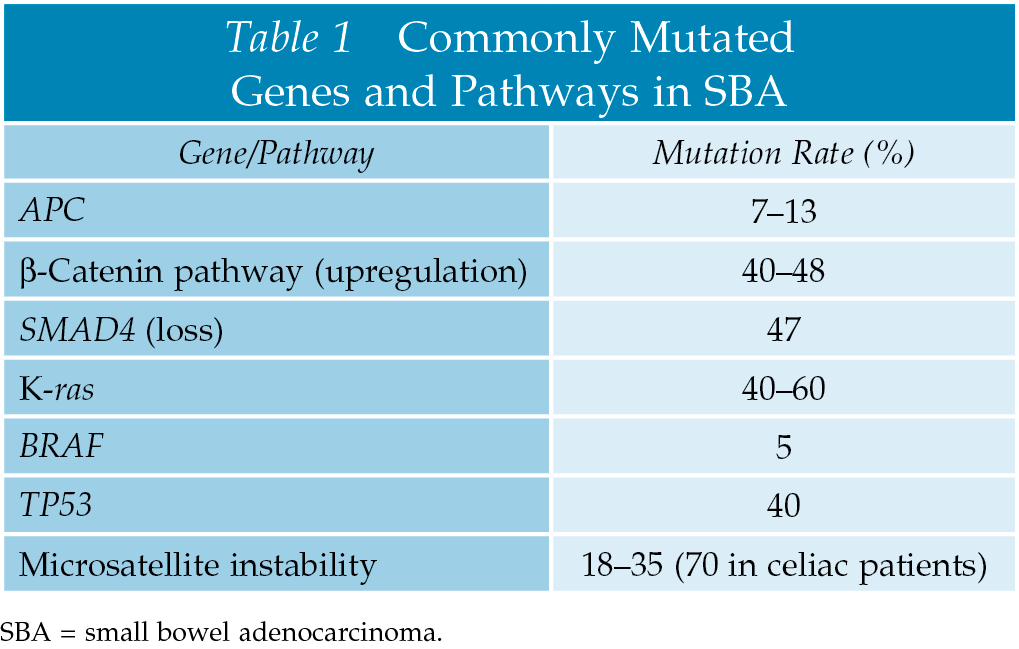
- Multiple mutations have been identified in small bowel adenocarcinomas:
- Many of which are also implicated in colorectal cancer:
- However:
- The sequential genetic alterations in small bowel adenocarcinoma are less well understood than for colorectal adenocarcinoma
- However:
- Many of which are also implicated in colorectal cancer:
- Several familial syndromes:
- Are associated with increased incidence of small bowel adenocarcinoma:
- Hereditary cancer syndromes including:
- Lynch syndrome (hereditary nonpolyposis colorectal cancer)
- FAP
- Peutz-Jeghers syndrome:
- All of this cancer syndromes are associated with elevated lifetime rates of small bowel adenocarcinomas:
- As high as 2% to 8%, 3% to 5% (mostly in the duodenum), and 13%, respectively
- All of this cancer syndromes are associated with elevated lifetime rates of small bowel adenocarcinomas:
- Hereditary cancer syndromes including:
- Are associated with increased incidence of small bowel adenocarcinoma:
- Chronic inflammatory conditions:
- Are also implicated in the etiology of small bowel adenocarcinoma, including:
- Crohn disease
- Celiac disease
- The risk of adenocarcinoma in Crohn disease:
- Is proportional to the extent and duration of small bowel disease:
- With 0.2% risk at 10 years and 2.2% at 25 years
- This is a 27- to 60-fold increased risk over the general population
- With 0.2% risk at 10 years and 2.2% at 25 years
- Is proportional to the extent and duration of small bowel disease:
- The risk of adenocarcinoma in Crohn disease:
- Individuals with celiac disease:
- Are also at 34-fold increased risk for small bowel adenocarcinoma than those without celiac disease
- Are also implicated in the etiology of small bowel adenocarcinoma, including:
#Arrangoiz #CancerSurgeon #SurgicalOncologist #SmallBowelCancer #Teacher

 Rodrigo Arrangoiz MS, MD, FACS, FSSO