Sebaceous Gland Carcinoma

  • Sebaceous gland carcinoma is an aggressive, uncommon, cutaneous tumor:

    • First well-described by Allaire in 1891.

  • This tumor is thought to arise from sebaceous glands in the skin and, thus, may arise anywhere on the body where these glands exist, including the genitalia:

    • Approximately 75% of these tumors arise in the periocular region:

      • In this region, sebaceous gland carcinoma represents 1.0% to 5.5% of eyelid malignancies:

        • Fourth after basal cell carcinoma, squamous cell carcinoma, and melanoma.

      • Women tend to be affected somewhat more often than men:

        • With 57% to 77% of patients being women in several large series.

      • Most patients present in their sixth or seventh decade of life:

        • Although the range is from early childhood through the nineties:

          • The youngest reported case arose in a 3-year-old child.

      • An area rich in a variety of types of sebaceous glands:

        • Sebaceous gland carcinoma resembles normal sebaceous glands.

        • One may reasonably speculate that sebaceous gland carcinoma arises from mature sebaceous glands.

        • Histologic studies have suggested that periocular sebaceous gland carcinomas arise from the sebaceous glands in this region:

          • The following five types of sebaceous glands are seen in the periocular region:

            • Meibomian glands of the tarsal plate

            • Glands of Zeis of the cilia

            • Sebaceous glands of the eyebrows

            • Glands of the caruncle

            • Glands of the fine hair follicles of the eyelid surface

  • This tumor exhibits an aggressive clinical course:

    • With a significant tendency for both local recurrence and distant metastasis:

      • Reported local recurrence rates range from 9% to 36%, with larger series reporting recurrence rates in the 30% range:

        • Local recurrence tends to occur within 5 years.

      • The rate of metastasis in extraocular and ocular sebaceous gland carcinoma is thought to be similar, occurring in 14% to 25% of cases:

        • First to the draining lymph nodes and then to distant sites:

          • Sites of distant metastasis include the:

            • Liver, lungs, bones, and brain

  • Diagnosis and therapy tend to be delayed because sebaceous gland carcinoma is frequently mistaken for more common benign entities, further complicating treatment of this aggressive malignancy:

    • In addition, a varied histologic appearance may occur, and delayed diagnosis or misdiagnosis following a biopsy is not uncommon.

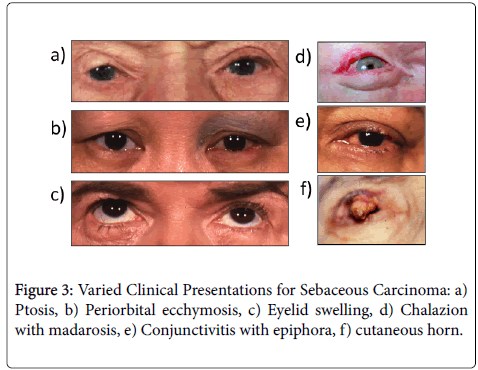
  • When arising in the periocular region, the clinical presentation is often variable, and sebaceous gland carcinoma is often not initially suspected:

    • Instead, patients may receive multiple courses of incision and drainage for chalazion before a definitive biopsy is performed.

  • Most sebaceous gland carcinomas have no obvious etiology:

    • Only a few are associated with Muir-Torre syndrome:

      • Although sebaceous adenoma and epithelioma are more specific markers for Muir-Torre syndrome:

        • An evaluation for this syndrome is advisable once sebaceous gland carcinoma is diagnosed:

          • In approximately 40% of cases, patients with Muir-Torre syndrome develop some type of sebaceous tumor before or concurrent with visceral malignancy.

clinical-ophthalmology-eyelid-swelling-8-635-g003Unknown


20d943b1-6f20-49c3-9754-2f3756051c93

Training:

• General surgery:

• Michigan State University:

• 2004 al 2010

• Surgical Oncology / Head and Neck Surgery / Endocrine Surgery:

• Fox Chase Cancer Center (Filadelfia):

• 2010 al 2012

• Masters in Science (Clinical research for health professionals):

• Drexel University (Filadelfia):

• 2010 al 2012

• Surgical Oncology / Head and Neck Surgery / Endocrine Surgery:

• IFHNOS / Memorial Sloan Kettering Cancer Center:

• 2014 al 2016

#Arrangoiz

#Surgeon

#Cirujano

#SurgicalOncologist

#CirujanoOncologo

#CancerSurgeon

#CirujanodeCancer

http://www.sociedadquirurigca.com

Leave a comment