Diagnostic Thyroid Testing: Serum Thyroglobulin

  • Thyroglobulin (Tg):
    • Is a large glycoprotein that is stored as colloid:
      • The primary storage form of thyroid hormone, in the lumen of thyroid follicles
    • It is continuously secreted into circulation from the thyroid gland:
      • Thereby reflecting the mass of normal and malignant thyroid tissue
  • Higher serum concentrations result from:
    • TSH stimulation and / or injury of thyroid tissue:
      • However, for the individual with an intact thyroid gland:
        • Its clinical value for evaluating thyroid dysfunction or goiter is limited in the era of modern serum thyroid function testing and imaging
        • However, the demonstration of a suppressed serum Tg level in such a patient can be useful in differentiating factitious thyrotoxicosis (from exogenous thyroid hormone ingestion) from excessive endogenous thyroid hormone release of any etiology:
          • In this situation, when thyrotoxicosis is due to ingestion of exogenous thyroid hormone:
            • Normal thyroid hormone production is suppressed and serum Tg levels are decreased
          • In contrast, if excess thyroid hormone is produced from the thyroid:
            • Serum Tg levels are elevated
  • In current clinical practice:
    • The primary use of serum Tg concentrations is as a tumor marker in patients with differentiated thyroid cancer:
      • That is obtained to detect persistent and / or recurrent disease after a total thyroidectomy and radioactive iodine (131I) ablation
  • Most Tg assays have only first-generation functional sensitivity between 0.5 and 1 ng/mL:
    • But the second generation Tg assays are rapidly becoming the standard and have an improved functional sensitivity of 0.05 to 0.1 ng/mL
  • The Tg assay can be made more sensitive to detect persistent or recurrent tumor:
    • After stimulation by TSH:
      • Either endogenously by withholding thyroxine treatment in an athyreotic patient or with administration of recombinant human TSH (rhTSH):
        • The latter of which results in an approximate tenfold increase in basal serum Tg concentrations
  • Detection of persistent and / or recurrent disease in thyroid cancer depends on the performance of Tg immunometric assays:
    • Which currently have suboptimal sensitivity and high interassay variability
  • Virtually all immunometric methods:
    • Will report an undetectable Tg level in euthyroid Tg Ab positive controls:
      • Approximately 25% of patients with differentiated thyroid cancer have a positive serum TgAb titer:
        • Thus when a suspicious lymph node or neck mass is detected in an individual who has undergone a total thyroidectomy:
          • An unmeasurable basal or rhTSH-stimulated Tg in the setting of a positive serum TgAb level:
            • Does not necessarily exclude thyroid cancer recurrence
        • It is reasonable in this relatively uncommon situation to measure Tg instead by Tg Ab-resistant radioimmunoassay (RIA) or liquid chromatography tandem mass spectrometry:
          • Which are available at some specialty endocrine laboratories.
  • When the serum Tg Ab titer is positive:
    • It may also be used as a surrogate marker of tumor persistence / recurrence
  • In one study, a > 50% decrease of Tg Ab levels within the first year after a total thyroidectomy:
    • Was associated with the absence of tumor recurrence / persistence in all patients studied
    • Tumor recurrence / persistence was present in 37% of patients who had any rise of serum Tg Ab within the same period
  • Thus thyroid cancer patients with rising Tg antibody levels:
    • Are at high risk for disease persistence / recurrence and should be evaluated promptly
    • In addition, the sensitivities and absolute values reported by different methods of measuring Tg and TgAb are highly variable:
      • It is essential to always use the same Tg and TgAb method when following an individual over time for tumor persistence/recurrence
  • Finally, the presence of interfering heterophile antibodies (antibodies against the animal-derived antibodies used in the immunometric assay):
    • May rarely result in abnormally high or low serum Tg levels
    • The most common interfering antibodies are HAMAs:
      • Clinically, this should be suspected when an elevated serum Tg level is inappropriate for the clinical situation and does not increase with rhTSH stimulation
      • When heterophile antibody is suspected, the clinician should repeat the test using a commercially available heterophile-blocking tube (HBT) or measure Tg with an RIA assay

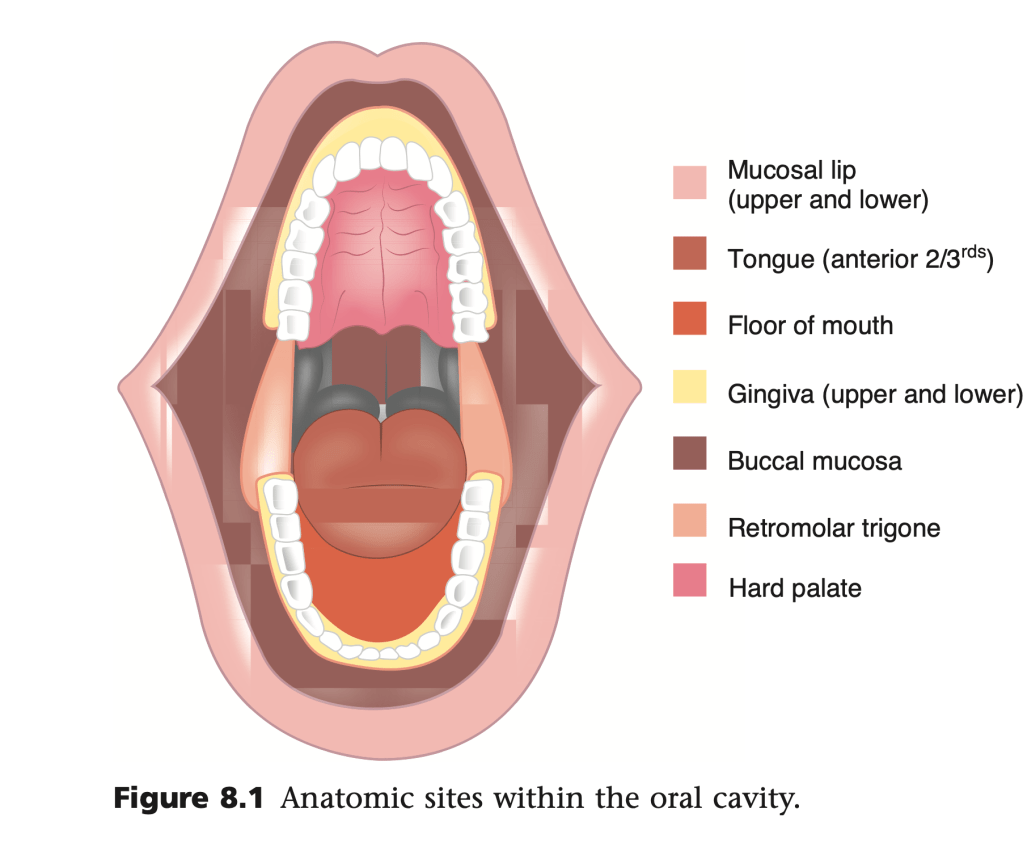
Oral Cavity Cancer Generalities

  • The oral cavity represents the entrance to the upper aerodigestive tract:
    • Which begins at the lips and ends at the anterior surface of the faucial arch
  • It is lined by squamous epithelium:
    • With interspersed minor salivary glands
  • The oral cavity also contains the:
    • Dentoalveolar structures with the upper and lower dentition
  • The oral cavity is continuously exposed to inhaled and ingested carcinogens:
    • Thus it is the most common site for the origin of malignant epithelial neoplasms in the head and neck region
  • Known carcinogens for oral cavity carcinoma include:
    • Those present in tobacco, alcohol, and betel nuts
    • The association of human papilloma virus with oral cancer:
      • Is not as well established as in oropharyngeal cancers
  • Primary tumors of the oral cavity may arise from:
    • The surface epithelium
    • Minor salivary glands
    • Submucosal soft tissues
  • Lesions of dentoalveolar origin:
    • Represent a unique group of neoplasms and cysts
  • More than 90% of malignant tumors in the oral cavity are:
    • Squamous cell carcinomas:
      • The remainder are minor salivary gland carcinomas and other rare tumors
  • Most patients with cancer in the oral cavity are men:
    • Although the incidence of tongue cancer in women in the United States has progressively increased over the past several decades

The combination of BRAF600E mutation and TERT promotor mutations increases risk of recurrence and death in papillary thyroid cancer

  • Most patients with papillary thyroid cancer (PTC) have an excellent prognosis:
    • But predicting which patients do not do well has been an ongoing area of interest
  • Ideally, identifying those at higher risk of cancer recurrence:
    • Would potentially allow the more aggressive therapies to be utilized when appropriate for patients with high risk papillary thyroid cancer
  • A lot of work has identified molecular markers, which are mutations in cancer-related genes that can help in the diagnosis of thyroid cancer on thyroid biopsy specimens
  • Two specific molecular markers, BRAFv600E and TERT promotor mutations:
    • Have been associated with aggressive tumor behavior and worse outcomes in papillary thyroid cancer
  • The BRAFv600E mutation is quite common in papillary thyroid cancer:
    • So using this mutation alone to predict outcome has been challenging, though it has been associated with poor prognosis
  • The TERT promoter mutation alone was not shown to cause adverse outcomes in some previous studies, though other studies suggested it was associated with a more aggressive clinical picture
  • A study by Moon S et al. aimed to determine the prognosis of papillary thyroid cancer in patients with either of these mutations alone or in combination by a review of the current studies:
    • Moon S et al. Effects of coexistent BRAFV600E and TERT promoter mutations on poor clinical outcomes in papillary thyroid cancer: a meta-analysis
  • Summary of the Study:
    • A literature review was done to identify studies that included BRAFV600Eand TERT promoter mutations in thyroid cancer
    • A total of 13 studies were identified
    • Data was extracted and reviewed for clinical information to include the number of males and females, age at diagnosis, cancer stage, spread to lymph nodes, extrathyroidal extention, spread outside of the neck, cancer recurrence and death
    • A total of 4347 patients with papillary thyroid cancer were evaluated in the study and 283 patients had both BRAFv600E and TERT promoter mutations
    • A BRAFv600E mutation alone:
      • Was related to advanced age at time of diagnosis, advanced cancer stage, extrathyroidal extension of tumor, and spread to lymph nodes, compared with no mutation
    • A TERT promoter mutation alone:
      • Was associated with older age at diagnoses, spread to lymph node and spread outside of the neck
    • The combination of BRAFv600E and TERT promoter mutations together when compared with no mutations:
      • Was associated with older age at diagnosis, male gender, advanced cancer staging, extrathyroidal extension, spread to lymph node and spread outside of the neck
    • Overall, the combination of BRAF600E and TERT mutations:
      • Was associated with high recurrence rate when compared with no mutations
    • Further, it was noted that the combination of mutations also had a higher risk of death than no mutations or BRAFv600E alone, although few patients were in this group
  • What are the implications to this study:
    • This study shows that molecular marker analysis can be used to identify patients that have more aggressive thyroid cancer
    • The combination of BRAFv600E and TERT promotor mutations worsens the prognosis for papillary thyroid cancer
    • Additionally, a limited data set suggested higher risk of death with the combination of BRAF600E and TERT promoter mutations
    • As we improve our understanding of the molecular changes in thyroid cancer, we will improve our ability to identify patients that have a more aggressive thyroid cancer
    • Ultimately this knowledge will lead to improved treatment options
    • Future studies must aim to determine if identifying these mutations at the time of diagnosis can lead to improved outcomes for patients at higher risk
#Arrangoiz #ThyroidSurgeon

Immediate Surgery Can Improve Long-Term Outcomes in Older Breast Cancer Patients

  • Immediate surgery can improve outcomes among women age 70 and older who have operable breast cancer and are not receiving radiotherapy:
  • Results of the meta-analysis showed that patients who had immediate surgery:
    • Had lower rates of local recurrence early on, when compared to patients who had delayed surgery:
      • With longer follow-up, patients who had undergone surgery immediately also had lower rates of distant recurrence and breast cancer death
  • The meta-analysis included data from three trials encompassing 1082 women with breast cancer who were at least 70 years of age and had a median of 5 years on study:
    • The trials were all designed to compare immediate surgery to deferral of surgery until after progression, in the absence of radiotherapy
  • Results showed that, among patients with node-negative disease:
    • The rate of local recurrence at 5 years was 14.4% in patients who received tamoxifen plus surgery and 45.4% in patients who received tamoxifen alone (rate ratio [RR], 0.25; 95% CI, 0.19-0.34; P <.00001).
  • Among patients with node-positive disease:
    • The rate of local recurrence at 5 years was 6.8% in those treated with tamoxifen plus surgery and 48.1% in patients receiving tamoxifen alone (RR, 0.18; 95% CI, 0.11-0.29; P <.00001)
  • Immediate surgery leads to a very great reduction in the rates of local recurrence, and the curves separate immediately:
    • So that benefit is seen immediately, irrespective of nodal status, with really quite large absolute differences at 5 years
  • The study also found lower rates of distant recurrence and breast cancer death among patients who received immediate surgery:
    • However, those benefits only became apparent with longer follow-up:
      • The rate of distant recurrence at 15 years was 37.0% in patients who received tamoxifen plus surgery and 51.3% in patients who received tamoxifen alone (RR, 0.72; 95% CI, 0.57-0.90; P =.003)
      • The rate of breast cancer death at 15 years was 34.2% in patients who received tamoxifen plus surgery and 48.9% in those who received tamoxifen alone (RR, 0.68; 95% CI, 0.54-0.86; P =.002).
  • References:

Occult Breast Cancer

  • Occult breast cancer:
    • Which manifests as axillary lymph node metastasis:
      • Without the evidence of a primary breast tumor on clinical examination or mammography
    • It accounts for 0.3% to 1.0% of all breast cancers
  • The American College of Radiology:
    • Recommends the use of MRI for occult breast cancer patients:
      • Who do not have evidence of a breast primary on traditional radiological examination (mammogram and ultrasound) and clinical examination
    • Level I evidence has shown MRI is significantly more sensitive in detecting a primary lesion than mammography or ultrasound:
      • Identifying a primary tumor in 72% of cases that were originally deemed occult
  • Patients with occult breast cancer who have abnormalities demonstrated on MRI should then undergo evaluation with:
    • Targeted ultrasound plus ultrasound-guided needle biopsy or MRI-guided needle biopsy and receive treatment according to the clinical stage of the breast cancer
  • Treatment recommendations for those with negative MRI results and occult breast cancer presenting as isolated axillary metastases:
    • Are based on nodal status and breast cancer subtype
  • Most patients with axillary metastasis from an unknown breast primary:
    • Are candidates for neoadjuvant therapy
  • A meta-analysis reported outcomes for occult breast cancer in patients undergoing axillary lymph node dissection (ALND) (with or without radiation therapy [RT]) versus mastectomy:
    • It included 7 international studies, with 241 patients presenting between 1973 and 2011
    • The mean follow up was 62 months
    • There was no difference in survival, locoregional recurrence rate, or distant metastatic rate between those occult breast cancer patients who underwent mastectomy versus those who underwent ALND + breast RT (without breast surgery)
    • Radiotherapy improves locoregional recurrence and possibly mortality rates of patients undergoing ALND
    • Based on this meta-analysis, combined ALND and RT is an acceptable approach
  • The current National Comprehensive Cancer Network guidelines:
    • Recommend that patients with negative MRI results should be treated with mastectomy plus axillary lymph node dissection (modified radical mastectomy) OR ALND plus whole-breast irradiation
  • Approximately 40% of patients undergoing neoadjuvant chemotherapy for clinically node-positive disease:
    • Are successfully down staged in the axilla, and may be able to avoid ALND
    • Although this may prove to be safe for patients with primary occult breast cancer, there are no studies that have specifically addressed the safety of sentinel lymph node biopsy with targeted axillary dissection in this highly select subset
  • Treatment gold standard for occult breast cancer presenting with axillary metastases which remain clinically positive after neoadjvuant chemotherapy, remains ALND
  • References
    1. Ge L-P, Liu X-Y, Xiao Y, et al. Clinicopathological characteristics and treatment outcomes of occult breast cancer: a SEER population-based study. Cancer Manag Res. 2018;10:4381-4391. doi: 10.2147/CMAR.S169019
    2. Ofri A, Moore K. Occult breast cancer: where are we at? Breast. 2020;54:211-215. doi: 10.1016/j.breast.2020.10.012
    3. American College of Radiology. ACR practice parameter for the performance of contrast-enhanced magnetic resonance imaging (MRI) of the breast. Accessed April 7, 2023. https://www.acr.org/-/media/ACR/Files/Practice-Parameters/MR-Contrast-Breast.pdf?la1⁄4en.
    4. de Bresser J, de Vos B, van der Ent F, Hulsewé K. Breast MRI in clinically and mammographically occult breast cancer presenting with an axillary metastasis: a systematic review. Eur J Surg Oncol. 2010;36(2):114-119. doi: 10.1016/j.ejso.2009.09.007
    5. Macedo FIB, Eid JJ, Flynn J, Jacobs MJ, Mittal VK. Optimal surgical management for occult breast carcinoma: a meta-analysis. Ann Surg Oncol. 2016;23(6):1838-1844. doi: 10.1245/s10434-016-5104-8
    6. National Comprehensive Cancer Network. Breast Cancer. Version: 3.2023. Accessed April 7, 2023. https://www.nccn.org/professionals/physician_gls/pdf/breast.pdf
    7. American Society of Breast Surgeons. Consensus Statement on Axillary Management for Patients With In-Situ and Invasive Breast Cancer: a concise overview. Accessed April 17, 2023. https://www.breastsurgeons.org/docs/statements/management-of-the-axilla.pdf