Blog

Monaleesa-2 Study in Breast Cancer

  • The use of an aromatase inhibitor (letrozole) with an inhibitor of the cyclin dependent kinases 4 and 6 (ribociclib) was compared with aromatase inhibitor alone in postmenopausal women with hormone receptor positive HER2-negative metastatic breast cancer in the MONALEESA-2 study
  • Results showed with the addition of ribociclib to letrozole alone:
    • An improvement in:
      • Progression-free survival (PFS):
        • From 42.2% to 63%
      • Overall response rate:
        • From 37.1% to 52.7%
  • This regimen was also investigated in premenopausal women with advanced, hormone receptor-positive breast cancer, and improved PFS compared with placebo plus endocrine therapy

References

1. Hortobagi GN, Stemmer SM, Burris HA, Yap YS, Sonke GS, Paluch-Shimon S, et al. Ribociclib as first-line therapy for HR-positive, advanced breast cancer. N Engl J Med.2016;375(18)1738-1748.

2. Tripathy D, Im SA2, Colleoni M3, Franke F4, Bardia A5, Harbeck Nm et al. Ribociclib plus endocrine therapy for premenopausal women with hormone-receptor-positive, advanced breast cancer (MONALEESA-7): a randomised phase 3 trial. Lancet Oncol. 2018;19(7):904-915.

Oncotype DX 21 – Gene Recurrence Score Assay

The 21-gene recurrence score assay is a gene-expression assay that provides prognostic and predictive information in hormone receptor positive breast cancer.

The recurrence score based on the 21-gene assay ranges from 0 to 100 and is predictive of chemotherapy benefit when it is higher than 25.

References

1. Sparano JA et al, N Engl J Med 2018 Sparano JA, Gray RJ, Makower DF, Pritchard KI, Albain KS, Hayes DF, et al. Adjuvant chemotherapy guided by a 21-gene expression assay in breast cancer. N Engl J Med 2018;379(2):111-121.

2. Paik S, Tang G, Shak S, Kim C, Baker J, Kim W, et al. Gene expression and benefit of chemotherapy in women with node-negative, estrogen receptor-positive breast cancer. J Clin Oncol; 2006;24(23):3726-3734

Randomized Trial of Dose-Dense Versus Conventionally Scheduled and Sequential Versus Concurrent Combination Chemotherapy as Postoperative Adjuvant Treatment of Node-Positive Primary Breast Cancer: First Report of Intergroup Trial C9741/Cancer and Leukemia Group B Trial 9741

Purpose: Using a 2 × 2 factorial design, we studied the adjuvant chemotherapy of women with axillary node–positive breast cancer to compare sequential doxorubicin (A), paclitaxel (T), and cyclophosphamide (C) with concurrent doxorubicin and cyclophosphamide (AC) followed by paclitaxel (T) for disease-free (DFS) and overall survival (OS); to determine whether the dose density of the agents improves DFS and OS; and to compare toxicities.

Patients and Methods: A total of 2,005 female patients were randomly assigned to receive one of the following regimens: (I) sequential A × 4 (doses) → T × 4 → C × 4 with doses every 3 weeks, (II) sequential A × 4 → T × 4 → C × 4 every 2 weeks with filgrastim, (III) concurrent AC × 4 → T × 4 every 3 weeks, or (IV) concurrent AC × 4 → T × 4 every 2 weeks with filgrastim.

Results: A protocol-specified analysis was performed at a median follow-up of 36 months: 315 patients had experienced relapse or died, compared with 515 expected treatment failures. Dose-dense treatment improved the primary end point, DFS (risk ratio [RR] = 0.74; P = .010), and OS (RR = 0.69; P= .013). Four-year DFS was 82% for the dose-dense regimens and 75% for the others. There was no difference in either DFS or OS between the concurrent and sequential schedules. There was no interaction between density and sequence. Severe neutropenia was less frequent in patients who received the dose-dense regimens.

Conclusion: Dose density improves clinical outcomes significantly, despite the lower than expected number of events at this time. Sequential chemotherapy is as effective as concurrent chemotherapy.

ACOSOG Z1071 Study

Sentinel Lymph Node Surgery After Neoadjuvant Chemotherapy in Patients With Node-Positive Breast CancerThe ACOSOG Z1071 (Alliance) Clinical Trial

According to the Z1071 study, for patients who had positive nodes pre-chemotherapy and then had a sentinel node biopsy, the false-positive rate was less than 10% if dual tracer was used, greater than two sentinel nodes were removed, and any clipped nodes were included.

If only one lymph node was removed, the false-negative rate was unacceptably high and further axillary surgery was needed. Until the Alliance 11202 trial is completed, the standard treatment remains an axillary dissection for positive nodes after chemotherapy.

References

Boughey JC, Suman VJ, Mittendorf EA, et al. Sentinel lymph node surgery after neoadjuvant chemotherapy in patients with node-positive breast cancer: The ACOSOG Z1071 (Alliance) Clinical Trial. JAMA. 2013; 310(14): 1455-1461. doi: 10.1001/jama.2013.278932.

Concurrent Chemoradiation Therapy of Locally Advanced Oropharyngeal Squamous Cell Carcinoma

  • The Groupe d’Oncologie Radiotherapie Tete et Cou trial evaluated the concomitant approach in patients with oropharynx cancer only
  • A total of 226 patients were randomly assigned to either:
    • Radiation therapy alone (70 Gy) or
    • Radiation therapy (70 Gy) with concurrent carboplatin and infusion 5-FU
  • Significant benefits in 5-year overall survival (22% versus 16%, p = .05) and locoregional control (48% versus 25%, p = .002) were noted in the combined treatment arm
  • Complete responses were observed in a significant number of patients:
    • Thus avoiding the sequelae and short-term morbidity of surgical resection
  • Other Phase II trials also support the feasibility of administering other chemotherapy regimens concurrently with radiation therapy for patients with locoregionally advanced head and neck cancer, including but not limited to:
    • Cisplatin plus paclitaxel
    • Cisplatin plus infusional 5-FU
    • 5-FU plus hydroxyurea
    • Carboplatin plus paclitaxel
    • Paclitaxel, 5-FU, and hydroxyurea

PRIMARY CONCURRENT CHEMOTHERAPY AND RADIATION IN HEAD AND NECK SQUAMOUS CELL CARCINOMA

  • Primary treatment with concurrent chemotherapy and radiation:
    • Has been accepted widely as a standard of care:
      • Since the publication of the Meta-Analysis of Chemotherapy on Head and Neck Cancer in 2000
    • This meta-analysis was later updated in 2009:
      • Involving an analysis of 50 trials that showed an absolute survival benefit of 6.5% at 5 years:
        • Associated with administering chemotherapy concurrently with radiation
  • Bolus cisplatin (100 mg/m2 on days 1, 22, and 43) concurrent with radiation therapy:
    • Has been extensively studied and may be considered the standard to which other chemotherapy regimens are compared in clinical research
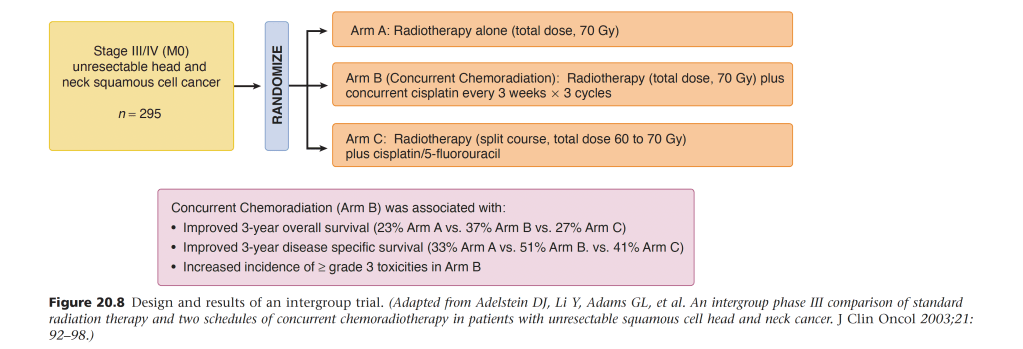
  • The intergroup trial conducted by Adelstein and colleagues was influential in establishing this regimen as a standard of care (Figure):
    • In a three-arm randomized phase III trial of 295 patients:
      • With locally advanced stage M0 head and neck squamous cell carcinoma (SCC):
        • The treatment groups were:
          • Radiation therapy alone (70 Gy) versus
          • Identical radiation plus concurrent cisplatin (100 mg/ m2 administered intravenously on days 1, 22, and 43) versus a split course of radiation with cisplatin plus 5-FU
      • With a median follow up of 41 months:
        • The concurrent cisplatin / radiation arm had a significant advantage in survival at 3 years compared with radiation alone:
          • 37% versus 23%, p = .014
        • Survival in the split-course concurrent arm (27%):
          • Was not significantly better than that in the radiation arm
        • This improved efficacy comes at the cost of an increased incidence of acute toxicities:
          • Including mucositis and nausea / vomiting
        • Four toxic deaths occurred among 95 patients enrolled in the cisplatin chemoradiation arm