Risk stratification in differentiated thyroid cancer has traditionally used a relatively small set of clinical and pathological factors to create models that predict disease-specific mortality or overall survival:
Although clinically useful, these models provided static estimates of risk with information available within the first few months of initial therapy and demonstrated suboptimal, long-term outcome predictions for any individual patient
Over the last decade, additional models have been developed that provide predictive information with regard to other clinically relevant outcomes, such as:
The risk of having persistent disease after initial therapy
The risk of structural or biochemical disease recurrence
The likelihood of going into remission following initial therapy in adult patients with thyroid cancer
Furthermore, rather than using information that is only available at one particular point in time, these new models emphasize the importance of dynamic risk assessment:
Where the initial risk assessment is modified over time as new data become available
These dynamic risk assessments allow us to:
Integrate response to therapy assessments with the underlying individual tumor biology:
To provide real-time risk assessments at any point in the course of the patient’s disease
Thus, the modern view of risk stratification begins with:
The identification of a suspicious nodule (peri-diagnostic period) and continues through the phases of:
Asymptomatic, small thyroid nodules (usually ≤ 1 cm maximal diameter, 1 cm3, or 1 mL volume) confined to the thyroid and surrounded by normal thyroid parenchyma:
Can be followed with active surveillance:
With or without cytologic confirmation:
In patients who value their normal thyroid function and who desire avoidance of thyroid surgery
Patients who demonstrate tumors larger than 1.5 to 2.0 cm; tumors in subcapsular locations adjacent to important structures, such as the trachea and recurrent laryngeal nerve; or tumors with documented growth rate doubling times of < 2 years:
Are generally considered inappropriate for observation and would be considered to have actionable disease
If the tumor growth rate is unknown at the time of nodule detection:
Then this can be established with serial ultrasound evaluations done approximately every 6 months for 1 to 2 years
The frequency of ultrasound evaluations and long-term follow-up:
Depends on the tumor size, location, and established growth rate
With the use of this paradigm:
Active surveillance continues until:
There is a 3-mm increase in tumor diameter:
Which corresponds to a 100% increase in tumor volume
Identification of metastatic disease
Direct invasion into surrounding structures of the thyroid
A decision to discontinue active surveillance based on patient preference
This risk-stratified, minimalistic management approach to very low-risk thyroid cancers has been shown to be safe and effective over 5 to 10 years of follow-up in studies from Japan, Korea, and the United States:
In the first 10 years of active surveillance follow-up:
Only 2% to 8% of papillary microcarcinomas:
Increase ≥ 3 mm in maximum diameter
12% to 14% demonstrate an increase in tumor volume of > 50%:
The smallest change in nodule volume that can be reproducibly measured
Novel lymph node metastases:
Are detected in 2% to 4%
The likelihood of disease progression is higher in younger patients than in older patients
Importantly, at the time of disease progression:
Deferred surgical intervention is quite effective with excellent outcomes and no disease-specific mortality
References:
Ito Y, Miyauchi A. Active surveillance as first-line management of papillary microcarcinoma. Annu Rev Med. 2019;70:369–379.
Ito Y, Miyauchi A, Kudo T, Oda H, Yamamoto M, Sasai H, Masuoka H, Fukushima M, Higashiyama T, Kihara M, Miya A.. Trends in the implementation of active surveillance for low-risk papillary thyroid microcarcinomas at Kuma Hospital: gradual increase and heterogeneity in the acceptance of this new management option. Thyroid. 2018;28(4):488–495.
Tuttle RM, Zhang L, Shaha A. A clinical framework to facilitate selection of patients with differentiated thyroid cancer for active surveillance or less aggressive initial surgical management. Expert Rev Endocrinol Metab. 2018;13(2):77–85.
Tuttle RM, Fagin JA, Minkowitz G, Wong RJ, Roman B, Patel S, Untch B, Ganly I, Shaha AR, Shah JP, Pace M, Li D, Bach A, Lin O, Whiting A, Ghossein R, Landa I, Sabra M, Boucai L, Fish S, Morris LGT. Natural history and tumor volume kinetics of papillary thyroid cancers during active surveillance. JAMA Otolaryngol Head Neck Surg. 2017;143(10):1015–1020.
Tuttle RM, Zhang L, Shaha A. A clinical framework to facilitate selection of patients with differentiated thyroid cancer for active surveillance or less aggressive initial surgical management. Expert Rev Endocrinol Metab. 2018;13(2):77–85.
D’Agostino TA, Shuk E, Maloney EK, Zeuren R, Tuttle RM, Bylund CL. Treatment decision making in early-stage papillary thyroid cancer. Psychooncology. 2018;27(1):61–68.
Groopman J, Hartzband P.. Your Medical Mind. How to Decide What Is Right for You. New York, NY: Penguin Books.
Ito Y, Miyauchi A. Prognostic factors and therapeutic strategies for differentiated carcinomas of the thyroid. Endocr J. 2009;56(2):177–192.
Now accept a minimalistic surgical approach (thyroid lobectomy without neck dissection):
To treat intrathyroidal papillary thyroid carcinomas < 4 cm in properly selected patients
Careful peri-diagnosis, preoperative, and intraoperative risk stratification:
Are the keys to successful use of thyroid lobectomy:
Without having to perform an unacceptable rate of early-completion thyroidectomies
Patients classified as being ideal for lobectomy:
Would have papillary microcarcinomas:
That appeared to be confined to the thyroid in the setting of an otherwise normal thyroid ultrasound and clinical N0 neck
We classify patients as appropriate for lobectomy:
If the tumor is 1 to 4 cm in maximum dimension, if the contralateral lobe is normal, or if there are other abnormalities on the ultrasound, such as thyroiditis or benign-appearing nodules (again, in the setting of the clinical N0 neck)
Patients with extrathyroidal extension, clinical N1 disease, or distant metastasis:
Would be considered inappropriate for thyroid lobectomy as initial therapy
In addition to the relevance of peri-diagnostic and preoperative risk stratification with respect to the selection of thyroid lobectomy as initial therapy:
It is important to recognize that there are intraoperative findings that should alter that recommendation and lead to an immediate total thyroidectomy:
We encourage patients to find a surgeon who they trust and to empower the surgeon to make a final decision in the operating room regarding the extent of initial surgery that should be performed, which can vary from lobectomy to total thyroidectomy, with or without neck dissection
However, even with appropriate preoperative and intraoperative risk stratification:
As many as 6% to 20% of patients will have unexpected findings on the final pathologyreport:
That may lead to a completion thyroidectomy and usually, radioactive iodine
An additional 5% to 10% may require completion thyroidectomy:
At some later point during follow-up for diagnostic or therapeutic purposes
The rate of early-completion thyroidectomy, performed following review of the initial pathology report, will vary, depending on how aggressive each management team is with regard to the use of radioactive iodine for either remnant ablation or adjuvant treatment
If minor factors, such as minor extrathyroidal extension, very small-volume lymph node metastasis, or small tumors with aggressive histologic features usually lead to radioactive iodine therapy, then the completion thyroidectomy rate may be as high as 20%
In our hands, the completion thyroidectomy rate is much lower, as we have a much more restricted use of radioactive iodine:
The most common reason for completion thyroidectomy in our hands is unanticipated, extensive vascular invasion documented on the pathology report that obviously could not be visualized preoperatively or intraoperatively
Thus, patients need to understand that the final determination of whether a thyroid lobectomy is the appropriate initial therapy can only be achieved by:
The integration of preoperative, intraoperative, and postoperative risk stratification
Patients who are uncomfortable with this approach will often choose a total thyroidectomy as initial therapy
Patients motivated to keep part of the thyroid will often accept that uncertainty, recognizing that the final decision regarding the completeness of initial therapy cannot be completely known until several weeks after the surgery is completed when more complete risk stratification can be accomplished
References:
Tuttle RM, Zhang L, Shaha A. A clinical framework to facilitate selection of patients with differentiated thyroid cancer for active surveillance or less aggressive initial surgical management. Expert Rev Endocrinol Metab. 2018;13(2):77–85.
Carty SE, Doherty GM, Inabnet WB III, Pasieka JL, Randolph GW, Shaha AR, Terris DJ, Tufano RP, Tuttle RM; Surgical Affairs Committee Of The American Thyroid Association. American Thyroid Association statement on the essential elements of interdisciplinary communication of perioperative information for patients undergoing thyroid cancer surgery. Thyroid. 2012;22(4):395–399.
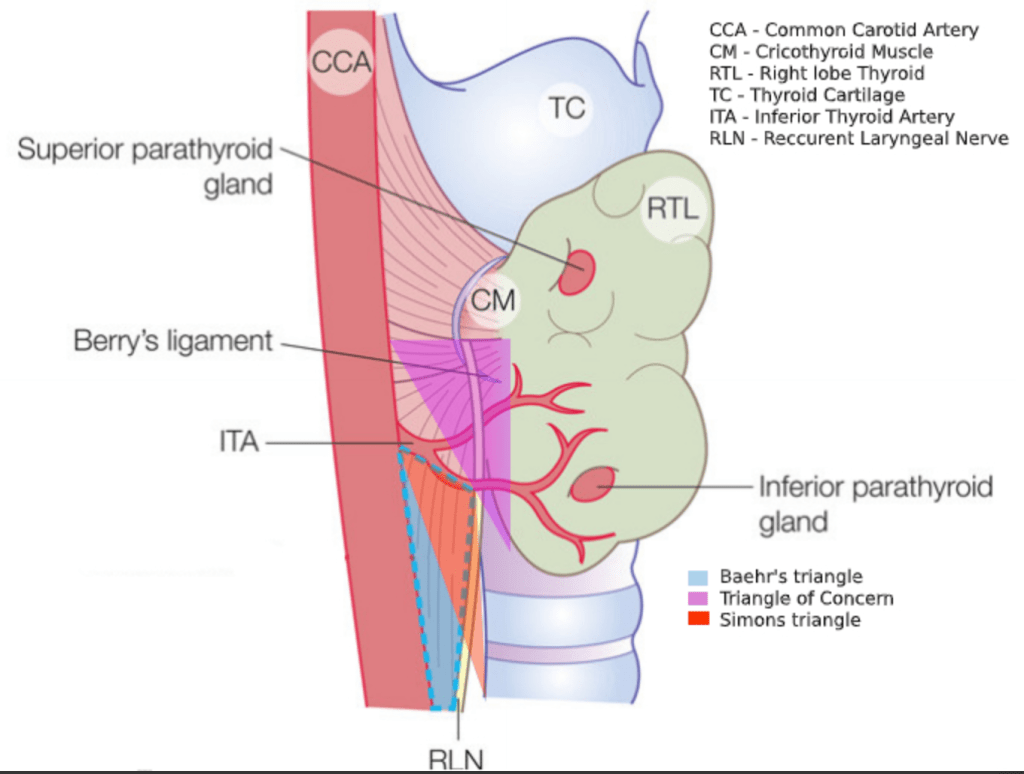
Recurrent laryngeal nerve exits as a single trunk here at thoracic inlet
Triangle of Concern:
The commonest site for bleeding in thyroidectomy:
Is the ‘triangle of concern’, comprising the:
Trachea medially
RLN nerve laterally
With the thyrothymic ligament and loose fat above the sternum at the base
Berry’s ligament at the apex
This triangle has the small branches of the inferior thyroid artery that require meticulous hemostasis with in the vicinity of RLN, which can cause injury to nerve
Results of the meta-analysis showed that patients who had immediate surgery:
Had lower rates of local recurrence early on, when compared to patients who had delayed surgery:
With longer follow-up, patients who had undergone surgery immediately also had lower rates of distant recurrence and breast cancer death
The meta-analysis included data from three trials encompassing 1082 women with breast cancer who were at least 70 years of age and had a median of 5 years on study:
The trials were all designed to compare immediate surgery to deferral of surgery until after progression, in the absence of radiotherapy
Results showed that, among patients with node-negative disease:
The rate of local recurrence at 5 years was 14.4% in patients who received tamoxifen plus surgery and 45.4% in patients who received tamoxifen alone (rate ratio [RR], 0.25; 95% CI, 0.19-0.34; P <.00001).
Among patients with node-positive disease:
The rate of local recurrence at 5 years was 6.8% in those treated with tamoxifen plus surgery and 48.1% in patients receiving tamoxifen alone (RR, 0.18; 95% CI, 0.11-0.29; P <.00001)
Immediate surgery leads to a very great reduction in the rates of local recurrence, and the curves separate immediately:
So that benefit is seen immediately, irrespective of nodal status, with really quite large absolute differences at 5 years
The study also found lower rates of distant recurrence and breast cancer death among patients who received immediate surgery:
However, those benefits only became apparent with longer follow-up:
The rate of distant recurrence at 15 years was 37.0% in patients who received tamoxifen plus surgery and 51.3% in patients who received tamoxifen alone (RR, 0.72; 95% CI, 0.57-0.90; P =.003)
The rate of breast cancer death at 15 years was 34.2% in patients who received tamoxifen plus surgery and 48.9% in those who received tamoxifen alone (RR, 0.68; 95% CI, 0.54-0.86; P =.002).
Practice-Changing Insights from the SUPREMO Trial at the San Antonio Symposium
The SUPREMO trial (Selective Use of Postoperative Radiotherapy After Mastectomy) presented its long-term results at the recent San Antonio Breast Cancer Symposium, marking a significant moment in the management of intermediate-risk breast cancer. As the only practice-changing presentation at the symposium, this trial provides robust evidence for the de-escalation of chest wall irradiation (CWI) in specific patient populations following mastectomy.
About the Trial:
SUPREMO is a phase III international, multicenter trial designed to assess whether CWI improves overall survival (OS) or reduces recurrence in intermediate-risk breast cancer patients. This group includes patients with tumors exhibiting certain characteristics that make the need for postoperative radiotherapy uncertain【1】【2】.
Key Findings (Median Follow-Up: 9.6 Years):
• Overall Survival (OS):
No statistically significant difference was observed in 10-year OS between patients receiving CWI (81.4%) and those who did not (82.0%). This confirms that CWI does not confer a survival advantage in this population【1】【2】【3】.
• Local Recurrence:
While CWI reduced the relative risk of chest wall recurrence by more than 50%, the absolute reduction in recurrence was less than 2%, deemed clinically insignificant for most patients【2】【3】.
• Subgroup Analysis:
Both node-negative patients (N0) and those with T1-T2 tumors with 1-3 positive lymph nodes (N1) demonstrated no OS advantage with CWI. This suggests that many intermediate-risk patients, previously considered candidates for postoperative radiotherapy, may safely omit this treatment【1】【3】.
Clinical Implications:
The SUPREMO trial supports a tailored, de-escalated approach to radiation therapy in intermediate-risk breast cancer patients. By identifying subgroups unlikely to benefit from CWI, clinicians can reduce treatment-related morbidity while maintaining excellent oncologic outcomes. Patients meeting the following eligibility criteria may particularly benefit from this evidence【1】【2】:
1. pT1-2, N1 Disease: Tumors ≤50 mm with 1-3 positive axillary lymph nodes.
2. pT3, N0 Disease: Tumors >50 mm with no nodal involvement.
3. High-Risk Features in Node-Negative Disease: Tumors >20 mm but ≤50 mm with grade 3 histology and/or lymphovascular invasion (LVI).
Context and Broader Impact:
These findings align with an ongoing shift toward de-escalation strategies in oncology, prioritizing individualized treatment plans that balance efficacy and quality of life. The trial provides additional support for reducing overtreatment, especially in light of advancements in systemic therapies, which may further mitigate recurrence risk in intermediate-risk breast cancer【3】【4】.
Future Directions:
While SUPREMO guides practice for intermediate-risk patients, further research is needed to refine the role of radiotherapy in other subgroups, including those with high-risk features or specific molecular subtypes. Additionally, long-term follow-up beyond 10 years will provide further clarity on late recurrences and survival outcomes【4】.
References:
1. Kunkler, I. H., et al. Postmastectomy Radiotherapy for Intermediate-Risk Breast Cancer: Results from the SUPREMO Trial. Lancet Oncology, 2023.
2. San Antonio Breast Cancer Symposium 2023. SUPREMO Trial Results. [Conference Abstracts and Presentations].
3. Kunkler, I. H., et al. Radiotherapy De-Escalation in Breast Cancer: Lessons from SUPREMO. Journal of Clinical Oncology, 2023.
4. Smith, B. D., et al. Tailored Radiotherapy Approaches in Breast Cancer. Nature Reviews Clinical Oncology, 2023.