Blog

Timeliness for Surgery in Breast Cancer Care

  • The management of breast cancer:
    • Has become increasingly complex and multidisciplinary:
      • With increasing imaging studies, appointments, and often, second or third opinions patients seek for care
    • Together, many of these factors have led to lengthening time intervals between diagnosis and surgery
  • At the same time, time from diagnosis to surgical treatment of 60 days:
    • Is now a Commission on Cancer quality metric
  • Minimizing delays in treatment:
    • Is a sensible goal believed to lead to improved outcomes
  • The precise time frame that is considered reasonable and safe versus detrimental to breast cancer survival is not known:
    • Although a number of recent large retrospective studies have evaluated this
  • Bleicher et al:
    • In a 2016 study of nearly 100,000 women > age 65 in the SEER-Medicare database:
      • Showed that overall survival decreased by 9% after a 60-day delay from diagnosis to surgery
    • In addition, the association between overall survival and time to surgery:
      • Was significant for stage I (HR 1.13, p<0.001) and stage II (HR 1.06, p<0.01):
        • But not for stage III breast cancer patients
    • The association between breast cancer-specific survival and time to surgery (HR 1.84, p=0.02):
      • Persisted solely for stage I patients:
        • Likely attributable to the baseline mortality in this group being smaller than the relative impact imposed by a delay in treatment
  • A 2020 study of ~350,000 patients (of all ages) in the NCDB with stage I to III breast cancer treated with up front surgical therapy examined the relationship between overall survival, time to surgery, and biologic subtype of breast cancer (i.e. triple negative, ER+PR+, HER2+):
    • Prevailing opinion prior to this study was that delays would be more detrimental to those with more biologically aggressive tumors such as TN or HER2+ due to downstream delays in adjuvant systemic therapy resulting from delayed surgical treatment
    • This study found that overall survival was observed to decline with every month delay in surgical treatment (HR 1.1, p<0.001), and this did not vary by biologic subtype (p>0.33)
  • A more recent 2023 study of NCDB stage I to III breast cancer patients treated with up front surgery analyzed survival for every one-week interval after 30 days post-diagnosis:
    • Median time to surgery was 30 days:
      • 90% of patients underwent surgery within 60 days
    • Delays of 9 weeks or greater:
      • Were found to be more common in younger women and the uninsured
    • They found that there was no significant association between time to surgery and survival:
      • For any of the groups until after 9 weeks post-diagnosis
    • A surgical delay of 9 weeks or longer after diagnosis was associated with worse overall survival (HR 1.15, p < 0.001) compared with surgery within 4 weeks of diagnosis
    • Again, no significant interaction was found between tumor biologic subtype and time to surgery’s association with survival
    • Therefore, the conclusion was made that 8 weeks or shorter serve as a standard quality metric for timeliness of surgery
  • References:
    • Bleicher RJ et al. Preoperative delays in the US Medicare population with breast cancer. J Clin Oncol 2012; 30:4485-92
    • Bleicher RJ et al. Time to Surgery and Breast Cancer Survival in the United States. JAMA Surg 2016; 2:330-9
    • Mateo AM et al. Time to Surgery and the Impact of Delay in the Non-Neoadjuvant Setting on Triple-Negative Breast Cancers and Other Phenotypes. Ann Surg Oncol 2020; 27:1679-92
    • Wiener AA et al. Reexamining Time From Breast Cancer Diagnosis to Primary Breast Surgery. JAMA Surg 2023; 158:485-92

Timing of Surgical Management for Breast Cancer

  • The timing of surgical management for breast cancer patients:
    • Has been evaluated in multiple retrospective studies
  • Patients are increasingly more anxious regarding a breast cancer diagnosis and are wanting more immediate intervention despite the delays which are possible from increased use of reconstructive procedures
  • Multiple studies have aimed to determine the optimal timing of surgical intervention in breast cancer as it pertains to overall and survival outcomes
  • One of the most recent retrospective reviews performed in 2023 was conducted by Weiner et al:
    • This study evaluated whether there was a correlation between time from a breast cancer diagnosis to surgical intervention and the patient’s overall survival:
      • Data from the NCDB database was utilized from 2010 to 2014 and included female patients who were 18 and older with stage I to III breast cancer who underwent upfront surgery
      • This review found that patients undergoing surgery greater than 8 weeks from diagnosis:
        • Had a poorer overall survival when compared to patients who underwent surgical intervention less than 8 weeks from diagnosis
      • The review concluded that time to surgery of 8 weeks or less:
        • Should be used as the quality metric for breast cancer patients
      • Data analysis from this same study revealed that while time to surgery may portend a worse survival when greater than 8 weeks:
        • The most impactful driver of breast cancer survival outcomes still remains tumor characteristics to include:
          • Loco-regional spread and nodal status
          • Tumor size and receptor subtypes
  • The European Union of Breast Cancer Specialists published quality indicators for breast cancer patients in 2010 to include timeliness of surgery as a recommended but not mandatory quality metric:
    • This recommendation specifically endorsed that patients who were planned for upfront surgery:
      • Should receive surgical intervention within 6 weeks of biopsy confirmation of breast cancer:
        • With a minimum of 75% of patients falling within the 6-week timeframe and a goal that 90% or greater of patients with breast cancer will have surgical treatment within this timeframe
  • References

Breast Cancer-Related Lymphedema (BCRL)

  • Breast cancer-related lymphedema:
    • Has been a significant concern for breast cancer patients undergoing axillary surgery
  • The development of BCRL:
    • Is associated with significantly lower physical and psychosocial well-being and increased health care utilization
  • The risk of BCRL:
    • Is a function of the extent of axillary intervention:
      • Ranging from about 12% following a sentinel node biopsy to about 30% after an axillary lymph node dissection (ALND)
    • The highest risk of BCRL (51%):
      • Has been reported in patients with inflammatory breast cancer:
        • Who receive trimodality therapy (neoadjuvant taxane-containing chemotherapy, modified radical mastectomy, and adjuvant radiation)
    • Therefore, adjuvant radiotherapy:
      • Is associated with an increased risk of BCRL
  • The value of routine screening for BCRL in patients at risk:
    • Is controversial
  • There is growing evidence that subclinical lymphedema:
    • Defined as relative volume change of the affected arm of 5% to 10% compared to the baseline measurement:
      • Is strongly associated with the development of more symptomatic BCRL:
        • Which correlates with a relative volume change of > 10%
  • Consequently, identifying patients with subclinical lymphedema:
    • Is a potential opportunity for early intervention and long-term improvement in quality of life
  • Furlan et al:
    • Prospectively evaluated 85 breast cancer patients (n=40 had an ALND and n=45 had a sentinel node biopsy) by obtaining serial circumferential arm measurements preoperatively, then 1 month, 3, 6, 12, and 24 months after surgery
    • Study results showed that the earliest signs of subclinical lymphedema:
      • Were detected no sooner than the 6-month assessment:
        • Those with subclinical lymphedema were promptly referred for decongestive therapy
  • An international randomized trial comparing bioimpedance spectroscopy (BIS) and tape measurement to detect subclinical lymphedema:
    • Showed that BIS had a higher sensitivity and was associated with an earlier referral for decongestive therapy
    • In the same study, earlier administration of decongestive therapy:
      • Was associated with a lower risk of progression to symptomatic BCRL
  • The practical aspects of implementing BCRL screening with bioimpedance spectroscopy (BIS) versus tape measurements and other techniques warrant further study
  • References:
    • Coriddi M, Kim LN, Haglich K, et al. The impact of lymphedema on patient-reported outcomes after breast reconstruction: a preliminary propensity score-matched analysis. Ann Surg Oncol. 2023;30(5):3061-3071. doi: 10.1245/s10434-022-12994-z
    • Cheville A, Lee M, Moynihan T, et al. The impact of arm lymphedema on healthcare utilization during long-term breast cancer survivorship: a population-based cohort study. J Cancer Surviv. 2020;14(3):347-355. doi: 10.1007/s11764-019-00851-0
    • Bucci LK, Brunelle CL, Bernstein MC, et al. Subclinical lymphedema after treatment for breast cancer: risk of progression and considerations for early intervention. Ann Surg Oncol. 2021;28(13):8624-8633. doi: 10.1245/s10434-021-10173-0
    • Farley CR, Irwin S, Adesoye T, et al. Lymphedema in inflammatory breast cancer patients following trimodal treatment. Ann Surg Oncol. 2022;29(10):6370-6378. doi: 10.1245/s10434-022-12142-7
    • Furlan C, Matheus CN, Jales RM, Derchain SFM, Bennini JR Jr, Sarian LO. Longitudinal, long-term comparison of single-versus multipoint upper limb circumference periodical measurements as a tool to predict persistent lymphedema in women treated surgically for breast cancer: an optimized strategy to early diagnose lymphedema and avoid permanent sequelae in breast cancer survivors. Ann Surg Oncol. 2021;28(13):8665-8676. doi: 10.1245/s10434-021-10290-w
    • Ridner SH, Dietrich MS, Boyages J, et al. A comparison of bioimpedance spectroscopy or tape measure triggered compression intervention in chronic breast cancer lymphedema prevention. Lymphat Res Biol. 2022;20(6):618-628. doi: 10.1089/lrb.2021.0084

Surveillance Following Risk Reducing Mastectomy in BRCA Carriers

  • Many patients with pathogenic BRCA 1 and BRCA2 variants elect to undergo bilateral risk reducing mastectomy (RRM):
    • To not only maximally reduce risk of developing breast cancer, but also to omit the need for intensive breast imaging surveillance
  • However, there is a paucity of data on surveillance strategies for BRCA 1 / BRCA 2 mutation carriers:
    • Following either RRM or therapeutic mastectomies
  • Regarding imaging surveillance after RRM:
    • The American College of Radiology Appropriateness Criteria expert panel concluded:
      • That most imaging techniques are usually inappropriate for surveillance for patients who have undergone RRM:
        • Including those who have had skin and or nipple-sparing mastectomy
      • In patients with suspected clinical findings:
        • Ultrasound is the best imaging tool for diagnostic evaluation
  • A study from Israel included 53 asymptomatic BRCA 1 / BRCA 2 mutation carriers who underwent bilateral RRM and breast reconstruction:
    • They found that over a median follow-up of 5.4 years:
      • None went on to develop breast cancer
    • In their population, patients were routinely followed with clinical exams every 6 months in a high-risk breast clinic as well as with annual ultrasound and breast MRI, staggered at 6-month intervals
    • Based on the study findings, the authors suggested that imaging surveillance can be omitted for patients post-RRM
  • Another larger retrospective study of 254 BRCA 1 /BRCA 2 positive patients in the Netherlands found that among 147 asymptomatic BRCA 1 / BRCA 2 positive patients who had bilateral RRM:
    • Only one developed breast cancer in follow-up over a 5.5-year follow-up period:
      • The risk of subsequent breast cancer developing was 0.2% / year
  • In a Cochrane review of seven retrospective and prospective studies of RRM for BRCA1 / BRCA 2 positive patients:
    • The estimated risk of breast cancer was:
      • 0.8% over 5 to 15 year follow up
    • Five of those seven studies documented zero cases of breast cancer among 461 BRCA1 / BRCA 2 positive patients followed up to 14 years after RRM
  • NCCN guidelines do not make recommendation for surveillance post RRM for BRCA+ patients
  • Considering the number of studies demonstrating very low risk of breast cancer arising subsequent to RRM:
    • Which equates to lower-than-average woman’s lifetime risk of breast cancer (non-genetic mutation carrier):
      • Clinical exam follow-up by a primary care provider is acceptable and sufficient surveillance for the BRCA1 / BRCA 2 mutation carrier
  • References:

Dropping Radioiodine Doesn’t Drop Outcomes in Low-Risk Thyroid Cancer

  • Leboulleux S, Bournaud C, Chougnet CN, et al. Thyroidectomy without radioiodine in patients with low-risk thyroid cancer: 5 years of follow-up of the prospective randomised ESTIMABL2 trial. Lancet Diabetes Endocrinol, 2025;13(1):38-46; doi: 10.1016/S2213-8587(24)00276-6. PMID: 39586309.
  • Background:
    • Radioiodine (RAI) has historically been used as an adjuvant therapy after total thyroidectomy for differentiated thyroid cancer (DTC) to ablate remnant thyroid tissue and reduce recurrence risk
    • However, for low-risk DTC, characterized by:
      • Tumors ≤ 2 cm without extrathyroidal extension or lymph node or distant metastases:
        • The benefit of routine RAI remains uncertain
    • Recent guidelines, including those from the American Thyroid Association (ATA):
      • Suggest that RAI may be safely omitted in select low-risk cases:
        • But prospective data confirming this approach have been limited
  • Methods:
    • This was a multicenter, prospective, randomized, phase 3 study designed to assess whether omitting RAI affects oncologic outcomes in patients with low-risk DTC
    • Eligible patients were 18 to 75 years old, had undergone total thyroidectomy, and had pT1a-pT2N0 / NxM0 disease with no aggressive histologic features
    • Participants were randomly assigned (1:1) to either thyroidectomy alone (no RAI) or thyroidectomy followed by low-dose RAI (1.1 GBq, approximately 30 mCi)
    • Both groups received thyroid stimulating hormone (TSH) suppression therapy according to guidelines
    • The primary outcome was disease-free survival (DFS) at 5 years:
      • Assessed by determination of a structural disease event based on serial neck ultrasonography, a biochemical event based on thyroglobulin (Tg) and Tg antibody monitoring, or a functional event based on posttherapeutic RAI whole-body scanning (WBS)
    • Diagnostic WBS during surveillance was not performed, since it is not considered standard for low-risk DTC
    • Secondary outcomes included recurrence rate, quality of life (QoL), and adverse effects related to RAI
    • Statistical analysis was conducted using an intention-to-treat (ITT) approach, with Kaplan–Meier estimates for DFS and Cox proportional-hazards models for recurrence risk
    • This study aimed to provide high-level evidence guiding de-escalation strategies in low-risk DTC management
  • Results:
    • The study included 730 patients with low-risk DTC who were randomly assigned to thyroidectomy alone (n = 365) or thyroidectomy followed by low-dose RAI therapy (1.1 GBq, n = 365)
    • Among 698 patients evaluable at 5 years, the proportions without an event were 93.2% in the no-RAI group and 94.8% in the RAI group, a difference of –1.6% (90% CI, –4.5 to 1.4)
    • Event occurrences were structural or functional abnormalities (n = 11: five in the RAI group and six in the no RAI group) and biologic abnormalities (n = 31; 13 in the RAI group and 18 in the no-RAI group)
    • After randomization and initial treatment (RAI or not), 11 patients in each group underwent a subsequent treatment consisting of additional surgery and / or RAI (131I) therapy
    • Postoperative serum thyroglobulin level of > 1 ng/ml measured during TSH suppression, patient age between 55 and 60 years, follicular histology, and larger tumor size were predictive of an event
    • The recurrence rate remained low and comparable between groups
    • No significant differences were observed in overall survival, and there were no cases of distant metastases in either group
    • Patients in the no-RAI group reported better QoL scores, with lower rates of fatigue, salivary gland dysfunction, and dry mouth, consistent with prior reports on RAI-related adverse effects
  • Conclusions:
    • These findings support a de-escalation strategy in the postoperative management of low-risk DTC, reinforcing that thyroidectomy alone is sufficient in appropriately selected patients
    • This trial provides high-level evidence to guide modern risk-adapted treatment strategies and aligns with evolving guidelines recommending a more conservative approach while maintaining oncologic outcomes and improving QoL scores
  • De-escalation trends for low-risk DTC have been suggested and even recommended in guidelines for many years; however, these recommendations lacked the backing of data from sufficiently large randomized controlled trials, which was the aim of this study
  • The group published their initial 3-year findings in the New England Journal of Medicine in 2022, showing noninferiority at 3 years of surveillance alone after initial surgical treatment in over 700 randomly assigned patients
  • Numerous retrospective studies and systematic reviews have also pointed to the safety of omitting radioiodine ablation for low-risk DTC
  • The strengths of the study include its prospective, randomized, multicenter design, which reduces selection bias and enhances the reliability of the data
  • The study also had clinically relevant, comprehensive, and patient-centered end points, including its primary end point of disease-free survival, and secondary outcomes, including recurrence rates and, importantly, quality of life
  • The inclusion of patients from several centers and adherence to ATA low-risk criteria make the study findings more generalizable and directly applicable in clinical practice
  • The study does have several shortcomings:
    • It focuses strictly on low-risk DTC, excluding intermediate-risk patients, thus limiting the ability to extrapolate findings to patients with larger tumors or minimal lymph node involvement
    • Additionally, the study included only T1Nx or T1N0 tumors, which were overwhelmingly of papillary histology, with only 3% follicular and 1% oncocytic, making it difficult to confidently apply the findings to these other thyroid cancer types
    • In our current era, it is also unfortunate that the authors do not report molecular profiles for the tumors that recurred and those that did not
    • Lastly, despite 5 years being a reasonable time frame for follow-up, given the indolent nature of DTC, it is possible that a longer follow-up (10 to 20 years) is needed to confirm sustained low recurrence rates
    • I found most astonishing was to see that patients enrolled in this study routinely underwent total thyroidectomy for T1 disease and that many of these patients also underwent central and even lateral neck dissections for clinically N0 disease
  • It is important to have rigorous studies to prove the safety and efficacy of our treatment paradigms
  • This study supports reducing overtreatment of low-risk thyroid cancer without compromising patient outcomes and shows improvement in patients’ quality of life with treatment de-escalation
  • Key points of the study
    • Omitting RAI does not compromise oncologic outcomes:
      • At 5-years, disease-free survival and recurrence rates were not significantly different between those who received RAI and those who did not
    • Patients in the non-RAI group reported better quality-of-life scores with less fatigue and fewer salivary gland complications
  • The ESTIMABL2 trial findings validate de-escalation strategies and align with dynamic risk assessment to identify individualized treatment considering risk-adapted management
  • References:
    • Schlumberger M, Leboulleux S, Catargi B, et al. Outcome after ablation in patients with low-risk thyroid cancer (ESTIMABL1): 5-year follow-up results of a randomised, phase 3, equivalence trial. Lancet Diabetes Endocrinol 2018;6(8):618-626.
    • Haugen BR, Alexander EK, Bible KC, et al. 2015 American Thyroid Association management guidelines for adult patients with thyroid nodules and differentiated thyroid cancer: the American Thyroid Association guidelines task force on thyroid nodules and differentiated thyroid cancer. Thyroid 2016;26:1-133.
    • Lamartina L, Durante C, Filetti S, Cooper DS. Low-risk differentiated thyroid cancer and radioiodine remnant ablation: a systematic review of the literature. J Clin Endocrinol Metab 2015;100(5):1748-1761.
    • Leboulleux S, Bournaud C, Chougnet CN, et al. Thyroidectomy without radioiodine in patients with low-risk thyroid cancer: 5 years of follow-up of the prospective randomised ESTIMABL2 trial. Lancet Diabetes Endocrinol 2025;13(1):38-46.

Screening for Breast Cancer in Transgender Males

  • The adult transgender population in the US is estimated to be 0.6% of the population:
    • At least 1.4 million people
  • Cross sex hormonal therapy:
    • Is androgen based for people transitioning female to male:
      • This results in decreased breast glandular tissue
      • The pathological histology of the breast tissue:
        • Is similar to a postmenopausal cis female
      • If the breast tissue remains intact, there is the same risk of benign and malignant disease as natal females
  • “Top surgery” is:
    • Bilateral subcutaneous mastectomies
    • Chest contouring
    • Repositioning of the nipple areolar complex
  • Guidelines for imaging prior to top surgery:
    • Generally follow established guidelines for cis gendered females
  • The American Society of Plastic Surgeons recommends:
    • Pre-operative screening:
      • Based on age and risk factors per these existing guidelines
    • For high-risk patients:
      • This may include mammography and MRI
    • For average risk patients under the age of 40:
      • There are no defined guidelines, and this is left to surgeon discretion
  • The risk of breast cancer following top surgery:
    • Has been shown to decrease risk when compared to natal female risk or when no top surgery is done
  • For Female to Male  (F to M) patients who have not had top surgery:
    • Their risk is based on gender genotype and is same as cis gender women
  • The goal of top surgery is chest contouring:
    • Thus, there is residual breast tissue over a standard nipple sparing mastectomy done for risk reduction or oncological purposes
  • Top surgery does decrease breast cancer risk:
    • Studies have shown this risk is similar to natal males
    • Because there is likely residual breast tissue, it is imperative that physicians counsel patients about risk and self-awareness
  • Testosterone therapy:
    • While theorized to undergo aromatization to estrogen and thus cause increased risk:
      • Has not been shown in this population to increase overall risk of development of breast cancer
  • Cross sex hormone therapy:
    • Does not appear to alter breast cancer risk
  • Currently screening guidelines from the American College of Radiology state:
    • That for transgender men who have not had top surgery, or had breast reduction only:
      • Guidelines for cisgender females should be followed:
        • Imaging is “not usually appropriate” in transmasculine patients of any age or risk if they had bilateral mastectomies (top surgery):
          • It is important to note that there are no longitudinal studies evaluating the efficacy of screening in this population
  • References:

Do Delays Impact Breast Cancer Survival?

👉An emerging quality indicator for breast cancer care is timeliness of care delivery and efficiency, which is a concern for patients as well as for clinicians.

👉Several recent studies have suggested detrimental effects of long delays between breast cancer diagnosis and starting adjuvant therapy.

👉The American College of Surgeons Commission on Cancer has defined receipt of systemic chemotherapy within 120 days of diagnosis of hormone receptor-negative cancer as a quality metric for patients younger than 70 years.

👉The goals of this analysis of data from the National Cancer Database were to examine the effect of surgical treatment type on time to adjuvant chemotherapy and the effect of treatment delay on survival among patients with stage I to III breast cancer treated with both surgery and adjuvant chemotherapy from 2010 to 2014.

👉A delay in starting adjuvant chemotherapy after surgery for breast cancer can adversely affect survival, say US researchers, who found that the type of surgery performed plays a significant role in that delay.

👉In particular, the team found that for women who underwent reconstruction after mastectomy, there was more likely to be a delay before starting adjuvant chemotherapy that was longer than the 120 days currently recommended.

👉This, crucially, could have an effect on survival, they warn, because a delay from diagnosis to chemotherapy of more than 120 days was associated with a 29% reduction in overall survival.

👉The research was published online in the Annals of Surgical Oncology on July 22.

👉Overall, the results were encouraging, in that 89.5% of women who are recommended chemotherapy postoperatively do get it within 120 days of their diagnosis, but there is still room for improvement – Dr. Arrangoiz

👉The authors of the study recommended that hospitals examine whether they can reduce the interval from breast cancer diagnosis to surgical procedure.

👉The delay, could be a result of poor access to care, longer wait times for a second opinion, and the coordination between surgeons needed to organize immediate breast reconstruction.

👉The authors point out not only that timeliness in the delivery of cancer care is a concern for patients and physicians on a subjective level but also that there is “a growing body of data” to suggest it affects outcomes.

👉Although previous studies were inconclusive or found no correlation between the timing of breast cancer care and overall survival, more recent studies have shown that long delays have detrimental effects.

👉This led to a recommendation by the American College of Surgeons’ Commission on Cancer to include the administration of systemic chemotherapy within 120 days of diagnosis as a quality metric for the treatment of some women with breast cancer.


Screening for Breast Cancer in Transgender Males

  • Transgender males over the age of 40:
    • Whom have not undergone top surgery (chest masculinization surgery):
      • Should be screened similarly to cisgender females and in accordance with current screening guidelines
  • There is data to suggest that transgender men who have taken testosterone:
    • May have a decrease in breast cancer incidence:
      • However, the effects of exogenous testosterone on breast cancer risk are less clear, overall
  • In transgender males who have not undergone top surgery and are determined to have a lifetime risk of greater than 20%:
    • Current recommendations mirror those for cisgender females:
      • With recommendation to undergo annual breast MRI as an adjunct to annal screening mammography
  • References:
Rodrigo Arrangoiz, MD (Oncology Surgeon)

Follicular Thyroid Carcinoma (FTC)

  • The second most common type of thyroid cancer is:
    • Follicular thyroid carcinoma (FTC)
  • Fundamentally all follicular carcinomas are:
    • RAS-like tumors
  • There profile is different from classic PTC because:
    • They do not have BRAF mutations:
      • Most of them have RAS and RAS-like mutations
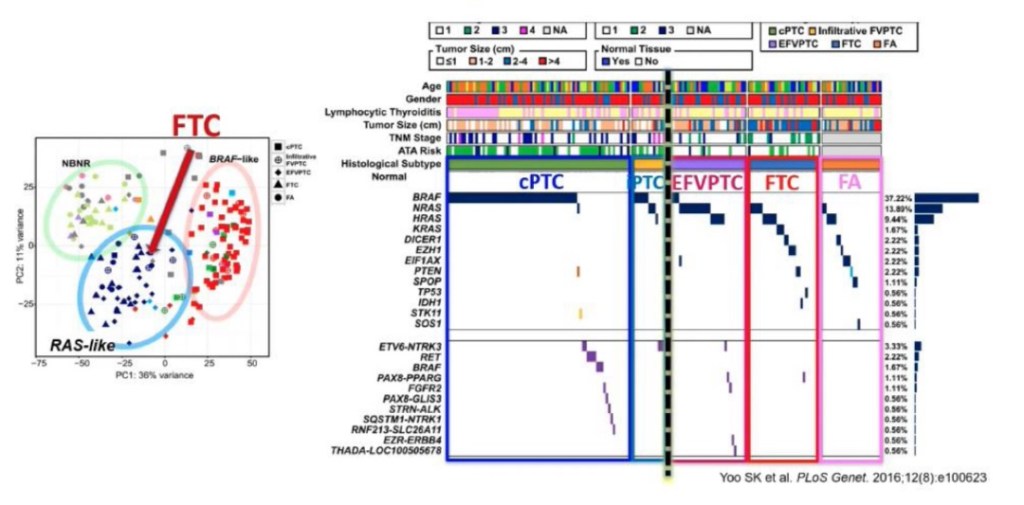
  • Yoo S.K et al, from Korea showed that the genetic profile of follicular carcinomas:
    • Is very similar to follicular adenomas because they are related tumors
    • Most FTC originate from a FA and eventually break through the capsule and become carcinomas
  • In encapsulated follicular variant of PTC:
    • Their molecular profile is much closer to a FA and FTC than to classic PTC
  • Infiltrative follicular variant of PTC:
    • Has a molecular profile that is more like classic PTC than FTC
  • The biologic difference between follicular pattern RAS-like tumors and classic PTC:
    • Is the infiltrative growth pattern (Figure)
    • The difference between these tumors:
      • Is not only phenotypically based on gross pattern, but also based on biological and clinical differences;
        • Because follicular pattern RAS-like tumors:
          • Retain avidity to radioactive iodine
        • BRAF-like tumors (classic PTC and infiltrative follicular variant of PTC):
          • Have the classic features of PTC
          • They are infiltrative
          • They spread to lymph nodes first and later to distant sites
          • They lose the expression of genes associated with thyroid differentiation
        • RAS-like tumors (FA, FTC, NIFTP, and invasive encapsulated follicular variant of PTC):
          • May or may not have nuclear features of PTC
          • They are encapsulated
          • They spread to distant sites (rarely to lymph nodes)
          • They retain expression of genes associated with thyroid differentiation

Graph exemplifying the difference between follicular pattern RAS-like tumors and classic PTC,
which is the infiltrative growth pattern.

Transcriptomic Classification of Thyroid Cancer

  • The trans-genomic classification of thyroid cancer, particularly papillary thyroid carcinoma (PTC):
    • Has significant clinical implications, as it enables personalized diagnosis, prognosis, and treatment strategies
  • Recent studies have identified molecular subtypes of PTC based on genomic and transcriptomic profiling:
    • Which provide insights into tumor behavior and therapeutic responses
  • Key Molecular Subtypes
    • Immune-Enriched Subtype (Subtype 2):
      • High immune infiltration and overexpression of immune checkpoints
      • Potential candidates for immunotherapy.
    • BRAF-Enriched Subtype (Subtype 4):
      • Associated with aggressive features like:
        • Extrathyroidal extension
        • Advanced TNM stages
    • Enriched in MAPK and PI3K / AKT signaling pathways:
      • Suggesting targeted therapy options
    • Stromal Subtype (Subtype 3):
      • High stromal content with distinct microenvironmental features
    • CNV-Enriched Subtype (Subtype 6):
      • Characterized by copy number variations with unique genetic drivers
  • Clinical Implications:
    • Prognostic Value:
      • Molecular subtypes correlate with survival outcomes
      • Type 3 subtypes (high-risk):
        • Show poorer progression-free survival compared to Type 1 (low-risk)
    • Therapeutic Guidance:
      • Subtypes like the Immune-Enriched or Ras-like Type 1:
        • May benefit from immunotherapy or radioactive iodine (RAI) therapy, respectively
      • BRAF-mutant subtypes:
        • May require targeted tyrosine kinase inhibitors due to RAI resistance
    • Preoperative Decision-Making:
      • Genomic classifiers applied to fine needle aspirates can help stratify patients for active surveillance or surgery
    • Tailored Treatments:
      • Understanding subtype-specific pathways enables the development of novel therapies, such as EZH2 inhibitors for aggressive subtypes
  • This classification system bridges the gap between molecular biology and clinical practice, paving the way for precision medicine in thyroid cancer management