Blog

Molecular Genetics of Thyroid Cancer Part 1

  • Most of the data that has been gathered is associated with somatic mutations:
    • Many of which occur early in the
      transformation process and are crucial for cancer development
  • In thyroid cancer, vital genes are commonly mutated via two separate molecular mechanisms:
    • Point mutations
    • Chromosomal rearrangements
  • Point mutations:
    • Are the result of a single nucleotide change within the DNA chain:
      • Which activates or inactivates a
        protein
  • Chromosomal rearrangements:
    • Represent a large-scale genetic abnormality with breakage and fusion of parts of the same chromosome or different chromosomes
  • The molecular pathogenesis of thyroid cancer:
    • Is relatively simple with two molecular pathways:
      • The mitogen‑activated protein kinase (MAPK) pathway
      • The phosphatidylinositol 3 – kinase – protein kinase B (PI3K-AKT) pathway (Figure)
  • These pathways are activated in most thyroid cancers:
    • Via distinct molecular mechanisms mentioned previously, like:
      • Point mutations (single nucleotide variant):
        • Where a single nucleotide is
          changed:
          • Which activates or inactivates a protein
      • Gene fusions:
        • Were parts of two different genes located in the same or different chromosome are fused to each other:
          • That results in the generation of chimeric protein
      • Copy number alterations (CNA):
        • That have been recently accepted as a driver mutation for oncocytic cell tumors
  • Activation of the MAPK pathway:
    • Is a critical step for tumor initiation
    • The mutated genes that impact
      these pathways encode:
      • The cell-membrane receptor tyrosine kinases:
        • RET and NTRK1
      • Intracellular signal transducers:
        • RAS and BRAF
    • These mutually exclusive mutations:
      • They do not overlap with each other because they activate the same pathway and only one event is sufficient to activate the process for cancer development:
        • Occur in roughly 70% to 75% of patients with PTC and are associated with specific clinical, pathologic, and biological tumor characteristics (Table)
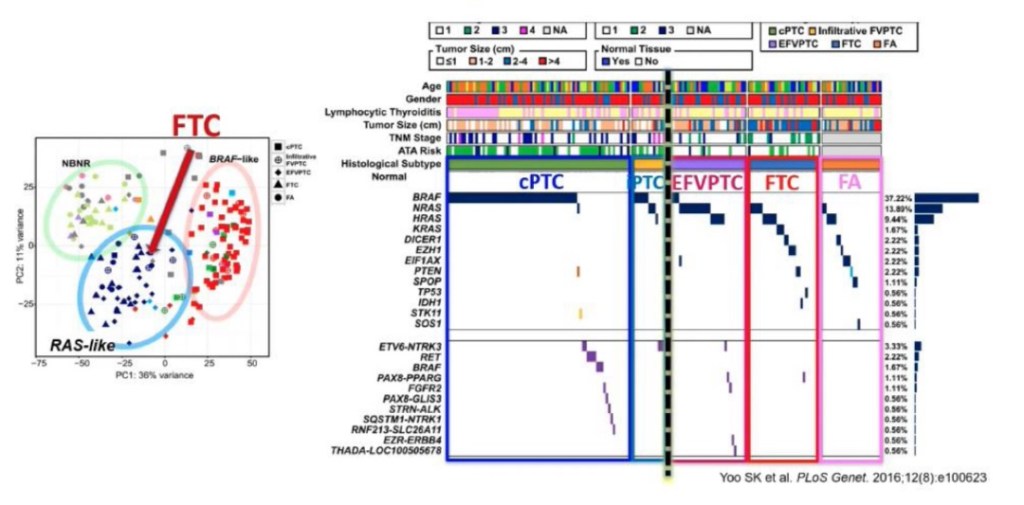
    • In follicular thyroid cancer (FTC), in addition to mutations of RAS:
      • Another common event is PAX8 / PPARG rearrangement
  • Thyroid cancer progression and dedifferentiation involves a number of additional mutations:
    • That affects the PI3K-AKT pathway and other cell signaling pathways

Clinical Presentation of Medullary Thyroid Carcinoma

  • Sporadic MTC (75% of all cases):Typically occurs between the fourth to sixth decade of life:However, patients with hereditary disease:Present earlier
    • Patients with MTC who present with a palpable thyroid nodule:70% will have cervical lymphadenopathy
      • 15% to 20% will have palpable cervical lymphadenopathy.
    • Pain or aching:Is also a common symptom of MTC
    • Local tumor invasion may produce symptoms of:Dysphagia, dyspnea, or dysphonia
    • Patients with extensive metastatic disease frequently develop:Diarrhea:Which may result from:Increased intestinal motility and impaired intestinal water and electrolyte flux:Due to high calcitonin levels
      • About 2% to 4% of patients develop:Cushing syndrome:As a result of ectopic production of ACTH
  • Classic MEN2A is the most common variant of MEN2 (95% of the cases):Most patients carry germline RET mutations in:Codons 609, 611, 618, or 620 of exon 10
      • Codon 634 of exon 11
    • Almost all patients develop MTC:But pheochromocytomas have the highest penetrance in patients with:Codon 634 mutations:52% by age 50
          • 88% by age 77
        • These adrenal tumors:Are almost always benign
          • Are usually multicentric
          • Are associated with diffuse adrenal nodular hyperplasia
      • HPT:Is usually mild and may involve one to four parathyroid glands.
        • RET codon 634 mutations:Are associated with a penetrance of up to 30% for PHPT, whereas it ranges from 2 to 12% for the remaining mutations.
  • Cutaneous lichen amyloidosis (CLA):Can occur sporadically or in an inherited manner:Either separately or in the context of MEN2A
    • The skin lesions of CLA in MEN2A:Are most apparent in the dermatomes corresponding to T2 to T6:Scapular region of the back
    • The classic symptom is:Itching:That worsens in times of stress
        • Improves with sun exposure
    • The lesions are incited by notalgia paresthetica:A sensory neuropathy of the dorsal spinal nerve:May occur prior to MTC
    • CLA is almost exclusively found in patients with:The codon 634 mutations (exon 11)
      • Although cases have also been reported in patients with:Codon 804 mutations
      • Pheochromocytomas and PHPT in CLA patients:Occur at frequencies similar to classic MEN2A
  • In patients with MEN2B:MTC often presents in infancy and is usually highly aggressive
    • Approximately 75% to 90% of MEN2B cases occur in patients:Having de novo RET mutations:Whereas 10% to 25% occur in families with:Known history of MEN2B
    • About 95% of MEN2B individuals:Have codon M918T mutations (exon 13) – Highest risk (HST)The remaining 5% have codon A883F mutations (exon 15) – High risk (H):The MTCs in codon A883F tend to be less aggressive
    • Pheochromocytomas develop in:About 50% of MEN2B patients
    • These individuals also have a typical appearance that includes:Eye abnormalities:Thickened and everted eyelids
        • Mild ptosis
        • Thickened corneal nerves
      • Marfanoid body habitus
      • Long narrow facies
      • Pes cavus
      • Pectus excavatum
      • High-arched palate
      • Scoliosis
      • Slipped capital femoral epiphyses
      • Mucosal neuromas
      • Diffuse ganglioneuromatosis of the aerodigestive tractLeading to bloating, intermittent constipation, diarrhea, and even intestinal obstruction
    • Some patients have atypical MEN2B:Which presents later in life:Around 20 to 30 years of age:These patients have double RET germline mutations:Occurring in tandem on the same allele:Usually V804M and either Y806C, S904C, E805K, or Q781R 


prof_739_20190417135234

  • Rodrigo Arrangoiz MS, MD, FACS:
    • Is a member of the American Head and Neck Society

img_4750

    • He is a member of the American Thyroid Association:

Unknown

Training:

• General surgery:

• Michigan State University:

• 2004 al 2010

• Surgical Oncology / Head and Neck Surgery / Endocrine Surgery:

• Fox Chase Cancer Center (Filadelfia):

• 2010 al 2012

• Masters in Science (Clinical research for health professionals):

• Drexel University (Filadelfia):

• 2010 al 2012

• Surgical Oncology / Head and Neck Surgery / Endocrine Surgery:

• IFHNOS / Memorial Sloan Kettering Cancer Center:

• 2014 al 2016

#Arrangoiz

#Teacher

#Surgeon

#Cirujano

#ThyroidExpert

#ThyroidSurgeon

#CirujanodeTiroides

#ExpertoenTiroides

#ExpertoenParatiroides

#Paratiroides

#Hiperparatiroidismo

#CancerdeTiroides

#ThyroidCancer

#PapillaryThyroidCancer

#SurgicalOncologist

#CirujanoOncologo

#CancerSurgeon

#CirujanodeCancer

#HeadandNeckSurgeon

#CirugiaEndocrina

#CirujanodeTumoresdeCabezayCuello

#OralCavityCancer

#Melanoma

Thyroid Neoplasms

  • The preponderance of thyroid neoplasms:
    • Originate from the thyroid epithelial follicular cells:
      • While 3% to 5% of neoplasms arise from the C cells or parafollicular cells
  • Differentiated thyroid cancer (DTC):
    • Which derives from these follicular cells, includes:
      • Papillary thyroid carcinoma (PTC)
      • Follicular thyroid carcinoma (FTC)
      • Oncocytic cell carcinoma (formerly known as Hürthle Cell Carcinoma / OCC)
      • Poorly differentiated carcinoma
        (insular carcinoma)
      • Anaplastic thyroid carcinoma (ACC / undifferentiated)
    • These thyroid tumors comprise the majority, more than 90% of the cases, of all thyroid neoplasms
    • Of all these subtypes, ATC is the rarest and is characterized by its extremely poor prognosis
    • Likewise, poorly differentiated carcinoma is
      characterized by its aggressive behavior and its unfavorable prognosis
  • Between the year 2010 and 2014:
    • 63,229 patients per year were diagnosed with thyroid cancer:
      • Of these 89.4% had PTC, 4.6% had FTC, 2.0% had OCC, 1.7% had medullary thyroid carcinoma (MTC), and 0.8% had ATC
  • A follicular adenoma:
    • Is a benign tumor (clonal neoplasm):
      • That may serve as a precursor lesion for some follicular carcinomas
  • Less-differentiated thyroid cancers, namely poorly differentiated carcinomas, and anaplastic carcinomas:
    • Can develop de novo:
      • Although many of them arise through the process of a stepwise dedifferentiation of papillary and follicular carcinomas (Figure)
  • Thyroid nodules:
    • Are a major health problem worldwide
  • Studies have shown that the prevalence of palpable thyroid nodules:
    • Is roughly 5% in women and 1% in men:
      • Living in parts of the world with sufficient iodine
  • In contrast, high-resolution ultrasound:
    • Can detect thyroid nodules in around 19% to 68% of randomly selected people:
      • With higher frequencies in women and the elderly
  • The clinical significance of thyroid nodules lies in the need to exclude thyroid cancer:
    • Which occurs anywhere between 7% and 15% of the cases:
      • Depending on age, gender, radiation exposure history, and family history
  • The discovery in 1953 of the double helix structure of deoxyribonucleic acid (DNA), by James Watson and Francis Crick:
    • Marked a milestone in the history of science and gave rise to modern molecular genetics that has
      rapidly advanced and has help to identify the driver mutations in in many cancers, including thyroid neoplasms:
      • RET / PTC, RAS, TP53, RET, TSHR, GNAS, PTEN, APC, TRK, CTNNB1, PAX8-PPARG, BRAF, AKAP9-BRAF, AKT1, TERT, ETVS-NTRK3, DICER1, EIFF1AX, STRN-ALK, MEN1, VCL-FGRF2, TGF-MET, THADA-IGF2BP3, MAP2K1, PAX8-GLIS3, PAX8-GLIS1 (Figure)
  • Analogous to other malignant neoplasms, the initiation and progression of thyroid cancer:
    • Occurs through steady accumulation of multiple genetic and epigenetic alterations, including:
      • Activating and inactivating somatic mutations
      • Alteration in gene expression patterns
      • MicroRNA (miRNA) dysregulation
      • Aberrant gene methylation

Medullary Thyroid Carcinoma Part 2

img_3549

  • Diagnosis:The diagnosis of medullary thyroid cancer (MTC):Is usually made after fine-needle aspiration (FNA) biopsy in a patient who has a solitary thyroid nodule (or a dominant nodule within a multinodular goiter):The sensitivity of FNA is 50% to 80%:Although higher sensitivity can be obtained by the addition of immunohistochemical staining for calcitoninIf the clinical suspicion for MTC is high:Patient with diarrhea, flushing, and a thyroid nodule):Calcitonin can be measured in the washout of the FNA biopsy needle:Although this may not be readily available in many commercial laboratoriesIn some cases:The diagnosis of MTC is made after thyroid lobectomy for a suspicious or indeterminate FNA biopsy:Surgical specimens from patients with MTC show:Spindle-shaped and frequently pleomorphic cells without follicle development:Because these cells originate from the calcitonin-producing parafollicular C cells of the thyroidThe use of serum calcitonin screening to complement ultrasound and FNA in the routine diagnosis of thyroid nodules is controversial in the United States:Measurement of serum calcitonin has not been a part of the routine evaluation of patients with thyroid nodules in the United States:The high frequency of falsely elevated serum calcitonin values, the inability to confirm the high calcitonin by pentagastrin stimulation in the United States, and the accuracy of FNA biopsy:Would argue against a change in this recommendation
          • Further, occasional patients with locoregional metastases or locally invasive MTC will have normal unstimulated serum calcitonin concentrations
          • In some countries (eg, European countries) where pentagastrin is available, however, serum basal and stimulated calcitonin levels are routinely used in the evaluation of thyroid nodules to facilitate the preoperative diagnosis of MTC

PastedGraphic-1

  • Differential Diagnosis:The differential diagnosis in a patient presenting with a neck mass:Is extensive and varies with the age of the patient at presentationThe majority of these masses represent benign thyroid nodules and cysts
      • Neck masses that are not of thyroidal origin may be from:Congenital:Vascular anomaly)Inflammatory:Lymph node enlargement)Other neoplastic:Primary or metastatic disease disorders
    • In addition to medullary thyroid cancer (MTC):Elevated calcitonin results may also be seen in patients with:Hypercalcemia
        • Hypergastrinemia
        • Neuroendocrine tumors
        • Renal insufficiency
        • Papillary and follicular thyroid carcinomas
        • Goiter
        • Chronic autoimmune thyroiditis
      • Prolonged treatment with:Omeprazole (greater than two to four months)Beta blockersGlucocorticoids:Has been associated with hypercalcitoninemia
      • In addition, the presence of heterophilic antibodies to calcitonin:Can falsely elevate serum calcitonin levels 
    • Elevated carcinoembryonic antigen (CEA) levels can also occur in patients with:Heterophilic antibodiesGastrointestinal tract inflammatory diseaseBenign lung diseaseNonthyroid malignanciesCigarette smoking
  • Evaluation:For patients diagnosed with medullary thyroid cancer (MTC) on the basis of cytologic evaluation of a thyroid nodule:Evaluation should include:Measurement of serum calcitonin, carcinoembryonic antigen (CEA), ultrasonography of the neck (if not already performed), genetic testing for germline RET mutations, and biochemical evaluation for coexisting tumors, especially pheochromocytoma. Serum calcitonin and CEA:The serum calcitonin and carcinoembryonic antigen (CEA) concentrations should be measured in patients diagnosed with MTC on the basis of cytologic evaluation of a thyroid nodule:
          • These tests can establish that the tumor is capable of hypersecreting the hormones and, if so, the values can be compared with postoperative values
        • Postoperatively:Results may provide a prognostic factor or indicate biochemical cure
      • In a study of 226 patients with MTC:Preoperative serum calcitonin concentrations:Where significantly correlated with tumor size in both the sporadic and familial casesIn addition, among 45 patients who had a preoperative serum calcitonin concentration of 50 pg/mL or less:44 had normal concentrations after surgery:In contrast, only 50 of 120 patients with preoperative serum calcitonin concentrations higher than 50 pg/mL had normal concentrations after surgery
      • In a second study of 224 patients with MTC:62% of patients without nodal metastases had normal calcitonin postoperatively:10% of node positive patients had normal postoperative calcitonin levels
      • Assessment of calcitonin and CEA doubling times postoperatively:Provides sensitive markers for progression and aggressiveness of metastatic MTC:Postoperative calcitonin doubling time was a prognostic factor for survival in a study of 65 patients followed for 3 to 30 years: Ten-year survival was: 8%, 37%, and 100% for doubling times:Under six months, between six months and 24 months, and greater than 24 months, respectively
    • Radiologic evaluation:MTC can spread by:Local invasion or metastasis:Within the neck or distantlyWhen MTC is diagnosed by fine-needle aspiration (FNA) biopsy:Ultrasonography of the neck is indicated to look for cervical lymph node involvementFor patients with local lymph node metastases on ultrasound or with preoperative serum basal calcitonin > 500 pg/mL (indicating high risk of local or distant metastatic disease):Additional imaging is required to assess for metastatic disease:In this setting, based con literature review I suggest cross-sectional imaging including:Chest computed tomography (CT)
            • Neck CT with IV contast
            • Three-phase contrast-enhanced liver CT or contrast-enhanced liver magnetic resonance imaging (MRI)
            • Axial MRI, and bone scintigraphy:In patients suspected of having skeletal metastases:MRI may be superior to other imaging modalities
        • I do not recommend 18-fluoro-2-deoxyglucose positron emission tomography (FDG-PET) imaging or somatostatin receptor imaging:For routine initial screening for metastatic disease:The sensitivity of FDG-PET scanning for detecting metastatic disease is variable:But improves with higher calcitonin levels:Sensitivity 78% versus 20% for basal calcitonin value greater than or less than 1000 pg/mL, respectively)
            • The use of radionuclide imaging with 111-In-octreotide or 99m-Tc-DMSA:Is not currently recommended for routine initial screening for metastatic disease:However, three patients have been described who had regional and distant metastases of MTC detected by somatostatin receptor scintigraphy but not by CT scan
                • How to select patients with a negative CT scan to undergo somatostatin receptor scintigraphy is not clear:Scanning may be more useful in localizing residual or recurrent disease after primary therapy
  • Genetic screening in sporadic MTC:Germline RET testing:In all patients with newly diagnosed C cell hyperplasia or apparently sporadic MTC:Initial germline testing in patients with C cell hyperplasia or apparently sporadic MTC should include:Sequencing of exons 10, 11, and 13 through 16 of the RET gene
          • Sequencing of the remaining exons in the RET gene should be considered in patients with:Clinical features or family history highly suggestive of hereditary medullary syndromes:Who demonstrate no mutations in exons 10, 11, or 13 through 16
          • While it is possible for clinicians to directly order genetic testing from reference laboratories:It is strongly encourage to have a consultation with genetic counselors who are familiar with both the ethical issues and legal informed consent requirements (which can vary significantly in different regions) that are involved in germline testing
    • When the index patient is positive for a germline mutation:Family members should be offered genetic counseling and genetic screening
    • An important question is what proportion of patients with apparently sporadic MTC have unsuspected germline mutations in the RET proto-oncogene (the underlying defect in MEN2) and, therefore, have heritable disease:Studies of unselected patients with MTC have found, on average:That approximately 6% to 7%  (range 1.5% to 24%) have germline RET mutationsIn one report:35 of 482 patients (7.3%) with apparently sporadic MTC had mutations, and in 18 of these 35:Gene carriers were identified in relatives
    • 75% of the familial medullary cases:Had no prior family history:A much higher percentage (approximately 60%) of patients with sporadic MTC have somatic (acquired) mutations in the RET gene within the tumor cells:These mutations are present only in the tumor cells and are not detected by standard genetic testing, ie, using leukocyte DNA
          • The presence of somatic RET mutations correlate with:Lymph node metastasesPersistent diseaseLower survivalHowever, in one study:Only mutations in exons 15 and 16 of the RET gene:Were associated with the worse prognosis:While those in other exons had a more indolent course
        • Since it is unclear how knowledge of a specific somatic (acquired) RET mutation should impact clinical management:I do not routinely test tumor samples
    • Testing for coexisting tumors:Most patients require biochemical evaluation for coexisting tumors (particularly pheochromocytoma and hyperparathyroidism) prior to thyroidectomy:Even when genetic screening is performed preoperatively:The results are rarely known prior to surgery.For patients with unknown RET mutational status and for patients who have a germline RET mutation:Serum calcium:To rule out hyperparathyroidism requiring concomitant surgical interventionPlasma fractionated metanephrines:As the initial screen for pheochromocytoma):Normal plasma fractionated metanephrines values:Exclude a symptomatic catecholamine-secreting neoplasm
            • Mildly elevated values of normetanephrine could be falsely positive:In which case additional evaluations including 24-hour urinary fractionated metanephrines, catecholamines, and adrenal imaging may be required to effectively rule in or rule out pheochromocytoma prior to surgery:Adrenal imaging should not be performed unless there is biochemical evidence suggesting a possible pheochromocytoma. (See 
    • In a patient with negative RET proto-oncogene testing and no family history of MEN2 syndrome:Biochemical testing for coexisting tumors is typically not required


cropped-18403652_10206829497335208_5004404657991480104_n1.jpg

  • What is Head and Neck Surgery?:
    • It is a surgical sub-specialty that deals mainly with benign and malignant tumors of the head and neck region, including:
      • The scalp, facial region, eyes, ears, nose, nasal fossae, paranasal sinuses, oral cavity, pharynx (nasopharynx, oropharynx, hypopharynx), larynx (supraglotic larynx, glottis larynx, subglotic larynx), thyroid gland, parathyroid gland, salivary glands (parotid glands, submandibular glands, sublingual glands, minor salivary glands), soft tissues of the neck, skin of the head and neck region.
        • The head and neck surgeon’s work area:Does not cover tumors or diseases of the brain and other areas of the central nervous system or those of the cervical spine:This is the neurosurgeon field.
    • Among the diagnostic procedures performed by the head and neck surgeon,  are the following:
      • Nasopharyngolaryngoscopy:
        • Performed to examine, evaluate and, possibly perform a biopsy, of oral cavity, pharyngeal and laryngeal lesions.
    • The surgeries most commonly performed by the head and neck surgeon are:
      • Total or near total thyroidectomies
      • Hemithryoidectomies (lobectomies)
      • Comprehensive neck dissections
      • Selective neck dissections
      • Maxillectomies:
        • Total maxillectomy
        • Subtotal maxillectomy
        • Infrastructure maxillectomy
        • Suprastructure maxillectomy
        • Medial maxillectomy
      • Mandibulectomy:
        • Segmental
        • Marginal
      • Tracheostomy
      • Salivary gland surgeries:
        • Parotid gland operations:
          • Limited superficial parotidectomy with identification and preservation of the facial nerve
          • Superficial parotidectomy with identification and preservation of the facial nerve
          • Near total parotidectomy with identification and preservation of the facial nerve
          • Total parotidectomy
        • Submandibular gland resection
        • Sublingual gland resection
      • Resection of tumors of the oral cavity:
        • Glossectomy
        • Resection of the floor of the mouth tumors
      • Resection of tumors of the pharynx
      • Resection of tumors of the larynx
      • Split-thickness skin grafts
      • Full-thickness skin grafts
      • Sentinel lymph node mapping and sentinel lymph node biopsy
      • Resection of malignant skin tumors (BCC, SCC, melanoma) of the head and neck region
  • The formation of the head and neck surgeon includes mastering the following subjects:
    • Surgical Anatomy
    • History and Basic Principles of Head and Neck Surgery
    • Epidemiology, Etiology, and Pathology of Head and Neck Diseases
    • Diagnostic Radiology of the Head and Neck Region
    • Tumors of the Scalp, Skin and Melanoma
    • Eyelids and Orbit
    • Nasal Cavity and Paranasal Sinuses
    • Skull Base and Temporal Bone
    • Lips and Oral Cavity
    • Pharynx and Esophagus
    • Larynx and Trachea
    • Cervical Lymph Nodes
    • Thyroid and Parathyroid Glands
    • Salivary Glands
    • Neurogenic Tumors and Paragangliomas
    • Soft Tissue Tumors
    • Bone Tumors and Odontogenic Lesions
    • Reconstructive Surgery
    • Oncologic Dentistry and Maxillofacial Prosthetics
    • Principles of Radiation Oncology
    • Principles of Chemotherapy
    • Molecular Oncology, Genomics and Immunology
    • Nutrition
    • Biostatistic


  • Rodrigo Arrangoiz MS, MD, FACS a head and neck surgeon / endocrine surgeon / surgical oncologist and is a member of Sociedad Quirúrgica S.C at the America British Cowdray Medical Center in Mexico City:


prof_739_20190417135234

  • Rodrigo Arrangoiz MS, MD, FACS:
    • Is a member of the American Head and Neck Society

img_4750

    • He is a member of the American Thyroid Association:

Unknown

Training:

• General surgery:

• Michigan State University:

• 2004 al 2010

• Surgical Oncology / Head and Neck Surgery / Endocrine Surgery:

• Fox Chase Cancer Center (Filadelfia):

• 2010 al 2012

• Masters in Science (Clinical research for health professionals):

• Drexel University (Filadelfia):

• 2010 al 2012

• Surgical Oncology / Head and Neck Surgery / Endocrine Surgery:

• IFHNOS / Memorial Sloan Kettering Cancer Center:

• 2014 al 2016

#Arrangoiz

#Teacher

#Surgeon

#Cirujano

#ThyroidExpert

#ThyroidSurgeon

#CirujanodeTiroides

#ExpertoenTiroides

#ExpertoenParatiroides

#Paratiroides

#Hiperparatiroidismo

#CancerdeTiroides

#ThyroidCancer

#PapillaryThyroidCancer

#SurgicalOncologist

#CirujanoOncologo

#CancerSurgeon

#CirujanodeCancer

#HeadandNeckSurgeon

#CirugiaEndocrina

#CirujanodeTumoresdeCabezayCuello

#OralCavityCancer

#Melanoma

Medullary Thyroid Carcinoma (MTC)

  • Medullary thyroid carcinoma (MTC) arises from:
    • The neuroendocrine parafollicular C cells or C cells of the thyroid gland
  • Sporadic MTC accounts for about 75% to 80% of all cases of the disease:
    • The remaining cases – 20% to 25% consist of inherited tumor syndromes, such as:
      • MEN type 2A (MEN2A):
        • Which is the most common type
      • MEN2B
      • Familial MTC:
        • Is now viewed as a variant of MEN2A
  • Sporadic disease:
    • Typically presents in the fifth or sixth decade of life
  • Inherited forms of the disease:
    • Tend to present at earlier ages
  • The 5-year relative survival for:
    • Stages I to III:
      • 93%
    • Stage IV:
      • 28%
  • Because the C cells are predominantly located in the upper portion of each thyroid lobe:
    • Patients with sporadic disease typically present with:
      • Upper pole nodules
  • Metastatic cervical adenopathy:
    • Appears in about 50% (50% to 70%) of patients at initial presentation
  • Symptoms of upper aerodigestive tract compression or invasion:
    • Are reported by up to 15% of patients with sporadic disease
  • Distant metastases:
    • In the lungs or bones cause symptoms:
      • In 5% to 10% of patients
  • Many patients with advanced MTC can have:
    • Diarrhea, Cushing syndrome, or facial flushing:
      • Because the tumor can secrete calcitonin and sometimes other hormonally active peptides (ie, adrenocorticotropic hormone [ACTH], calcitonin gene-related peptide [CGRP]):
        • Treatment with somatostatin analogs (eg, octreotide, lanreotide) may be useful in patients with these symptoms
  • Patients with unresectable or metastatic disease:
    • May have either slowly progressive or rapidly progressive disease
  • Nodule Evaluation and Diagnosis Patients with MTC:
    • Can be identified by using:
      • Pathologic diagnosis or by prospective genetic screening
    • Sporadic MTC:
      • Is usually suspected after FNA of a solitary nodule
      • Reports suggest that about:
        • 3% of patients with nodular thyroid disease:
          • Will have an increased serum calcitonin level when measured by a sensitive immunometric assay:
            • 40% of these patients will have MTC at thyroidectomy
        • However, routine measurement of the basal serum calcitonin concentration is not recommended by the NCCN Panel for evaluating a patient with nodular thyroid disease because of:
          • The expense of screening all thyroid nodules and only finding a few cases of MTC
          • The lack of confirmatory pentagastrin stimulation testing
          • The resulting need for thyroidectomy in some patients who have benign thyroid disease
        • The ATA is:
          • Equivocal about routine calcitonin measurement
    • Inherited MTC:
      • For patients in known kindreds with inherited MTC:
        • Prospective family screening with testing for mutant RET genes:
          • Can identify disease carriers long before clinical symptoms or signs are noted
      • The traditional approach of stimulating secretion of calcitonin:
        • By either pentagastrin or calcium infusion to identify patients with MTC:
          • Is no longer recommended:
            • Because elevated calcitonin is not a specific or adequately sensitive marker for MTC and because pentagastrin is no longer available in the United States
      • When MEN2A is suspected, the NCCN Guidelines recommend measurement of:
        • Calcium levels with (or without) serum intact parathyroid hormone levels
      • Compared with sporadic disease, the typical age of presentation for familial disease:
        • Is the third or fourth decade of life, without gender preference
      • In patients with MEN2A:
        • Signs or symptoms of hyperparathyroidism or pheochromocytoma rarely present before those of MTC, even in the absence of screening
    • All familial forms of MTC and MEN2 are:
      • Inherited in an autosomal-dominant fashion
      • Mutations in the RET proto-oncogene:
        • Are found in at least 95% of kindreds with MEN2A and 88% of cases of familial MTC
      • The RET proto-oncogene codes for:
        • A cell membrane-associated tyrosine kinase receptor for a glial, cell line-derived neurotrophic factor
      • Mutations associated with MEN2A and familial MTC:
        • Have been primarily identified in several codons of the cysteine-rich extracellular domains of:
          • Exons 10, 11, and 13
      • MEN2B and some familial MTC mutations are found within the:
        • Intracellular exons 14 to 16
      • Somatic mutations in exons 11, 13, and 16 have also been found:
        • In at least 25% of sporadic MTC tumors:
          • Particularly the codon 918 mutation:
            • That activates the tyrosine kinase function of the receptor and are associated with poorer prognosis of the patient
      • About 6% of patients with clinically sporadic MTC:
        • Carry a germline mutation in RET:
          • Leading to identification of new kindreds with multiple (previously undiagnosed) affected individuals
    • Germline testing for RET proto-oncogene mutations with genetic counseling by a physician or genetic counselor:
      • Is recommended for all patients with newly diagnosed clinically apparent sporadic MTC:
        • If a germline RET mutation is found:
          • Then mutation testing should also be done for family members
    • MTC can involve difficult ethical decisions for clinicians:
      • If parents or guardians refuse screening and /or treatment for children with possible MTC
  • The generally accepted preoperative workup includes:
    • Measurement of serum markers:
      • Basal serum calcitonin and serum carcinoembryonic antigen [CEA]
    • Screening of patients with germline RET proto-oncogene mutations for:
      • Pheochromocytoma (MEN2A and MEN2B):
        • Before surgery for MTC:
          • It is important to diagnose and address coexisting pheochromocytoma, to avoid hypertensive crisis during surgery:
            • Pheochromocytoma can be removed using laparoscopic adrenalectomy
      • Hyperparathyroidism (MEN2A)
    • Preoperative thyroid and neck ultrasound (including central and lateral neck compartments) is recommended
    • Contrast-enhanced CT of neck / chest and liver MRI or 3-phase CT of liver can be considered as clinically indicated:
      • Such as in cases of:
        • High burden of disease
        • Calcitonin greater than 400 pg/mL
        • Elevated CEA levels
      • Distant metastasis:
        • Does not contraindicate surgery
      • Liver imaging is rarely needed:
        • If the calcitonin is less than 400 pg/mL
    • Evaluation of vocal cord mobility can also be considered:
      • For patients with:
        • Abnormal voice, surgical history involving the recurrent laryngeal or vagus nerves, invasive disease, or bulky disease of the central neck
  • Staging:
    • The NCCN Guidelines for Thyroid Carcinoma:
      • Do not use TNM stages to guide therapy:
        • Instead, many characteristics of the tumor and patient play important roles in these NCCN Guidelines:
          • Many specialists in thyroid cancer also follow this paradigm
      • The TNM criteria for clinicopathologic tumor staging are based on:
        • Tumor size
        • The presence or absence of extrathyroidal invasion
        • Locoregional nodal metastases
        • Distant metastases
      • The 8th edition of the AJCC Cancer Staging Manual separated MTC into its own stand-alone chapter:
        • However, the TNM staging classification lacks other important prognostic factors:
          • Notably absent is the age at diagnosis:
            • Patients younger than 40 years at diagnosis have a:
              • 5- and 10-year disease-specific survival rate of about 95% and 75%, respectively, compared with 65% and 50% for those older than 40 years
            • Controlling for the effect of age at diagnosis:
              • The prognosis of patients with inherited disease (who typically are diagnosed at an earlier age):
                • Is probably similar to those with sporadic disease
          • Despite an even younger typical age at diagnosis, however:
            • Patients with MEN2B who have MTC:
              • Are more likely than those with MEN2A (or familial MTC) to have:
                • Locally aggressive disease
      • Other factors that may be important for predicting a worse prognosis include:
        • The heterogeneity and paucity of calcitonin immunostaining of the tumor
        • A rapidly increasing CEA level:
          • Particularly in the setting of a stable calcitonin level
        • Postoperative residual hypercalcitoninemia
    • A study comparing different staging systems found that a system incorporating:
      • Age, gender, and distant metastases (EORTC):
        • Had the greatest predictive value:
          • However, the AJCC staging system was deemed to be the most appropriate
    • Codon analysis:
      • Is useful for predicting prognosis
      • Presence of an exon 16 mutation:
        • Either within a sporadic tumor or associated with MEN2B:
          • Is associated with more aggressive disease
        • More than 95% of patients with MEN2B:
          • Have a mutation in exon 16 (codon 918)
        • Whereas 2% to 3% have a mutation in:
          • Exon 15 (codon 883)
  • Surgical Management:
    • Surgery is the main treatment for MTC
    • While no curative systemic therapy for MTC is available:
      • Vandetanib and cabozantinib are recommended for:
        • Locally advanced and metastatic MTC
    • MTC cells do not concentrate RAI:
      • Therefore, iodine-131 imaging cannot be used, and RAI treatment is not effective in these patients
    • MTC does not respond well to conventional cytotoxic chemotherapy
    • Postoperative levothyroxine is indicated for all patients:
      • However, TSH suppression is not appropriate:
        • Because C cells lack TSH receptors:
          • Thus, TSH should be kept in the normal range by adjusting the levothyroxine dose
    • Patients should be assessed for hyperparathyroidism and pheochromocytoma preoperatively:
      • Even in patients who have apparently sporadic disease:
        • Because the possibility of MEN2 should dictate testing for a germline RET proto-oncogene mutation for all patients with MTC
      • Pheochromocytomas should be removed (eg, laparoscopic adrenalectomy) before surgery on the thyroid:
        • To avoid hypertensive crisis during surgery
      • Patients with pheochromocytomas must be treated preoperatively with:
        • Alpha-adrenergic blockade (phenoxybenzamine) or with alpha-methyltyrosine:
          • To avoid a hypertensive crisis during surgery
        • Forced hydration and alpha-blockade:
          • Are necessary to prevent hypotension after the tumor is removed
        • After institution of alpha-blockade and hydration:
          • Beta-adrenergic blockade may be necessary to treat tachyarrhythmia
    • Total thyroidectomy and bilateral central neck dissection (level VI):
      • Are indicated in all patients with MTC:
        • Whose tumor is 1 cm or larger
        • Who have bilateral thyroid disease
    • Total thyroidectomy is recommended and neck dissection can be considered for:
      • Those whose tumor is smaller than 1 cm
      • For unilateral thyroid disease
    • Given the risks of thyroidectomy in very young children:
      • Referral to a surgeon and team with experience in pediatric thyroid surgery is advised
    • If a patient with inherited disease is diagnosed early enough:
      • The recommendation is to perform a prophylactic total thyroidectomy:
        • By age 5 years or
        • When the mutation is identified (in older patients), especially in patients with:
          • Codon 609, 611, 618, 620, 630, or 634 RET mutations:
            • Note that C634 mutations:
              • Are the most common mutations
      • Total thyroidectomy is recommended in:
        • The first year of life or at diagnosis for patients with:
          • MEN2B who have codon 883 RET mutations, 918 RET mutations, or compound heterozygous (V804M + E805K, V804M + Y806C, or V804M + S904C) RET mutations:
            • Because these RET mutations carry the highest risk for MTC
      • However, for patients with codon 768, 790, 791, 804, and 891 RET (risk level A) mutations:
        • The lethality of MTC may be lower than with other RET mutations:
          • In patients with these less high-risk (ie, lower-risk level A) RET mutations:
            • Annual basal calcitonin testing and annual ultrasound are recommended
            • Total thyroidectomy and central node dissection may be deferred:
              • If these tests are normal
              • There is no family history of aggressive MTC
              • The family agrees to defer surgery
          • Delaying thyroidectomy may also be appropriate for children with lower-risk mutations (ie, level A):
            • Because of the late onset of MTC development
      • A study found no evidence of persistent or recurrent MTC 5 years or more after prophylactic total thyroidectomy;
        • In young patients with RET mutations for MEN2A:
          • Longer follow-up is necessary to determine if these patients are cured
    • Variations in surgical strategy for MTC depend on:
      • The risk for locoregional node metastases and on
      • Whether simultaneous parathyroid resection for hyperparathyroidism is necessary
    • A bilateral central neck dissection (level VI):
      • Can be considered for all patients with MEN2B
    • For those patients with MEN2A who undergo prophylactic thyroidectomy:
      • Therapeutic ipsilateral or bilateral central neck dissection (level VI) is recommended:
        • If patients have an increased calcitonin or CEA test or
        • If ultrasound shows a thyroid or nodal abnormality
    • Similarly, more extensive lymph node dissection (levels II–V) is considered for:
      • These patients with primary tumor(s) 1 cm or larger in diameter (> 0.5 cm for patients with MEN2B) or for patients with central compartment lymph node metastases
    • With a concurrent diagnosis of hyperparathyroidism in MEN2A or familial MTC:
      • The surgeon should leave or autotransplant the equivalent mass of one normal parathyroid gland if multiglandular hyperplasia is present
      • Cryopreservation of resected parathyroid tissue should be considered to allow future implantation in the event of iatrogenic hypoparathyroidism
    • Disfiguring radical node dissections:
      • Do not improve prognosis and are not indicated
      • In the presence of grossly invasive disease:
        • More extended procedures with resection of involved neck structures may be appropriate:
          • Function-preserving approaches are preferred
  • In some patients, MTC is diagnosed after thyroid surgery:
    • In these patients, additional workup is recommended:
      • To ascertain whether they have RET proto-oncogene mutations (eg, exons 10, 11, 13–16):
        • Which will determine whether they need additional surgery (eg, completion thyroidectomy and/or neck dissection)
  • Adjuvant RT EBRT and IMRT:
    • Have not been adequately studied as adjuvant therapy in MTC:
    • Slight improvements in local disease-free survival have been reported after EBRT for selected patients:
      • Such as those with:
        • Extrathyroidal invasion or
        • Extensive locoregional node involvement
      • However, most centers do not have extensive experience with adjuvant EBRT or IMRT for this disease
    • While therapeutic EBRT or IMRT may be considered for grossly incomplete resection:
      • When additional attempts at surgical resection have been ruled out:
        • Adjuvant EBRT or IMRT is rarely recommended
    • EBRT or IMRT can also be given to palliate painful or progressing bone metastases
  • Persistently Increased Calcitonin:
    • Basal serum concentrations of calcitonin and CEA:
      • Should be measured 2 or 3 months postoperatively
    • About 80% of patients with palpable MTC and 50% of those with nonpalpable but macroscopic MTC:
      • Who undergo supposedly curative resection:
        • Have serum calcitonin values indicative of residual disease:
          • Those patients with residual disease may benefit from further evaluation to detect either residual resectable disease in the neck or the presence of distant metastases
    • Patients with detectable basal calcitonin or elevated CEA:
      • Who have negative imaging and who are asymptomatic:
        • May be followed
    • Patients with a basal serum calcitonin value greater than 1000 pg/mL and with no obvious MTC in the neck and upper mediastinum:
      • Probably have distant metastases:
        • Most likely in the liver
    • However, occasionally patients have relatively low serum CEA and calcitonin levels:
      • But have extensive metastatic disease:
        • Initial postoperative imaging is therefore reasonable despite the absence of very high serum markers
    • The prognosis for patients with postoperative hypercalcitoninemia:
      • Depends primarily on:
        • The extent of disease at the time of initial surgery
      • In a study of 31 patients (10 patients with apparently sporadic disease, 15 patients with MEN2A, and 6 patients with MEN2B):
        • The 5- and 10-year survival rates were 90% and 86%, respectively
        • Two studies have reported higher mortality rates for patients with high postoperative serum calcitonin values:
          • With more than 50% of patients having a recurrence during a mean follow-up of 10 years
        • Routine lymphadenectomy or excision of palpable tumor:
          • Generally fails to normalize the serum calcitonin concentrations in such patients:
            • Therefore, some have focused on detection and eradication of microscopic tumor deposits with a curative intent in patients without distant metastases
        • Extensive dissection to remove all nodal and perinodal tissue from the neck and upper mediastinum:
          • Was first reported to normalize the serum calcitonin levels in 4 of 11 patients at least 2 years postoperatively
        • In subsequent larger studies, 20% to 40% of patients undergoing microdissection of the central and bilateral neck compartments:
          • Were biochemically cured, with minimal perioperative morbidity
      • When repeat surgery is planned for curative intent:
        • Preoperative assessment should include locoregional imaging (ie, ultrasonography of the neck and upper mediastinum) and attempts to exclude patients with distant metastases, which may include:
          • Contrast-enhanced CT or MRI of the neck, chest, and abdomen
  • Postoperative Management and Surveillance:
    • Calcitonin is very useful for surveillance:
      • Because this hormone is only produced in the parafollicular cells
    • Thus, measurements of serum calcitonin and CEA levels:
      • Are the cornerstone of postoperative assessment for residual disease
    • For patients with a detectable basal calcitonin or elevated CEA level:
      • Neck ultrasound is recommended
    • Patients with undetectable calcitonin levels and normal CEA levels:
      • Can subsequently be followed with annual measurements of serum markers
    • Additional studies or more frequent testing:
      • Can be done for those with significantly rising calcitonin or CEA
    • Nonetheless, the likelihood of significant residual disease is very low in patients with an undetectable basal calcitonin level in a sensitive assay
    • If the patient has MEN2:
      • Annual screening for pheochromocytoma (MEN2B or MEN2A) and hyperparathyroidism (MEN2A):
        • Should also be performed
    • For some low-risk RET mutations:
      • Examples:
        • Codons 768, 790, 804, or 891:
          • Less frequent screening may be appropriate
    • Patients with detectable serum markers:
      • Calcitonin levels ≥ 150 pg/mL:
        • Should have CT of the neck, chest, and liver
        • Bone scan and MRI of axial skeleton:
          • Should be considered in select patients such as those with very elevated calcitonin levels
    • The NCCN Panel recognizes that many different imaging modalities may be used to examine for residual or metastatic tumor:
      • But there is insufficient evidence to recommend any particular choice or combination of tests
    • For patients with asymptomatic disease and detectable markers in whom imaging fails to identify foci of disease:
      • The NCCN Panel recommends conservative surveillance:
        • With repeat measurement of the serum markers every 6 to 12 months
      • Additional imaging studies (eg, FDG PET/CT, Ga68 DOTATATE, or MRI with contrast of the neck, chest, and abdomen with liver protocol):
        • May be indicated depending on calcitonin / CEA doubling time
    • For patients who are asymptomatic with abnormal markers and repeated negative imaging:
      • Continued disease monitoring or consideration of cervical reoperation is recommended if primary surgery was incomplete
    • For the patient with increasing serum markers:
      • More frequent imaging may be considered
    • Outside of clinical trials:
      • No therapeutic intervention is recommended on the basis of abnormal markers alone

#Arrangoiz #ThyroidSurgeon #ThyroidExpert #MedullaryThyroidCarcinoma #MTC #HeadandNeckSurgeon #CancerSurgeon #Miami #MountSinaiMedicalCenter

Medullary Thyroid Cancer (MTC)

  • Introduction:Medullary thyroid cancer (MTC):Is a neuroendocrine tumor of the parafollicular or C cells of the thyroid gland:MTC accounts for:Approximately 1% to 2% of all thyroid cancers in the United States:
        • The production of calcitonin:Is a characteristic feature of this tumor
      • Most medullary thyroid carcinomas:Are sporadic (75% to 80%):However:Approximately 20% to 25%  are familial:As part of the multiple endocrine neoplasia type 2 (MEN2) syndrome

img_2748

  • Clinical Presentation:Sporadic MTC:Sporadic medullary thyroid cancer (MTC):Accounts for approximately 75% of all cases of the disease:The typical age of presentation:Is in the fourth and sixth decades of lifeSymptoms and signs:The most common presentation of sporadic MTC:Is that of a solitary thyroid nodule:Which occurs in 75% to 95% percent of patientsThe C cells or parafoliccular cells are predominantly located in the upper portion of each thyroid lobe:Thus:Most tumors are located in this region
      • In most patients with MTC:The disease has already metastasized at the time of diagnosis:Approximately 70% of patients have clinically detectable cervical lymph node involvementUp to 15% of patients with MTC:Have symptoms of upper aerodigestive tract compression or invasion:Such as dysphagia or hoarseness
        • Approximately 5% to 10%:Have distant metastatic disease:Distant metastases may occur in the:Liver, lung, bones, and, less often, brain and skin
            • Nodal metastases:Are more common in patients with multifocal disease:However, as calcitonin screening results in the identification of more “micro” medullary cancers:The number of patients with metastases at presentation appears to be decreasing
                • Calcitonin screening for MTC in patients with thyroid nodules is controversial
    • Systemic symptoms may occur due to hormonal secretion by the tumor:Tumor secretion of calcitonin, calcitonin gene-related peptide, or other substance:Can cause diarrhea or facial flushing in patients with advanced diseaseIn addition, occasional tumors secrete corticotropin (ACTH):Causing ectopic Cushing’s syndrome
  • Biochemical tests:Basal serum calcitonin concentrations:Usually correlate with tumor mass but also reflect tumor differentiation, and they are almost always high in patients with a palpable tumorMost MTCs also secrete carcinoembryonic antigen (CEA):Which, like calcitonin, can be used as a tumor markerIn addition, the expression of CEA on MTC cells has led to the use of anti-CEA antibodies for immunotherapy
    • Thyroid function tests are normal in patients with MTC
  • Imaging:There are several ultrasound features of thyroid nodules (eg, hypoechoic, microcalcifications) that are associated with thyroid cancer risk:However, there are no ultrasound features that are pathognomonic for thyroid cancer.
      • Furthermore, the majority of studies evaluating suspicious ultrasound characteristics of nodules focused on papillary thyroid cancer
      • In a small retrospective study examining the ultrasound characteristic of nodules that were histologically proven to be MTC and papillary thyroid cancer50% of MTCs were solid and hypoechoic16% showed microcalcificationsCompared with 69.2% and 69.2%:Respectively, for papillary thyroid cancers The presence of at least one suspicious ultrasound feature was almost equal in patients with MTC (58.3%) and controls with benign nodules (55.5%), whereas it was significantly more frequent in patients with papillary thyroid cancer (100%)
      • In other seriesHypoechogenicity was present in 50% to 89% and microcalcifications in 30% to 70%:There was no difference in echogenicity or the presence or type of calcifications between MTC and papillary thyroid cancer . Large areas of calcification (macrocalcification) were noted in 16% to 30%:Rarely:The diagnosis of MTC is suggested by the presence of dense calcifications seen on radiographs or imaging of the anterior neck.
  • Inherited MTC:Multiple endocrine neoplasia type 2 (MEN2):Is subclassified into two distinct syndromes (MEN2A and MEN2B):Each of which is transmitted in an autosomal dominant fashion and is associated with MTC
      • These syndromes result from:Different mutations in the RET proto-oncogene
      • In the past:Familial MTC (FMTC):An inherited syndrome characterized by the presence of only MTC without hyperparathyroidism or pheochromocytoma:Was considered a separate entity but is now considered a variant of MEN2A
    • Hereditary MTC is:Typically bilateral and multicentric:Classical MEN2A is associated with: MTC
          • Pheochromocytoma
          • Primary parathyroid hyperplasiaWhile the penetrance of MTC is nearly 100%:There is inter- and intrafamily variability in the specific pattern of the other disease manifestations
      • MEN2B shares the inherited predisposition to MTC and pheochromocytoma present in classical MEN2A:But does not include hyperparathyroidismMTC occurs in almost all patients
        • The tumor develops at:An earlier age and may be more aggressive than in MEN2A
        • Patients typically have:marfanoid habitus (but do not have Marfan syndrome),Mucosal neuromas
          • Intestinal ganglioneuromatosis
      • In the index case:The clinical presentation and manifestations of MEN2-associated MTC are similar to those of sporadic MTC:The most common presentation is that of:;solitary thyroid nodule or cervical lymphadenopathyEarly diagnosis (prior to any clinical manifestations) by screening of “at-risk” family members in MEN2 kindreds is important because MTC is a life-threatening disease that can be cured or prevented by early thyroidectomy

cropped-18403652_10206829497335208_5004404657991480104_n1.jpg

  • What is Head and Neck Surgery?:
    • It is a surgical sub-specialty that deals mainly with benign and malignant tumors of the head and neck region, including:
      • The scalp, facial region, eyes, ears, nose, nasal fossae, paranasal sinuses, oral cavity, pharynx (nasopharynx, oropharynx, hypopharynx), larynx (supraglotic larynx, glottis larynx, subglotic larynx), thyroid gland, parathyroid gland, salivary glands (parotid glands, submandibular glands, sublingual glands, minor salivary glands), soft tissues of the neck, skin of the head and neck region.
        • The head and neck surgeon’s work area:Does not cover tumors or diseases of the brain and other areas of the central nervous system or those of the cervical spine:This is the neurosurgeon field.
    • Among the diagnostic procedures performed by the head and neck surgeon,  are the following:
      • Nasopharyngolaryngoscopy:
        • Performed to examine, evaluate and, possibly perform a biopsy, of oral cavity, pharyngeal and laryngeal lesions.
    • The surgeries most commonly performed by the head and neck surgeon are:
      • Total or near total thyroidectomies
      • Hemithryoidectomies (lobectomies)
      • Comprehensive neck dissections
      • Selective neck dissections
      • Maxillectomies:
        • Total maxillectomy
        • Subtotal maxillectomy
        • Infrastructure maxillectomy
        • Suprastructure maxillectomy
        • Medial maxillectomy
      • Mandibulectomy:
        • Segmental
        • Marginal
      • Tracheostomy
      • Salivary gland surgeries:
        • Parotid gland operations:
          • Limited superficial parotidectomy with identification and preservation of the facial nerve
          • Superficial parotidectomy with identification and preservation of the facial nerve
          • Near total parotidectomy with identification and preservation of the facial nerve
          • Total parotidectomy
        • Submandibular gland resection
        • Sublingual gland resection
      • Resection of tumors of the oral cavity:
        • Glossectomy
        • Resection of the floor of the mouth tumors
      • Resection of tumors of the pharynx
      • Resection of tumors of the larynx
      • Split-thickness skin grafts
      • Full-thickness skin grafts
      • Sentinel lymph node mapping and sentinel lymph node biopsy
      • Resection of malignant skin tumors (BCC, SCC, melanoma) of the head and neck region
  • The formation of the head and neck surgeon includes mastering the following subjects:
    • Surgical Anatomy
    • History and Basic Principles of Head and Neck Surgery
    • Epidemiology, Etiology, and Pathology of Head and Neck Diseases
    • Diagnostic Radiology of the Head and Neck Region
    • Tumors of the Scalp, Skin and Melanoma
    • Eyelids and Orbit
    • Nasal Cavity and Paranasal Sinuses
    • Skull Base and Temporal Bone
    • Lips and Oral Cavity
    • Pharynx and Esophagus
    • Larynx and Trachea
    • Cervical Lymph Nodes
    • Thyroid and Parathyroid Glands
    • Salivary Glands
    • Neurogenic Tumors and Paragangliomas
    • Soft Tissue Tumors
    • Bone Tumors and Odontogenic Lesions
    • Reconstructive Surgery
    • Oncologic Dentistry and Maxillofacial Prosthetics
    • Principles of Radiation Oncology
    • Principles of Chemotherapy
    • Molecular Oncology, Genomics and Immunology
    • Nutrition
    • Biostatistic


  • Rodrigo Arrangoiz MS, MD, FACS a head and neck surgeon / endocrine surgeon / surgical oncologist and is a member of Sociedad Quirúrgica S.C at the America British Cowdray Medical Center in Mexico City:


prof_739_20190417135234

  • Rodrigo Arrangoiz MS, MD, FACS:
    • Is a member of the American Head and Neck Society

img_4750

    • He is a member of the American Thyroid Association:

Unknown

Training:

• General surgery:

• Michigan State University:

• 2004 al 2010

• Surgical Oncology / Head and Neck Surgery / Endocrine Surgery:

• Fox Chase Cancer Center (Filadelfia):

• 2010 al 2012

• Masters in Science (Clinical research for health professionals):

• Drexel University (Filadelfia):

• 2010 al 2012

• Surgical Oncology / Head and Neck Surgery / Endocrine Surgery:

• IFHNOS / Memorial Sloan Kettering Cancer Center:

• 2014 al 2016

#Arrangoiz

#Teacher

#Surgeon

#Cirujano

#ThyroidExpert

#ThyroidSurgeon

#CirujanodeTiroides

#ExpertoenTiroides

#ExpertoenParatiroides

#Paratiroides

#Hiperparatiroidismo

#CancerdeTiroides

#ThyroidCancer

#PapillaryThyroidCancer

#SurgicalOncologist

#CirujanoOncologo

#CancerSurgeon

#CirujanodeCancer

#HeadandNeckSurgeon

#CirugiaEndocrina

#CirujanodeTumoresdeCabezayCuello

#OralCavityCancer

#Melanoma

Diagnostic Value of Preoperative Serum Calcitonin Levels in Medullary Thyroid Carcinoma

  • Clin Thyroidol 2022;34:85–88.
  • Background:
    • Thyroid cancers represent approximately 1% of all new cancer diagnoses each year
    • Thyroid cancers are divided into:
      • Papillary carcinomas, follicular carcinomas, medullary thyroid carcinomas (MTCs), anaplastic carcinomas, primary thyroid lymphomas, and primary thyroid sarcomas
    • In the United States, MTCs represent 1% to 2% of all thyroid malignancies, with a slight preponderance in women
    • MTC originates from parafollicular calcitonin-producing cells (C- cells)
    • Approximately 75% to 80% of cases are sporadic:
      • While hereditary forms such as multiple endocrine neoplasia (MEN) type 2A or 2B account for almost 20% to 25% of cases
    • The 10-year survival rates of MTC are estimated at 81% to 89%
    • Calcitonin is a specific tumor marker for MTC:
      • Although the routine use of serum calcitonin measurements for the preoperative assessment of thyroid nodules is still controversial, according to current guidelines
    • The aim of this study was to assess serum calcitonin cutoff levels in patients undergoing surgery for benign and malignant thyroid disease in Germany and Austria
    • A second goal was to assess the potential correlations between serum calcitonin levels and size of the resected MTCs, the presences of lymph node metastases, and the time to biochemical normalization
  • Methods:
    • The cohort was obtained from the German DGAV/StuDoQ registry, which is a prospective, multi-center database that includes data on the surgical treatment of benign and malignant thyroid disease, as well as hyperparathyroidism
    • All patients with thyroid surgery documented in the registry between March 2017 and September 2020 were included
    • Data regarding subject demographics, preoperative and postoperative serum calcitonin levels, the diagnosis of C-cell hyperplasia or MTC, surgical procedures, histopathology, and biochemical cure rates were recorded
    • C-cell hyperplasia was defined as the presence of > 50 microscopically calcitonin-positive cells in at least one low-power field and considered to be a benign thyroid pathology
    • Biochemical recovery of MTC was defined by serum calcitonin levels below 10 pg/ml postoperatively (timepoint unspecified)
    • The study also assessed sex-specific calcitonin cutoff levels
    • The tumor size and the presence of lymph node metastases predicting biochemical recovery of calcitonin levels were analyzed by univariate and multivariate logistic regression
  • Results:
    • Total thyroidectomy was performed in 93% of the patients
    • MTC was diagnosed in 1.2%, and the mean (±SD) tumor diameter was 14.7±12.43 mm (range, 1–80)
    • Histopathology of MTCs revealed that 173 ± 48.4% were pT1a, 100±28.0% pT1b, 65±18.2% pT2, 17±4.8% pT3, and 2±0.6% pT4
    • Preoperative calcitonin screening was available in 92.4% of the data set
    • Of the 29,054 patients without C-cell hyperplasia or MTC:
      • The median preoperative calcitonin level was 2.0 pg/ml, and calcitonin levels were marginally higher in those with coexisting renal hyperparathyroidism than in those without
    • In the 206 patients with C-cell hyperplasia:
      • The median calcitonin level was 16.1 pg/ml (range, 1–183.3)
    • There were 330 patients with MTC:
      • In whom the median calcitonin level was 168.0 pg/ml, with men having higher calcitonin levels than women
      • Both female and male patients with C-cell hyperplasia or MTC:
        • Demonstrated significantly higher calcitonin levels than those with benign thyroid disease
    • Using receiver operating characteristic (ROC) analysis:
      • The serum calcitonin thresholds for predicting MTC were 7.9 pg/ml in women and 15 pg/ml in men (P<0.001)
      • The tumor size of MTC was positively correlated with median calcitonin levels:
        • Tumor diameters of 6 to 10 mm had a median calcitonin level of 81 pg/ml (range, 10.6–2000), tumors with diameters between 3 and 5 mm 31 pg/ml (range, 1–5890), and tumors smaller than 3 mm 13 pg/ml (range, 0-187.8)
      • Single lymph node metastases were detected at a median calcitonin level of 256 pg/ml (range, 23–2740), which increased to 3012 pg/ml (range, 825–4410) in patients with more than 21 metastatic lymph nodes
      • The median calcitonin level in those with metastatic MTC was 7025 pg/ml (range, 1538–85,800)
      • In 71.4% of patients with MTC, biochemical normalization of serum calcitonin levels was achieved after thyroid surgery:
        • With higher rates seen in those with hereditary MTCs than in those with sporadic forms
      • Overall, biochemical cure was achieved in:
        • 90% of pT1a tumors, 66.7% of pT1b tumors, 48.7% of pT2 tumors, and 25% of pT3 tumors, but calcitonin normalization was not significantly correlated with tumor size
  • Conclusions:
    • Preoperative serum calcitonin levels of > 7.9 pg/ml in women and >15 pg/ml in men should be regularly monitored and considered for the diagnosis of MTC, particularly in patients with increasing serum calcitonin levels or sonographically suspicious thyroid nodules
  • It is well established that the early diagnosis and surgical treatment of MTC significantly improve the outcomes of this disease
  • The routine measurement of serum calcitonin in patients with thyroid nodules is still controversial in the United States; the latest guidelines from the American Thyroid Asso-ciation do not recommend it as a routine screening test
  • In contrast, several European countries have implemented the preoperative measurement of serum calcitonin to improve the diagnosis of MTC
  • During the beginning of the COVID-19 pandemic, restrictions for outpatient procedures were implemented across institutions in the United States
  • In the Phoenix Veteran Administration Hospital, they implemented a protocol for thyroid nodules that included serum calcitonin as a surrogate marker for the potential diagnosis of MTC
  • Recommendations are emergent fine-needle aspiration (FNA) in patients with serum calcitonin levels >10 pg/ml
  • In patients with calcitonin levels > 100 pg/ml, thyroid surgery was recommended
  • The strengths of this study include its large sample size, multicenter cohort, and long follow-up (mean duration, 3.5 years)
  • In addition, the establishment of a sex-specific serum calcitonin cutoff is useful for clinicians
  • However, limitations include the use of different calcitonin assays among the various centers and missing data regarding the use of proton-pump inhibitors, renal function, and liver cirrhosis, all of which may falsely increase calcitonin levels
  • In summary, the evidence provided by this study suggests that routine serum calcitonin screening in patients with thyroid nodules allows earlier diagnosis and improves the prognosis of MTC, particularly in those with smaller tumor sizes and less lymph node involvement
  • Although the cost-effectiveness of such a strategy is an important factor, the practice should be considered in our thyroid clinics across the United States

#Arrangoiz #ThyroidSurgeon #ThyroidExpert #CancerSurgeon #HeadandNeckSurgeon #MedullaryThyroidCancer #MTC #EndocrineSurgery #Miami #Mexico #MountSinaiMedicalCenter

Medullary Thyroid Cancer

  • Medullary thyroid cancer (MTC):
    • Is a rare thyroid malignancy
    • Considered a neuroendocrine type of tumor
  • It originates from:
    • The parafollicular or C-cells of the thyroid:
      • Which are neural crest derivatives and produce a variety of biogenic amines, including:
        • Calcitonin and carcinoembryonic antigen (CEA):
          • Used as tumor markers
  • MTC:
    • Represents up to 2% to 4% of thyroid cancer cases
    • Accounts for about 14% of all thyroid cancer related deaths
  • MTC can be:
    • Sporadic (or acquired via somatic mutation):
      • In 75% of the cases
    • Hereditary (or familial via germline mutation):
      • In the remaining 25%:
        • With the latter comprising the polyglandular cancer syndrome:
          • Known as multiple endocrine neoplasia 2 (MEN2): types A and B
  • The RET oncogene:
    • Is the most common genetic alteration in MTC:
      • Being present in 100% of MEN2 syndromes and in about 45% of sporadic MTC
  • Mutually exclusive point mutations of RAS has been reported in sporadic MTC:
    • But with less frequency (approximately 15%),
  • The remainder cases of sporadic MTC:
    • Do not have identifiable mutations
  • Many patients are diagnosed incidentally in the absence of symptoms:
    • Although some may experience compressive symptoms, diarrhea, and / or flushing
  • MTC is initially diagnosed by:
    • US-guided fine-needle aspiration (FNA) biopsy of a thyroid nodule
    • There are no distinctive ultrasound features between MTC and a follicular-derived thyroid cancer:
      • Hence, cytology findings suggestive of MTC should be further assessed with immunohistochemistry
      • MTC stains positive for:
        • Calcitonin, chromogranin, and CEA, and negative for thyroglobulin
    • The advent of molecular genetic testing for thyroid nodules has significantly improved diagnosis among indeterminate FNA samples
  • After a cytological diagnosis of MTC (prior to surgery):
    • The serum calcitonin and CEA levels should be measured:
      • Followed by a genetic testing for a RET germline mutation
  • All patients with MTC should undergo genetic testing because up to 7% of apparent sporadic MTC:
    • Are indeed de-novo hereditary mutations:
      • Meaning not inherited from either parent
    • In addition, up to 75% of patients with MEN2B have a de-novo germline RET mutation
  • It is important that pediatricians, primary care providers, and dentists be able to recognize the characteristic MEN2B body features:
    • Including a marfanoid body habitus, eye abnormalities (thickened and everted eyelids and inability to produce tears), mucosal neuromas in the eyelids and aerodigestive tract (visible in the lips, tongue, nostrils), and diffuse ganglioneuromas of the gastrointestinal tract:
      • Leading to chronic constipation, abdominal pain, and possible intestinal obstruction
  • Total thyroidectomy with cervical lymph node dissection is the standard treatment:
    • Unfortunately, there is only a 10% cure rate when cervical lymph nodes are involved at the time of initial surgery
  • Post-operative levothyroxine:
    • Should be administered to maintain euthyroidism, and radioactive iodine treatment is not indicated
  • For persistent locoregional and / or distant metastases:
    • Repeat surgery, external beam radiation, or other focal therapies can be implemented
  • When these therapies are no longer options due to progressive or symptomatic disease:
    • Systemic therapy should be considered:
      • There are 4 FDA approved kinase inhibitors for MTC
    • The non-selective multi-kinase inhibitors:
      • Vandetanib and cabozantinib:
        • Were the first drugs approved for MTC
    • The selective RET-inhibitors:
      • Selpercatinib and pralsetinib:
        • Were approved in 2020 and may be used as first or subsequent lines of therapy for RET mutated MTC
    • New treatments with immunotherapy, tumor vaccines, peptide receptor radionuclide therapy (PRRT) are being studied in clinical trials for MTC
  • References:
    • Wells SA, Asa SL, Dralle H, et al. Revised American Thyroid Association guidelines for the management of medullary thyroid carcinoma. Thyroid 2015; 25: 567–610.
    • Roman S, Lin R, Sosa JA. Prognosis of medullary thyroid carcinoma: demographic, clinical, and pathologic predictors of survival in 1252 cases. Cancer 2006; 107: 2134–2142.
    • COSMIC https://cancer.sanger.ac.uk/cosmic.
    • Wirth LJ, Waguespack SG, Busaidy NL, et al. Genomic landscape of FNAs positive for medullary thyroid cancer (MTC) and potential impact on systemic therapy. JCO 2019; 37: 6087–6087.
    • Hu MI, Waguespack SG, Dosiou C, et al. Afirma Genomic Sequencing Classifier and Xpression Atlas Molecular Findings in Consecutive Bethesda III-VI Thyroid Nodules. J Clin Endocrinol Metab 2021; 106: 2198–2207.
    • Ciarletto AM, Narick C, Malchoff CD, et al. Analytical and clinical validation of pairwise microRNA expression analysis to identify medullary thyroid cancer in thyroid fine-needle aspiration samples. Cancer Cytopathol 2021; 129: 239–249.
    • Nikiforov YE, Baloch ZW. Clinical validation of the ThyroSeq v3 genomic classifier in thyroid nodules with indeterminate FNA cytology. Cancer Cytopathology 2019; 127: 225–230.
    • Wells SA, Robinson BG, Gagel RF, et al. Vandetanib in Patients With Locally Advanced or Metastatic Medullary Thyroid Cancer: A Randomized, Double-Blind Phase III Trial. JCO 2012; 30: 134–141.
    • Elisei R, Schlumberger MJ, Müller SP, et al. Cabozantinib in Progressive Medullary Thyroid Cancer. JCO 2013; 31: 3639–3646.
    • Wirth LJ, Sherman E, Robinson B, et al. Efficacy of Selpercatinib in RET -Altered Thyroid Cancers. N Engl J Med 2020; 383: 825–835.
    • Subbiah V, Hu MI, Wirth LJ, et al. Pralsetinib for patients with advanced or metastatic RET-altered thyroid cancer (ARROW): a multi-cohort, open-label, registrational, phase 1/2 study. The Lancet Diabetes & Endocrinology; 0. Epub ahead of print 9 June 2021. DOI: 10.1016/S2213-8587(21)00120-0.

#Arrangoiz #Doctor #Surgeon #CancerSurgeon #SurgicalOncologist #ThyroidSurgeon #ThyroidExpert #HeadandNeckSurgeon #MountSinaiMedicalCenter #MiamiSurgeon #CancerSurgeon #Miami #Mexico

Effect of Primary Tumor Resection on Survival Outcomes for Stage IV Medullary Thyroid Carcinoma

  • Article:
    • Liu C-Q, Shen C-K, Du Y-X, et al. Survival outcome and optimal candidates of primary tumor resection for patients with metastatic medullary thyroid cancer. J Clin Endocrinol Metab 2024;109(11):2979-2985; doi: 10.1210/clinem/dgae214. PMID: 38570918.
  • Background:
    • Medullary thyroid cancer (MTC):
      • Is a rare malignancy with high metastatic potential
    • Distant metastases are present in 10% of patients at diagnosis and portend an overall poor prognosis:
      • With 10-year survival rates below 50%
    • Complete surgical excision of the primary tumor, including lymph nodes:
      • Is the only curative strategy for localized MTC:
        • However, limited data exist on the potential benefit of primary tumor resection (PTR) on survival in people with distant metastases at diagnosis
    • This study aimed to leverage a population-based registry to:
      • Assess the prognostic significant of site-specific metastasis and number of metastases
      • Evaluate survival outcomes of patients with metastatic MTC who underwent PTR
      • Identify the optimal candidates for PTR in patients with metastatic MTC
  • Methods:
    • This study analyzed the Surveillance, Epidemiology, and End Results (SEER) database:
      • Between 2010 and 2020 for patients with MTC who had distant metastasis at diagnosis
    • Key variables extracted included demographics (age, gender), tumor characteristics (grade, size, metastatic site), and treatment details (PTR, neck dissection, radiation, and chemotherapy)
    • The SEER database exclusively provides data on five metastatic sites: lung, bone, liver, brain, and distant lymph nodes
    • Patients were divided into PTR and non-PTR groups, and survival outcomes (overall survival [OS] and cancer-specific survival [CSS]) were analyzed using Kaplan–Meier curves and log-rank tests
    • Cox regression models were used to identify independent prognostic factors
  • Results:
    • The most common metastatic sites in the 186 patients (median age, 56 years; range, 8 to 89) included in this study were:
      • Bone (45.7%)
      • Liver (39.8%)
      • Lung (36.6%)
    • Brain metastasis (n = 10, 5.4%):
      • Was associated with significantly poorer:
        • OS (P = 0.0007) and CSS (P = 0.0013):
          • As compared to other metastatic sites
    • Kaplan–Meier analyses found that patients with more metastatic sites had worse CSS (P= 0.026):
      • However, the number of metastases was not a significant predictor of survival on univariable and multivariable Cox regression
    • More than half of the cohort (n = 106, 56.5%) underwent PTR
    • The PTR group had approximately one-third the hazard of overall mortality (HR, 0.29; 95% CI, 0.13–0.64; P = 0.002) and cancer-specific mortality (HR, 0.38; 95% CI, 0.16–0.94; P = 0.036) than the non-PTR group
    • In subgroup analyses by metastatic site:
      • PTR was associated with better survival in patients with metastasis to the lung, bone, liver, or distant lymph node (DLN):
        • But showed no significant difference for those with brain metastasis
      • In patients who had one or two organs with metastasis:
        • PTR was associated with improved OS (P< 0.01) and CSS (P < 0.05):
          • Whereas no survival difference was observed in those who had more than two organs with metastasis
  • Conclusions:
    • In patients with MTC and distant metastasis at diagnosis:
      • Patients who underwent PTR had better OS and CSS than those who did not
    • No difference in survival with PTR was observed in the small subgroup with:
      • Brain metastases, who also had a worse prognosis than those with other metastatic sites
    • The authors conclude that PTR may confer survival benefits in metastatic MTC:
      • Optimal candidates are those with metastases in one or two organs and those without brain metastases
  • Summary:
    • For patients with extensive regional or metastatic MTC:
      • For whom the goals of care are palliative:
        • The 2015 American Thyroid Association (ATA) guidelines recommend a personalized approach:
          • With consideration of neck surgery, radiation and systemic therapies
    • PTR for patients with distant metastatic MTC is often performed for local control, including with palliative intent:
      • Given the high mortality and morbidity associated with airway or neck invasion
    • Tumor debulking:
      • Can also offer reduction in calcitonin level to improve rates of chronic diarrhea:
        • However, this contrasts with the traditional treatment of other stage IV neoplasms and has to date lacked randomized prospective data
    • Using SEER data between 2010 and 2020, this study showed that patients who underwent PTR had better survival outcomes than those who did not
    • These findings are largely consistent with an earlier analysis of the SEER database capturing cases between 1998 and 2015
    • A key limitation of this registry-based study is the absence of data on performance status, a putative risk factor for survival and an important predictor of PTR eligibility
    • Given the retrospective design and lack of adjustment for performance status as a confounder, causality between the role of PTR and survival cannot be established
    • Additionally, metastatic MTC varies widely in behavior, from indolent to aggressive
    • Predictors of disease activity such as tumor markers and doubling times of calcitonin and carcinoembryonic antigen were not included in this study owing to registry limitations
    • The multiple subgroup analyses that aimed to identify optimal candidates for PTR based on metastatic site and number were also largely underpowered
    • Thus, the authors’ recommendation that PTR should only be considered in those with one or two metastatic organs or those without brain metastases should be interpreted with caution
    • Notably, these data from 2010 to 2020 largely precede the widespread use of multikinase and selective RET inhibitors:
      • Which have changed the therapeutic landscape of MTC, and also may alter the role of PTR
    • Data on RET pathogenic variant status and use of targeted therapies were not captured by the SEER database
    • The role of RET-targeted kinase inhibitors as neoadjuvant therapy is under active investigation with an ongoing phase II trial on the use of selpercatinib before surgery for RET-altered thyroid cancers
    • Although we cannot infer a survival benefit from PTR from these retrospective registry-based studies:
      • These data reassure clinicians to continue recommending PTR in suitable candidates with MTC and distant metastases
      • Furthermore, although quality of life was not examined in this article, the importance of lowering calcitonin cannot be overstated, as high calcitonin can confer significant morbidity through hormone-mediated chronic diarrhea
    • As targeted molecular therapy becomes more prevalent, further data will be required to inform the evolving role of PTR in metastatic MTC management