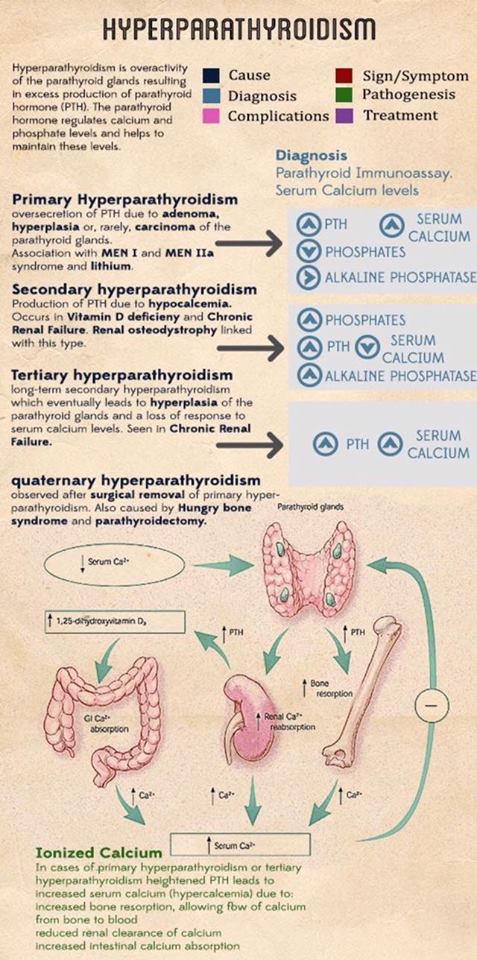
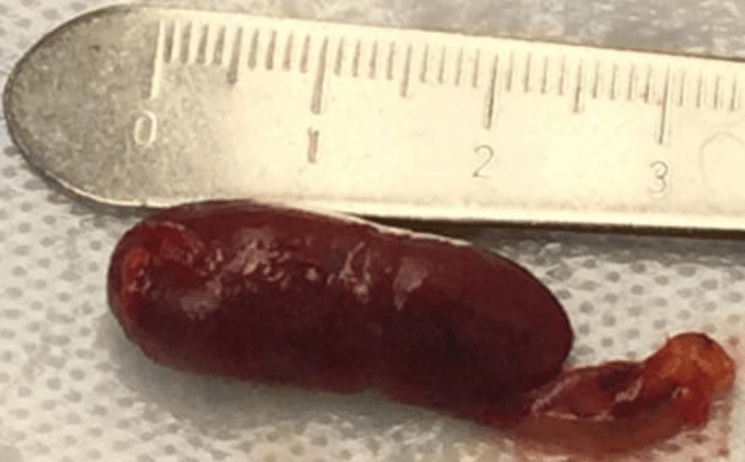
- Recent cure rates of hyperparathyroidism following parathyroidectomy:
- Are reported between 92% and 97%
- When cure is not obtained, it is due to either:
- Recurrent or persistent disease (Figure)
- Persistent hyperparathyroidism:
- Is defined as hypercalcemia and elevated parathyroid hormone (PTH) levels:
- During the 6-month period after parathyroidectomy:
- It occurs in 0.4% to 7.8% of patients
- During the 6-month period after parathyroidectomy:
- Is defined as hypercalcemia and elevated parathyroid hormone (PTH) levels:
- Recurrent hyperparathyroidism:
- Is defined as hypercalcemia and elevated PTH levels that occur after normal values have been obtained for 6 months after parathyroidectomy and may be slightly less common than persistent disease:
- Occurring in 0.4% to 4.8% of patients
- Is defined as hypercalcemia and elevated PTH levels that occur after normal values have been obtained for 6 months after parathyroidectomy and may be slightly less common than persistent disease:
- It is most common in:
- Familial hyperparathyroidism
- Advances in imaging modalities and surgical techniques have decreased the rate of persistent disease significantly over the past two decades
- Persistent disease is considered a technical error:
- Most commonly due to a missed single parathyroid adenoma
- A rare but notable cause of persistent or recurrent hyperparathyroidism is parathyromatosis:
- A condition in which multiple benign hyperfunctioning parathyroid tissues are
scattered throughout the neck and superior mediastinum and that occurs due to surgical implants from the fragmentation of abnormal parathyroid tissue in the previous operation
- A condition in which multiple benign hyperfunctioning parathyroid tissues are
- Other causes are detailed in Table 1 (Table 1)
- Additional studies have shown that specific clinical factors are associated with an increased or decreased risk of having persistent hyperparathyroidism:
- Negative, equivocal, or discordant imaging including ultrasonography and sestamibi is associated with a higher likelihood of persistent disease
- Whereas intraoperative PTH (IOPTH) monitoring, with 50% decrease in serum PTH after removal of parathyroid tissue, increased weight of the affected gland, and surgery performed at high-volume centers is associated with successful initial parathyroidectomy

- Work-up and Diagnosis:
- When a patient presents with recurrent or persistent hyperparathyroidism, all other causes of hyperparathyroidism including:
- Vitamin D deficiency, renal insufficiency, medications such as lithium resulting in hypercalcemia, and renal calcium leak need to be ruled out and treated if identified
- Additional work-up should also be done to evaluate for familial causes of hyperparathyroidism
- The operative reports, imaging studies, and pathology reports associated with prior operation(s) should be obtained and meticulously reviewed
- Confirmation of the location(s) of abnormal parathyroid glands:
- Using at least two imaging modalities preoperatively is recommended in all cases of recurrent or persistent disease
- Imaging modalities include ultrasonography, sestamibi with or without single-photon emission CT, and four-dimensional CT and should include evaluation of the mediastinum
- When multiple imaging techniques are used:
- 95% of abnormal glands can be identified
- Evaluation of the vocal cords:
- To assess for any previous recurrent laryngeal nerve injury resulting in paralysis is recommended for all neck reoperations
- Fine-needle aspiration (FNA):
- May be used preoperatively to confirm presence of abnormal parathyroid tissue when noninvasive imaging studies are unclear but should be used with caution and
only in select patients:- As FNA carries the risk of hematoma, parathyromatosis, and cancer seeding
- Selective PTH venous sampling (SVS) has also been described to regionalize recurrent or persistent disease when other imaging modalities fail and has been reported as successful in up to 94% of cases:
- SVS is performed by obtaining serial samples of PTH from the superior vena cava, brachiocephalic, internal jugular, vertebral, thymic, and thyroid veins, after which levels are compared to identify the approximate location of the hyperfunctioning gland
- May be used preoperatively to confirm presence of abnormal parathyroid tissue when noninvasive imaging studies are unclear but should be used with caution and
- When a patient presents with recurrent or persistent hyperparathyroidism, all other causes of hyperparathyroidism including:
- Indications for Surgery:
- Reoperation is associated with significantly increased risk of:
- Hypoparathyroidism (5% to 20%)
- Recurrent laryngeal nerve injury (10% to 15%)
- Therefore, it is recommended to have a higher
threshold before recommending reoperation for recurrent or persistent disease - Indications for reoperation:
- Significant life-limiting symptoms
- Nephrolithiasis
- Osteoporosis
- Hypercalcemia
- Decrease in renal function
- If surgery is indicated, early reexcision in the case of persistent disease:
- Is not recommended, rather revision should be delayed by 4 to 6 months to avoid a surgical bed affected by inflammation and scarring
- Reoperation is associated with significantly increased risk of:
- Operative Approach:
- The goal of resection:
- Is to remove the remaining hyperfunctioning parathyroid tissue while preserving enough to avoid hypoparathyroidism
- Due to increased scar tissue in a reoperative neck, care is taken to avoid injury to surrounding structures, including the recurrent laryngeal nerve
- For most patients, resecting the residual hyperfunctioning parathyroid tissue:
- Is possible through a standard, anterior cervical incision
- A lateral approach for targeted glands in the
tracheoesophageal groove or sternocleidomastoid:- Is an excellent approach to avoid scar tissue
- Glands within the mediastinum:
- Most often lie within the thyrothymic ligament
- They can be gently pulled up through a cervical incision successfully, even in the reoperative neck
- A thoracic approach:
- Is recommended for those with abnormal parathyroid tissue of 6 cm or greater identified below the superior aspect of the clavicle
- IOPTH is recommended:
- As it significantly improves the ability to confirm adequate resection of recurrent disease intraoperatively:
- With sensitivity of up to 100%
- As it significantly improves the ability to confirm adequate resection of recurrent disease intraoperatively:
- Additional strategies have been reported to localize parathyroid tissue and minimize injury to surrounding structures in a reoperative neck, including:
- The use of the gamma probe after injection of 99m technetium-methoxy isobutyl isonitrile preoperatively, ultrasonography-guided methylene blue injection, near-infrared autofluorescence imaging, indocyanine green fluorescence angiography, and recurrent laryngeal nerve monitoring:
- Previously, IV infusion of methylene blue was
used by some to identify parathyroid tissue; however, this is no longer recommended due to associated toxicities
- Parathyroid autotransplantation and cryopreservation are often recommended following resection of the affected parathyroid tissue in reoperative parathyroidectomies:
- Especially if the abnormal gland is the last viable parathyroid tissue, multiple glands have been previously removed, or there is concern for possible devascularization of the
remaining glands - A case where cryopreservation may not be necessary is that of a missed adenoma
where other parathyroid glands have not been disturbed in either the initial operation or re-exploration
- Especially if the abnormal gland is the last viable parathyroid tissue, multiple glands have been previously removed, or there is concern for possible devascularization of the
- The goal of resection:
- Follow-up postoperatively includes monitoring of serum PTH and calcium with the treatment of hypocalcemia if present