Blog

LIBRETTO-531 Trial in Thyroid Cancer

  • LIBRETTO‑531:
    • Design & Patient Population:
      • Phase III, global, multicenter, open-label, randomized (2:1) trial (NCT04211337):
        • Comparing selpercatinib (160 mg BID) to physician’s choice of cabozantinib or vandetanib:
          • In MKI-naïve, progressive advanced /metastatic RET-mutant MTC patients 
        • Stratified by RET M918T mutation status and intended control arm MKI
        • Crossover permitted from MKI arm to selpercatinib upon progression
    • Efficacy Results (Interim, ~ 12-months follow-up):
      • Primary endpoint (PFS, RECIST v1.1):
        • Selpercatinib:
          • Median not reached
        • MKI arm:
          • 16.8 months (95% CI, 12.2–25.1); HR 0.28; P<0.001 
        • 12‑month PFS:
          • 86.8% vs 65.7%
      • Secondary endpoint (Treatment Failure-Free Survival – TFFS):
        • Not reached vs 13.9 months in MKI arm; HR 0.25
      • Overall Response Rate (ORR):
        • 69.4% in selpercatinib group vs 38.8% in MKI group 
      • Safety-driven dose modifications:
        • 38.9% with selpercatinib vs 77.3% with MKIs
      • Discontinuations 4.7% vs 26.8% 
  • Safety & Patient-Reported Outcomes:
  • Common ≥ 25% AEs:
    • Hypertension, edema, dry mouth, fatigue, diarrhea
  • Grade 3/4 laboratory abnormalities:
    • Lymphopenia, elevated ALT / AST, electrolyte disturbances
  • Patient-reported tolerability (FACT-GP5):
    • Demonstrated robust reliability (ICC 0.80–0.85); high side-effect burden correlated with decreased functioning
  • Mechanism of Action:
    • Selpercatinib is a highly selective RET inhibitor, effective against both:
      • RET point mutations (e.g., M918T in MTC)
      • RET fusions (common in papillary thyroid carcinoma and NSCLC)
    • High selectivity translates to less off-target toxicity compared to multikinase inhibitors (vandetanib/cabozantinib), which inhibit VEGFR, MET, etc.
  • Guideline Endorsements:
    • NCCN (2024) now includes selpercatinib as a Category 1 first-line option:
      • For RET-mutant, progressive/unresectable MTC, alongside cabozantinib and vandetanib
    • ATA Guidelines:
      • Similarly endorse selective RET inhibitors as preferred agents for RET-driven MTC
    • ESMO / European Consensus:
      • Align with use in RET-mutant MTC post-MKI therapy
  • Regulatory Perspective:
    • FDA granted traditional approval on September 27, 2024 for adults and pediatrics ≥ 2 years with advanced / metastatic RET-mutant MTC requirement systemic therapy
    • Earlier accelerated approval received in 2020 for patients ≥ 12 years; expanded to ≥ 2 years with pediatric dosing in May 2024
  • Clinical Implications for Head and Neck Oncology Teams:
    • First-line therapy improvement:
      • LIBRETTO‑531 is the first randomized trial demonstrating selpercatinib superiority over MKIs in efficacy and tolerability
      • Reduced surgical urgency:
        • Durable responses may defer or potentially downstage extra-thyroidal or metastatic disease, assisting in surgical planning
      • Multidisciplinary coordination:
        • Shared decision-making essential for selecting candidates, managing MTC lesion status, and monitoring biochemical markers (calcitonin, CEA)
      • Monitoring & sequencing:
        • Be vigilant for long-term tolerability needs, dose adjustments, and resistance (e.g., RET solvent-front mutations); TKIs sequencing should involve endocrine-oncology collaboration
  • Recommended References for Further Reading:
    • Primary LIBRETTO‑531 publication: NEJM (PubMed PMID: 37870969) 
    • Preceding phase I/II evidence: Wirth et al., N Engl J Med 2020 (LIBRETTO‑001)
    • NCCN Thyroid Carcinoma Guidelines, v2.2024  .
      FDA approval details for selpercatinib
    • Patient-reported outcomes analysis: Regnault et al., J Patient Rep Outcomes 2024
  • Summary for Surgical Experts:
    • Selpercatinib sets a new standard first-line systemic therapy in RET-mutant MTC, delivering superior tumor and nodal responses while maintaining patient quality-of-life
    • Surgeons should integrate molecular profiling early, allowing neoadjuvant-like benefit of targeted therapy before considering resection or resection of metastatic deposits
    • Long-term surgical planning may be increasingly influenced by TKI response and durability
  • Clinical Implications for Surgeons and Oncologists:
    • Preoperative:
      • Patients with borderline resectable MTC may benefit from downstaging with selpercatinib
      • Early molecular testing for RET mutations is essential
    • Postoperative:
      • Patients with biochemical persistence (calcitonin / CEA) or structural recurrence can receive selpercatinib earlier
      • More favorable AE profile allows longer-term outpatient management
  • References:
    • Wirth LJ, et al. Selpercatinib vs Standard Therapy in RET-Mutant MTC. N Engl J Med. 2023;389(15):1344-1356. PMID: 37870969
      NCCN Guidelines: Thyroid Carcinoma v2.2024. https://www.nccn.org
    • ATA Guidelines Update (Thyroid, 2022): Use of targeted therapy in RET-mutant disease
      FDA Approval Summary: https://www.fda.gov/drugs
    • Drilon A, et al. Targeting RET-driven cancers with selpercatinib. Cancer Discov. 2020. PMID: 3221355

The Delphi Criteria for Advanced Disease in Thyroid Cancer

  • The Delphi criteria for advanced disease in thyroid cancer:
    • Refer to a consensus-based set of clinical, pathological, and radiological features:
      • Developed by expert panels (often using the Delphi method):
        • To define what constitutes advanced thyroid cancer
    • These criteria help guide decision-making:
      • In terms of treatment strategies, referral to tertiary centers, and inclusion in clinical trials
  • While there is no universal single set of “Delphi criteria” adopted globally for thyroid cancer:
    • Multiple Delphi panels have been convened in recent years to create consensus on what features define advanced or aggressive disease
  • Below is a synthesis of key features commonly included in such panels and used in high-level consensus guidelines:
    • ATA, NCCN, and expert Delphi studies
  • Delphi-Based Criteria for Advanced Thyroid Cancer:
    • Clinical Features:
      • Age > 55 years:
        • For differentiated thyroid cancer (DTC)
      • Rapid tumor growth
      • Hoarseness or vocal cord paralysis
      • Dysphagia or airway compression
      • Distant metastases:
        • Lung, bone, brain
      • Recurrent or persistent disease after initial therapy
    • Pathological Features:
      • High-risk histologies:
        • Poorly differentiated thyroid carcinoma
        • Anaplastic thyroid carcinoma
        • Hürthle cell carcinoma with widely invasive features
        • Tall cell, hobnail, or columnar variants of PTC
        • Extensive vascular invasion
        • Extrathyroidal extension:
          • Especially gross
        • Incomplete resection margins:
          • R2 or R1
    • Radiological Features:
      • Evidence of invasion into adjacent structures::
        • Trachea, esophagus, larynx, recurrent laryngeal nerve, carotid artery
      • Radiographic evidence of unresectability
      • Distant metastases confirmed via CT, MRI, or PET / CT
    • Molecular/Functional Criteria:
      • RAI-refractory disease:
        • Based on functional imaging and response
      • Presence of high-risk mutations:
        • TERT promoter
        • TP53
        • BRAF + TERT
      • High FDG-avidity on PET scan:
        • Often correlates with aggressiveness
    • Biochemical Markers:
      • Rapidly rising thyroglobulin levels post-thyroidectomy and RAI
      • Elevated Tg levels with negative RAI uptake:
        • Suggesting RAI-refractory disease
  • Notable Delphi Studies / Consensus Papers:
    • Tuttle RM et al., Memorial Sloan Kettering Cancer Center: Clinical criteria for RAI-refractory DTC
    • American Thyroid Association (ATA) 2015 Guidelines: Use a similar risk stratification model that incorporates many of these features
    • NCCN Guidelines (latest version): Lists features of unresectable, progressive, or symptomatic disease requiring systemic therapy
    • Molecular Oncology Tumor Boards have also developed decision-making algorithms based on Delphi consensus

Hunry Bone Syndrome Post-Parathyroidectomy

  • After initial parathyroidectomy, reported rates of moderate postoperative hypocalcemia range from 5% to 47%:
    • However, permanent hypoparathyroidism and severe hypocalcemia due to hungry bone syndrome are rare

#Arrangoiz #ParathyroidSurgeon #ParathyroidExpert #Hyperparathyroidism #PrimaryHyperparathyroidism #CancerSurgeon #EndocrineSurgery #Teacher #Surgeon #HeadandNeckSurgeon #SurgicalOncologist #ParathyroidAdenoma #Hypercalcemia #ElevatedCalciumLevels #Miami #MountSinaiMedicalCenter #MSMC #Mexico #Hialeah

ESTIMABL 2 Trial in Thyroid Cancer (NCT01837745)

  • Trial Overview – ESTIMABL2 (NCT01837745):
    • Is a French, multicenter, phase III randomized trial investigating the necessity of post-thyroidectomy radioactive iodine (RAI) in patients with low-risk DTC:
      • Defined as intrathyroidal papillary carcinomas ≤ 1 cm (pT1a-m) or 1 to 2 cm (pT1b), with no suspicious lymph nodes on preoperative neck ultrasound (N0 / Nx)
    • All underwent total thyroidectomy (with or without prophylactic central neck dissection) and were randomized at 2 to 5 months post-op to:
      • RAI group:
        • 1.1 GBq (30 mCi) after rhTSH preparation
      • No‑RAI group:
        • Surveillance only 
    • Follow-up Protocol:
      • 3-year endpoint:
        • Thyroglobulin (Tg) and anti-Tg antibodies annually, neck ultrasound in alternating years
    • Event definition:
      • Need for further radioactive iodine or surgery:
        • Due to abnormal uptake, ultrasound changes, Tg rise, or antibody surge
      • Non-inferiority margin:
        • 5% difference in event-free survival 
    • Primary (3-Year) Results:
      • Evaluable patients:
        • 729 (FU: 367; RAI: 362)
        • Events:
          • 18 (4.9%) in surveillance vs 15 (4.1%) in RAI
        • Event-free survival:
          • 95.1% (no RAI) vs 95.9% (RAI)
          • Difference 0.8% (95% CI –3.3% to 1.8%) → non-inferiority confirmed 
    • Secondary interventions (surgery / RAI):
      • 6 (1.6%) vs 9 (2.5%)
  • 5-Year Long-Term Outcomes:
    • Evaluable at 5 years:
      • 698 patients
    • Event-free survival:
      • No RAI: 93.2%
      • RAI: 94.8%
        • Difference: 1.6% (90% CI –4.5 to 1.4%)
          • Remains within non-inferiority bounds 
  • Quality of response:
    • Surveillance group had higher rates of “excellent response” (83.3% vs 75.6%) and fewer indeterminate results 
  • Clinical Implications for Surgeons:
    • Omission of adjuvant RAI in strictly defined ATA low-risk patients (pT1, cN0, complete surgery, normal Tg and US) is safe and effective, even at 5 years
    • Non-inferiority margin of 5% comfortably met at both 3 and 5 years, a robust outcome
    • Superior biochemical and imaging outcomes in the surveillance arm suggest less overdiagnosis and overtreatment
    • Reduces patient burden:
      • Avoids radiation, isolation, and enhances convenience
    • Supports tailored management:
      • RAI can be reserved for cases with unfavorable histology, remnant tissue on US, or rising Tg / antibodies
  • Recommendations for Practice:
    • Strict selection is essential:
      • Only patients with pT1 N0 / Nx, complete surgery, and negative post-op US are eligible for RAI omission
    • Omit RAI in these low-risk patients, with follow-up consisting of Tg, TgAb, and periodic neck ultrasound
    • Reserve RAI for patients with adverse features:
      • Aggressive histology
      • Tg rise
      • Suspicious imaging
    • Discuss care pathway in MDT rounds, highlighting QoL gains and similar oncologic outcomes
    • Educate patients:
      • Provide clear rationale and plan for surveillance to avoid anxiety over omitted therapy
  • Final Takeaways:
    • The ESTIMABL2 trial delivers strong evidence that surveillance alone post-thyroidectomy is a safe, effective, and patient-centric strategy in carefully selected ATA low-risk DTC patient:
      • Offering similar long-term outcomes to standard RAI treatment, with additional QoL and diagnostic benefits

Hypercalcemia and Thiazide Diuretic Use

👉Elevated serum calcium levels have been associated with thiazide diuretic use and need to be differentiated from primary hyperparthyroidism – Dr. Rodrigo Arrangoiz

👉The overall annual age- and sex-adjusted (to 2000 U.S. whites) incidence of hypercalcemia due to thiazide diuretic use was 7.7 (95% CI, 5.9 to 9.5) per 100,000 individuals.

👉The average 24-hour plasma calcium concentrations are increased with thiazide diuretic use, but the mean 24-hour PTH levels remain unchanged in subjects with normal baseline PTH levels and no evidence of hypercalciuria.

👉Thiazides diuretics have several metabolic effects that may contribute to increased calcium levels:

  • A decrease in urine calcium excretion is the most likely cause.
  • In some cases of diuretic use metabolic alkalosis can occur that could cause an increase in total serum calcium levels through a pH-dependent increase in protein-bound calcium.
  • Although plasma 1,25 (OH) vitamin D levels are unchanged, increased intestinal calcium absorption in response to thiazide diurectic use has been noted and could also contribute to an increase in serum calcium.
  • One last possible explanation for the elevated serum calcium levels associated with thiazide diuretic use is hemoconcentration associated with diuresis.

👉CheckYourCalcium (realízate un calcio total en sangre).

#CheckYourCalcium #Arrangoiz #ParathyroidExpert #ParathyroidSurgeon #Hiperparatiroidism #Hipercalcemia #CheckYourCalcium #HeadandNeckSurgeon #MountSinaiMedicalCenter #MSMC #Miami #Mexico #Hyperparathyroidism

👉 Para obtener más información sobre el hiperparatiroidismo:

https://s3.amazonaws.com/academia.edu.documents/48239291/Current_Thinking_in_Hyperparathyroidism.pdf?response-content-disposition=attachment%3B%20filename%3DCurrent_Thinking_in_Hyperparathyroidism.pdf&X-Amz-Algorithm=AWS4-HMAC-SHA256&X-Amz-Credential=AKIAIWOWYYGZ2Y53UL3A%2F20190724%2Fus-east-1%2Fs3%2Faws4_request&X-Amz-Date=20190724T015127Z&X-Amz-Expires=3600&X-Amz-SignedHeaders=host&X-Amz-Signature=9633131723dc3e5fa1671838123524ae980c0bfb31e4a92be406b43a103bc355

ESTIMABL1 Trial Overview

  • Title:
    • Outcome after ablation in patients with low‑risk thyroid cancer (ESTIMABL1)
  • Design:
    • A multicenter, randomized, open-label, phase III equivalence trial:
      • Across 24 centers in France (2007 to 2010)
  • Population:
    • 752 adults with low-risk papillary or follicular differentiated thyroid cancer (DTC) post-total thyroidectomy
  • Randomization (1:1:1:1) into four groups:
    • RAI dose:
      • Low (1.1 GBq / ~30 mCi) vs High (3.7 GBq / ~100 mCi)
    • TSH stimulation:
      • rhTSH injections vs thyroid hormone withdrawal
  • Primary Endpoint:
    • Successful remnant ablation at 6 to 10 months:
      • Defined as stimulated thyroglobulin ≤ 1 ng/mL and no residual tissue on ultrasound
  • Initial and Long-Term Efficacy:
    • 6 to 10 Month Ablation Success:
      • ~ 92% across all groups:
        • With equivalence between:
          • Low and high dose
          • rhTSH vs withdrawal
    • 5.4-Year Median Follow-Up (n = 726):
      • 98% had no evidence of disease (715 / 726)
      • 11 patients had evidence of persistent or recurrent disease (structural or biochemical)
        • Recurrence was evenly distributed across RAI dose and stimulation method:
          • Indicating no impact of strategy on long-term outcomes
  • Prognostic Predictors:
    • Stimulated thyroglobulin at ablation:
      • Was predictive of eventual disease status and ablation success:
        • Patients with higher thyroglobulin were more likely to have persistent disease regardless of group
    • No lymph node stratification influence or stimulation method effect was observed
  • Clinical Implications:
    • Low-dose RAI (1.1 GBq) with rhTSH is validated as standard of care:
      • Equivalent efficacy with better patient experience
    • ATA 2015 guidelines endorse this strategy for low-risk DTC:
      • Simplified staging and reduced toxicity
    • No impact on long-term disease-free survival:
      • Supports tailored management based on disease biology rather than RAI intensity
  • Evidence Synthesis:
    • Meta-analysis of RCTs (> 1,500 patients, 4 to 10 years follow-up):
      • Confirms no difference in long-term recurrence between 1.1 GBq and 3.7 GBq (OR 0.93, 95% CI 0.53–1.63)
    • Similar equivalence was seen between rhTSH vs hormone withdrawal and across centers (France & UK)
    • HiLo trial results align, confirming comparable recurrence rates with low-dose RAI and rhTSH
  • Surgical Take-Home Points:
    • Remnant ablation using low-dose RAI + rhTSH is effective and minimizes side effects compared to high-dose or withdrawal strategies
    • Stimulated thyroglobulin at post-op ablation is a stronger predictor of recurrence than RAI dose or preparation method
    • No difference in long-term disease-free survival across dose or stimulation arms supports risk-adapted RAI use
    • Multidisciplinary protocols should adopt low-dose rhTSH-based ablation for ATA low-risk patients, reserving higher dose only for select cases (e.g., unresected tissue, aggressive pathology)
    • Surveillance strategies:
      • Regular ultrasound + Tg on levothyroxine; use stimulated Tg selectively for indeterminate findings

Parathyroid Awareness Month

👉Negative preoperative imaging does not exclude patients from surgery for hyperparathyroidism.

👉Experienced parathyroid surgeons have high cure rate (95%) with or without preoperative localization.

👉https://doi.org/10.1210/jc.2002-021095

#CheckYourCalcium #Arrangoiz #ParathyroidSurgeon #PararhyroidExpert MountSinaiMedicalCenter #MSMC #Miami #Mexico #HeadandNeckSurgeon #Hyperparathyroidism

Guidelines on the Use of Radioactive Iodine in Low-Risk Thyroid Cancer

  • American Thyroid Association (ATA) Low-Risk of Recurrence Overview:
    • Patients considered low-risk (pre- or post-operative):
      • Intrathyroidal papillary thyroid cancer ≤ 4 cm:
        • T1 to T2
      • No clinical nodal involvement:
        • N0 or minimal N1a
      • No distant metastasis (M0)
      • No aggressive histologic variants
      • No gross extrathyroidal extension
  • Core Randomized Trials:
    • ESTIMABL1 (2012, France):
      • Design:
        • 2 × 2 factorial randomized control trial (RCT):
          • Comparing low-dose (1.1 GBq) vs high-dose (3.7 GBq) radioactive iodine (RAI), and rhTSH stimulation vs thyroid hormone withdrawal for remnant ablation
      • Primary Outcome:
        • Remnant ablation success at 6 to 10 months:
          • ~92% to 95%
        • 5‑Year Follow-Up (2018):
          • 98% no evidence of disease
          • No differences between RAI dose or preparation method 
      • Clinical Meaning:
        • Low-dose RAI + rhTSH is as effective as high-dose with withdrawal
        • Lower toxicity, better patient convenience:
          • Incorporated in ATA 2015 guidelines (New Guidelines Coming Out Fall 2025)
    • HiLo (UK, Mallick et al., 2012):
      • Design:
        • Similar to ESTIMABL1:
          • Compared low- vs high-dose plus rhTSH vs withdrawal
      • Outcome:
        • Comparable ablation success and low recurrence rates 
    • ESTIMABL2 (France, 2022):
      • Design:
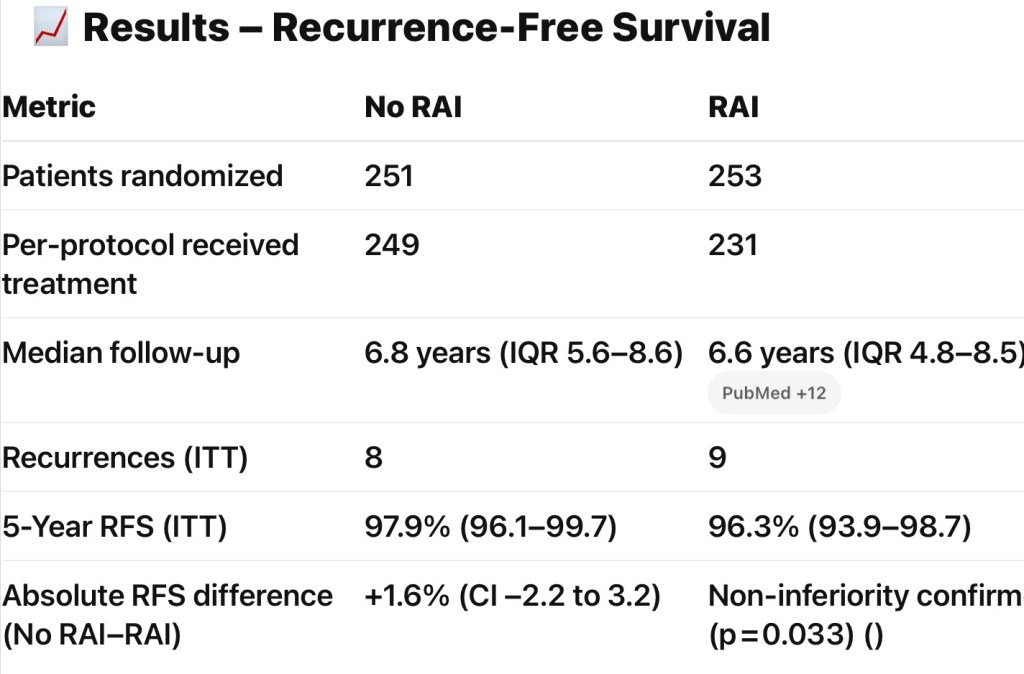
        • RCT of low-dose RAI (1.1 GBq) vs no RAI, post-total thyroidectomy in low-risk DTC
      • 3-Year Results:
        • Recurrence:
          • 2.7% (no RAI) vs 1.9% (RAI); non-inferior 
      • Commentary:
        • Non-inferiority holds even at lowest end of risk spectrum:
          • Upholds omission in select patients
    • IoN (“Iodine or Not”) Trial (UK, Lancet June 2025):
      • Design:
        • Phase II / III RCT randomizing 504 low-risk DTC patients to RAI vs no RAI
      • 5-Year Data:
        • 98% disease-free without RAI vs 96% with RAI
        • Omitting RAI improved quality of life and reduced isolation burden 
      • Significance:
        • Largest definitive trial confirming RAI omission is safe in ATA low-risk patients
    • Additional Evidence and Observational Data:
      • Long-term observational studies (> 8 years):
        • Show high remission and low recurrence with low-dose RAI 
      • Meta-analyses and reviews echo findings:
        • Low-dose or no RAI yields excellent oncologic outcomes in strictly low-risk DTC
  • Clinical Take‑Home Points for Surgeons:
    • Low-dose (1.1 GBq) RAI is sufficient for remnant ablation when RAI is used
    • rhTSH is preferred for patient comfort
    • RAI omission is safe in ATA low-risk cases:
      • Per ESTIMABL2 and IoN with:
        • ~ 98% disease-free survival at 5 years
      • QoL benefit and reduced isolation burden when RAI is not used:
        • Especially relevant for younger, family-centered patients
    • ATA 2015 guidelines:
      • Support selective RAI omission, reinforced by current trials
    • Surgical completeness matters:
      • Trials include total thyroidectomy with low /absent nodal burden
      • Partial thyroidectomy or residual disease was excluded
    • Follow-up protocol:
      • Stringent ultrasound and thyroglobulin monitoring essential when omitting RAI
  • Practical ATA-Based Approach:
    • Very Low / Low Risk ATA:
      • Intrathyroidal ≤ 4 cm
      • N0 to N1a
      • No vascular invasion:
        • Omit RAI:
          • Active surveillance with US + Tg (with / without rhTSH)
      • If ablation desired (e.g., Tg monitoring ease):
        • Use 1.1 GBq + rhTSH
    • Intermediate Risk:
      • Minimal extrathyroidal extension
      • > 5 involved nodes:
        • Consider selective RAI at low dose:
          • Decision individualized based on risk tolerance
  • Summary:
    • In ATA-defined low-risk DTC:
      • Low-dose RAI + rhTSH is as effective as high-dose or withdrawal methods
    • Importantly, omission of RAI does not compromise outcomes and offers QoL and cost benefits
    • Surveillance replaces ablation, with triggers reserved for structural or biochemical recurrence
#Arrangoiz #CancerSurgeon #ThyroidSurgeon

Vitamin D Deficiency and Primary Hyperparathyroidism (PHTP)

Obtaining measurements of vitamin D metabolites (usually 25 OH Vitamin D) may be useful to distinguish PHPT from other conditions and it can help confirm the diagnosis of PHPT.

The vast majority of patients with PHPT will have concomitant vitamin D deficiency. In a series of more than 10,000 patients with proven PHPT found that 77% of patients had 25 OH Vitamin D levels below 30 ng/ ml (normal range above 35 ng/ml), 36% had levels below 20 ng/ml, and none of the patients had elevated 25 OH Vitamin D levels.

  • In this study they also found an increase conversion of 25 OH Vitamin D to 1-25 OH Vitamin D.

    • A vitamin D deficiency is something to expect in patients with PHPT with an average value of 22.4 ng/ml.

Low vitamin D levels do NOT cause high levels of serum calcium.

The notion that vitamin D deficiency causes a decrease in the serum calcium levels (because of a decrease intestinal absorption) and that this decrease in serum calcium concentration will lead to an activation of the parathyroid glands, with subsequent parathyroid gland hyperplasia and increase PTH secretion leading to hypercalcaemia should be rethought (Figure).

  • Norman et al., , showed that 98% of the patients in their study who had PHPT with concomitant vitamin D deficiency had a parathyroid adenoma and only two percent had parathyroid gland hyperplasia refuting the current thinking.
  • Shah et al., performed a meta-analysis of the world literature in 2014 and concluded Vitamin D replacement in subjects with PHPT and coexistent vitamin D deficiency increase 25 (OH) D and reduces serum PTH significantly without causing hypercalcemia and hypercalciuria but mentioned that the finding of there study needs to be confirmed by larger randomized control trials.

Slide2

Rodrigo Arrangoiz MS, MD, FACS
Cirugía Oncológica
Fox Chase Cancer Center
Tumores de Cabeza y Cuello / Cirugía Endocrina
Fox Chase Cancer Center
Tumores de Cabeza y Cuello / Cirugía Endocrina
IFHNOS / Memorial Sloan Kettering Cancer Center
Maestría en Ciencias de Investigación
Drexel University
Certificado por el Colegio Americano de Cirugía
Fellow del Colegio Americano de Cirugía
Fellow de la Sociedad de Cirugia Oncológica  
#hyperparathyroidism
#hypercalcemia
#vitaminDdeficiency
#Endocrinesurgeon
#headandnecksurgeon
#MountSinaiMedicalCenter
#MSMC
#Miami
#Mexico

Parathyroidectomy Treatment of a Choice for Hyperparathyroidism

👉Did you know that the only cure for primary hyperparathyroidism is surgery?

👉Dr. Rodrigo Arrangoiz is Pioneer in Mexico in radio-guided minimally invasive parathyroidectomy.

https://m.youtube.com/watch feature=youtu.be&v=AgvQmtz1gnA

👉Find more info at http://www.hiperparatiroidismo.info

#Arrangoiz

#ParathyroidExpert #ParathyroidSurgeon #Hiperparatiroidismo #Hipercalcemia #CheckYourCalcium #HeadandNeckSurgeon #EndocrineSurgeon

#Hyperparathyrodism

#CirujanodeParatiroides

#ExpertoenParatiroides

#SociedadQuirurgica