Blog

After Grade-3 AKI from cisplatin in Post-Operative Chemoradiation (CRT) for Head and Neck Squamous Cell Carcinoma

  • What to do right now?
    • Stop cisplatin permanently:
      • Grade-3 renal toxicity signals significant tubular injury with risk of incomplete recovery:
        • Continuing platinum can cause irreversible damage
      • FDA labeling flags severe, cumulative nephrotoxicity and advises dose reduction or alternatives in renal impairment Cancer Treatment and Diagnosis+1
    • Continue radiation on schedule and switch the systemic partner only if the patient can tolerate it:
      • Preferred: 
        • RT + cetuximab (loading 400 mg / m² → 250 mg / m² weekly):
          • If infusion tolerance and skin toxicity risk acceptable
            • Evidence for postoperative use is not as mature as for cisplatin:
              • But RTOG 0234 showed feasibility and favorable signals with cetuximab-based regimens
            • Several groups (and guidelines) allow cetuximab when cisplatin is contraindicated
        • If not feasible, RT alone is acceptable PMC
  • Supportive care (same day):
    • Nephrology consult:
      • Classify per CTCAE v5.0 and KDIGO:
    • Aggressive IV hydration with isotonic saline and magnesium supplementation:
      • Hold other nephrotoxins:
        • NSAIDs, IV contrast, aminoglycosides
    • Routine mannitol isn’t required:
      • May be considered selectively at very high cisplatin doses:
        • Not applicable here since cisplatin is being stopped eviq.org.au
    • Frequent labs (serum Cr / eGFR, electrolytes) until recovery:
      • Document nadir eGFR for the chart
  • What NOT to do?
    • Do not re-challenge with cisplatin after a grade-3 AKI in the adjuvant setting:
      • Renal injury may recover incompletely and worsen with further exposure eviq.org.au+1
    • Avoid reflex “swap to carboplatin” in the adjuvant post-op setting after severe AKI:
      • Carboplatin is renally cleared and, while less nephrotoxic, lacks adjuvant level-I evidence with RT for head and neck
      • Prior cisplatin exposure can also predispose to carboplatin – AKI
      • If considered at all:
        • Do so only with nephrology input and careful pharmacokinetics Frontiers
  • Finishing the course (practical scenarios):
    • If some cisplatin already given but < 200 mg /m²: 
      • Aim to complete RT with cetuximab if the patient can tolerate it:
        • Otherwise proceed with RT alone
    • ≥ 200 mg / m² is the commonly cited efficacy threshold in CRT literature:
      • If already achieved, simply finish RT BC Cancer
    • If weekly cisplatin was planned (JCOG1008 context): 
      • That RCT supports weekly as a valid starting schedule post-op:
        • But once grade-3 AKI occurs:
          • The same rules appl:
            • Stop cisplatin and transition as above PubMed
  • One-page order set:
    • Hold cisplatin permanently.
    • RT: 
      • Continue per plan
      • Coordinate new concurrent agent start within 0 to 3 days
    • Cetuximab (if chosen):
      • 400 mg / m² load → 250 mg / m² weekly through RT
        • Premedicate; dermatitis prophylaxis PMC
    • Renal bundle: 
      • NS 1 to 2 L / day IV while inpatient or symptomatic
      • MgSO₄ per lab
      • Stop ACEi/ARBs/NSAIDs/IV contrast if possible
      • Daily weights
      • I/Os eviq.org.au
    • Monitoring: 
      • BMP / Mg daily until stable:
        • Then every 48 to 72 hours
      • Re-stage eGFR at 2 to 4 weeks
      • KDIGO-based follow-up for AKI recovery KDIGO
  • Bottom line: 
    • After grade-3 AKIdo not give more cisplatin
    • Finish radiation and, if feasible, add cetuximab (or proceed with RT alone) while executing a tight renal-recovery plan (hydration, magnesium, nephrotoxin avoidance, close labs)
    • This balances cure intent with kidney safety, in line with contemporary supportive-care guidance

SOUND Trial – Journal Club Questions and Answers

  • What was the primary objective of the SOUND trial?
    • Answer:
      • To determine whether sentinel lymph node biopsy (SLNB) can be safely omitted in women with early-stage, clinically node-negative breast cancer with negative axillary ultrasound:
        • Without compromising distant disease-free survival
  • What does “SOUND” stand for in this trial?
    • Answer:
      • SOUND stands for:
        • Sentinel node vs Observation after axillary UltraSouND
  • What were the eligibility criteria for patients
    • Answer:
      • Women with unifocal invasive breast cancer ≤ 2.0 cm
      • Clinically node-negative
      • Negative axillary ultrasound (AUS)
      • Undergoing breast-conserving surgery
      • No prior neoadjuvant therapy
  • Describe the study design of the SOUND trial:
    • Answer:
      • Phase 3, multicenter, randomized non-inferiority trial
        • Two arms:
          • SLNB group vs. observation (no axillary surgery)
      • Primary endpoint:
        • 5-year distant disease-free survival (DDFS)
  • What was the primary endpoint, and how was non-inferiority defined?
    • Answer:
      • Primary endpoint:
        • 5-year distant disease-free survival (DDFS)
      • Non-inferiority margin:
        • Upper bound of 95% CI for the hazard ratio had to be ≤ 1.50
  • What were the key results of the SOUND trial
    • Answer:
      • 5-year DDFS:
        • 95.5% (observation) vs. 96.2% (SLNB)
      • Non-inferiority was demonstrated
      • No significant difference in axillary recurrence or overall survival
  • What does this trial suggest about the role of SLNB in modern breast cancer management?
    • Answer:
      • SLNB may be safely omitted in carefully selected patients with low-risk, early-stage breast cancer and negative AUS:
        • Reinforcing a less invasive, de-escalated approach
  • What were the secondary outcomes, and how did they compare?
    • Answer:
      • Overall survival:
        • No difference:
          • OS at 5 yr: 
            • 98.4% vs 98.2%
      • Axillary recurrence:
        • < 1.5% in both arms
      • Quality-of-life data (previous reports) favored the observation group
  • What is the clinical significance of using axillary ultrasound as a triage tool?
    • Answer:
      • Axillary ultrasound helps identify patients who do not need SLNB, reducing unnecessary surgery in node-negative disease with high diagnostic accuracy
  • How does the SOUND trial compare to ACOSOG Z0011 and INSEMA?
    • Answer:
      • ACOSOG Z0011:
        • Tested omission of ALND after positive SLNB
      • INSEMA:
        • Tested omission of SLNB in cN0 patients undergoing BCS + radiation
      • SOUND:
        • Focused on completely omitting axillary surgery in AUS-negative patients
  • What were some exclusion criteria in the trial
    • Answer:
      • Multifocal or multicentric disease
      • Tumors > 2.0 cm
      • Mastectomy patients
      • Neoadjuvant therapy
      • Prior axillary surgery
  • What were some limitations of the SOUND trial
    • Answer:
      • Limited to low-risk patients
      • Mostly postmenopausal, HR-positive / HER2-negative tumors
      • Not generalizable to mastectomy, young, or high-risk patients
  • How might omission of SLNB affect decisions about adjuvant systemic therapy?
    • Answer:
      • Without nodal staging, oncologists may rely more on tumor biology, imaging, and genomic testing to guide chemotherapy decisions
  • What were the main benefits of omitting SLNB noted in the trial?
    • Answer:
      • Reduced risk of lymphedema
      • Better arm mobility
      • Improved quality of life
      • Shorter operative times and fewer complications
  • Based on SOUND, how would you counsel a 62-year-old woman with a 1.5 cm ER+ / HER2 negative tumor and negative axillary ultrasound?
    • Answer:
      • She is a candidate for SLNB omission:
        • I would explain that observation is safe, doesn’t affect survival, and lowers surgical risk, but the decision should involve the oncology team to ensure systemic therapy isn’t compromised

Who should get Adjuvant Cisplatin‐Radiation Therapy (RT) after Surgery for Head and Neck Squamous Cell Carcinoma (HNSCC)?

  • High-risk triggers (guideline-concordant):
    • Positive margin (R+) or close margin (institutional cutoffs commonly < 1 to 5 mm)
    • Extranodal extension (ENE / ECS +) in any positive node
  • Rationale:
    • These were the features driving benefit from adding concurrent cisplatin to postoperative RT in the pivotal randomized trials and follow-ups PMC+2PMC+2
  • Pivotal trials:
    • EORTC 22931 (Bernier, NEJM 2004):
      • Design: 
        • Post-op RT alone (66 Gy) vs RT + cisplatin 100 mg / m² q3wk ×3
      • 5-yr outcomes (KM estimates): 
        • OS 53% vs 40%
        • PFS 47% vs 36%:
          • Both favoring CRT
        • Reported hazard ratios (RT + Cisplatin vs RT): 
          • OS HR ≈ 0.70–0.75
          • PFS HR 0.75:
            • Benefit across most high-risk features
      • Takeaway: 
    • RTOG 9501 (Cooper, NEJM 2004; 10-yr update 2012):
      • Design: 
        • Post-op RT alone (60 Gy/6 wk) vs RT + cisplatin 100 mg / m² on days 1, 22, 43
      • Overall cohort (10-yr KM): 
        • LRF 28.8% vs 22.3% (p=0.10)
        • DFS 19.1% vs 20.1% (p=0.25)
        • OS 27.0% vs 29.1% (p=0.31)
          • No significant advantage in the unselected population
        • Key subset (pre-specified high-risk: R+ and / or ENE+):
          • LRF 33.1% (RT) vs 21.0% (CRT), p=0.02
          • DFS 12.3% vs 18.4%, p=0.05
          • OS 19.6% vs 27.1%, p=0.07 (trend)
          • KM curves:
            • Markedly diverge in this subgroup, establishing R+ / ENE+ as the clearest indication for cisplatin-RT PubMed+1
    • Cross-trial comparative / pooled insight:
      • Bernier et al., Head & Neck 2005 compared EORTC 22931 and RTOG 9501:
        • Concluded the greatest benefit from CRT accrues to patients with:
          • ENE+ and / or positive margins PubMed+1
      • Updated combined analysis (2025):
        • Again supports an OS benefit for CRT across the combined cohorts:
          • While noting competing non-cancer mortality:
            • Still, ENE and / or R+ remain the most reproducible risk features prompting CR PubMed+1
  • How to apply at tumor board:
    • Offer adjuvant cisplatin-RT when any of the following are present::
      • Positive margin:
        • R1:
          • Re-resection preferred when feasible, otherwise CRT
      • Close margin:
        • Where institutional policy treats as high risk:
          • Commonly < 1 to 5 mm, site-dependent
      • ENE / ECS+ in a lymph node (any extent) PMC
      • Intermediate-risk (e.g., PNI, LVI, pT3, pN2 without ENE, multiple nodes but ENE-negative):
        • RT alone remains standard:
    • Cisplatin fitness: 
      • If contraindicated (CrCl < 60 mL/min, grade ≥ 2 SNHL, neuropathy, poor PS):
        • Use RT alone or alternative systemic partner per site-specific guidance:
          • But the randomized survival gain post-op is with cisplatin ACS Publications
  • Quick “exam-pearl” summaries:
    • EORTC 22931: 
    • RTOG 9501 (10-yr): 
      • Whole cohort:
        • No OS benefit
        • R+ / ENE+ subset
          • Better LRC and DFSOS trend with CRT:
            • This is the clinical trigger PubMed
      • Define “close” carefully:
        • Many centers treat < 5 mm (some < 3 mm or < 1 mm by subsite) as high-risk when re-resection isn’t possible PMC+1
  • Bottom line:
    • After resection of LA-HNSCC:
      • Adjuvant cisplatin-RT is indicated for ENE+ and positive (or institutionally “close”) margin:
        • The exact groups where the Kaplan–Meier curves in RTOG 9501 and EORTC 22931 show the clearest advantage for adding chemotherapy to RT

Sentinel Lymph Node Biopsy In Breast Cancer

  • Sentinel lymph node biopsy (SLNB):
    • Has replaced axillary lymph node dissection (ALND) as the primary method of axillary staging for patients with early stage breast cancer, based on data from:
    • NSABP B-32 (Phase III RCT) — SLNB vs ALND in cN0 patients:
      • No differences in overall survival, disease-free survival, or regional control:
        • Markedly less morbidity with SLNB
      • Conclusion:
        • If the sentinel node is negative, SLNB alone is appropriate and safe
    • Milan / IEO Randomized Trial (Veronesi et al., NEJM 2003) — SLNB with ALND only if SLN positive vs routine ALND:
      • SLNB was safe and accurate, reducing need for complete dissection without compromising outcomes
    • ALMANAC RCT (UK) — SLNB vs standard axillary treatment:
      • Similar cancer control with significantly lower arm morbidity and better quality of life after SLNB:
        • Tecommended as treatment of choice for early cN0 disease
    • Foundational validation work that enabled the shift to SLNB:
      • Krag et al., NEJM 1998 (Multicenter validation):
        • Demonstrated reliable identification of the sentinel node and accuracy of the technique
      • Giuliano et al., Ann Surg 1994 (Feasibility / accuracy):
        • First clinical series showing lymphatic mapping and SLN biopsy accurately stage the axilla
  • Changes in patient presentation and advancements in systemic therapy:
    • Have led clinicians to question the utility of ALND even in the presence of involved nodes
  • The American College of Surgeons Oncology Group (ACOSOG) Z0011 trial:
    • Randomized women with cT1 / cT2 tumors undergoing breast conservation with one or two positive sentinel nodes:
      • To undergo ALND vs. no additional axillary surgery
    • Results showed no difference in local recurrence, disease-free survival (DFS), or overall survival (OS) between the groups
      • The authors concluded that ALND was not indicated in this setting
  • One of the major advantages of SLNB compared to ALND:
    • Is the ability to stage the axilla with reduced rates of lymphedema
  • A meta-analysis of five randomized controlled trials (including the Z0011 trial):
    • Reported a 70% reduction in risk of lymphedema with SLNB compared to ALND
  • Multi-gene assays:
    • Such as the 21-gene recurrence score (RS):
      • Have provided prognostic information regarding risk of distant recurrence for patients with:
        • Node-negative, ER+ breast cancers
      • Although evidence suggests that adding chemotherapy to endocrine therapy does result in improved DFS and OS for node-positive patients:
        • Exploratory data suggest that this may not be true for all patients:
          • A retrospective analysis of the RS performed on 367 specimens from the SWOG 8814 trial:
            • Showed that RS was prognostic for DFS and OS in node-positive patients
        • The National Comprehensive Cancer Network allows patients with 1 to 3 positive nodes to consider the 21-gene recurrence score to determine benefit from chemotherapy
  • References
    • Giuliano AE, Ballman K, McCall L, et al. Locoregional recurrence after sentinel lymph node dissection with or without axillary dissection in patients with sentinel lymph node metastases: long-term follow-up from the American College of Surgeons Oncology Group (Alliance) ACOSOG Z0011 randomized trial. Ann Surg. 2016; 264(3):413-420.
    • Glechner A, Wockel A, Gartlehner G, et al. Sentinel lymph node dissection only versus complete axillary lymph node dissection in early invasive breast cancer: a systematic review and meta-analysis. Eur J Cancer. 2013;49(4):812-825.
    • Albain KS, Barlow WE, Shak S, et al. Prognostic and predictive value of the 21-gene recurrence score assay in postmenopausal women with node-positive, estrogen-receptor-positive breast cancer on chemotherapy: a retrospective analysis of a randomised trial. Lancet Oncol. 2010;11(1):55-65.
    • Breast cancer. National Comprehensive Cancer Network. 2018. https://www.nccn.org/professionals/physician_gls/pdf/breast.pdf Accessed September 14, 2018.
#Arrangoiz #BreastSurgeon #CancerSurgeon #SurgicalOncology #MountSinaiMedicalCenter #MSMC #Miami #Mexico

Type I Hypersensitivity Reactions – Key Mechanisms and Mediators

  • Overview:
    • Type I (immediate) hypersensitivity:
      • Is the classic IgE – mediated allergic reaction
    • Sensitized individuals produce allergen – specific IgE:
      • That binds to FcεRI receptors on mast cells and basophils:
        • On re-exposure, cross-linking of IgE:
          • Triggers rapid release of pre-formed mediators and synthesis of secondary mediators:
            • Producing the acute allergic response
  • Key Chemical Mediators:
    • Histamine:
      • Source:
        • Mast cells (tissue)
        • Basophils (blood)
      • Actions: 
        • Vasodilation
        • Increased vascular permeability:
          • Leading to tissue edema and post-capillary venule leakage
        • Smooth-muscle contraction:
          • Bronchospasm
        • Pruritus
    • Bradykinin:
      • Formation: 
        • Generated from high-molecular-weight kininogen by kallikrein
      • Actions: 
        • Peripheral vasodilation
        • Marked increase in vascular permeability
        • Pain
        • Pulmonary vasoconstriction
        • Bronchoconstriction
      • Clinical link: 
        • Major mediator of hereditary or ACE-inhibitor – induced angioedema.
    • Leukotrienes (C₄, D₄, E₄):
      • Potent, sustained bronchoconstrictors
      • Increase vascular permeability
      • Promote mucus secretion
    • Prostaglandin D₂ and platelet-activating factor:
      • Contribute to vasodilation, bronchospasm, and recruitment of inflammatory cells
  • Regulation by ACE:
    • Angiotensin-converting enzyme (ACE):
      • Highly expressed on pulmonary and endothelial surfaces
      • Inactivates bradykinin and other kinins,:
        • Limiting edema
      • ACE inhibition (e.g., by ACE-inhibitor medications):
        • Elevates bradykinin levels:
          • Predisposing to angioedema with airway compromise
  • Clinical Correlates:
    • Immediate phase (minutes): 
      • Mast-cell histamine release → urticaria, bronchospasm, hypotension (anaphylaxis)
    • Late phase (hours): 
      • Cytokine and leukotriene–driven influx of eosinophils and neutrophils:
        • Sustained inflammation (e.g., asthma exacerbation)
  • Key Takeaway:
    • Type I hypersensitivity hinges on IgE-primed mast cells and basophils as the principal histamine sources:
      • With histamine as the rapid primary effector
    • Bradykinin amplifies vascular leakage and pain but is normally curtailed by ACE:
      • Impaired degradation (e.g., ACE-inhibitor therapy) can precipitate angioedema independent of histamine
Rodrigo Arrangoiz, MD (Oncology Surgeon)

RTOG 0522: Adding Cetuximab to Cisplatin – Chemoradiation (CRT) in Locally Advanced Head and NEck Squamous Cell Carcinoma (LA-HNSCC)

  • Design:
    • Phase III, 891 analyzable patients with stage III to IV HNSCC randomized to:
      • Accelerated RT + cisplatin (100 mg / m² D1 and D22) with or without cetuximab (400 mg / m² load then 250 mg / m² weekly)
    • Primary endpoint: 
  • Result (no efficacy gain, more acute toxicity):
    • 3-yr PFS: 
      • 61.2% (CRT) vs 58.9% (CRT + cetuximab)P = 0.76
    • 3-yr OS: 
      • 72.9% vs 75.8%P = 0.32
    • LRC:
      • No difference
    • DM:
      • No difference
    • Treatment delivery: 
      • Similar cisplatin given (mean 191.1 vs 185.7 mg / m²):
        • But more RT interruptions with cetuximab (26.9% vs 15.1%). PubMed
    • Toxicity signal:
      • Higher grade 3 to 4 mucositis (33% vs 43%), skin reactions (in- and out-of-field), fatigueanorexia, and hypokalemia with the triplet
      • Late grade ≥ 3 toxicity not increased PubMed+1
  • Biomarkers / subgroups:
    • p16+ OPSCC had better outcomes overall:
      • But no benefit from adding cetuximab (no predictive effect)
    • EGFR expression:
      • Did not distinguish outcomes:
        • An age interaction noted in exploratory analysis is not practice-changing PubMed
  • Exam / clinic pearl:
    • Do not “stack” an EGFR inhibitor onto standard cisplatin – CRT:
      • No improvement in OS / PFS / LRC and more acute toxicity
    • If a patient is cisplatin-ineligible:
      • Switch the partner (e.g., RT+cetuximab):
        • But don’t add cetuximab to cisplatin PubMed
  • References:
  • Bottom line: 
    • Adding cetuximab to cisplatin – CRT:
      • Does not help and harms tolerability:
        • Reserve cetuximab as an alternative when cisplatin cannot be given

De-escalating Axillary Surgery in Breast Cancer

  • Where we are now (2025):
    • In carefully selected cT1 to cT2, cN0 patients with negative pre-op axillary US:
      • Omitting SLNB is non-inferior to SLNB for disease endpoints and reduces arm morbidity:
        • SOUND Trial , INSEMA Trial; endorsed in ASCO 2025
    • If SLN is positive (≤ 2 nodes) after lumpectomy + WBRT:
      • Omit ALND (ACSOG Z0011, 10-yr)
    • For micrometastases:
      • IBCSG 23-01 supports no ALND
    • AMAROS:
      • Axillary RT ≈ ALND for control with less lymphedema
    • Post-NAC cN1→cN0:
      • SLNB / TAD feasible if you remove the clipped node, use dual tracers, and retrieve ≥2–3 SLNs:
        • Lower FNR:
          • ACSOG Z1071 / SENTINA / SN-FNAC
    • Persistent cN+ → ALND
    • Radiation interfaces (2025 ASTRO-ASCO-SSO PMRT update) – Clarify when RNI / PMRT substitutes for completion ALND after positive SLN, and after NAC:
      • What de-escalation buys you:
        • Meaningfully less lymphedema and arm morbidity:
          • AMAROS 5-year lymphedema: 23% ALND vs 11% axillary RT; SLNB is lower still; omission (SOUND / INSEMA) lowest
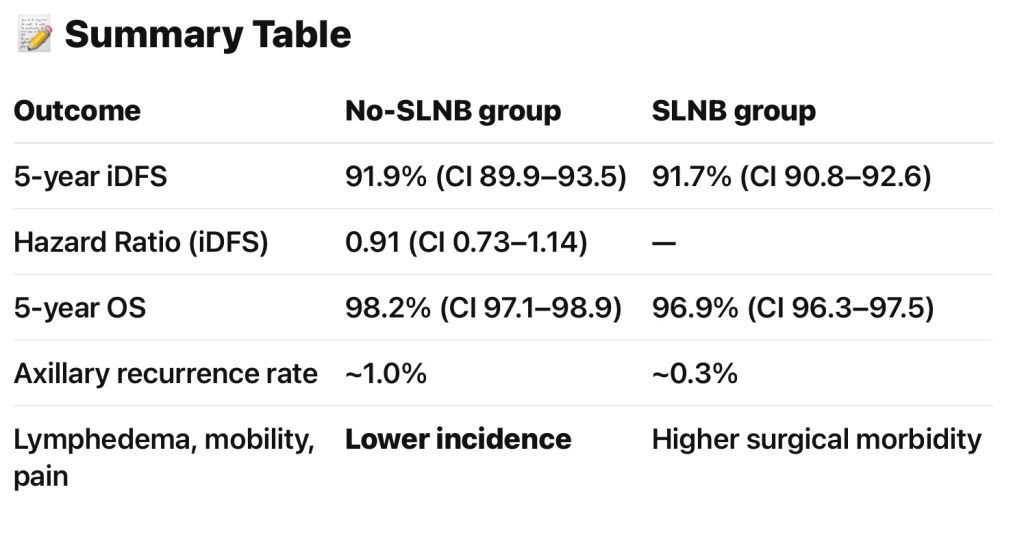
          • INSEMA: omission vs SLNB—lower arm symptoms; 5-yr iDFS 91.9% vs 91.7% (HR 0.91; NI met). 
  • Trial data:
    • Upfront surgery, cN0:
      • SOUND (JAMA Oncol 2023) – negative axillary US, tumor ≤ 2 cm
        • Design: SLNB vs no axillary surgery
        • Outcome: Non-inferior 5-yr distant DFS
        • Omission safe when nodal information won’t alter plan
        • Multinational, 18 centers (Italy / Spain / Switzerland / Chile)
      • INSEMA (NEJM 2025) – mostly BCS, cT1 to 2 cN0
        • Primary: 5-yr iDFS non-inferiority met (No axillary surgery 91.9% vs SLNB 91.7%; HR 0.91 [0.73–1.14])
        • OS ~ 98% vs 97%
        • Less arm morbidity if omitted
    • ASCO 2025 SLNB guideline update:
      • Allows omission of routine SLNB in selected stage I to II patients: ≥ 50 y, HR+ / HER2−, ≤ 2 cm, G1 to G2, negative axillary imaging, BCS + adjuvant therapy, and when nodal status won’t change systemic / RT
        • Shared decision-making emphasized
      • Limited SLN positivity (upfront):
        • ACSOG Z0011 (10-yr) – lumpectomy + WBRT, 1 to 2 positive SLN
          • 10-yr OS: 86.3% SLNB-alone vs 83.6% ALND
          • Regional failures < 1%
          • ALND not routine recommended 
        • IBCSG 23-01 (10-yr) – SLN micromets ≤ 2 mm:
          • No difference DFS; non-inferior to omit ALND
          • Axillary recurrences ~ 1.7% without cALND at 10 yrs
        • AMAROS – SLN+ randomized to ALND vs axillary RT:
          • Comparable control
          • Less lymphedema with RT (≈ 11% vs 23% at 5 yrs)
          • Consider RT instead of ALND
        • Neoadjuvant setting:
          • Z1071 / SENTINA / SN-FNAC – initially cN1→NAC→ycN0
          • FNR reduced by: clip + retrieve positive node (TAD), dual tracer, and retrieving ≥ 2 to 3 SLNs
          • If still cN+, ALND remains standard.
        • Radiation guidance (2025)
          • ASTRO-ASCO-SSO PMRT update (2025)
            Clarifies PMRT / RNI after upfront surgery and after NAC
          • Indicates when axillary RT is reasonable alternative to ALND in select SLN+ scenarios
          • Encourages moderate hypofractionation, details target volumes/boost
    • Practical algorithms (evidence-based):
      • Upfront cN0 (exam + negative axillary US):
        • Meets ASCO 2025 “omission” profile (≥ 50, HR+ / HER2−, ≤ 2 cm, G1 to G2) and BCS planned → Discuss omitting SLNB (SOUND Trial /INSEMA Trial) 
        • Not low-risk or mastectomy planned → SLNB (can later omit ALND depending on path)
      • SLNB results (upfront surgery):
        • 0 nodes+ → No further axillary surgery
        • 1 to 2 nodes+, lumpectomy + WBRT → Omit ALND (Z0011) or Axillary RT (AMAROS) if nodal coverage desired
        • Micromets (≤ 2 mm) → No ALND (IBCSG 23-01)
        • > 2 nodes+, gross ENE, no RT planned /possible, inflammatory BC, or T3 / T4 → ALND (plus consider RNI / PMRT)
      • NAC pathway:
        • Biopsy-proven cN1 → Clip positive node pre-NAC:
          • ycN0 after NAC → TAD (SLNB + clipped node removal) using dual tracer, aim ≥ 2 to 3 SLNs
          • If any positive or clip not retrieved, strong consideration for ALND (or RNI per MDT)
        • ycN+ → ALND (then RNI per PMRT guideline)
    • Numbers and pearls slide:
      • INSEMA:
        • 5-yearr iDFS 91.9% (omit) vs 91.7% (SLNB); HR 0.91 (NI met)
        • Lower arm morbidity with omission
      • SOUND:
        • Negative US + small tumors → no axillary surgery non-inferior to SLNB for distant DFS at 5 yrs
      • Z0011 (10-yr):
        • OS 86.3% SLNB-alone vs 83.6% ALND; regional recurrence < 1%
      • IBCSG 23-01 (10-yr):
        • Micromets – no ALND
        • Axillary recurrence ≈ 1.7% without cALND
      • AMAROS:
        • Lymphedema 23% ALND vs 11% axillary RT (5 yrs)
        • Similar control
      • Post-NAC accuracy:
        • TAD + dual tracer + ≥ 2 to 3 SLNs lowers FNR (vs SLNB alone)
      • ASTRO-ASCO-SSO 2025 PMRT:
        • When SLN+ and no ALND, RNI/PMRT often appropriate; specifics by burden / response 
  • Review Questions:
  • Can I omit SLNB in a 62-year-old, HR+ / HER2−, 1.3 cm IDC, negative axillary US, BCS?
    • Yes, option to omit per ASCO 2025 (criteria met) informed by SOUND and INSEMA; confirm that nodal information won’t change systemic / RT plan
  • What if the same patient is having a mastectomy
    • Generally perform SLNB (you lose SLNB opportunity later; pathology could upstage; influences RNI / PMRT)
  • Patient with 2 SLN+ undergoing lumpectomy – ALND or RT?
    • No routine ALND (Z0011)
    • Consider axillary RT (AMAROS) if you want nodal coverage with less lymphedema than ALND
  • Post-NAC cN1→ycN0 – how do I minimize FNR?
    • Do TAD: clip and retrieve the index node, dual tracers, retrieve ≥ 2 to 3 SLNs
    • If clip not found or any positive nodes → ALND (or RNI per MDT)
  • Which patients still truly need ALND today
    • Inflammatory BC
    • Persistent cN+ after NAC
    • > 2 SLN+ upfront
    • Gross ENE
    • When WBRT / RNI not feasible but regional control is required
  • How do the new PMRT guidelines affect axillary surgery choices?
    • 2025 ASTRO-ASCO-SSO:
      • Clearer indications for RNI / PMRT after upfront surgery and after NAC
      • Can replace ALND in select SLN+ cases – coordinate with radiation oncology


Choice of Radiosensitizer in Baseline Grade-2 Sensorineural Hearing Loss (SNHL) in Head and Neck Cancer

  • Rule of Thumb:
    • Avoid cisplatin in patients with grade ≥ 2 baseline hearing loss 
  • Cisplatin:
    • Is ototoxic and can cause irreversible worsening of SNHL:
      • Risk is cumulative and dose-dependent
  • Alternatives:
    • Cetuximab + Radiotherapy (RT):
      • NCCN-endorsed option for cisplatin-ineligible patients
      • Inferior to cisplatin in HPV-positive disease:
        • RTOG-1016, De-ESCALaTE trials:
          • But appropriate when platinum is contraindicated
  • Carboplatin-based chemoradiation:
    • Some centers use carboplatin (AUC 1 to 2 weekly) ± 5-FU or paclitaxel with RT:
      • Evidence less robust than cisplatin:
        • But can be considered when cetuximab is unsuitable
  • Practice Pearls:
    • Baseline audiogram required in all patients before starting cisplatin or alternatives
    • Avoid concurrent ototoxic drugs:
      • Loop diuretics, aminoglycosides, high-dose salicylates
    • Monitor hearing during therapy if any platinum agent is considered
  • References:
    • NCCN Clinical Practice Guidelines in Oncology: Head and Neck Cancers, Version 2025.
    • Ahn MJ, D’Cruz A, Vermorken JB, et al. Eligibility criteria for cisplatin in head and neck cancer: consensus recommendations. Lancet Oncol. 2016;17(8):e447–e456.
    • Gillison ML, Trotti AM, Harris J, et al. Radiotherapy plus cetuximab or cisplatin in HPV-positive oropharyngeal cancer (RTOG-1016). Lancet. 2019;393:40–50.
    • Mehanna H, et al. Radiotherapy plus cisplatin or cetuximab in low-risk HPV-positive oropharyngeal cancer (De-ESCALaTE). Lancet. 2019;393:51–60.

Safety of Omitting Radiotherapy After Lumpectomy in Early Breast Cancer — What the Randomized Evidence Says

Bottom line: In carefully selected patients (typically older, ER+/HER2–, node-negative, small tumors on endocrine therapy), skipping whole-breast radiotherapy (RT) raises local recurrence modestly but does not worsen overall survival in long-term randomized data. 

Key randomized signals (10-year):

• PRIME II (age ≥65, HR+, ≤3 cm, node-negative, endocrine therapy): local recurrence 9.5% without RT vs 0.9% with RT; no difference in distant recurrence or overall survival (~81% both arms). 

• CALGB 9343 (age ≥70, T1N0 ER+): local/regional control higher with RT (98% vs 90%) but no differences in time to mastectomy, distant metastasis, breast cancer-specific survival, or OS (67% vs 66%). 

Meta-analytic perspective: Syntheses focused on randomized trials consistently show RT substantially lowers local recurrence after breast-conserving surgery, with minimal or no OS impact in these low-risk cohorts—informing shared decisions when a patient prioritizes avoiding RT toxicity or logistics. 

Who may be appropriate to consider for omission?

• Age ≥65–70, ER+, HER2–, pT1, node-negative, clear margins, committed to endocrine therapy; ideally with a reassuring axillary assessment and low-risk biology. (Emerging prospective cohorts like LUMINA/IDEA support expanding biologic selection but are not RCTs.) 

Why this matters for patients:

• Fewer visits, less fatigue/dermatitis, and lower long-term toxicity burden—without sacrificing survival in the right subset. 

Practical takeaways for clinic:

Discuss omission for the classic low-risk profile above; quote absolute local-recurrence trade-offs (e.g., ~9–10% vs ~1% at 10 years in PRIME II).  If RT is preferred or biology is borderline, consider de-escalated RT (partial-breast or 5-fraction regimens) to cut burden while preserving control.  Use shared decision-making; align with patient goals, comorbidity, adherence to endocrine therapy, and imaging/pathology risk features. 

#BreastCancer #RadiationOncology #Deescalation #SharedDecisionMaking #Oncology

#Arrangoiz

2025 ASCO Guidance — Axillary Surgery De-escalation

  • When to omit SLNB (new, practice-changing):
    • ASCO now recommends not performing routine SLNB in a clearly defined low-risk subgroup if omitting nodal pathology will not change adjuvant plans:
      • Postmenopausal:
        • ≥ 50 years
      • HR-positive / HER2-negative
      • Grade 1 to 2
      • Tumor ≤ 2 cm (cT1)
      • Pre-op axillary ultrasound negative
      • Breast-conserving therapy planned
      • Team agrees systemic therapy and RT will not be altered by SLNB findings:
    • Recommendation built on SOUND and INSEMA randomized trials:
      • Observed outcomes in the RCTs:
        • Omission was non-inferior to SLNB for iDFS / distant DFS
        • Regional events were rare
        • Arm morbidity lower without surgery
    • ASCO also emphasizes:
      • Do not escalate or alter adjuvant systemic therapy or radiation just because SLNB was omitted:
        • Plan treatments as you would for this low-risk profile
  • When SLNB is still appropriate:
    • Outside the narrow “omit” criteria above:
      • >2 cm
      • High-grade
      • TNBC
      • HER2+
      • Multifocality affecting RT fields
      • No reliable AUS
      • Planned mastectomy where nodal information might change PMRT
    • After neoadjuvant therapy:
      • Initially cN0 or cN1→cN0:
        • ASCO continues to support SLNB (or targeted axillary dissection when appropriate) to document response:
          • The 2025 update centers on upfront surgery, don’t generalize omission to neoadjuvant settings
  • When to omit completion ALND:
    • 1 to 2 positive sentinel nodes after upfront surgery:
      • Continue to omit ALND with whole-breast RT (Z0011 / AMAROS era practice remains)
    • After mastectomy with 1 to 2 positive SNs and delivery of PMRT to chest wall + regional nodes:
      • ASCO supports omitting ALND (supported by SENOMAC data):
        • Coordinate fields with radiation oncology
  • Radiation interface (2025 ASTRO / ASCO / SSO PMRT update):
    • Joint 2025 PMRT guideline clarifies when PMRT / regional nodal irradiation is indicated and explicitly supports ALND omission if PMRT is given for 1 to 2 positive SNs post-mastectomy
    • Use multidisciplinary planning to balance coverage / toxicity when nodal pathology is limited or absent
  • Practical checklist for your clinic (BCT, upfront surgery):
    • AUS first:
      • If AUS negative and patient fits the low-risk profile above → discuss no SLNB
      • Document that omission won’t change systemic / RT plans
    • If AUS suspicious → needle sample:
      • Positive = manage per current standards:
        • SLNB ± targeted node or ALND / RT depending on context
        • If SLNB done and 1 to 2 SN+ → omit ALND:
          • Ensure appropriate RT fields (BCT) or PMRT (after mastectomy)
    • Neoadjuvant cases:
      • Do not translate “omit SLNB” from SOUND / INSEMA:
        • Use SLNB / TAD pathways
  • Pearls and Pitfalls:
    • Selection discipline matters:
      • The non-inferiority signal depends on accurate AUS triage and truly low-risk biology
    • Don’t “compensate” with extra RT or chemotherapy solely because you omitted SLNB:
      • ASCO warns against reflex escalation
    • Documentation:
      • Note eligibility criteria, shared decision discussion, and that omission won’t impact adjuvant choices
      • Monitor the edge cases (young age, lobular histology, multifocality):
        • Trials had limited power there:
          • Consider SLNB if nodal information could change RT / systemic therapy
  • Sources / key reads:
    • ASCO Guideline Update (2025) — SLNB in early breast cancer; ASCO Post summary with criteria and implementation notes. 
    • INSEMA (NEJM 2025) — Omission of axillary surgery vs SLNB; non-inferior iDFS, less morbidity. 
    • SOUND (JAMA Oncol 2023) — No axillary surgery vs SLNB in small tumors with negative AUS; non-inferior distant DFS. 
    • PMRT 2025 Joint Guideline (ASTRO/ASCO/SSO) — When to deliver PMRT and how it enables ALND omission with limited SN positivity after mastectomy.