Blog

While BRCA1 and BRCA2 are well known to be associated with breast cancer risk, a number of other genetic mutations also increase the risk of this disease.

High-penetrance genes include PTEN and p53. Other mutations such as those in CHEK2, ATM, and PALB2 are associated with moderate risk.

While the development of large-panel testing has allowed for the detection of many mutations that may be associated with increased risk, some are of very low penetrance. For example, STK11 was found to be associated with a pathogenic mutation in 0.01% of breast cancers.

Filippini SE, Vega A. Breast cancer genes: beyond BRCA1 and BRCA2. Front Biosci (Landmark Ed). 2013;18:1358-1372.

Lerner-Ellis J, Khalouei S, Sopik V, Narod SA. Genetic risk assessment and prevention: the role of genetic testing panels in breast cancer.

Expert Rev Anticancer Ther. 2015;15:1315-1326.

Patient Management Using Thyroseq V3

  • The ThyroSeq test results refine cancer probability in thyroid nodules with indeterminate cytology, informing the most appropriate management of these patients

There are two classes of negative test results:

ThyroSeq test result: NEGATIVE

  • According to the NCCN guidelines:
    • If molecular testing, in conjunction with clinical and ultrasound features:
      • Predicts a risk of cancer comparable to the risk of malignancy seen in a benign FNA cytology (approximately 5% or less):
        • Observation can be considered
    • Therefore, in those clinical situations where the pre-test probability of cancer in nodules with Bethesda III and IV cytology is less than 45%:
      • A negative ThyroSeq test results:
        • Would confer the cancer probability of 5% or less:
          • Justifying observation in lieu of surgical management in appropriately selected cases
        • Because the probability of cancer in such nodules is comparable to that of benign FNA cytology:
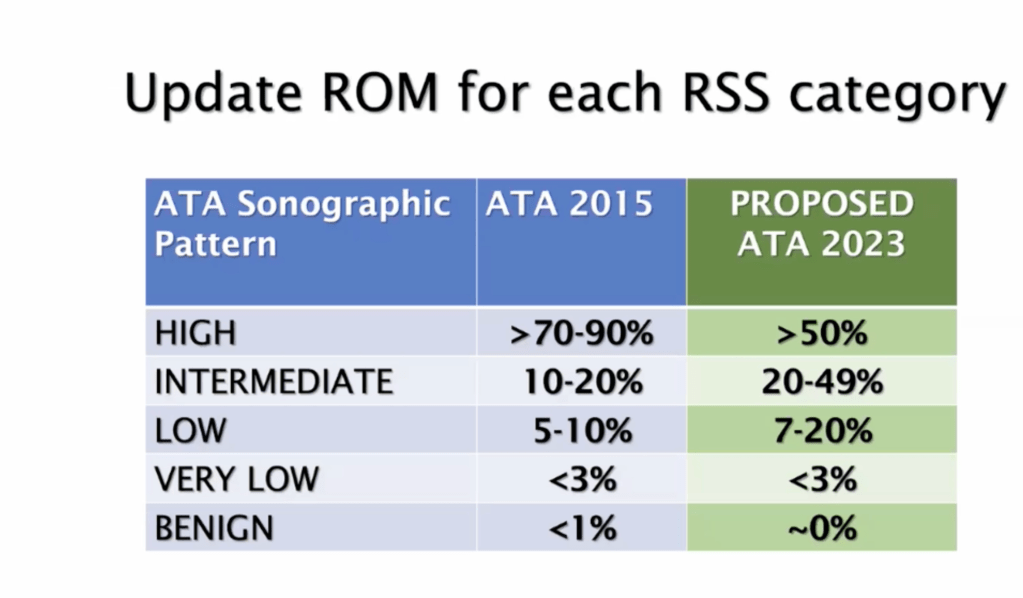
          • The management of patients may follow the recommendations for nodules with benign cytology, which, based on the 2015 ATA guidelines:
            • Should be determined based on ultrasound (US) pattern:
              • Specifically, the recommendation for nodules that have:
                • High suspicion US pattern:
                  • Is repeat US and US-guided FNA within 12 months
                • For nodules with low to intermediate suspicion US pattern:
                  • Repeat US at 12 to 24 months and if sonographic evidence of growth or development of new suspicious sonographic features, the FNA could be repeated or observation continued with repeat US, with repeat FNA in case of continued growth (ATA Recommendation #23)
  • In nodules with Bethesda V cytology and negative ThyroSeq result:
    • The residual cancer risk of approximately 20% does not allow to avoid surgical management:
      • Thyroid lobectomy may be sufficient initial treatment for many of these patients as the majority of these nodules are expected to be benign

ThyroSeq test result: CURRENTLY NEGATIVE

  • Test results are reported as currently negative:
    • When the sample is found positive for a low-risk gene mutation that alone is not sufficient for full cancer development (eg. PTEN, EIF1AX) and found in a subpopulation of cells\
    • Although at the time of sampling most of these nodules are benign:
      • Some of them may undergo clonal expansion and acquire additional mutations.
    • In the absence of high-suspicion US pattern or other clinical risk factors:
      • Many of these patients are likely to benefit from active surveillance with potential repeat of FNA and possibly molecular testing in 1 year.

ThyroSeq test result: POSITIVE

  • For these nodules, the type and level of mutation(s) provide further refinement of the probability of cancer and estimate cancer aggressiveness / risk:
    • According to the ATA risk stratification system for thyroid cancer:
      • The risk of structural disease recurrence can be:
        • Low (1% to 5%)
        • Intermediate (10% to 20%)
        • High (30% to 55%)
  • ThyroSeq test positive for an isolated RAS or RAS-like mutation:
    • Predicts a high probability (approximately 80%) of either:
      • Low-risk cancer or a pre-cancerous tumor, NIFTP.
    • Many of these nodules may be managed by therapeutic lobectomy:
      • Which is currently recommended by the ATA guidelines for low-risk papillary and follicular carcinomas (ATA Recommendation #35) and NIFTP
  • ThyroSeq test positive for an isolated BRAF V600E or BRAF V600E-like mutation:
    • Confers a very high (greater than 95%) probability of cancer that typically is of intermediate risk for recurrence:
      • According to the ATA guidelines:
        • BRAF-mutated less than 1 cm unifocal intrathyroidal carcinoma:
          • Is of low risk for disease recurrence:
            • Therefore may be treated with thyroid lobectomy alone
        • Whereas 1 cm to 4 cm intrathyroidal BRAF-positive PTC:
          • Is an intermediate-risk tumor:
            • Where total thyroidectomy or lobectomy should be considered based on clinical and US findings
  • ThyroSeq test positive for multiple high-risk mutations:
    • Is virtually diagnostic of cancer and predicts an elevated risk of disease recurrence
    • Most of these patients would likely benefit from:
      • Total thyroidectomy, with possible consideration for regional lymph node dissection if one of the mutations is BRAF V600E

#Arrangoiz #ThyroidSurgeon #ThyroidCancer #ThyroidExpert #CancerSurgeon #HeadandNeckSurgeon #ThyroidNodules #Thyroseq

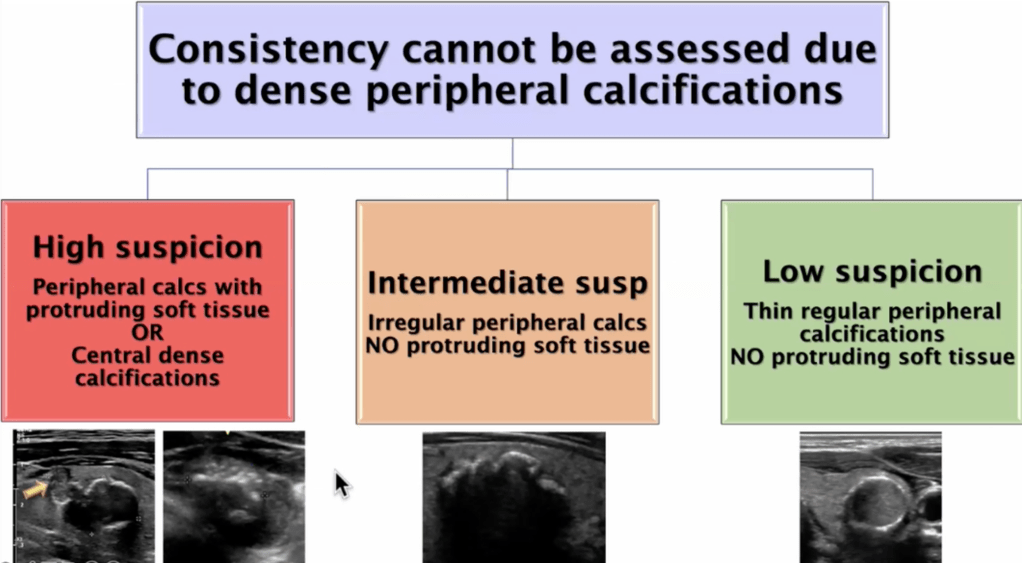
Thyroid Nodules with EggShell Calcifications

Disrupted Eggshell Calcifications have a higher risk of cancer

Genetics of Triple Negative Breast Cancer

  • TNBCs arising in BRCA1 carriers have many similarities with sporadic basal-like tumors:
    • There being considerable overlap in tumor phenotypes
  • Carriers of a deleterious BRCA1 mutation are more likely to have TNBCs than patients with sporadic cancers; in fact:
    • TNBC is the most common histologic subtype of breast cancer arising in BRCA1 mutation carriers
  • The likelihood that breast cancer in a BRCA1 carrier will be of the TNBC variety is high according to numerous authors:
    • 56% to 87%
    • 60% to 80%
    • 69%
  • Penault-Llorca and Viale report even higher rates:
    • Up to 90% of BRCA1-mutated tumors:
      • Being of the TNBC or basal type
    • For carriers of BRCA2, however:
      • Breast cancers are less likely to be TNBC:
        • 25%
  • Another question posed by several researchers is, what is the likelihood of a patient with TNBC being the carrier of a deleterious genetic mutation?
    • Couch and colleagues examined the frequency of gene mutations in 1,824 patients with TNBC unselected for family history of breast or ovarian cancer:
      • Moreover, 8.5% had mutations of BRCA1 and 2.7% had mutations in BRCA2
    • Deleterious mutations in 15 other predisposition genes were detected in 3.7%, including:
      • PALB2, BARD1, RAD51D, RAD51C, and BRIP1
    • No mutations were found in CHEK2, CDH1, or STK11
    • The frequency of BRCA mutations varied according to the patient’s age:
      • Of all the deleterious mutations detected in Couch and colleagues’ cohort:
        • 38% were found in patients with TNBC diagnosed at the age of less than 40 years
  • Wang and colleagues studied a group of 956 Chinese women with TNBC and found similar rates of BRCA1 and BRCA2 carrier status:
    • 7.1% and 2.3%, respectively
    • When examined by age, however, for patients aged 50 years or older:
      • The BRCA1 mutation rate was 10.5% compared with 3.7% for those aged older than 50 years
  • BRCA1 mutation carrier status in patients with TNBC also varies by ethnicity:
    • In women of Ashkenazi Jewish descent with TNBC:
      • Up to 29% were BRCA1 mutation carriers
  • Greenup and colleagues reported on 450 racially diverse patients with TNBC who had evaluable test results referred for genetic counseling to two academic hereditary cancer clinics:
    • Moreover, 30.8% patients carried a BRCA mutation, 23.5% BRCA1, 7% BRCA2, and one patient carried both BRCA1 and BRCA2
    • These authors also found differences in BRCA carrier status according to age and ethnicity:
      • In those patients diagnosed at less than 40 years of age, 44% were BRCA positive:
        • With majority being BRCA1 positive:
          • 84%, 54 patients
        • In that same age group 14% (nine patients) were BRCA2 positive
      • With regard to ethnicity, 20.4% of African American women were BRCA carriers, 20% of Hispanics, 33.3% of Caucasians, 28.5% of Asians, and

#Arrangoiz #CancerSurgeon #BreastSurgeon #SurgicalOncologist #ComplexSurgicalOncology #BreastCancer #TripleNegativeBreastCancer #TNBC #Miami #Mexico #Teacher #Surgeon #MountSinaiMedicalCenter #MSMC