Practice-Changing Insights from the SUPREMO Trial at the San Antonio Symposium

Practice-Changing Insights from the SUPREMO Trial at the San Antonio Symposium

The SUPREMO trial (Selective Use of Postoperative Radiotherapy After Mastectomy) presented its long-term results at the recent San Antonio Breast Cancer Symposium, marking a significant moment in the management of intermediate-risk breast cancer. As the only practice-changing presentation at the symposium, this trial provides robust evidence for the de-escalation of chest wall irradiation (CWI) in specific patient populations following mastectomy.

About the Trial:

SUPREMO is a phase III international, multicenter trial designed to assess whether CWI improves overall survival (OS) or reduces recurrence in intermediate-risk breast cancer patients. This group includes patients with tumors exhibiting certain characteristics that make the need for postoperative radiotherapy uncertain【1】【2】.

Key Findings (Median Follow-Up: 9.6 Years):

• Overall Survival (OS):

No statistically significant difference was observed in 10-year OS between patients receiving CWI (81.4%) and those who did not (82.0%). This confirms that CWI does not confer a survival advantage in this population【1】【2】【3】.

• Local Recurrence:

While CWI reduced the relative risk of chest wall recurrence by more than 50%, the absolute reduction in recurrence was less than 2%, deemed clinically insignificant for most patients【2】【3】.

• Subgroup Analysis:

Both node-negative patients (N0) and those with T1-T2 tumors with 1-3 positive lymph nodes (N1) demonstrated no OS advantage with CWI. This suggests that many intermediate-risk patients, previously considered candidates for postoperative radiotherapy, may safely omit this treatment【1】【3】.

Clinical Implications:

The SUPREMO trial supports a tailored, de-escalated approach to radiation therapy in intermediate-risk breast cancer patients. By identifying subgroups unlikely to benefit from CWI, clinicians can reduce treatment-related morbidity while maintaining excellent oncologic outcomes. Patients meeting the following eligibility criteria may particularly benefit from this evidence【1】【2】:

1. pT1-2, N1 Disease: Tumors ≤50 mm with 1-3 positive axillary lymph nodes.

2. pT3, N0 Disease: Tumors >50 mm with no nodal involvement.

3. High-Risk Features in Node-Negative Disease: Tumors >20 mm but ≤50 mm with grade 3 histology and/or lymphovascular invasion (LVI).

Context and Broader Impact:

These findings align with an ongoing shift toward de-escalation strategies in oncology, prioritizing individualized treatment plans that balance efficacy and quality of life. The trial provides additional support for reducing overtreatment, especially in light of advancements in systemic therapies, which may further mitigate recurrence risk in intermediate-risk breast cancer【3】【4】.

Future Directions:

While SUPREMO guides practice for intermediate-risk patients, further research is needed to refine the role of radiotherapy in other subgroups, including those with high-risk features or specific molecular subtypes. Additionally, long-term follow-up beyond 10 years will provide further clarity on late recurrences and survival outcomes【4】.

References:

1. Kunkler, I. H., et al. Postmastectomy Radiotherapy for Intermediate-Risk Breast Cancer: Results from the SUPREMO Trial. Lancet Oncology, 2023.

2. San Antonio Breast Cancer Symposium 2023. SUPREMO Trial Results. [Conference Abstracts and Presentations].

3. Kunkler, I. H., et al. Radiotherapy De-Escalation in Breast Cancer: Lessons from SUPREMO. Journal of Clinical Oncology, 2023.

4. Smith, B. D., et al. Tailored Radiotherapy Approaches in Breast Cancer. Nature Reviews Clinical Oncology, 2023.

Absolute Benefit for Adjuvant Chemotherapy in Early Breast Cancer

  • Data from the Early Breast Cancer Trialists’ Collaborative Group:
    • Meta-analysis of adjuvant systemic therapy trials begun in or before 1995:

      • Show a 30% relative reduction:
        • In breast cancer-related mortality:
          • Associated with adjuvant hormonal therapy and with adjuvant chemotherapy
      • Reduced rates of ipsilateral local recurrence, contralateral cancers, and distant metastases in treated patients:
        • Suggest there is eradication of occult residual disease in many patients
      • The absolute survival benefit of adjuvant therapy:
        • Is greater in node-positive than in node-negative patients
      • The absolute survival benefit of chemotherapy:
        • Is greater for younger (less than 50 years of age) than for older women (50 to 69 years of age)
  • References:
    • Early Breast Cancer Trialists’ Collaborative Group (EBCTCG). Effects of chemotherapy and hormonal therapy for early breast cancer on recurrence and 15-year survival: an overview of the randomized trials. Lancet. 2005;365(9472):1687-1717.
    • Berry DA, Cronin KA, Plevritis SK, et al. Effect of screening and adjuvant therapy on mortality from breast cancer. N Engl J Med. 2005;353(17):1784-1792.

Predicting Survival Outcomes: The Updated AJCC/TNM Staging System

  • In October 2016:
    • The AJCC (www.cancerstaging.org) published the eighth edition of the AJCC / TNM cancer staging system:
      • Which replaced the seventh edition that had been used by clinicians, cancer registries, and researchers since 2009
    • On January 1st, 2018:
      • Tumor registries officially began using the eighth edition for tumor staging
  • Whereas the staging tables for medullary thyroid cancer and anaplastic thyroid cancer:
    • Showed only minimal changes:
      • The rules for the staging of well-differentiated thyroid cancer underwent substantial modifications
  • These included the following:
    • An increase of the age cutoff from 45 years to 55 years of age at diagnosis
    • Removal of microscopic extrathyroidal extension as a key component of the staging system
    • No longer mandating assignment of stage III to older patients with microscopic extrathyroidal extension or lymph node metastases
    • Establishment of a new T3b category for tumors of any size that demonstrate gross extrathyroidal extension involving only the surrounding strap muscles
  • The AJCC Differentiated Thyroid Cancer Committee carefully considered the possibility of inclusion of molecular markers (specifically, BRAFV600E and TERTpromoter mutations) in the AJCC prognostic staging definitions:
    • Whereas both of these mutations, particularly when present together, have been shown to be predictors of poor clinical outcomes:
      • They appeared to add only marginal benefit to the traditional anatomic staging factors:
        • Thus, molecular characterization of differentiated thyroid cancers, although providing some prognostic information, were not powerful enough factors to merit upstaging tumors to prognostic stages above those mandated by TNM risk factors
        • Nonetheless, similar to the approach used in the ATA risk-stratification system, molecular results can be used to refine further and individualize risk within risk categories or stages
  • The three critical factors that determine the prognostic stage groups of the eighth edition AJCC / TNM cancer staging system include the:
    • Age at diagnosis
    • The presence or absence of distant metastases
    • The presence or absence of gross extrathyroidal extension
  • Rather than the use of the standard TNM staging tables provided in the AJCC / TNM manual:
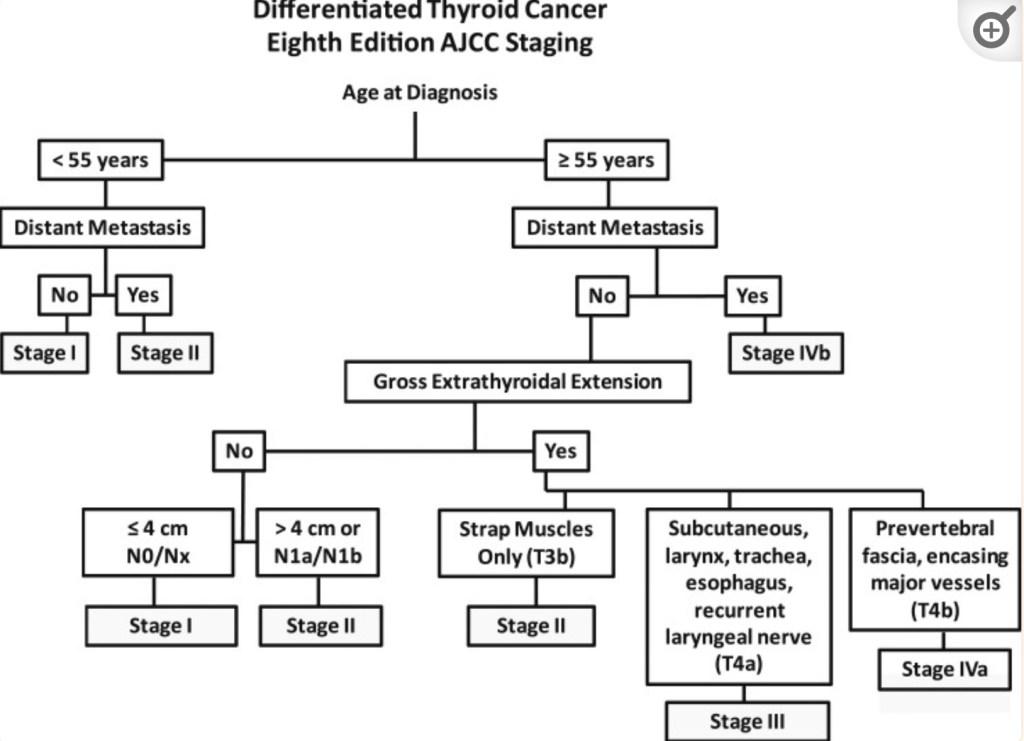
    • Tuttle el al find it easier to use the flow diagram in Figure 1 to stage patients rapidly based on the key clinical risk factors:
      • Age at diagnosis
      • Distant metastasis
      • Gross extrathyroidal extension
      • Lymph node metastases
  • In patients age < 55 years:
    • This figure rapidly classifies patients as either:
      • Stage I (any T, any N, M0)
      • Stage II (any T, any N, M1)
  • In patients age > 55 years:
    • In the older patients, additional factors, such as the presence or absence of distant metastasis, invasion of strap muscles, and extent of gross extrathyroidal extension, are also used to define the prognostic stage groups
  • In the eighth edition of the AJCC / TNM cancer staging system:
    • It was anticipated that the majority of patients would be classified as stage I or stage II:
      • Reflecting the excellent outcomes expected in the majority of thyroid cancer patients
      • A smaller number of patients, particularly the older patients with either distant metastases or gross extrathyroidal extension:
        • Were anticipated to do worse and are therefore classified as stage III or IV
  • Multiple publications have demonstrated that the eighth edition of the AJCC / TNM cancer staging system:
    • Moved a substantial number of patients into lower prognostic stage groups without affecting the overall survival of those lower-stage groups
    • The patients who remained in the higher-stage groups had poorer prognoses, as expected
    • This resulted in a much better separation of the four prognostic stage groups with respect to survival:
      • Such that 5- to 10-year disease-specific survival (DSS) was:
        • 99% in stage I patients
        • 88% to 97% in stage II patients
        • 72% to 85% in stage III patients
        • 67% to 72% in stage IV patients
  • Unlike previous editions of the AJCC / TNM staging system in which there was substantial overlap in survival in patients with stage I, II, and III disease:
    • The eighth edition provides meaningful separation among the prognostic stage groups that appear to be clinically relevant
    • The differences in predicted and published ∼10-year survival rates are best seen when analyzed based on age group (age <55 years vs age ≥55 years):
      • The predicted 10-year DSS has been validated for all age and stage groups, with only the younger (age < 55 years) stage II patients appearing to do more poorly than anticipated
      • The lower-than-anticipated 10-year DSS in the younger patients (age < 55 years) with stage II disease was the result of the stage migration of patients in the 45- to 55-year age group from seventh edition AJCC stage IV to eighth edition AJCC stage II
Figure 1: A simplified approach to AJCC staging in differentiated thyroid cancer, emphasizing the critical decision nodes, which include age at diagnosis, distant metastasis, and gross extrathyroidal extensions.

Risk Stratification in Highly Suspicious Thyroid Nodules or Cytologically Confirmed Primary Papillary Thyroid Cancer

  • Risk stratification begins:
    • Immediately upon identification of a suspicious thyroid nodule
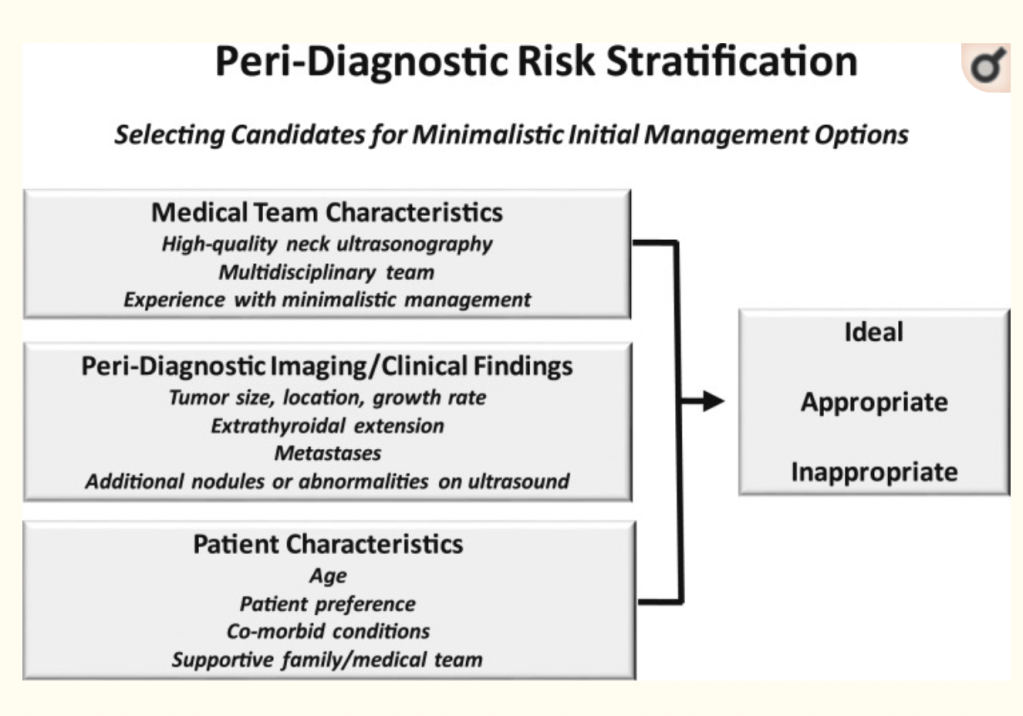
  • In the absence of a validated peri-diagnostic risk-stratification system, I use a clinical framework that incorporates:
    • Tumor imaging characteristics, medical team characteristics, and patient preferences to risk stratify patients as:
      • Ideal
      • Appropriate
      • Inappropriate for minimalistic initial management options:
        • Such as active surveillance or thyroid lobectomy
        • This clinical framework address the key factors that differentiate actionable from non-actionable disease
Peri-diagnostic risk stratification considers medical team characteristics, imaging/clinical findings, and patient characteristics to classify patients as ideal, appropriate, or inappropriate for a minimalistic initial management approach.

#Arrangoiz #ThyroidSurgeon #ThyroidExpert #ThyroidCancer #DynamicRiskStartification #HeadandNeckSurgeon #CancerSurgeon #MountSinaiMedicalCenter #MSMC

Neoadjuvant Chemotherapy in Breast Cancer

  • The administration of neoadjuvant chemotherapy (NAC):
    • Offers several advantages in locally advanced breast cancer:
      • It allows for downstaging the disease:
      • Which can potentially allow for less extensive surgery in the breast and axilla
    • It also provides information regarding the responsiveness of the cancer to systemic therapy while the tumor remains in vivo:
      • Which can guide the course of therapy
  • Administering chemotherapy in the neoadjuvant vs. adjuvant setting:
    • Does not change overall survival:
      • As demonstrated in the National Surgical Adjuvant Breast and Bowel Project (NSABP) B-18 and NSABP B-27 trials
  • The patient’s response to chemotherapy:
    • However, does offer prognostic information:
      • Particularly in patients with hormone receptor negative (HR-) disease
  • Patients who achieve pathologic complete response (pCR):
    • Which is typically defined as no residual invasive disease in the breast or axilla:
      • Appear to have improved event-free survival (EFS) and overall survival (OS) compared with patients with residual disease
      • This finding was demonstrated by a recent meta-analysis that included 36 studies including 5,768 patients with HER2 positive breast cancer:
        • This correlation was strongest in patients with HR- disease
      • Further, among patients with HER2 positive disease that do not have a pCR:
        • The degree of residual cancer burden appears to correlate with outcomes
  • Patients with HER2 positive tumors:
    • May complete up to 1 year of HER2-targeted therapy with trastuzamab ± pertuzamab
  • When planning surgery:
    • The pre-treatment volume does not need to be excised if the tumor has responded to chemotherapy:
      • However if multifocal disease is present, the satellite lesion(s) should be localized and excised with the index lesion
    • When considering the appropriateness for breast conservation following NAC, the distance between the lesions, location, and breast size must be considered
    • Placement of clips in the index lesion and any satellite lesions prior to initiation of NAC is critical for appropriate surgical planning post-NAC
  • References:
    • Rastogi P, Anderson SJ, Bear HD. Preoperative chemotherapy: updates of National Surgical Adjuvant Breast and Bowel Project Protocols B-18 and B-27. J Clin Oncol. 2008; 10;26(5):778-785.
    • Broglio KR, Quintana M, Foster M, et al. Association of pathologic complete response to neoadjuvant therapy in HER2-positive breast cancer with long-term outcomes: a meta-analysis. JAMA Oncol. 2016;2(6):751-760.
    • Symmans WF, Wei C, Gould R, et al. Long-term prognostic risk after neoadjuvant chemotherapy associated with residual cancer burden and breast cancer subtype. J Clin Oncol. 2017;35(10):1049-1060.
    • Boughey JC, Peintinger F, Meric-Bernstam F, et al. Impact of preoperative versus postoperative chemotherapy on the extent and number of surgical procedures in patients treated in randomized clinical trials for breast cancer. Ann Surg.2006;244(3):464-470.

Adenoid Cystic Carcinoma (ACC) of the Breast

  • Adenoid cystic carcinoma (ACC) of the breast:
    • Is a very rare special histological type of breast cancer:
      • Accounting for approximately 0.1% of all breast tumors
    • It is usually triple negative
    • It is much less likely to have nodal involvement
    • Is more common in postmenopausal women:
      • Most cases are in females
      • The median age of onset is:
        • Between 50 and 60 years
      • With a mean age of 66
    • The typical clinical feature is:
      • A single breast tumor / mass:
        • Multiple nodules are rare
      • Most ACCs are located:
        • Under the areola or in the upper outer quadrants
    • ACC of the breast has no characteristic imaging findings:
      • Ultrasound features are those of:
        • A hypoechoic solid or heterogeneous mass
      • On mammography:
        • The case may present as a lobulated mass with sharp or un sharp margins
      • Nevertheless, these clinical and radiographic features may be similar to any breast cancer:
        • Thus making their precise diagnosis difficult for radiologists
    • Histologically:
      • ACC of the breast typically consists of a dual-cell population of:
        • Luminal and myoepithelial-basal cells:
          • Which are generally negative for estrogen receptor (ER), progesterone receptor (PR), and human epidermal growth factor receptor 2 (HER2)
      • In addition, some studies have also reported some HR-positive ACC cases:
        • The significance of a positive hormone receptor status is not known:
          • Compared with ACC with negative HR expression, the clinical characteristics and prognosis of this type of ACC are also unknown
    • Distant metastases are rare:
      • However, the lung is the most common site
    • It has a better prognosis than infiltrating ductal triple negative breast cancer:
      • With a 5-year overall survival rate of 88%
      • As prognosis is good:
        • Accurate preoperative diagnosis is important in the determination of suitable treatment
  • References
  • Treitl D, Radkani P, Rizer M, El Hussein S, Paramo JC, Mesko TW. Adenoid cystic carcinoma of the breast, 20 years of experience in a single center with review of literature. Breast Cancer. 2018;25(1)28-33.
  • Welsh JL, Keeney MG, Hoskin TL, et al. Is axillary surgery beneficial for patients with adenoid cystic carcinoma of the breast? J Surg Oncol. 2017;116(6):690-695.
  • Kulkarni N, Pezzi CM, Greif JM, et al. Rare breast cancer: 933 adenoid cystic carcinomas from the National Cancer Data Base. Ann Surg Oncol. 2013;20(7):2236-2241.
  • Kshirsagar AY, Wader JV, Langade YB, Jadhav KP, Zaware SU, Shekhar N. Adenoid cystic carcinoma of the male breast. Int Surg (2006) 91(4):234–6.
  • Pang W, Wang Z, Jin X, Zhang Q. Adenoid cystic carcinoma of the breast in a male: A case report. Med (Baltimore) (2019) 98(32):e16760. doi: 10.1097/MD.0000000000016760
  • Tang W, Peng WJ, Gu YJ, Zhu H, Jiang TT, Li C. Imaging Manifestation of Adenoid Cystic Carcinoma of the Breast. J Comput Assist Tomogr (2015) 39(4):523–30. doi: 10.1097/RCT.
  • Torrao MM, da Costa JM, Ferreira E, da Silva MV, Paiva I, Lopes C. Adenoid cystic carcinoma of the breast. Breast J (2007) 13(2):206.
  • Marchio C, Weigelt B, Reis-Filho JS. Adenoid cystic carcinomas of the breast and salivary glands (or ‘The strange case of Dr Jekyll and Mr Hyde’ of exocrine gland carcinomas). J Clin Pathol (2010) 63(3):220–8. doi: 10.1136/jcp.2009.073908

#Arrangoiz @BreastSurgeon #BreastCancer #AdenocysticCarcinomaoftheBreast #ACC #SurgicalOncologist #CASO #CenterforAdvancedSurgicalOncology #Miami

Management of Early Breast Cancer

  • National Comprehensive Cancer Network (NCCN) guidelines:
    • Recommend surgical management:
      • For local control for women with early stage invasive breast cancer
    • Several studies have shown an equivalence in overall and / or breast cancer-specific survival rates:
      • For breast conservation with radiation compared to mastectomy among early stage breast cancer patients
    • For patients with ER positive disease:
      • Endocrine therapy with tamoxifen or aromatase inhibitors is prescribed after surgery:
        • A systematic review evaluated the efficacy of primary endocrine therapy alone versus surgery in women over 70 years old with operable tumors:
          • The review reported similar survival between the two groups, but women treated with surgery had lower rates of local failure when compared to endocrine therapy alone
          • The authors concluded that primary endocrine therapy should be reserved for women who are unfit for surgery or decline surgery
    • Sentinel node biopsy:
      • Has become the standard method for staging the axilla in women with early stage breast cancer:
        • Who are clinically node negative
      • Axillary dissection is only performed in women with:
        • Documented nodal involvement
        • Inflammatory breast cancers
        • Those who fail lymphatic mapping
  • References:
    • National Comprehensive Cancer Network. Breast Cancer. 2014; https://www.nccn.org/professionals/physician_gls/pdf/breast.pdf. Accessed 8/28/2024, 2024
    • Fisher B, Anderson S, Bryant J, et al. Twenty-year followup of a randomized trial comparing total mastectomy, lumpectomy, and lumpectomy plus irradiation for the treatment of invasive breast cancer. New Engl J Med. 2002;347(16):1233-1241.
    • Litiere S, Werutsky G, Fentiman IS, et al. Breast-conserving therapy versus mastectomy for stage I-II breast cancer: 20 year followup of the EORTC 10801 phase 3 randomized trial. Lancet Oncol. 2012;13(4):412-419.
    • Veronesi U, Cascinelli N, Mariani L, et al. Twenty-year follow-up of a randomized study comparing breast-conserving surgery with radical mastectomy for early breast cancer. New Engl J Med. 2002;347(16):1227-1232.
    • Morgan J, Wyld L, Collins KA, Reed MW. Surgery versus primary endocrine therapy for operable primary breast cancer in elderly women (70 years plus). Cochrane Database Syst Rev. 2014(5). https://www.cochrane.org/CD004272/BREASTCA_surgery-versus-primary-endocrine-therapy-for-elderly-women-with-operable-primary-breast-cancer Accessed August 25, 2019.

Pathologic Nipple Discharge

  • Pathologic nipple discharge:
    • Is characteristically spontaneous, unilateral, or bloody
  • Physiologic discharge:
    • Is non-spontaneous, bilateral, and milk
  • The most common causes for pathologic nipple discharge:
    • Are benign:
      • Intraductal papillomas
      • Duct ectasia
  • The presence of abnormal clinical findings on imaging or physical exam:
    • Is associated with increased risk of malignancy:
      • 38% vs. 2%
  • Contemporary workup for nipple discharge includes:
    • Mammography
    • Evaluation of the retroareolar region with ultrasound
  • Patients with normal findings on mammography, ultrasound, and physical exam:
    • Can be further evaluated with breast MRI:
      • As it is highly sensitive and specific for cancer
  • Surgical management of nipple discharge includes:
    • Excision of a single duct or central duct apparatus:
      • Depending on the number of ducts involved
  • References:
    • Li GZ, Wong SM, Lester S, Nakhlis F. Evaluating the risk of underlying malignancy in patients with pathologic nipple discharge. Breast J. 2018;24(4):624-627.
    • de Paula IB, Campos AM. Breast imaging in patients with nipple discharge. Radiol. Bras. 2017;50(6):383-388.
    • Yilmaz R, Bender O, Celik Yabul F, Dursun M, Tunaci M, Acunas G. Diagnosis of nipple discharge: value of magnetic resonance imaging and ultrasonography in comparison with ductoscopy. Balkan Med J. 2017;34(2):119-126.

Radiation Fractionation

  • Three important areas form the foundation for the evolving use of altered fractionation:
    • Tissue response
    • Duration of treatment
    • Fraction size and number
  • Acutely responding tissues:
    • Are rather active in ongoing cellular proliferation
    • Most tumors (except perhaps prostate cancer, breast cancers, and melanoma) and some normal tissues such as skin, mucous membranes, and gastrointestinal epithelium:
      • Share this characteristic:
        • These tissues are most affected by the overall treatment duration rather than by the size or number of fractions used
  • Late-responding tissues:
    • Have a low proliferative rate and include the spinal cord, brain, bone, and cartilage
    • These tissues are most affected by the:
      • Size and number of fractions rather than by treatment duration:
        • Therefore are spared by decreasing the dose per fraction of radiation delivered
  • Because most tumors consist of rapidly dividing cells:
    • Local tumor control is strongly dependent on the overall treatment duration rather than on the size or number of fractions
  • When squamous cell carcinoma of the head and neck is exposed to radiation:
    • The less radiosensitive cells within the lesion:
      • Can undergo rapid proliferation:
        • Approximately 3 to 5 weeks after treatment commences
        • This accelerated repopulation can overwhelm the ongoing treatment effects of radiation:
          • Which ultimately can lead to local failure
        • The clinical significance of this phenomenon is that even with significant regression of the primary tumor mass:
          • Local failure still ultimately could result from proliferation of these resistant clones
        • Therefore it is essential to complete treatment in as short a time as possible so that accelerated repopulation is minimized:
          • Increasing the chance for local control
      • For this reason, split-course radiation:
        • Which incorporates a treatment break during the course of radiotherapy is not recommended
  • Based on the aforementioned principles:
    • The goal of altered fractionation schemes:
      • Is to improve the therapeutic ratio by maximizing the tumoricidal effect and minimizing acute and late toxicities while using readily available low-LET radiation
  • Two major categories of altered fractionation schemes exist:
    • Hyperfractionation
    • Accelerated fractionation
  • They share basic radiobiological principles yet have their own particular features (Table)
  • Accelerated fractionation:
    • Is the strategy of choice for rapidly proliferative tumors
    • Accelerated fractionation is based on the concept that the shortened overall treatment time:
      • Would reduce the opportunity for accelerated repopulation effectively
  • Hyperfractionation:
    • Is preferred for slowly proliferating tumors
    • Hyperfractionation improves the therapeutic ratio primarily through:
      • Redistribution of tumor cells into more radiosensitive phases as a result of multiple fractions
      • Differential sparing of late-responding normal tissues because of a decrease in the size of the dose per fraction

Contralateral Prophylactic Mastectomy (CPM) American Society of Breast Surgeon Guidelines

  • Current consensus guidelines from the American Society of Breast Surgeons:
    • Do not recommend CPM for women with sporadic breast cancers
  • A Cochrane review of 8 studies evaluating patients who underwent CPM:
    • Concluded that while CPM reduces risk of contralateral breast cancer:
      • It is not associated with improved survival
  • Reasons for not recommending CPM include:
    • A low estimated risk of cancer in the contralateral breast (2% to 6% over 10 years)
    • Increased complication rates
    • Studies showing that CPM does not improve survival or recurrence from the index cancer
  • References:
    • Lostumbo L, Carbine N, Wallace J, Ko H. Prophylactic mastectomy for the prevention of breast cancer. Cochrane Database Syst Rev 2004(4):CD002748.
    • Boughey JC, Attai DJ, Chen SL, et al. Contralateral prophylactic mastectomy consensus statement from the american society of breast surgeons: additional considerations and a framework for shared decision making. Ann Surg Oncol. 2016;23(10):3106-3111