
- Lobular neoplasia:
- Is an atypical proliferation of small, dyscohesive epithelial cell:
- Within the terminal duct lobular unit (TDLU):
- That encompasses both:
- Atypical lobular hyperplasia (ALH) and lobular carcinoma in situ (LCIS)
- That encompasses both:
- Within the terminal duct lobular unit (TDLU):
- Is an atypical proliferation of small, dyscohesive epithelial cell:
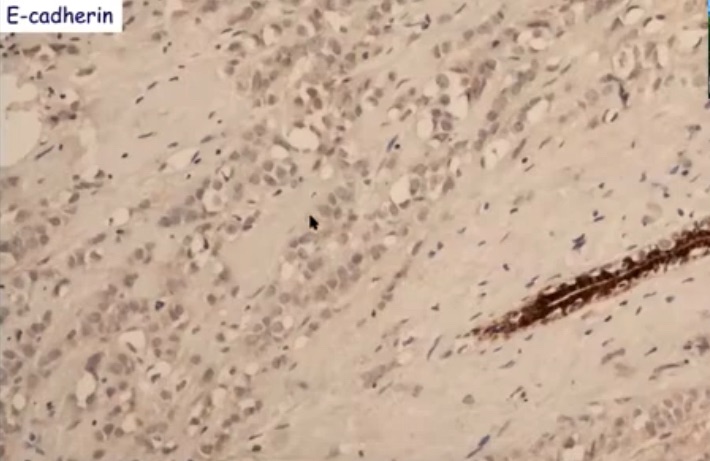
- The hallmark feature is:
- Loss of E-cadherin expression:
- Resulting in cellular discohesion
- Loss of E-cadherin expression:
- Lobular neoplasia:
- Functions as both a:
- Risk factor and non-obligate precursor to invasive breast carcinoma:
- With LCIS conferring a 7-to-10-fold increased risk of breast cancer compared to the general population
- Risk factor and non-obligate precursor to invasive breast carcinoma:
- Functions as both a:
- Definition and Classification:
- The distinction between ALH and LCIS:
- Is based on the extent of involvement:
- ALH shows < 50% of acini in the affected TDLU distended by lobular proliferation
- LCIS shows > 50% of acini in the affected TDLU distended by lobular proliferation with complete filling of at least one lobular unit
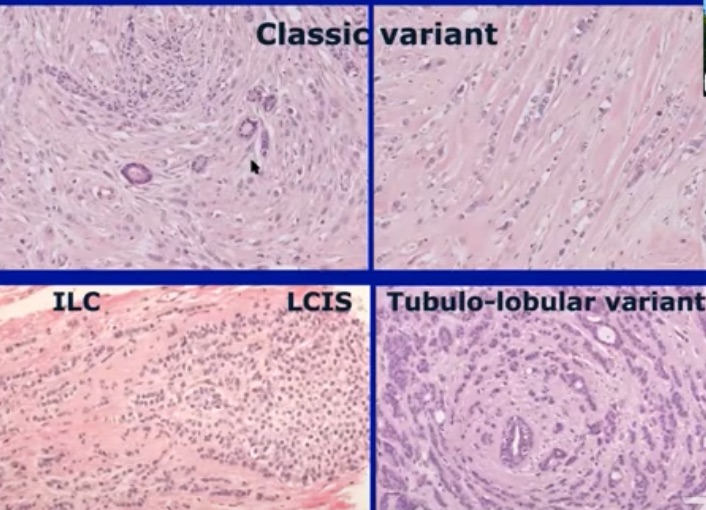
- LCIS is further subdivided into three subtypes:
- Classic LCIS:
- Small, monomorphic, non-cohesive cells
- Typically hormone receptor-positive and HER2-negative
- Pleomorphic LCIS (PLCIS):
- Greater nuclear pleomorphism, abundant cytoplasm
- May be HER2-positive
- Florid LCIS (FLCIS):
- LCIS with necrosis and calcifications
- Classic LCIS:
- Is based on the extent of involvement:
- The distinction between ALH and LCIS:
- Imaging Diagnosis:
- Classic lobular neoplasia (ALH and classic LCIS):
- Is usually not visible on imaging and is typically diagnosed incidentally
- When imaging abnormalities are present, the most common findings include:
- Mammography:
- Grouped amorphous calcifications (most common – 80% of cases)
- Ultrasound:
- Irregular, hypoechoic, avascular masses with posterior shadowing (uncommon)
- MRI:
- Heterogeneous non-mass-like enhancement with persistent kinetics
- Mammography:
- In contrast, FLCIS and PLCIS are typically imaging targets:
- Most often manifesting as calcifications
- Scrupulous radiologic-pathologic correlation is essential for appropriate management decisions
- Classic lobular neoplasia (ALH and classic LCIS):
- Evidence-Based Management:
- Management depends on the subtype and radiologic-pathologic concordance:
- Classic LN (ALH and Classic LCIS) on concordant core biopsy:
- Surveillance with imaging is now considered safe and appropriate
- Surgical excision is not routinely required when radiologic-pathologic correlation is concordant
- Studies show upgrade rates of only 0% to 5% for pure classic LN with concordant imaging
- One large series showed 3-year conservative management failure rate of only 6.2%, with no same-quadrant cancers developing
- Indications for surgical excision:
- Radiologic-pathologic discordance
- Concurrent high-risk lesions
- Pleomorphic LCIS:
- Requires excision:
- With consideration for negative margins due to high upgrade rates
- Requires excision:
- Florid LCIS:
- Requires complete surgical excision due to high upgrade rates to invasive carcinoma
- Classic LN (ALH and Classic LCIS) on concordant core biopsy:
- Management depends on the subtype and radiologic-pathologic concordance:
- Long-term risk management:
- Annual breast cancer risk of 1% to 2% with LCIS diagnosis
- Chemoprevention should be recommended to reduce risk
- Enhanced surveillance:
- High-risk imaging screening:
- Annual mammography plus MRI for appropriate candidates
- High-risk imaging screening:
- Bilateral prophylactic mastectomy is an option for select high-risk patients
- Upgrade rates vary by study but range from 0% to 13% for classic LN when radiologic-pathologic correlation is performed
- Most upgrades occur when discordance exists or when other high-risk lesions are present:
- The decision between surveillance and excision should involve shared decision-making with consideration of personal and family history, patient preferences, and institutional protocols
- References:
- Lobular Carcinoma in Situ: Diagnostic Criteria and Molecular Correlates. Sokolova A, Lakhani SR. Modern Pathology : An Official Journal of the United States and Canadian Academy of Pathology, Inc. 2021;34(Suppl 1):8-14. doi:10.1038/s41379-020-00689-3.
- Non-Invasive Lobular Neoplasia: Review and Updates. Tjendra Y, Susnik B. Seminars in Diagnostic Pathology. 2025;42(4):150883. doi:10.1016/j.semdp.2025.150883.
- Lobular Neoplasia of the Breast Revisited With Emphasis on the Role of E-Cadherin Immunohistochemistry. Dabbs DJ, Schnitt SJ, Geyer FC, et al. The American Journal of Surgical Pathology. 2013;37(7):e1-11. doi:10.1097/PAS.0b013e3182918a2b.
- Lobular Neoplasia. Lunt L, Coogan A, Perez CB. The Surgical Clinics of North America. 2022;102(6):947-963. doi:10.1016/j.suc.2022.07.001.
- Recommendations for Women With Lobular Carcinoma in Situ (LCIS). Oppong BA, King TA. Oncology (Williston Park, N.Y.). 2011;25(11):1051-6, 1058.
- Atypical Hyperplasia of the Breast — Risk Assessment and Management Options. Hartmann LC, Degnim AC, Santen RJ, Dupont WD, Ghosh K. The New England Journal of Medicine. 2015;372(1):78-89. doi:10.1056/NEJMsr1407164.
- Management of Lobular Neoplasia Diagnosed by Core Biopsy. Jani C, Lotz M, Keates S, et al. The Breast Journal. 2023;2023:8185446. doi:10.1155/2023/8185446.
- Update on Lobular Neoplasia. Heller SL, Gao Y. Radiographics : A Review Publication of the Radiological Society of North America, Inc. 2023;43(10):e220188. doi:10.1148/rg.220188.
- Lobular Carcinoma in Situ of the Breast: Clinical, Radiological, and Pathological Correlation. Scoggins M, Krishnamurthy S, Santiago L, Yang W. Academic Radiology. 2013;20(4):463-70. doi:10.1016/j.acra.2012.08.020.
Atypical Ductal Hyperplasia and Lobular Neoplasia: Update and Easing of Guidelines. Lewin AA, Mercado CL. AJR. American Journal of Roentgenology. 2020;214(2):265-275. doi:10.2214/AJR.19.21991. - Society of surgical oncology medical student & trainee primer for breast surgical oncology. Marissa K. Boyle, Julia M. Selfridge, Rachel E. Sargent, et al.
- Atypical Lobular Hyperplasia and Classic Lobular Carcinoma in Situ Can Be Safely Managed Without Surgical Excision. Laws A, Katlin F, Nakhlis F, et al. Annals of Surgical Oncology. 2022;29(3):1660-1667. doi:10.1245/s10434-021-10827-z.
- Observation Versus Excision of Lobular Neoplasia on Core Needle Biopsy of the Breast. Schmidt H, Arditi B, Wooster M, et al. Breast Cancer Research and Treatment. 2018;168(3):649-654. doi:10.1007/s10549-017-4629-2.
- Lobular Intraepithelial Neoplasia: Outcomes and Optimal Management. Boland PA, Dunne EC, Kovanaite A, et al. The Breast Journal. 2020;26(12):2383-2390. doi:10.1111/tbj.14117.





 Rodrigo Arrangoiz MS, MD, FACS, FSSO