My name is Rodrigo Arrangoiz I am a breast surgeon/ thyroid surgeon / parathyroid surgeon / head and neck surgeon / surgical oncologist that works at Center for Advanced Surgical Oncology in Miami, Florida.
I was trained as a surgeon at Michigan State University from (2005 to 2010) where I was a chief resident in 2010. My surgical oncology and head and neck training was performed at the Fox Chase Cancer Center in Philadelphia from 2010 to 2012. At the same time I underwent a masters in science (Clinical research for health professionals) at the University of Drexel. Through the International Federation of Head and Neck Societies / Memorial Sloan Kettering Cancer Center I performed a two year head and neck surgery and oncology / endocrine fellowship that ended in 2016.
Mi nombre es Rodrigo Arrangoiz, soy cirujano oncólogo / cirujano de tumores de cabeza y cuello / cirujano endocrino que trabaja Center for Advanced Surgical Oncology en Miami, Florida.
Fui entrenado como cirujano en Michigan State University (2005 a 2010 ) donde fui jefe de residentes en 2010. Mi formación en oncología quirúrgica y e n tumores de cabeza y cuello se realizó en el Fox Chase Cancer Center en Filadelfia de 2010 a 2012. Al mismo tiempo, me sometí a una maestría en ciencias (investigación clínica para profesionales de la salud) en la Universidad de Drexel. A través de la Federación Internacional de Sociedades de Cabeza y Cuello / Memorial Sloan Kettering Cancer Center realicé una sub especialidad en cirugía de cabeza y cuello / cirugia endocrina de dos años que terminó en 2016.
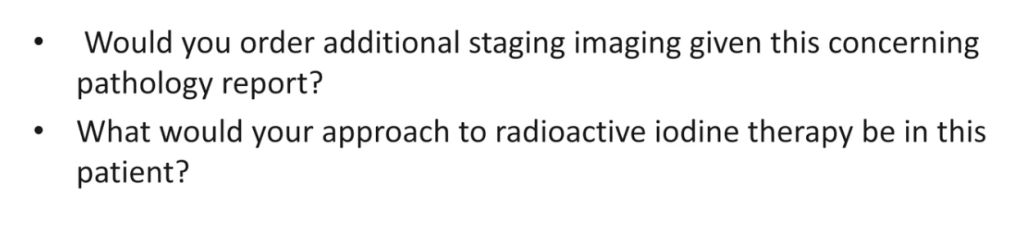
US Guided FNA Performed. Very close look at the central and lateral compartment lymph nodes on ultrasound, may be CT scan of the neck with IV contrast.
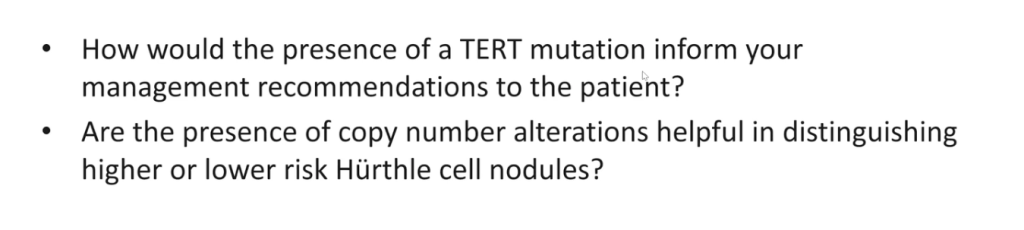
CT scan of the neck and chest, in the future may be PET/CT scan. Postoperative radiation iodine management.
That was likely classified as acinic cell carcinoma in the past
The tumor has striking histologic and molecular similarities:
To secretory carcinoma of the breast
Secretory carcinoma of the breast (SC):
Has shown to have a recurrent balanced chromosomal translocation:
t(12;15) (p13;q25):
Which leads to an oncogenic fusion gene ETV6-NTRK3
This translocation is also present in MASC:
This fusion gene encodes a chimeric tyrosine kinase:
That is known to play an important role on its oncogenesis
Immunohistochemical similarities between MASC and SC of the breast also include:
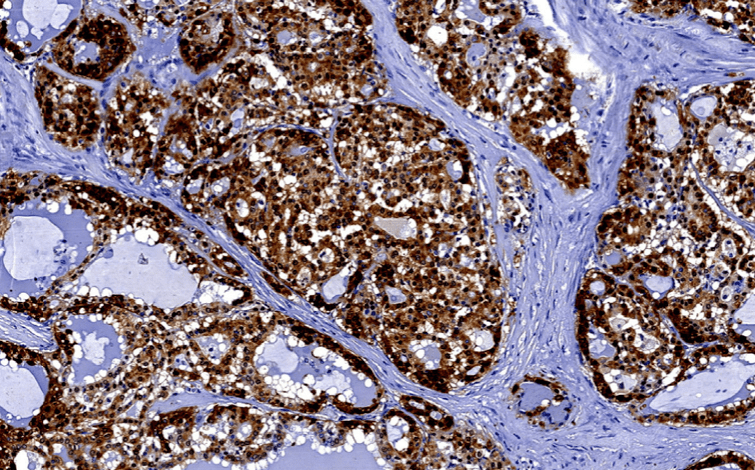
Being S100 protein, epithelial membrane antigen (EMA), and vimentin positive and “triple negative” (ER/PR/Her2 negative)
MASC predominantly affects:
Men and normally does not behave in an aggressive biology
The parotid gland is the most common affected gland by MASC
The official terminology of this entity:
Is now “secretory carcinoma”
At the histologic level:
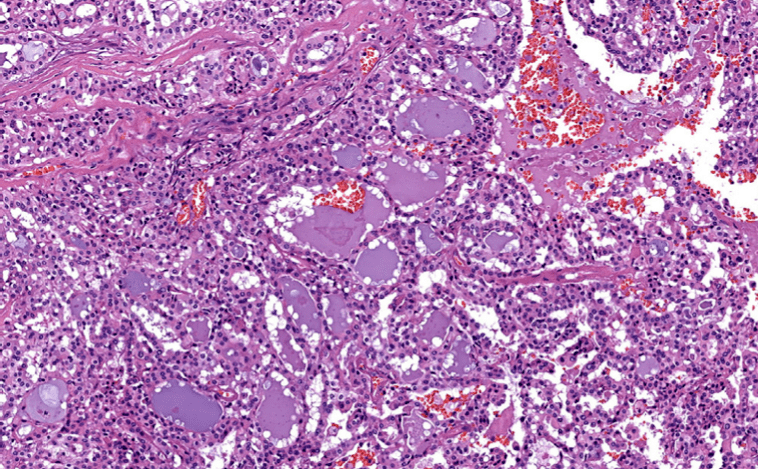
Tumor cells have eosinophilic or clear bubbly cytoplasm:
They may grow as tubules or microcysts, papillae, or macrocysts
Secretions are almost always present:
In the microcysts and / or macrocysts
MASC characteristically harbors:
A balancedchromosomal translocation (12, 15):
Resulting in the formation of the ETV6–NTRK3 fusion genes
Even though they have similar growth rate between MASC and ACC:
MASC is more likely to metastasize to the regional lymph nodes:
It should be considered as a more aggressive tumor compared with the regular low grade ACC
MASC usually presents as a painless:
It is a non-tender mass that increases in size overtime
The majority of MASC arise from the parotid gland;
Accounting for two thirds of the reported cases
The mean age for presentation of MASC is 47 years:
In contrast with SC of the breast that usually occurs in younger patients
MASC:
Is considered a low-grade carcinoma with a favorable prognosis:
According to Skálová et al:
It has moderate risk for local recurrence (15%)
Lymph node metastases (20%)
Low risk for distant metastases (5%)
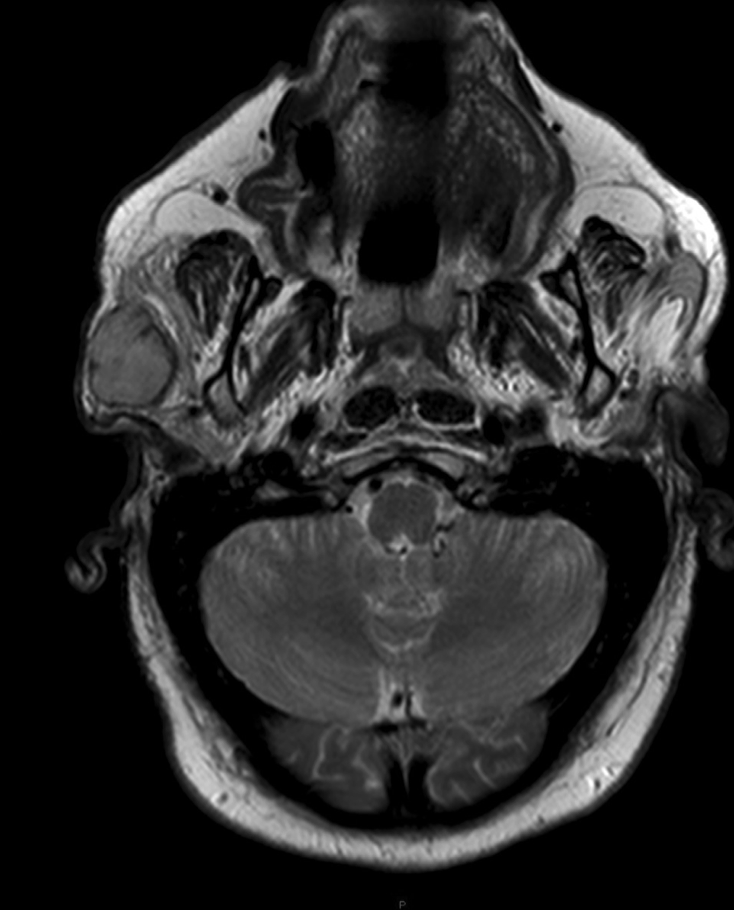
Neck magnetic resonance imaging of the head and neck showing the right parotid lesion.Superficial parotidectomy with preservation of the facial nerve.Hematoxylin and eosin staining.Immunohistochemical study for S-100 protein.