My name is Rodrigo Arrangoiz I am a breast surgeon/ thyroid surgeon / parathyroid surgeon / head and neck surgeon / surgical oncologist that works at Center for Advanced Surgical Oncology in Miami, Florida.
I was trained as a surgeon at Michigan State University from (2005 to 2010) where I was a chief resident in 2010. My surgical oncology and head and neck training was performed at the Fox Chase Cancer Center in Philadelphia from 2010 to 2012. At the same time I underwent a masters in science (Clinical research for health professionals) at the University of Drexel. Through the International Federation of Head and Neck Societies / Memorial Sloan Kettering Cancer Center I performed a two year head and neck surgery and oncology / endocrine fellowship that ended in 2016.
Mi nombre es Rodrigo Arrangoiz, soy cirujano oncólogo / cirujano de tumores de cabeza y cuello / cirujano endocrino que trabaja Center for Advanced Surgical Oncology en Miami, Florida.
Fui entrenado como cirujano en Michigan State University (2005 a 2010 ) donde fui jefe de residentes en 2010. Mi formación en oncología quirúrgica y e n tumores de cabeza y cuello se realizó en el Fox Chase Cancer Center en Filadelfia de 2010 a 2012. Al mismo tiempo, me sometí a una maestría en ciencias (investigación clínica para profesionales de la salud) en la Universidad de Drexel. A través de la Federación Internacional de Sociedades de Cabeza y Cuello / Memorial Sloan Kettering Cancer Center realicé una sub especialidad en cirugía de cabeza y cuello / cirugia endocrina de dos años que terminó en 2016.
The use of an aromatase inhibitor (letrozole) with an inhibitor of the cyclin dependent kinases 4 and 6 (ribociclib) was compared with aromatase inhibitor alone in postmenopausal women with hormone receptor positive HER2-negative metastatic breast cancer in the MONALEESA-2 study
Results showed with the addition of ribociclib to letrozole alone:
An improvement in:
Progression-free survival (PFS):
From 42.2% to 63%
Overall response rate:
From 37.1% to 52.7%
This regimen was also investigated in premenopausal women with advanced, hormone receptor-positive breast cancer, and improved PFS compared with placebo plus endocrine therapy
References
1. Hortobagi GN, Stemmer SM, Burris HA, Yap YS, Sonke GS, Paluch-Shimon S, et al. Ribociclib as first-line therapy for HR-positive, advanced breast cancer. N Engl J Med.2016;375(18)1738-1748.
2. Tripathy D, Im SA2, Colleoni M3, Franke F4, Bardia A5, Harbeck Nm et al. Ribociclib plus endocrine therapy for premenopausal women with hormone-receptor-positive, advanced breast cancer (MONALEESA-7): a randomised phase 3 trial. Lancet Oncol. 2018;19(7):904-915.
The 21-gene recurrence score assay is a gene-expression assay that provides prognostic and predictive information in hormone receptor positive breast cancer.
The recurrence score based on the 21-gene assay ranges from 0 to 100 and is predictive of chemotherapy benefit when it is higher than 25.
References
1. Sparano JA et al, N Engl J Med 2018 Sparano JA, Gray RJ, Makower DF, Pritchard KI, Albain KS, Hayes DF, et al. Adjuvant chemotherapy guided by a 21-gene expression assay in breast cancer. N Engl J Med 2018;379(2):111-121.
2. Paik S, Tang G, Shak S, Kim C, Baker J, Kim W, et al. Gene expression and benefit of chemotherapy in women with node-negative, estrogen receptor-positive breast cancer. J Clin Oncol; 2006;24(23):3726-3734
Purpose: Using a 2 × 2 factorial design, we studied the adjuvant chemotherapy of women with axillary node–positive breast cancer to compare sequential doxorubicin (A), paclitaxel (T), and cyclophosphamide (C) with concurrent doxorubicin and cyclophosphamide (AC) followed by paclitaxel (T) for disease-free (DFS) and overall survival (OS); to determine whether the dose density of the agents improves DFS and OS; and to compare toxicities.
Patients and Methods: A total of 2,005 female patients were randomly assigned to receive one of the following regimens: (I) sequential A × 4 (doses) → T × 4 → C × 4 with doses every 3 weeks, (II) sequential A × 4 → T × 4 → C × 4 every 2 weeks with filgrastim, (III) concurrent AC × 4 → T × 4 every 3 weeks, or (IV) concurrent AC × 4 → T × 4 every 2 weeks with filgrastim.
Results: A protocol-specified analysis was performed at a median follow-up of 36 months: 315 patients had experienced relapse or died, compared with 515 expected treatment failures. Dose-dense treatment improved the primary end point, DFS (risk ratio [RR] = 0.74; P = .010), and OS (RR = 0.69; P= .013). Four-year DFS was 82% for the dose-dense regimens and 75% for the others. There was no difference in either DFS or OS between the concurrent and sequential schedules. There was no interaction between density and sequence. Severe neutropenia was less frequent in patients who received the dose-dense regimens.
Conclusion: Dose density improves clinical outcomes significantly, despite the lower than expected number of events at this time. Sequential chemotherapy is as effective as concurrent chemotherapy.
Sentinel Lymph Node Surgery After Neoadjuvant Chemotherapy in Patients With Node-Positive Breast CancerThe ACOSOG Z1071 (Alliance) Clinical Trial
According to the Z1071 study, for patients who had positive nodes pre-chemotherapy and then had a sentinel node biopsy, the false-positive rate was less than 10% if dual tracer was used, greater than two sentinel nodes were removed, and any clipped nodes were included.
If only one lymph node was removed, the false-negative rate was unacceptably high and further axillary surgery was needed. Until the Alliance 11202 trial is completed, the standard treatment remains an axillary dissection for positive nodes after chemotherapy.
References
Boughey JC, Suman VJ, Mittendorf EA, et al. Sentinel lymph node surgery after neoadjuvant chemotherapy in patients with node-positive breast cancer: The ACOSOG Z1071 (Alliance) Clinical Trial. JAMA. 2013; 310(14): 1455-1461. doi: 10.1001/jama.2013.278932.
Primary treatment with concurrent chemotherapy and radiation:
Has been accepted widely as a standard of care:
Since the publication of the Meta-Analysis of Chemotherapy on Head and Neck Cancer in 2000
This meta-analysis was later updated in 2009:
Involving an analysis of 50 trials that showed an absolute survival benefit of 6.5% at 5 years:
Associated with administering chemotherapy concurrently with radiation
Bolus cisplatin (100 mg/m2 on days 1, 22, and 43) concurrent with radiation therapy:
Has been extensively studied and may be considered the standard to which other chemotherapy regimens are compared in clinical research
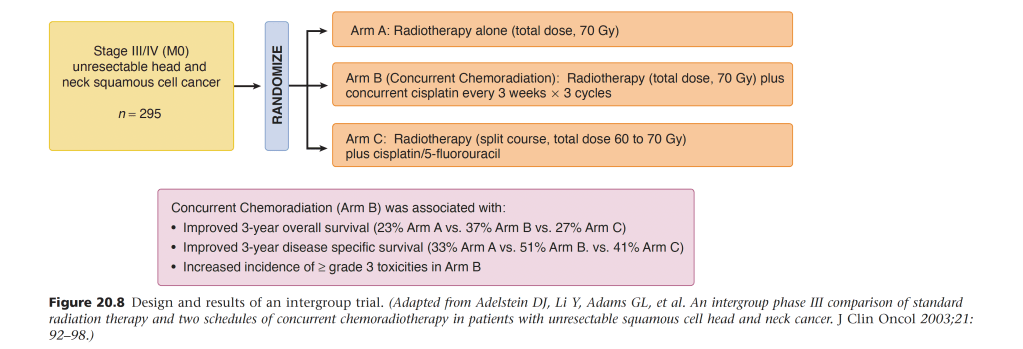
The intergroup trial conducted by Adelstein and colleagues was influential in establishing this regimen as a standard of care (Figure):
In a three-arm randomized phase III trial of 295 patients:
With locally advanced stage M0 head and neck squamous cell carcinoma (SCC):
The treatment groups were:
Radiation therapy alone (70 Gy) versus
Identical radiation plus concurrent cisplatin (100 mg/ m2 administered intravenously on days 1, 22, and 43) versus a split course of radiation with cisplatin plus 5-FU
With a median follow up of 41 months:
The concurrent cisplatin / radiation arm had a significant advantage in survival at 3 years compared with radiation alone:
37% versus 23%, p = .014
Survival in the split-course concurrent arm (27%):
Was not significantly better than that in the radiation arm
This improved efficacy comes at the cost of an increased incidence of acute toxicities:
Including mucositis and nausea / vomiting
Four toxic deaths occurred among 95 patients enrolled in the cisplatin chemoradiation arm
The lifetime risk of breast cancer for women with deleterious BRCA1 mutations is 40% to 80% and the risk is slightly lower for BRCA2 carriers.
Mastectomy is the most effective prophylactic surgical measure to prevent the development of breast cancer; it reduces a woman’s risk by approximately 90% because a small amount of breast tissue must remain on the skin flaps for viability.
Women with BRCA1 mutations also have an approximate 40% lifetime risk of developing ovarian cancer, and bilateral salpingo-oophorectomy is recommended for prophylaxis.
Removal of the fallopian tubes with the ovaries is recommended because the risk of fallopian tube cancers is slightly higher for mutation carriers.
Oophorectomy does not completely eliminate the risk of abdominal epithelial cancers that behave like and are nearly indistinguishable from ovarian cancer.
In BRCA mutation carriers, there is a greater risk of primary peritoneal carcinoma, which behaves and is treated like ovarian cancer.
The patient should have bilaterial salpingo-oophorectomy once she has had her children or by age 40 years if she has not had children.
It is not recommended to wait until age 60 years to have this procedure, as ovarian cancer usually develops at a younger age.
The National Comprehensive Cancer Network (NCCN) recommendations for use of breast MRI for women with hereditary breast and ovarian cancer syndrome are annual screening with mammography, and breast MRI at alternating 6-month intervals.
MRI is not a substitute for mammography, however, as the modalities are complementary in BRCA-positive mutation carriers.
References:
Bradbury AR, Dignam JJ, Ibe CN, et al. How often do BRCA mutation carriers tell their young children of the family’s risk for cancer? A study of parental disclosure of BRCA mutations to minors and young adults. J Clin Oncol. 2007;25:3705-3711.
Hartmann LC, Schaid DJ, Woods JE, et al. Efficacy of bilateral prophylactic mastectomy in women with a family history of breast cancer. N Engl J Med. 1999;340:77-84.
Hemel D, Domcheck SM. Breast cancer predisposition syndromes. Hematol Oncol Clin North Am. 2010;24:799-814.
Kauff ND, Domchek SM, Friebel TM, et al. Risk-reducing salpingo-oophorectomy for the prevention of BRCA1- and BRCA2-associated breast and gynecologic cancer: a multicenter, prospective study. J Clin Oncol. 2008;26:1331-1337.
National Comprehensive Cancer Network. NCCN Clinical Practice Guidelines in Oncology Genetic/Familial High-Risk Assessment: Breast and Ovarian. Available at http://www.nccn.org.




















 Rodrigo Arrangoiz MS, MD, FACS, FSSO