

- Despite what most of the literature reports:
- PHPT is symptomatic in more than 95% of the cases:
- If proper attention is payed to the subtle symptoms and signs that this disease can produce due to the fluctuating calcium levels
- PHPT is symptomatic in more than 95% of the cases:
- The “classic”pentad of PHPT:
- Kidney stones, Painful bones, Abdominal groans, Psychic moans, and Fatigue overtones:
- Is rarely seen today since the advent and general use of automated blood analyzers in the early 1970s
- Kidney stones, Painful bones, Abdominal groans, Psychic moans, and Fatigue overtones:
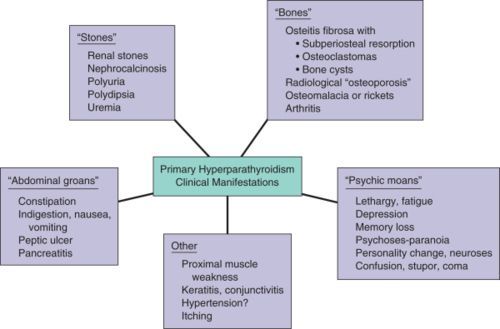
- Today most patients present with:
- Fatigue (# 1 symptom)
- General malaise
- Decrease levels of energy
- Anxiety
- Irritability leading to decrease social interaction
- Depression (10% of cases)
- Memory loss
- Decrease concentration
- Decrease ability to learn new things
- Decrease ability to complete daily tasks at home
- Decrease ability to complete daily tasks at work
- Decrease social interaction
- Insomnia
- Arthralgia’s (32% of the cases)
- Myalgia’s (14% to 41% of the cases)
- Bone pain
- Muscle weakness (specially proximal muscle groups)
- Intermittent headaches
- Polydipsia
- Polyuria
- Nocturia
- Nausea (24% of the cases)
- Anorexia (15% of the cases)
- Non-specific abdominal pain
- Heartburn (30% of the cases)
- Constipation (33% of the cases)
- Palpitations
- Arrhythmias (usually atrial fibrillation)
- Elevated blood pressure
- Thinning of the hair (specially in women in the frontal region)
- Pruritus

- Patients with PHPT also tend to score lower than healthy controls when evaluated by general multidimensional health assessment tools such as the Medical Outcomes Study Short-Form Health Survey(SF-36) and other specific questionnaires.
- PHPT that is truly “asymptomatic” is a rare occurrence:
- Seen in less than five percent of patients:
- This is important when talking about management based on current guidelines
- Seen in less than five percent of patients:
- Patients with PHPT have some degree of renal dysfunction or symptoms:
- In approximately 80% of the cases:
- The renal manifestations implicated with PHPT are:
- Decreased glomerular filtration rate
- Hypercalciuria
- Nephrolithiasis:
- Nephrolithiasis was previously reported in approximately 40% to 80% of patients but now occur only in about 20% to 25% of the cases:
- The pathophysiology is thought to be related to the filtered load of calcium in the glomerulus that increases proportionately with the degree of hypercalcaemia
- Most renal stones in patients with PHPT are composed of calcium oxalate, although slightly alkaline urine may favor the precipitation of calcium phosphate stones:
- Stone formers are more likely to be hypercalciuric, but less than one-third of the hypercalciuric patients with PHPT actually develop renal stones
- Hypercalciuria is not a predictor of nephrolithiasis in patients with PHPT and is no longer considered as an indication for surgery
- Nephrolithiasis was previously reported in approximately 40% to 80% of patients but now occur only in about 20% to 25% of the cases:
- Nephrocalcinosis
- Impaired urinary concentrating ability sometimes leading to polyuria, polydipsia, and nocturia
- Reduced fractional phosphate reabsorption leading to hypophosphatemia
- Increased urinary exertion of magnesium
- The renal manifestations implicated with PHPT are:
- In approximately 80% of the cases:
Rodrigo Arrangoiz MS, MD, FACS, FSSO head and neck surgeon that specializes in parathyroid diseases that is a member of Mount Sinai Medical Center
-
Rodrigo Arrangoiz MS, MD, FACS, FSSO is a member of the American Thyroid Association:

Publications:
-
Current Thinking on Primary Hyperparathyroidism
-
Does Vitamin D Deficiency Cause Primary
-
Primary Hyperparathyroidism and Thyroid Cancer: A Case Series
-
Parathyroid Embryology, Anatomy, and Pathophysiology of Primary Hyperparathyroidism
-
The return of the bilateral neck exploration for primary Hyperparathyroidism

 Rodrigo Arrangoiz MS, MD, FACS, FSSO