
The treatment landscape for HER2-positive early breast cancer (EBC) is evolving rapidly — and trastuzumab deruxtecan (T-DXd) is emerging as a potential new standard in both the neoadjuvant and adjuvant settings.
🔹 Neoadjuvant Setting
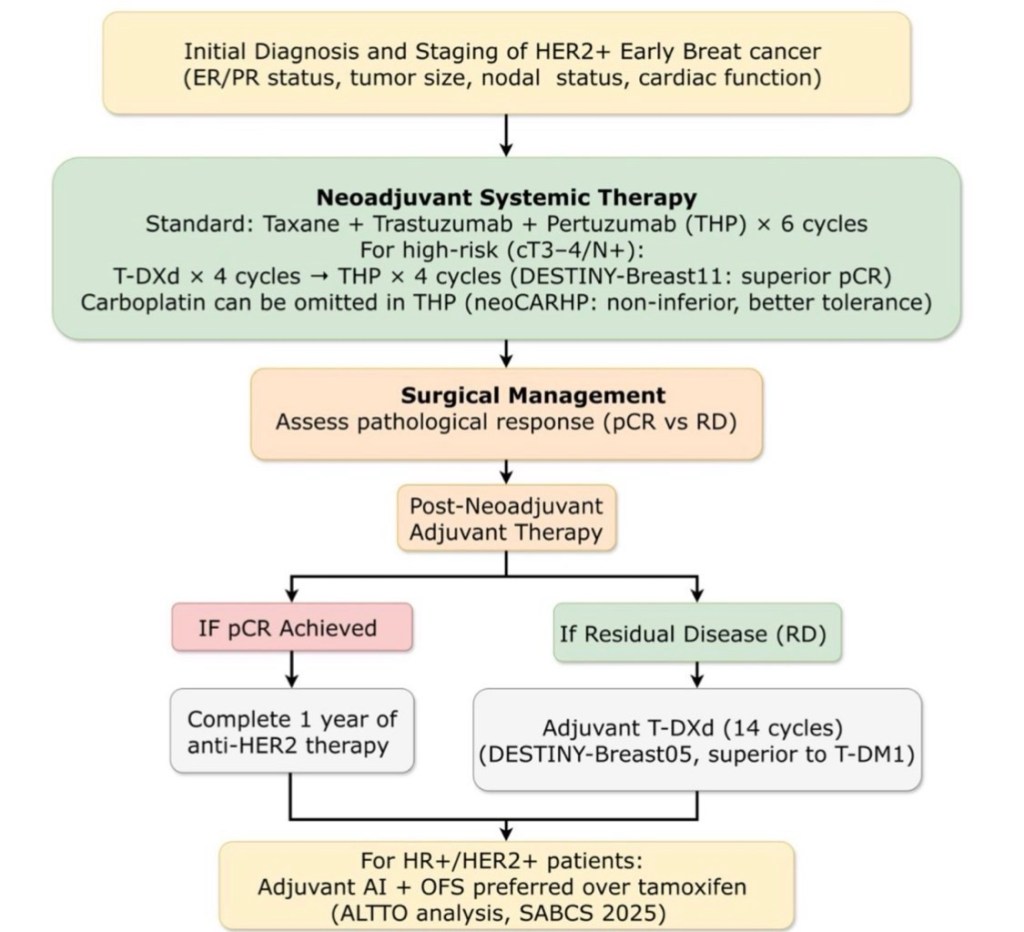
DESTINY-Breast11
T-DXd followed by THP (docetaxel + trastuzumab + pertuzumab) demonstrated:
Significantly higher pathologic complete response (pCR) rates compared with standard anthracycline-based regimens A chemotherapy-sparing strategy with reduced anthracycline exposure Favorable tolerability profile consistent with prior T-DXd data
📊 Early reports show pCR rates approaching ~65–70%, exceeding historical benchmarks for standard neoadjuvant regimens (typically ~55–60%).
Clinical Implication:
We may be entering an era of antibody–drug conjugate (ADC)-based neoadjuvant intensification, potentially redefining the backbone of HER2-directed therapy.
Reference:
Hurvitz SA et al. DESTINY-Breast11. Presented at ESMO 2024 / SABCS 2024 (late-breaking data).
🔹 Adjuvant Setting
DESTINY-Breast05
For patients with residual invasive disease after neoadjuvant therapy, T-DXd demonstrated:
53% reduction in risk of invasive disease–free survival (iDFS) events compared with T-DM1 Superior invasive disease–free survival Manageable toxicity, with ILD rates consistent with prior experience
This builds upon the paradigm established by KATHERINE, where T-DM1 replaced trastuzumab in patients with residual disease.
Now, T-DXd appears poised to replace T-DM1 in this high-risk population.
Reference:
DESTINY-Breast05. Presented at ASCO 2025.
von Minckwitz G et al. KATHERINE trial. NEJM. 2019;380:617–628.
🔬 Why This Matters
We are witnessing:
A shift from monoclonal antibodies → ADC-based escalation Earlier deployment of highly potent HER2-directed agents Refinement of risk-adapted therapy based on response
If adopted into guidelines (NCCN, ASCO, ESMO), this could:
Redefine the management of residual disease Potentially reduce recurrence risk further in high-risk HER2+ EBC Change neoadjuvant sequencing strategies
⚠️ Considerations
ILD/pneumonitis risk requires vigilance Cost-effectiveness and long-term survival data pending Optimal sequencing with pertuzumab still being clarified
📌 Bottom Line
T-DXd is no longer just a metastatic drug.
It is rapidly reshaping the curative-intent HER2+ early breast cancer algorithm.

 Rodrigo Arrangoiz MS, MD, FACS, FSSO