
- Arterial Anatomy of the Breast – A Practical Summary for Breast Surgeons
- Understanding the arterial supply of the breast is essential for:
- Oncologic resections
- Reconstructive planning
- Oncoplastic surgery
- Complication avoidance
- The breast receives a rich, redundant blood supply primarily from branches of the:
- Subclavian and axillary arterial systems:
- Which explains its generally good healing capacity:
- But also the risk of bleeding if anatomy is not respected
- Which explains its generally good healing capacity:
- Subclavian and axillary arterial systems:
- Understanding the arterial supply of the breast is essential for:
- Primary Arterial Sources:
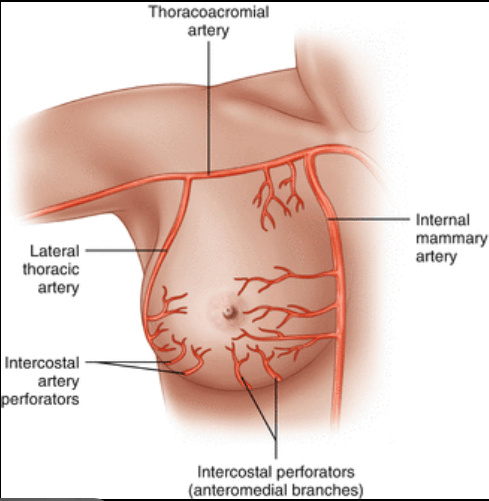
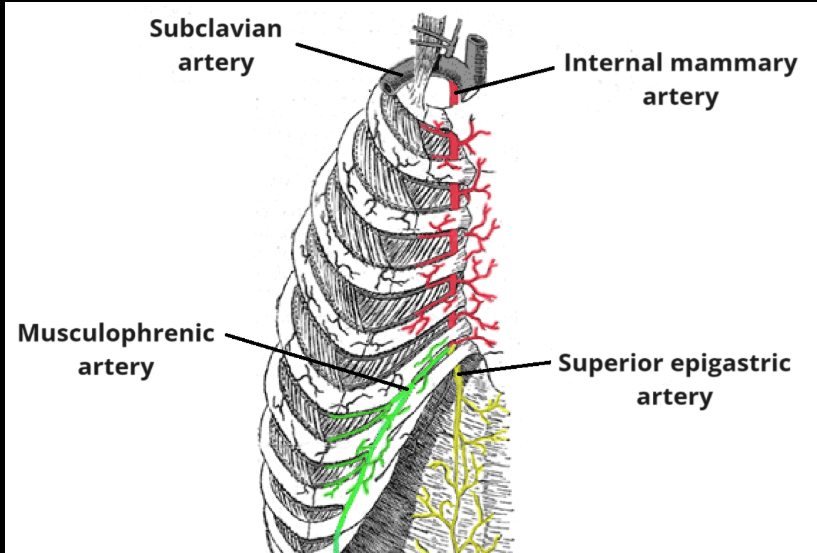
- Internal Mammary (Internal Thoracic) Artery:
- Most important medial blood supply to the breast
- Arises from the:
- Subclavian artery
- Gives rise to anterior intercostal perforators, especially:
- 2nd to 4th intercostal perforators:
- Dominant contributors
- 2nd to 4th intercostal perforators:
- Supplies:
- Medial breast
- Retroareolar complex
- Key surgical relevance:
- Critical during medial lumpectomies
- Important for nipple-areolar complex (NAC) viability
- Used as recipient vessels in free flap breast reconstruction
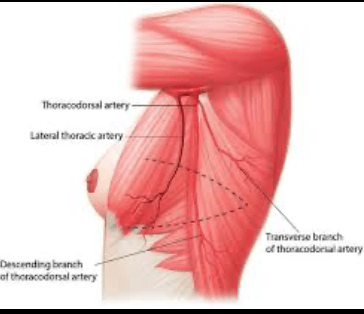
- Lateral Thoracic Artery:
- Branch of the axillary artery
- Runs along the lateral chest wall
- Supplies:
- Lateral breast
- Skin and glandular tissue
- Key surgical relevance:
- At risk during axillary dissection
- Important contributor in lateral oncoplastic flaps
- Thoracoacromial Artery (Pectoral Branch):
- Branch of the axillary artery
Supplies:- Upper outer quadrant
- Pectoralis major muscle
- Key surgical relevance:
- Important during subpectoral dissection:
- Preservation helps reduce skin flap ischemia
- Branch of the axillary artery
- Posterior Intercostal Arteries:
- Arise directly from the thoracic aorta
- Provide deep perforating branches
- Supply:
- Deep parenchyma
- Chest wall interface
- Key surgical relevance:
- Contribute to deep tissue perfusion
- Source of bleeding during deep resections
- Internal Mammary (Internal Thoracic) Artery:
- Perforator System and Anastomoses:
- The breast has an extensive subdermal and intraparenchymal anastomotic network
- Major perforators:
- Medial (internal mammary)
- Lateral (lateral thoracic)
- Clinical implications:
- Explains tolerance of wide local excisions
- Allows for oncoplastic rearrangements
- Supports skin- and nipple-sparing mastectomy when flaps are well designed
- Surgical Implications for Breast Surgeons:
- Breast-Conserving Surgery:
- Medial tumors:
- Respect internal mammary perforators
- Lateral tumors:
- Anticipate supply from lateral thoracic artery
- Medial tumors:
- Mastectomy (Skin- or Nipple-Sparing):
- Preserve:
- Subdermal plexus
- Medial perforators
- Excessive cautery near the NAC increases ischemia risk
- Preserve:
- Oncoplastic Surgery:
- Knowledge of arterial territories guides:
- Pedicle choice
- Flap orientation
- Central and medial pedicles rely heavily on internal mammary perforators
- Knowledge of arterial territories guides:
- Reconstruction:
- Internal mammary vessels are preferred recipient vessels for free flaps
- Axillary system preservation is important in implant-based reconstruction
- Breast-Conserving Surgery:
- Key Take-Home Points:
- Breast arterial supply is dual and redundant, centered on:
- Internal mammary system (medial dominance)
- Axillary system (lateral dominance)
- 2nd to 4th internal mammary perforators are the most critical vessels
- Surgical planning should always consider vascular territories, especially in:
- Re-operations
- Radiation-treated breasts
- Large resections or complex oncoplastic cases
- Breast arterial supply is dual and redundant, centered on:
- References:
- Arterial Anatomy of the Breast
- Cunningham L.The anatomy of the arteries and veins of the breast.
J Surg Oncol. 1977;9(1):71–85.
→ Classic anatomic description of breast vascular supply. - Salmon RJ. Vascularization of the breast and implications for surgery.
Surg Clin North Am. 1990;70(4):877–885.
→ Foundational surgical anatomy review. - Hall-Findlay EJ. Breast anatomy and vascular supply.
Clin Plast Surg. 2002;29(3):371–384.
→ Highly cited reference for oncoplastic and reconstructive surgery. - Sappey M. Traité d’Anatomie Descriptive. Paris: Delahaye; 1874.
→ Early detailed descriptions of breast perforators (historical reference). - Taylor GI, Palmer JH. The vascular territories (angiosomes) of the body.
Br J Plast Surg. 1987;40(2):113–141.
→ Angiosome concept applied to breast perfusion and flap design.
- Cunningham L.The anatomy of the arteries and veins of the breast.
- Internal Mammary & Perforator Anatomy:
- Cormack GC, Lamberty BG. The arterial anatomy of skin flaps.
Edinburgh: Churchill Livingstone; 1994.
→ Describes internal mammary perforators relevant to breast surgery. - Saint-Cyr M, Wong C, Schaverien M, et al. Perforator flaps: anatomy, technique, and clinical applications. Plast Reconstr Surg. 2009;124(1 Suppl):e1–e17.
→ Detailed perforator anatomy with relevance to NAC perfusion. - Hamdi M, Van Landuyt K, Monstrey S, Blondeel P. Pedicled perforator flaps in breast reconstruction. Semin Plast Surg. 2006;20(2):73–83.
- Cormack GC, Lamberty BG. The arterial anatomy of skin flaps.
- Surgical & Oncoplastic Relevance:
- Losken A, Hamdi M. Partial breast reconstruction: current perspectives. Plast Reconstr Surg. 2009;124(3):722–736.
→ Links vascular anatomy to oncoplastic pedicle choice. - Clough KB, Kaufman GJ, Nos C, Buccimazza I, Sarfati IM. Improving breast cancer surgery: a classification and quadrant-based approach. Plast Reconstr Surg. 2010;125(2):418–428.
- Mast BA. Breast reduction and mastopexy: pedicle selection and vascular considerations. Clin Plast Surg. 1996;23(3):567–576.
- Losken A, Hamdi M. Partial breast reconstruction: current perspectives. Plast Reconstr Surg. 2009;124(3):722–736.
- Nipple–Areolar Complex (NAC) Perfusion
- van Deventer PV, Graewe FR. Blood supply of the nipple–areolar complex. Plast Reconstr Surg. 1984;74(4):499–504.
- Russo V, Della Corte A, et al. Nipple–areola complex vascular anatomy and surgical implications. Aesthetic Plast Surg. 2017;41(2):267–274.
- Reconstruction-Focused References:
- Blondeel PN, Morris SF, Hallock GG, Neligan PC. Perforator Flaps: Anatomy, Technique, and Clinical Applications. St. Louis: Quality Medical Publishing; 2006.
- Nahabedian MY. Breast reconstruction and internal mammary vessels.
Plast Reconstr Surg. 2012;130(4):883–891.
- Arterial Anatomy of the Breast

 Rodrigo Arrangoiz MS, MD, FACS, FSSO