
- Perhaps one of the most striking advances in breast cancer management and understanding:
- Came with the molecular profiling of breast cancer:
- Characterizing four distinct subtypes:
- Based on the landmark paper by Perou et al., in 2000
- Characterizing four distinct subtypes:
- Came with the molecular profiling of breast cancer:
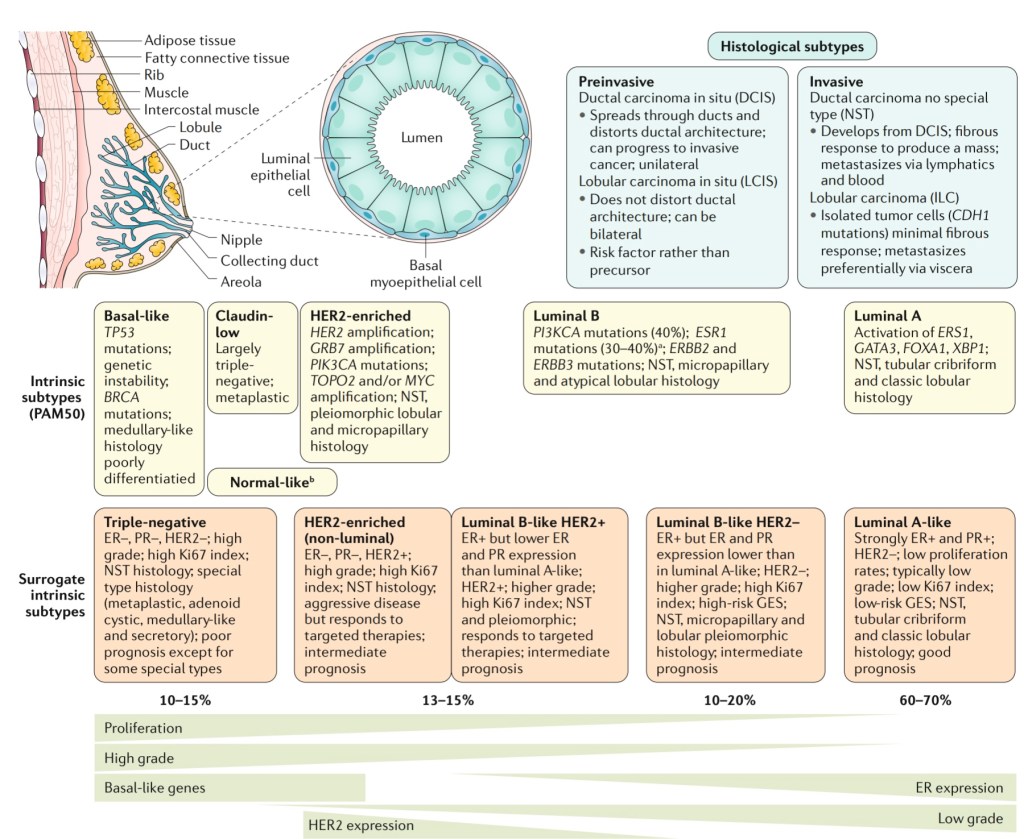
- These define tumor biology and correlate with outcome and are broadly described as:
- Luminal A, luminal B, human epidermal growth factor receptor 2 (HER2)-enriched, and basal like:
- According to the most common profiles for each subtype:
- However, not all tumors within each subtype contain all features
- According to the most common profiles for each subtype:
- Luminal A, luminal B, human epidermal growth factor receptor 2 (HER2)-enriched, and basal like:
- The estrogen receptor (ER), progesterone receptor (PR), and HER2 receptor:
- Are used as surrogates to approximate these subtypes and guide clinical care and management decisions
- Luminal A:
- Most (80% to 85%) of breast cancers express the estrogen receptor (ER-positive) and / or the progesterone receptor (PR+) (75% to 80%) but not HER2:
- These cancers tend to be more indolent than other subtypes
- Luminal A tumors are associated with the most favorable prognosis:
- Particularly in the short term:
- In part because expression of hormone receptors:
- Is predictive of a favorable response to hormonal therapy
- In part because expression of hormone receptors:
- Particularly in the short term:
- Most (80% to 85%) of breast cancers express the estrogen receptor (ER-positive) and / or the progesterone receptor (PR+) (75% to 80%) but not HER2:
- Luminal B:
- These breast cancers are ER-positive and / or PR+:
- They are further defined by either:
- HER2 amplification, or high Ki-67 (an indicator of cellular proliferation)
- They are further defined by either:
- They tend to have higher grade and more aggressive features than luminal A breast cancers
- These breast cancers are ER-positive and / or PR+:
- HER2-enriched:
- These breast cancers produce excess HER2 and do not express hormone receptors
- These cancers tend to grow and spread more aggressively than other breast cancers and are associated with poorer short-term prognosis compared to ER-positive breast cancers:
- However, the recent widespread use of targeted therapies for HER2-positive cancers:
- Has reversed much of the adverse prognostic impact of HER2 overexpression:
- With 40% to 70% of women achieving a pathologic complete response to combination chemotherapy and targeted anti-HER2 therapies
- Has reversed much of the adverse prognostic impact of HER2 overexpression:
- However, the recent widespread use of targeted therapies for HER2-positive cancers:
- Basal like:
- These tumors are more biologically aggressive:
- They are typically characterized by the lack of the ER, PR, and HER2 receptor
- These cancers are often found in:
- Premenopausal women
- Those with a BRCA1 gene mutation
- They are nearly two times more common:
- In Black women than White women in US
- The majority (> 70%) of triple negative breast cancers:
- Fall into the basal-like subtype
- Triple negative breast cancers:
- Have a poorer short-term prognosis than other breast cancer types:
- In part because there are currently no targeted therapies for these tumors:
- However, a proportion of these tumors are very chemosensitive, exhibiting a pathologic complete response in up to a third of patients
- In part because there are currently no targeted therapies for these tumors:
- Furthermore, several molecular subtypes of triple negative breast cancer have been described:
- These may provide further insights into the varying biologic response and assist in development of therapeutic targets in addition to chemotherapy
- Have a poorer short-term prognosis than other breast cancer types:
- These tumors are more biologically aggressive:

 Rodrigo Arrangoiz MS, MD, FACS, FSSO