
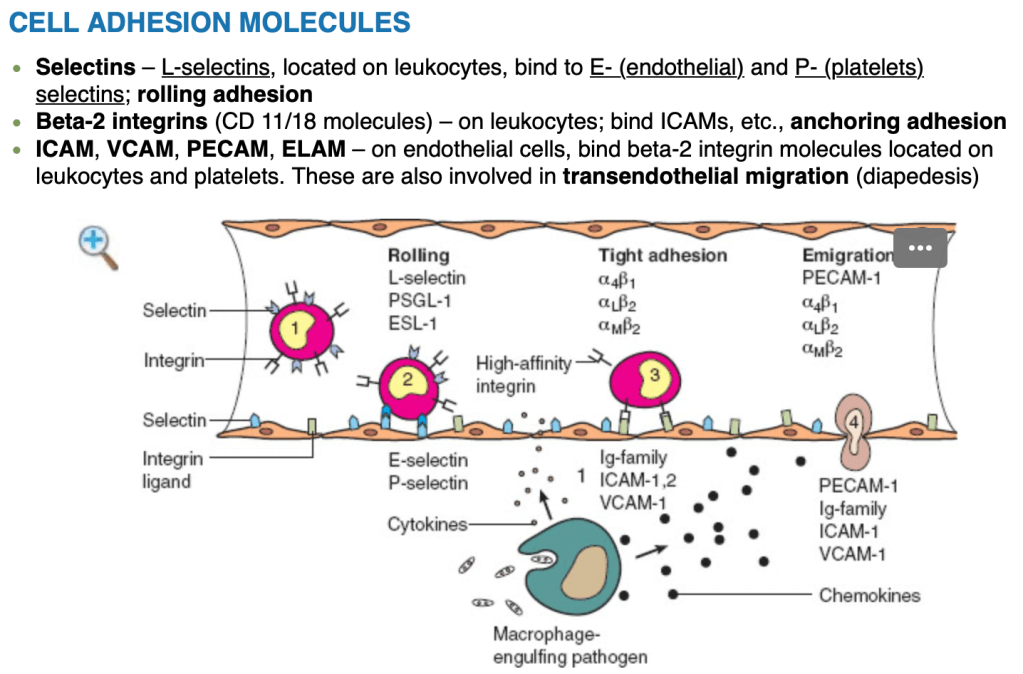
- Tethering and Rolling (milliseconds–seconds):
- What happens:
- Fast blood flow makes first contact fleeting:
- Cells need “molecular Velcro” that works under shear.
- Selectins on endothelium:
- E-selectin:
- Induced by TNF-α / IL-1
- P-selectin:
- Rapidly mobilized from Weibel–Palade bodies
- Also on platelets
- E-selectin:
- Ligands on leukocytes:
- PSGL-1 and other sialyl-Lewis^x (sLe^x):
- Decorated glycoproteins
- L-selectin (CD62L) is on leukocytes:
- Not endothelium:
- It helps secondary capture / rolling:
- Leukocyte–leukocyte interactions
- Binds Peripheral Node Addressin on High Endothelial Venules (PNAd on HEVs)
- Leukocyte–leukocyte interactions
- It helps secondary capture / rolling:
- Not endothelium:
- Mechanics:
- “Catch bonds” let cells roll, sampling endothelium for activating cues
- ✅ Fix to your line:
- Rolling is mainly:
- E-selectin / P-selectin (endothelium) ↔ sLe^x/PSGL-1 (leukocyte)
- L-selectin:
- Is leukocyte-borne:
- It augments rolling
- Is leukocyte-borne:
- P-selectin:
- Is not on neutrophils
- Rolling is mainly:
- PSGL-1 and other sialyl-Lewis^x (sLe^x):
- Fast blood flow makes first contact fleeting:
- What happens:
- Chemokine-Triggered Integrin Activation (“inside-out”):
- What happens:
- Endothelial-bound chemokines (on heparan sulfates:
- For example:
- CXCL8 /IL-8 (neutrophils), CCL2 / MCP-1(monocytes):
- Bind GPCRs (CXCR1/2, CCR2…), engaging Gαi → Rap1 → talin / kindlin:
- To flip integrins into high-affinity and clustered states
- Bind GPCRs (CXCR1/2, CCR2…), engaging Gαi → Rap1 → talin / kindlin:
- CXCL8 /IL-8 (neutrophils), CCL2 / MCP-1(monocytes):
- For example:
- Key integrins switched on:
- β2 family:
- LFA-1 (αLβ2; CD11a/CD18)
- Mac-1 (αMβ2; CD11b/CD18).
- β1 family:
- VLA-4 (α4β1):
- Prominent in monocytes / lymphocytes
- VLA-4 (α4β1):
- β2 family:
- Endothelial-bound chemokines (on heparan sulfates:
- What happens:
- Firm Arrest and Adhesion Strengthening (seconds–minutes):
- Counter-receptors on endothelium:
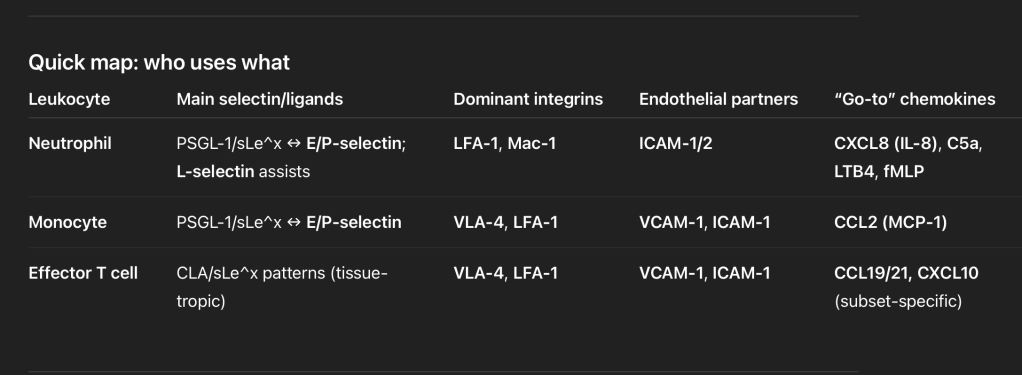
- ICAM-1 / ICAM-2 ↔ LFA-1 / Mac-1 (β2)
- VCAM-1 ↔ VLA-4 (β1)
- Outside-in signaling:
- Through engaged integrins stiffens the cytoskeleton (actin remodeling via Rho / Rac / Cdc42) and spreads the cell, locking it in place
- Counter-receptors on endothelium:
- Intraluminal Crawling:
- Arrested leukocytes crawl “upstream” under shear to junctions, mainly using Mac-1 ↔ ICAM-1:
- This helps them find permissive exit sites
- Arrested leukocytes crawl “upstream” under shear to junctions, mainly using Mac-1 ↔ ICAM-1:
- Diapedesis (Transendothelial Migration):
- Two routes:
- Paracellular (most common):
- Through junctions
- Transcellular:
- Through individual endothelial cells
- Paracellular (most common):
- Adhesion molecules guiding the crossing:
- PECAM-1 (CD31), JAM-A/B/C, CD99, ESAM:
- Mostly homophilic interactions at junctions
- Transient loosening of VE-cadherin adherens junctions (kinase signaling) opens a path
- PECAM-1 (CD31), JAM-A/B/C, CD99, ESAM:
- Basement membrane and pericytes:
- Leukocytes use integrins (e.g., α6β1, αvβ3) and proteases (MMP-2/-9, elastase) to breach matrix and pericyte sheaths, aiming for naturally “low-expression regions” of laminins / collagens
- Interstitial Chemotaxis → Focus of Infection / Injury:
- Once in tissue, cells follow gradients of:
- Chemokines:
- CXCL8 (neutrophils), CCL2 (monocytes), CCL19/21 (lymphocyte homing)
- Lipid mediators:
- LTB4, PGE₂ (context-dependent)
- Complement & danger cues:
- C5a, fMLP from bacteria
- Chemokines:
- Once in tissue, cells follow gradients of:
- Two routes:
- Exam pearls
- Sequence to memorize:
- Selectin-mediated rolling → chemokine GPCR signal → integrin activation → firm adhesion → crawling → diapedesis → chemotaxis
- Inside-out vs outside-in:
- Chemokines activate (inside-out) integrins
- Integrin engagement stabilizes and signals (outside-in)
- Platelets matter:
- Platelet P-selectin can recruit leukocytes to thrombi (immunothrombosis)
- Tissue tropism:
- VLA-4 ↔ VCAM-1 is big for monocytes / lymphocytes
- Neutrophils lean on β2 integrins

 Rodrigo Arrangoiz MS, MD, FACS, FSSO