
- ThyroSeq® test results refine cancer probability in thyroid nodules with indeterminate cytology, informing the most appropriate management of these patients
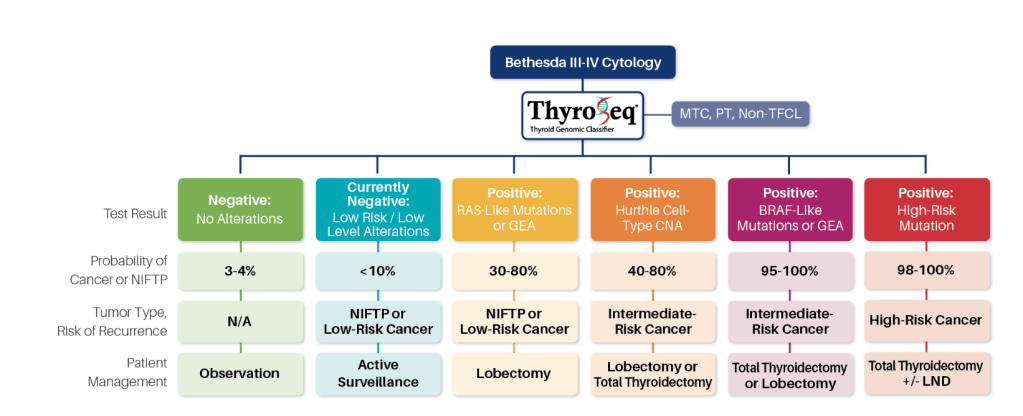
- Negative Results:
- According to NCCN guidelines, if molecular testing, in conjunction with clinical and ultrasound features, predicts a risk of cancer comparable to the risk of malignancy seen in a benign FNA cytology (roughly 5% or less):
- Active surveillance can be considered
- Therefore, in those clinical situations where the pretest probability of cancer in nodules with Bethesda III and IV cytology is less than 44%:
- A negative ThyroSeq test results would confer the cancer probability of 5% or less:
- Justifying observation in lieu of surgical management in appropriately selected cases
- Because the probability of cancer in such nodules is comparable to benign FNA cytology, the management of patients may follow the recommendations for nodules with benign cytology:
- Which, based on the 2015 ATA guidelines, should be determined based on ultrasound (US) pattern (Recommendation #23)
- A negative ThyroSeq test results would confer the cancer probability of 5% or less:
- In nodules with Bethesda V cytology and negative ThyroSeq result:
- The residual cancer risk of ~20% does not allow to avoid surgical management:
- Thyroid lobectomy may be sufficient initial treatment for many of these patients
- The residual cancer risk of ~20% does not allow to avoid surgical management:
- According to NCCN guidelines, if molecular testing, in conjunction with clinical and ultrasound features, predicts a risk of cancer comparable to the risk of malignancy seen in a benign FNA cytology (roughly 5% or less):
- Currently Negative Results:
- Test results are reported as currently negative:
- When the sample is found positive for a low risk and / or low-level gene mutation, DNA copy number alterations (CNA) or gene expression alterations (GEA) that alone is not sufficient for full cancer development
- Although at the time of sampling most of these nodules are benign:
- Some of them may undergo clonal expansion and acquire additional mutations
- In the absence of suspicious US features or other clinical risk factors:
- Many of these patients are likely to benefit from active surveillance with repeat of clinical exam and potentially FNA and molecular testing in 1 year
- Test results are reported as currently negative:
- Positive RAS-Like or GEA Results:
- ThyroSeq test positive for an isolated RAS mutation or RAS-like alteration (e.g. BRAF K601E mutation, THADA fusion, RAS-like GEA):
- Indicates that the nodule is a tumor (not hyperplasia) and predicts, depending on the specific alteration:
- A 30% to 80% probability of either a low-risk cancer or a pre-cancerous tumor, NIFTP
- Indicates that the nodule is a tumor (not hyperplasia) and predicts, depending on the specific alteration:
- Many of these nodules may be managed by therapeutic lobectomy:
- Which is currently recommended by the ATA guidelines for low-risk papillary and follicular carcinomas (Recommendation #35) and NIFTP
- ThyroSeq test positive for an isolated RAS mutation or RAS-like alteration (e.g. BRAF K601E mutation, THADA fusion, RAS-like GEA):
- Positive BRAF-Like of GEA Results:
- ThyroSeq test positive for an isolated BRAF V600E or BRAF V600E-like alteration (e.g. RET / PTC, BRAF fusions, BRAF V600E-like GEA):
- Confers a very high (greater than 95%) probability of cancer
- According to the ATA guidelines:
- BRAF-mutated unifocal intrathyroidal carcinoma less than 1 cm in size has low risk for recurrence:
- Therefore may be treated with thyroid lobectomy alone
- Whereas 1 cm to 4 cm BRAF-positive PTC is an intermediate-risk tumor:
- Where total thyroidectomy or lobectomy should be considered based on clinical and US findings
- BRAF-mutated unifocal intrathyroidal carcinoma less than 1 cm in size has low risk for recurrence:
- ThyroSeq test positive for an isolated BRAF V600E or BRAF V600E-like alteration (e.g. RET / PTC, BRAF fusions, BRAF V600E-like GEA):
- Postive Oncocytic Cell Type (formely Hurthle Cell Type) CNA Results:
- ThyroSeq test positive for isolated oncocytic cell type / Hürthle cell-type copy number alterations (CNA) confers, in different nodule size groups:
- A 40% to 80% probability of Hürthle Cell carcinoma:
- Whereas the rest of these nodules are benign Hurthle Cell adenomas
- A 40% to 80% probability of Hürthle Cell carcinoma:
- ThyroSeq test positive for isolated oncocytic cell type / Hürthle cell-type copy number alterations (CNA) confers, in different nodule size groups:
- Positive High Risk Mutations Results:
- ThyroSeq test positive for multiple high-risk mutations (e.g. BRAF V600E and TERT) confers a very high probability of cancer and predicts an increased risk of disease recurrence by the ATA guidelines and of tumor-related mortality
- Most of these patients would likely benefit from total thyroidectomy, with possible consideration for regional lymph node dissection if one of the mutations is BRAFV600E


 Rodrigo Arrangoiz MS, MD, FACS, FSSO