

-
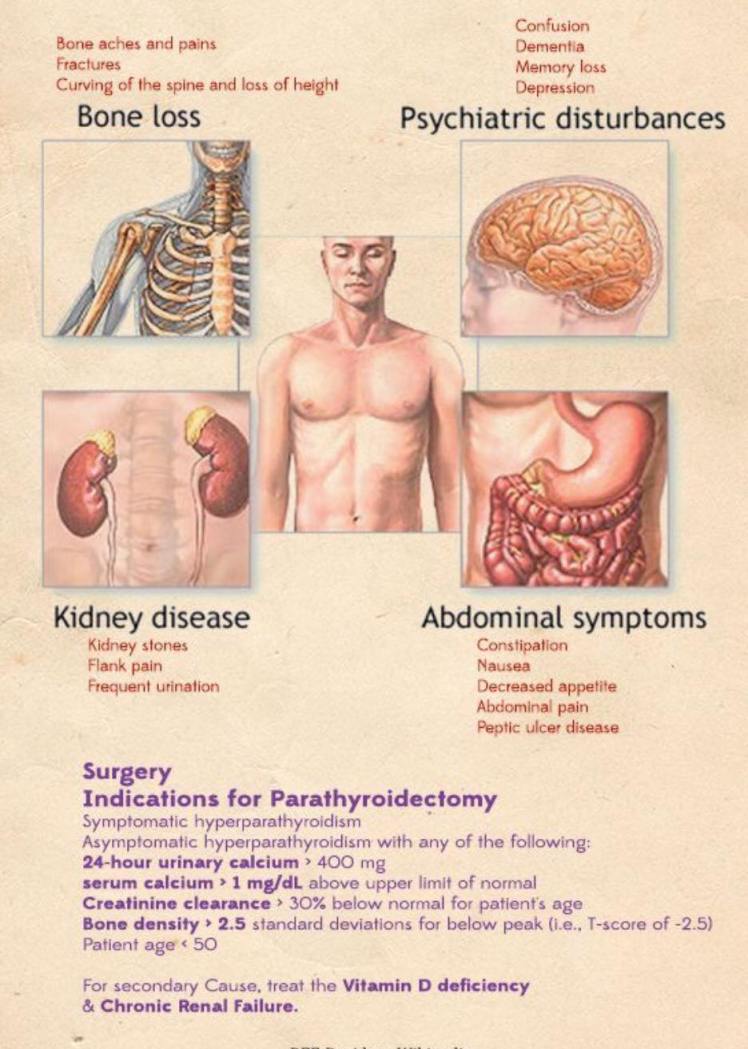
All symptomatic patients and most asymptomatic patients should be considered for parathyroidectomy:
-
Patients with nephrolithiasis (kidney stones), fragility fractures, osteoporosis, or evidence of spinal compression fractures are considered symptomatic.
-

-
In asymptomatic patients (usually less than 5% of the cases when an appropriate history is taken), indications for parathyroidectomy include:
-
Patient age younger than 50 years
-
Serum calcium level > 1 mg/dL above the upper limit of normal range,
-
Evidence of renal involvement:
-
Silent nephrolithiasis on imaging
-
Nephrocalcinosis
-
Hypercalciuria defined as a 24-hour urine calcium > 400 mg/dL
-
Impaired renal function defined as glomerular filtration rate < 60 mL/min).
-
-
Other findings that should prompt consideration for parathyroidectomy in asymptomatic patients include:
-
Neurocognitive dysfunction:
-
Manifesting as anxiety, depression, memory loss, and insomnia, which are multifactorial in cause but might be exacerbated by hypercalcemia
-
-
Frailty or diminished functional capacity
-
Gastroesophageal reflux
-
Fibromyalgia
-
Cardiovascular disease.
-
-
-
It is important to note that asymptomatic patients are often not truly asymptomatic, with insidious symptoms often attributed to other causes when they are related to or exacerbated by the underlying imbalance in calcium homeostasis; thus parathyroidectomy may be indicated even for asymptomatic patients.
Rodrigo Arrangoiz MS, MD, FACS
He is first author on some publications on hyperparathyroidism:
-
Current Thinking on Primary Hyperparathyroidism
-
Does Vitamin D Deficiency Cause Primary Hyperparathyroidism?
-
Parathyroid Embryology, Anatomy, and Pathophysiology of Primary Hyperparathyroidism:
-
Primary Hyperparathyroidism and Thyroid Cancer: A Case Series
-
The return of the bilateral neck exploration for primary Hyperparathyroidism:





 Rodrigo Arrangoiz MS, MD, FACS, FSSO