
- The evaluation of a chronically ill or hospitalized patient with abnormal serum thyroid function tests:
- Can often be challenging
- Nonthyroidal illness is not considered a primary thyroid disorder:
- Its pathophysiology is not completely understood:
- Although it is known that the elevation of cytokines and hypoxia plays a significant role
- It is generally recommended to avoid measuring serum thyroid function tests during acute illness:
- Unless thyroid dysfunction is thought to be a significant contributor to the illness
- Its pathophysiology is not completely understood:
- Severe nonthyroidal illness:
- Is accompanied by significant alterations in thyroid physiology
- Due to the decreased availability in all of the thyroid binding proteins (thyroxine bindings globulin, transthyretin, albumin):
- Serum total T4 and total T3 levels are reduced:
- Whereas free levels are usually normal or slightly low (Figure)
- Total T3 levels are further decreased:
- Due to reduced Dio1 activity:
- Which converts T4 to T3
- Due to reduced Dio1 activity:
- A relatively greater amount of T4 is metabolized to the inactive metabolite:
- Reverse T3 (rT3):
- By Dio3
- Although measurement of rT3 does not reliably distinguish nonthyroidal illness from primary hypothyroidism
- The degree of serum rT3 elevation, depressed T3 / rT3 ratio, and decreased FT3 and FT4 concentrations:
- Have been associated with higher mortality among patients in the intensive care unit (ICU):
- Treatment with T4 or T3, however, does not consistently improve outcome
- Have been associated with higher mortality among patients in the intensive care unit (ICU):
- Whether other T4 metabolites, including 3,3′-diiodothyronine (3,3′-T2); 3,5-diiodothyronine (3,5-T2); and 3-iodothyronamine (3-T1AM):
- Have functional roles in nonthyroidal illness remains unclear
- Reverse T3 (rT3):
- Serum total T4 and total T3 levels are reduced:
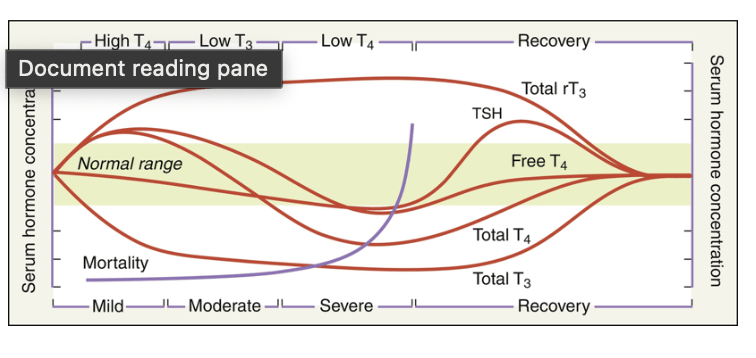
The degree of change in hormone concentrations relates to the severity and duration of the illness. Thyroid-stimulating hormone (TSH) may also be suppressed during severe illness and transiently rise moderately above the reference range before returning to normal with recovery. Mortality correlates inversely with the degree of reduction in total T4 concentration. (From Farwell AF. Sick euthyroid syndrome in the intensive care unit. In: Irwin RS, Rippe JM, eds. Intensive Care Medicine. 5th ed. Philadelphia: Lippincott Williams & Wilkins; 2003.)
- It is important that the diagnosis of primary thyroid dysfunction:
- Is not established during severe illness based solely on an abnormal serum TSH
- In nonthyroidal illness:
- Serum TSH concentrations may be low, normal, or high:
- Due to the TSH-lowering effects of commonly used medications (glucocorticoids, ipodate, amiodarone, dopamine) in patients managed for a nonthyroidal illness or from a reversible form of acquired central hypothyroidism in severe nonthyroidal illness
- Serum TSH concentrations may be low, normal, or high:
- During the recovery phase of nonthyroidal illness:
- The TSH may briefly rise above the upper reference range, as suppression of TSH lessens, before it normalizes
- When possible, thyroid evaluation after recovery from an acute illness is recommended in patients suspected of having intrinsic thyroid disease


 Rodrigo Arrangoiz MS, MD, FACS, FSSO