
- The sodium iodide symporter (NIS) gene:
- Also known as SLC5A5:
- Encodes a protein that transports iodide into thyroid follicular cells:
- This process is crucial for thyroid hormone synthesis
- Encodes a protein that transports iodide into thyroid follicular cells:
- Also known as SLC5A5:
- NIS is a plasma membrane glycoprotein:
- Located on the basolateral membrane of the thyroid follicular cells
- Mutations in the SLC5A5 gene:
- Can cause congenital iodide transport defects:
- Leading to hypothyroidism
- Can cause congenital iodide transport defects:
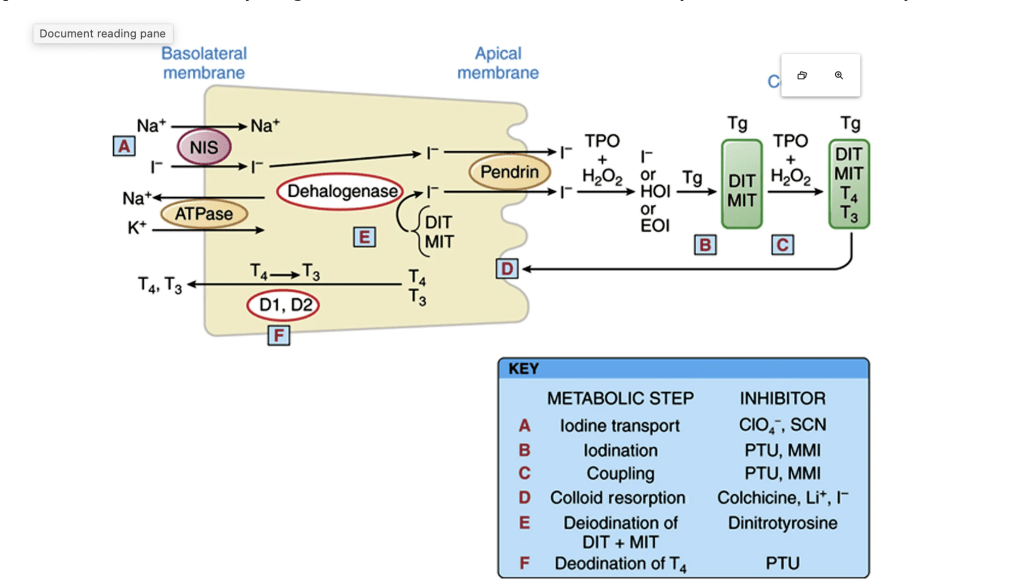
Thyroid hormone synthesis and secretion are activated when Thyroid stimulating hormone (TSH) binds to the TSH receptor on the basolateral membrane. Iodide is transported into the cell via the Na+/I− (NIS) symporter and flows down an electrical gradient, maintained by the sodium-potassium ATPase. Iodide becomes covalently attached to the tyrosyl residues of the precursor thyroid hormone glycoprotein, thyroglobulin, by thyroperoxidase (TPO) to form monoiodotyrosine (MIT) and diiodotyrosine (DIT). These are subsequently coupled by the action of TPO to form the iodothyronine hormones, tetraiodothyronine (T4) and triiodothyronine (T3). In the process of thyroid hormone secretion, Tg enters the cell by pinocytosis, forming colloid droplets. These fuse with lysosomes, forming phagolysosomes in which Tg is broken down by proteolysis, and then T4 and T3 are released and diffuse into circulation. MIT and DIT are formed by the iodination of tyrosyl amino acids on the thyroglobulin molecule. In a subsequent step, two DITs are coupled to form T4, or one DIT and one MIT are coupled to form T3. (From Brent GA, Koenig RJ. Thyroid and antithyroid drugs. In: Brunton L [ed]. Goodman and Gilman’s The Pharmacological Basis of Therapeutics. 13th ed. New York: McGraw-Hill; 2017.)


 Rodrigo Arrangoiz MS, MD, FACS, FSSO