
- The second most common type of thyroid cancer is:
- Follicular thyroid carcinoma (FTC)
- Fundamentally all follicular carcinomas are:
- RAS-like tumors
- There profile is different from classic PTC because:
- They do not have BRAF mutations:
- Most of them have RAS and RAS-like mutations
- They do not have BRAF mutations:
- Yoo S.K et al, from Korea showed that the genetic profile of follicular carcinomas:
- Is very similar to follicular adenomas because they are related tumors
- Most FTC originate from a FA and eventually break through the capsule and become carcinomas
- In encapsulated follicular variant of PTC:
- Their molecular profile is much closer to a FA and FTC than to classic PTC
- Infiltrative follicular variant of PTC:
- Has a molecular profile that is more like classic PTC than FTC
- The biologic difference between follicular pattern RAS-like tumors and classic PTC:
- Is the infiltrative growth pattern (Figure)
- The difference between these tumors:
- Is not only phenotypically based on gross pattern, but also based on biological and clinical differences;
- Because follicular pattern RAS-like tumors:
- Retain avidity to radioactive iodine
- BRAF-like tumors (classic PTC and infiltrative follicular variant of PTC):
- Have the classic features of PTC
- They are infiltrative
- They spread to lymph nodes first and later to distant sites
- They lose the expression of genes associated with thyroid differentiation
- RAS-like tumors (FA, FTC, NIFTP, and invasive encapsulated follicular variant of PTC):
- May or may not have nuclear features of PTC
- They are encapsulated
- They spread to distant sites (rarely to lymph nodes)
- They retain expression of genes associated with thyroid differentiation
- Because follicular pattern RAS-like tumors:
- Is not only phenotypically based on gross pattern, but also based on biological and clinical differences;
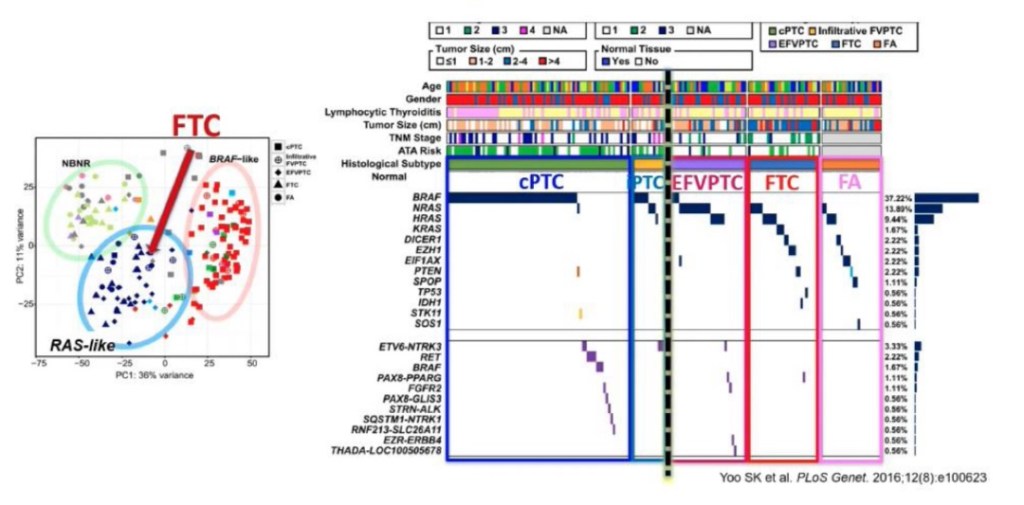
Graph exemplifying the difference between follicular pattern RAS-like tumors and classic PTC,
which is the infiltrative growth pattern.


 Rodrigo Arrangoiz MS, MD, FACS, FSSO