
-
Background:
-
Oral leukoplakia (OL):
-
Is a white patch or plaque that cannot be rubbed off, cannot be characterized clinically or histologically as any other condition:
-
It is not associated with any physical or chemical causative agent except tobacco:
-
-
-
-
Therefore, a process of exclusion establishes the diagnosis of the disease
-
-
-
-
-
In general, the term leukoplakia implies:
-
Only the clinical feature of a persistent, adherent white plaque or patch:
-
Therefore, reserve the term for idiopathic lesions when investigations fail to reveal any cause:
-
-
-
-
The term carries absolutely no histologic connotation:
-
Although, inevitably, some form of disturbance of the surface epithelium is characteristic
-
-
-
-
-
Follow-up studies suggest that cancer is more likely to occur in individuals with idiopathic leukoplakia:
-
Than in individuals who do not have this condition:
-
-
Thus, idiopathic leukoplakia:
-
-
Is considered a premalignant lesion
-
-
-
-
Pathophysiology:
-
The etiology of most cases of OL is unknown (idiopathic)
-
In other cases, the initiation of the condition may depend on:
-
Extrinsic local factors and / or intrinsic predisposing factors:
-
Factors most frequently blamed for the development of idiopathic leukoplakia include:
-
Tobacco use, alcohol consumption, chronic irritation, candidiasis, vitamin deficiency, endocrine disturbances, and possibly a virus
-
-
-
- Epidemiology:
- OL occurs in fewer than 1% of individuals
- OL is considered to be potentially malignant:
- With a transformation rate in various studies and locations:
- That range from 0.6% to 20%
- A long-term follow-up study by Fan et al:
- Indicated that oral leukoplakia can increase the risk of esophageal squamous cell carcinoma
- With a transformation rate in various studies and locations:
- OL is more common in men than in women:
- With a male-to-female ratio of 2:1
- Most cases of OL occur in persons in their fifth to seventh decade of life:
- Approximately 80% of patients are older than 40 years
-
Clinical presentation:
-
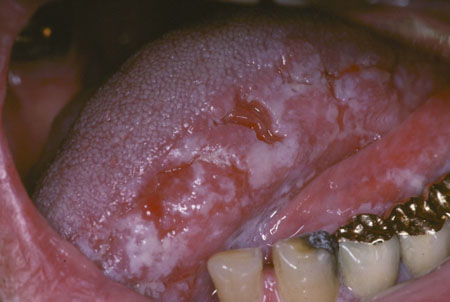
Oral leukoplakia (OL) manifests as patches or plaques that are bright white and sharply defined:
-
The surfaces of the patches are slightly raised above the surrounding mucosa
-
-
Individuals with OL are not symptomatic
-


-
The following three stages of OL have been described:
-
The earliest lesion is:
-
Nonpalpable, faintly translucent, and has white discoloration
-
-
Next, localized or diffuse, slightly elevated plaques with an irregular outline develop:
-
These lesions are opaque white and may have a fine, granular texture
-
-
In some instances, the lesions progress to thickened, white lesions, showing induration, fissuring, and ulcer formation
-
-
Clinically, OL falls into one of the following two main groups:
-
The most common are uniformly white plaques (homogenous OL):
-
Prevalent in the buccal mucosa:
-
Which usually have low premalignant potential
-
-
-
Far more serious is speckled or verrucous leukoplakia:
-
Which has a stronger malignant potential than homogenous leukoplakia:
-
Speckled leukoplakia:
-
Consists of white flecks or fine nodules on an atrophic erythematous base
-
-
-
These lesions can be regarded as a combination of or a transition between leukoplakia and erythroplasia:
-
Which is flat or depressed below the level of the surrounding mucosal red patch:
-
Is uncommon in the mouth, and carries the highest risk of malignant transformation
-
-
-
-
Rodrigo Arrangoiz MS, MD, FACS
Here are some publications on oral cavity cancer:
- Oral Tongue Cancer: Literature Review and Current Management https://www.oatext.com/pdf/CRR-2-153.pdf
- Understand Cancer: Research and Treatment Oral Cavity Cancer: Literature Review and Current Management. https://www.researchgate.net/publication/303366031_Understand_Cancer_Research_and_Treatment_Oral_Cavity_Cancer_Literature_Review_and_Current_Management
Training:
• General surgery:
• Michigan State University:
• 2004 al 2010

• Surgical Oncology / Head and Neck Surgery / Endocrine Surgery:
• Fox Chase Cancer Center (Filadelfia):
• 2010 al 2012

• Masters in Science (Clinical research for health professionals):
• Drexel University (Filadelfia):
• 2010 al 2012

• Surgical Oncology / Head and Neck Surgery / Endocrine Surgery:
• IFHNOS / Memorial Sloan Kettering Cancer Center:
• 2014 al 2016


 Rodrigo Arrangoiz MS, MD, FACS, FSSO